

Subscribe now for full access and no adverts
The fashion for writing about decisive battles in history began, perhaps, with the Ancient Greeks; but the modern genre was created by the British historian and lawyer E S Creasy, with his Fifteen Decisive Battles of the Western World (1850).
His successor in Britain was the former soldier and military theorist J F C Fuller, who greatly expanded Creasy’s list in The Decisive Battles of the Western World and their Influence upon History (1954-1956).
The American historian Cathal J Nolan, in his recent The Allure of Battle (2017), provides evidence of the popularity of the genre in a footnote that contains references to 18 recent works, all of which contain the word ‘battle’ in the title.
Creasy realised that the term ‘decisive’ was ambiguous. It could mean that the battle in question was conclusive ‘on the day’, or that it had significant consequences for the future – whether in the short, medium, or longer term; and he was clearly concerned with the second meaning.
Fuller and Nolan adopted the same approach; but the latter also subjected the entire concept to a radical critique, arguing that wars (and, specifically, modern wars of attrition) have more important consequences than single battles. We propose to take a fresh look at Creasy’s ‘fifteen’ in the light of modern scholarship in general.

Marathon
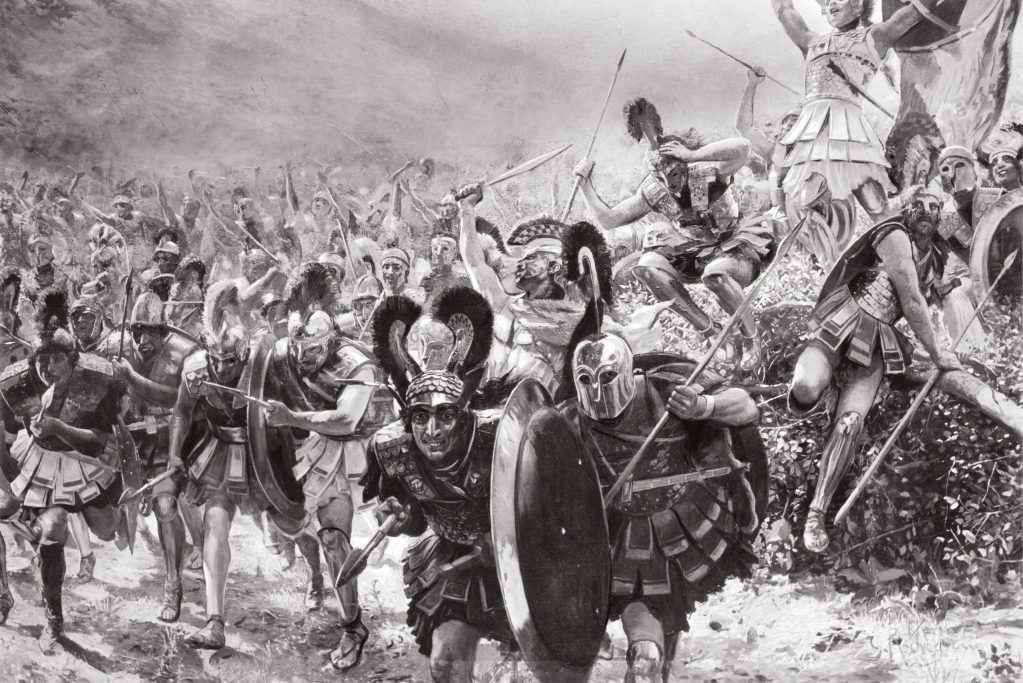
Creasy began his list of decisive battles with three that involved the Ancient Greeks: Marathon (490 BC), where a force of Athenian citizens defeated a numerically superior Persian army some 26 miles from Athens; Syracuse (413 BC), where the navy of Athens and her allies was destroyed by the allies of Sparta; and Gaugamela (331 BC), where Alexander the Great’s Macedonian army crushed a much more numerous Persian army.
As Fuller pointed out, Marathon was a minor affair compared with the fighting between Greeks and Persians ten years later. Nevertheless, Creasy argued that it was Marathon which was decisive:
The day of Marathon is the critical epoch in the history of the two nations. It broke forever the spell of Persian invincibility, which had paralysed men’s minds. It generated among the Greeks the spirit which beat back Xerxes, and afterwards led Xenophon, Agesilaus, and Alexander, in terrible retaliation, through their Asiatic campaigns. It secured for mankind the intellectual treasures of Athens, the growth of free institutions, the liberal enlightenment of the Western world, and the gradual ascendency for many ages of the great principles of European civilisation.