Subscribe now for full access and no adverts
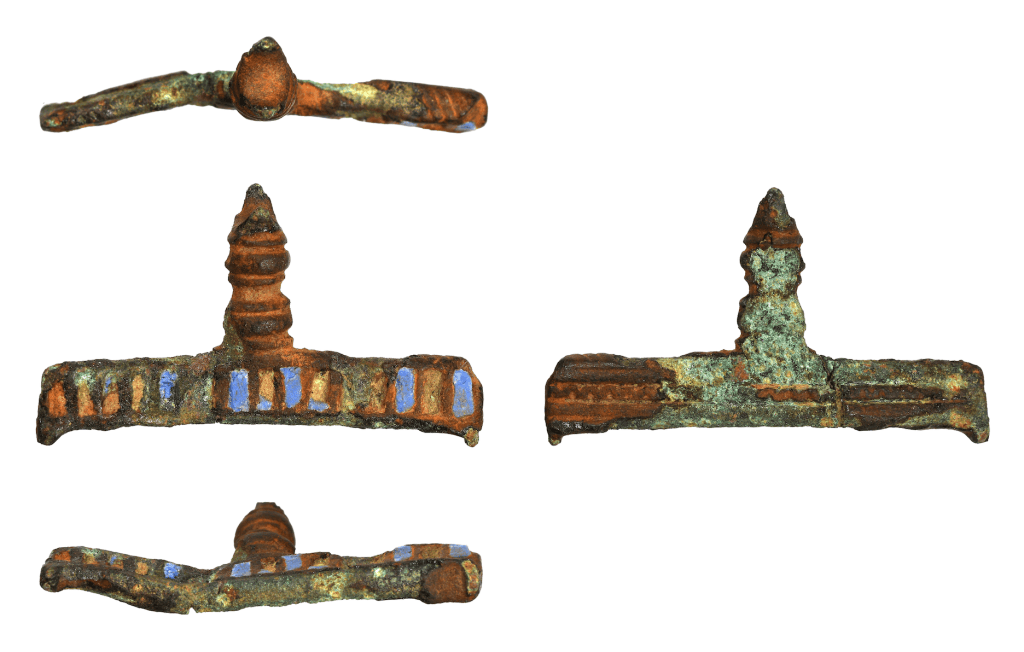
This Roman chatelaine was found in Walkeringham, Nottinghamshire, and dates to AD 100-200. Cast from copper alloy, and weighing just 7g, it is beautifully decorated with a pattern of 15 rectangular cells, some still set with the sky-blue enamel that originally formed its striped pattern. The reverse is decorated, too, with central grooves along the 42.4mm length and a wavy line in reserve metal that fills the object’s 6mm width.
Chatelaine sets like these were used to hang toiletry tools, such as ear cleaners, tweezers, nail cleaners, or toothpicks. While such items are missing from this particular example, the remains of lugs from which they could be suspended remain. The incomplete suspension loop at the top of the piece would probably have been an attachment point for a cord or leather strap, which could be used to hang the set from a belt.
Hygiene was particularly important to the Romans, and sets like these would have been carried on trips to the local bathhouse, or to a private bath complex within a wealthy Roman villa estate. Their intricate decoration attests to the significance of such items in Roman culture, and suggests that this was once a prized possession, perhaps with a wealthy owner.
Other examples on the Portable Antiquities Scheme database (see below) include DENO-71C9F5 from Lincolnshire, GLO-21AFE6 from Gloucestershire, NCL-B79326 from Northumberland, and BH-1DB7F2 from Hertfordshire. These are equally well decorated, with a striking variety in colour and pattern across them. BH-1DB7F2 in particular is adorned with red and blue triangles, and still has tweezers, an ear scoop, and nail cleaner attached.
For more information about this object, see https:// finds.org.uk/database/artefacts/record/id/1177499 or search for SWYOR-A084BA on the PAS database.
The Portable Antiquities Scheme is an initiative to encourage the recording of archaeological objects found by members of the public in England and Wales. For more information on the Scheme, and to browse its database of over 1.5 million finds, visit https://finds.org.uk. Information on this find was provided by Amy Downes, Finds Liaison Officer for South & West Yorkshire.
Text: Rebecca Preedy / Image: West Yorkshire Archaeology Advisory Service