Subscribe now for full access and no adverts
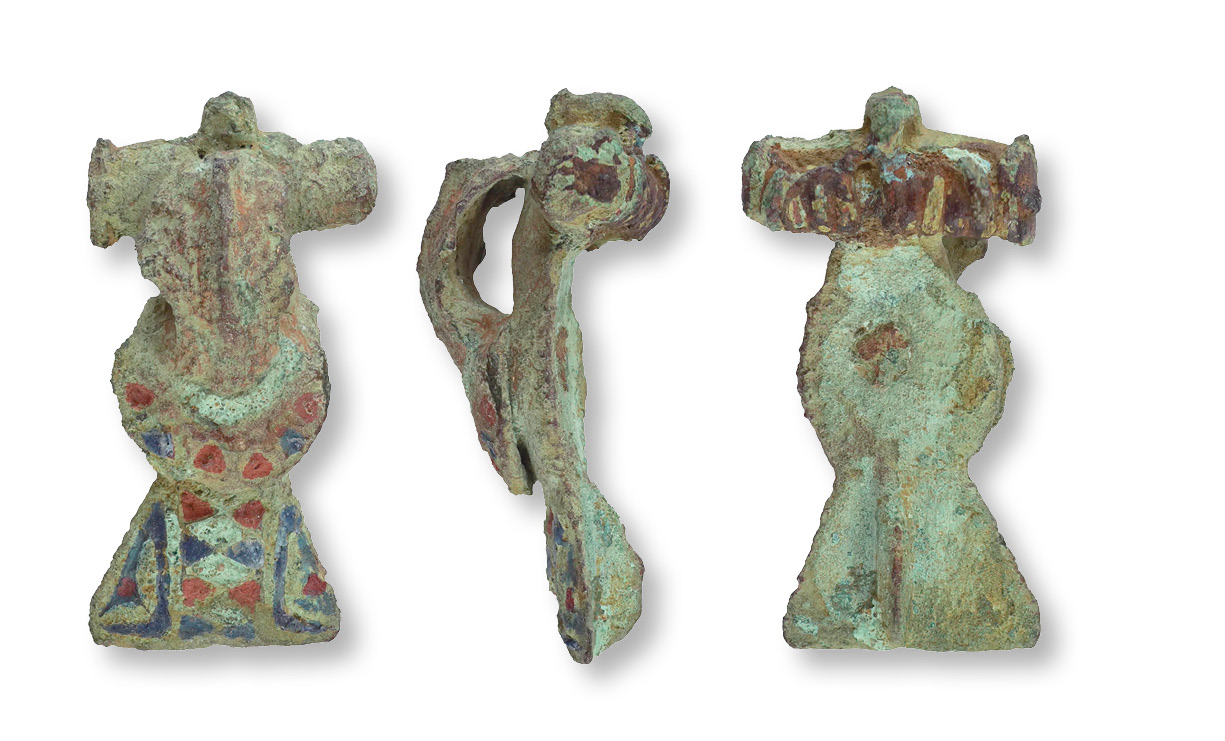
This is a Roman brooch made of copper alloy and dating to c.AD 60-100. It was recently found by a metal-detectorist on cultivated land near Sleaford in Lincolnshire, and has been designated as a find of county or local importance.
It is an Aesica-style brooch, so-named because the first of this type to be discovered was found during excavations at Aesica, the ninth fort along Hadrian’s Wall, near Haltwhistle in Northumberland. This style of brooch often incorporates ‘Celtic’ motifs, which the Romans first encountered during their conquest of England, and this example has short semi-cylindrical wings, a flat circular backplate, and a fantail foot. There is an arched bow, too, which appears to be separate from the body. The top may be riveted to the headplate, while the bottom is riveted to the circular backplate.
The base of the bow is decorated with a crescent-shaped panel filled with six recessed enamelled triangular cells, coloured in red and blue. It is thought that a second row of triangles is located above and between the cells, but this area is severely worn. The front of the fantail is decorated in a similar pattern. There are two central rows of enamelled triangular cells, with four on each side and also coloured in red and blue. On either side of each row is a triangular outline in blue enamel with a central red enamelled dot.
Brooches with similar decoration have previously been recorded by the Portable Antiquities Scheme (PAS), including one found 18 years ago near Swarkestone in Derbyshire (search DENO-BC16B3 on the PAS database) and another found a year ago near Sutton Four Oaks in Birmingham (WMID-87ABB2).
For more information about this brooch, see https://finds.org.uk/database/artefacts/record/id/1132153 or search for LIN-3F8AE8 on the PAS database.
Text: Kathryn Krakowka