What are they?
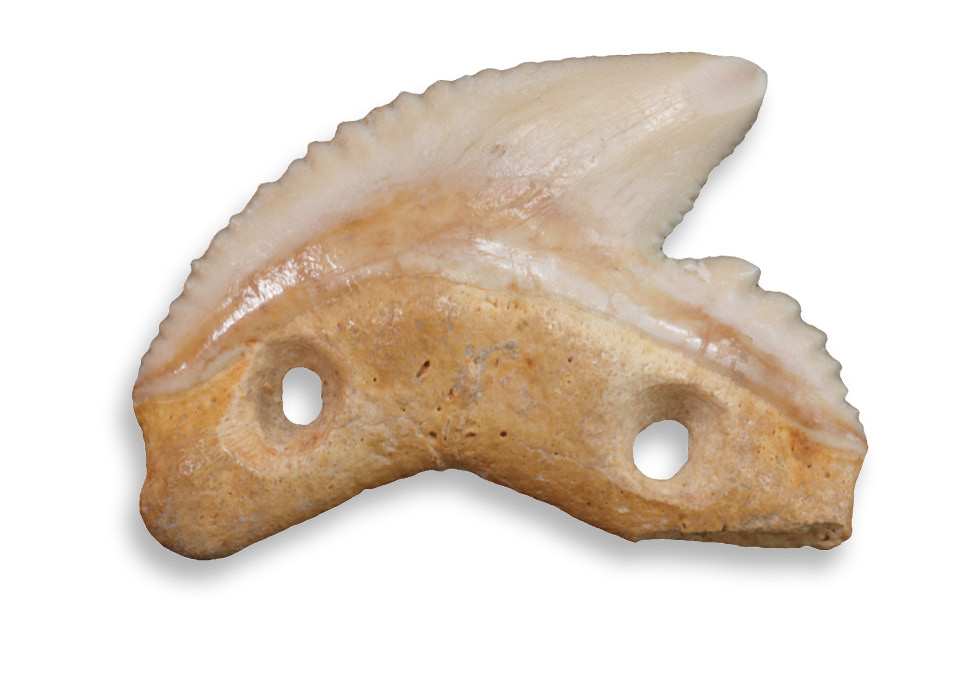
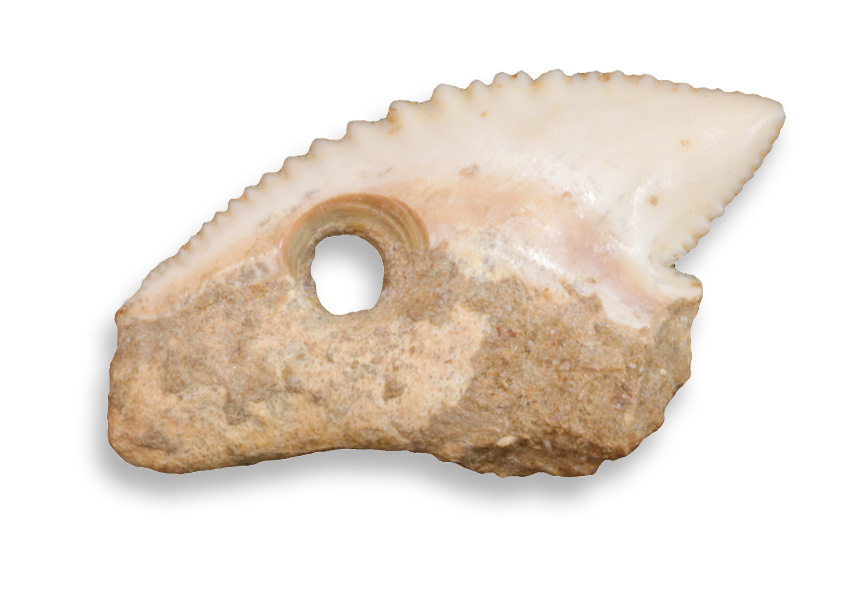
Each of these two modified tiger shark teeth was once part of a handled knife. They were found in contexts dated to 7,000-5,000 years ago, associated with the Toalean culture, hunter-gatherers who lived in south-western Sulawesi, Indonesia, between around 8,000 and 1,500 years ago. One of the teeth has two holes drilled through it, while the other (which was broken in antiquity) has only one surviving hole. The complete tooth is 1.8cm wide and 1.4cm tall, and both are believed to have come from sharks about 2m long (that is, almost adult size). Both teeth bear evidence of an adhesive made of a combination of mineral, plant, and animal materials, revealing that they had been hafted.
Where were they found, and when?
The teeth were discovered in 2018 and 2019, during excavations by a joint Indonesian-Australian team, in the limestone karsts of Maros-Pangkep in south Sulawesi, where most Toalean assemblages have been discovered to date. The example with two holes was found in Leang Panninge, a large cave in easternmost Maros, while the other was found in a smaller cave known as Leang Bulu’ Sipong 1, in the lowland karst area of Pangkep. Both caves contained rich assemblages of Toalean stone tools. The shark teeth have recently undergone further investigation, combining use-wear analysis and residue analysis with ethnographic data and experimental archaeology in order to find out more about the function of these artefacts.
Why do they matter?
The discovery of these shark-tooth blades offers valuable new insights into Middle Holocene Toalean culture, about which not much is known, including a rare opportunity to study its non-lithic material culture, as well as the hunter-gatherers’ interactions with maritime resources. Most Toalean assemblages are dominated by inland terrestrial species, with very little evidence of exploitation of marine fauna, making the presence of shark teeth unusual. As tiger shark corpses rarely wash up on beaches, the use of their teeth points to seafaring capability and fishing among some Toalean groups.
The shark-tooth artefacts are believed to have been connected to ritual or conflict rather than everyday activities, due to ethnographic data from the area and experiments using modern shark teeth. These two finds, which are the earliest modified shark teeth recovered from Sulawesi, therefore reveal previously undocumented social practices among the Toalean, as well as providing the first evidence of the antiquity of this type of weaponry, which is still in use across the wider Asia-Pacific region today.
The objects also represent the earliest known archaeological evidence for the use of shark teeth in composite weapons. Modified shark teeth are known from older contexts around the world, but those are largely associated with personal adornment.
SEE FOR YOURSELF: The shark teeth will shortly return to the Museum of Makassar, where they may be placed on display in the future. The research has been published in Antiquity (https://doi.org/10.15184/aqy.2023.144).
Text: Amy Brunskill / Photo: Michelle Langley