Subscribe now for full access and no adverts

This glass bead was a surface find by a metal-detectorist in Wanston. It is an example of an ‘eye’ bead, possibly dating to the Early Iron Age (c.800-c.350 BC), and was found on an area of farmland known to have previously produced ceramics.
Measuring 9.8mm by 9.8mm by 10.3mm, the bead is made from a clear, bubbly glass that would have been shaped around a mandrel. Three eyes were placed evenly on the flattened facets around the circumference, giving it an almost triangular shape. These eyes were made from translucent blue glass, and originally were probably surrounded by rings of opaque white glass, which has since deteriorated. The deterioration of opaque white glass can also be seen on KENT-99CD42 and CORN-D59B29, as well as on several beads found during the excavation of Middle Iron Age burials in East Yorkshire.
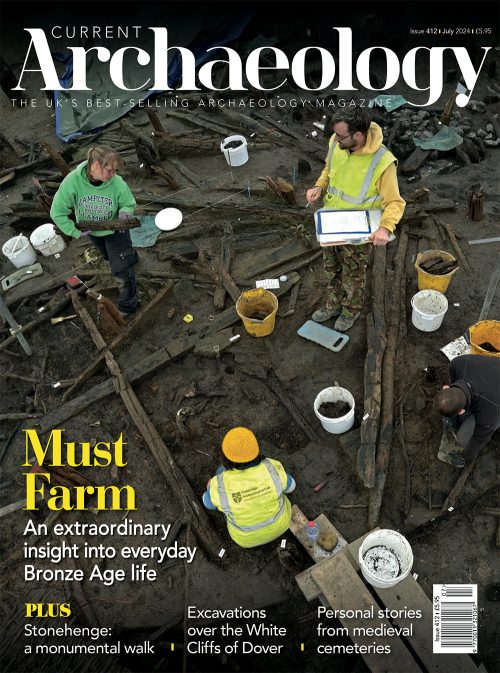
Glass beads are found in Britain from the Bronze Age onwards, with many of these early examples – even the Iron Age beads – probably made in the Near East or Mediterranean (for example, the spectacular assemblage from Must Farm, Cambridgeshire; see feature on the recently published report here). In general, beads are often found singly in settlement contexts, but strands of many beads are known from Middle Iron Age burials, particularly in East Yorkshire, where they are thought to have been worn as necklaces. While other eye beads are known from Iron Age Britain, it is the colours and decoration on the Wanston bead that makes it potentially unique in Britain and a very special find. A similar example is known from the Czech Republic, which was suggested to be possibly of Early Iron Age date.
For more information about this bead, see https://finds.org.uk/database/artefacts/record/id/1160619 or search for SUR-F8F548 on the PAS database.
The Portable Antiquities Scheme is an initiative to encourage the recording of archaeological objects found by members of the public in England and Wales. For more information on the Scheme, and to browse its database of more than 1.5 million finds, visit www.finds.org.uk. Information for this find was provided by Simon Maslin, Finds Liaison Officer – Surrey, and Elizabeth Foulds, freelance finds specialist.

Text: Rebecca Preedy / Image: Surrey County Council