Subscribe now for full access and no adverts
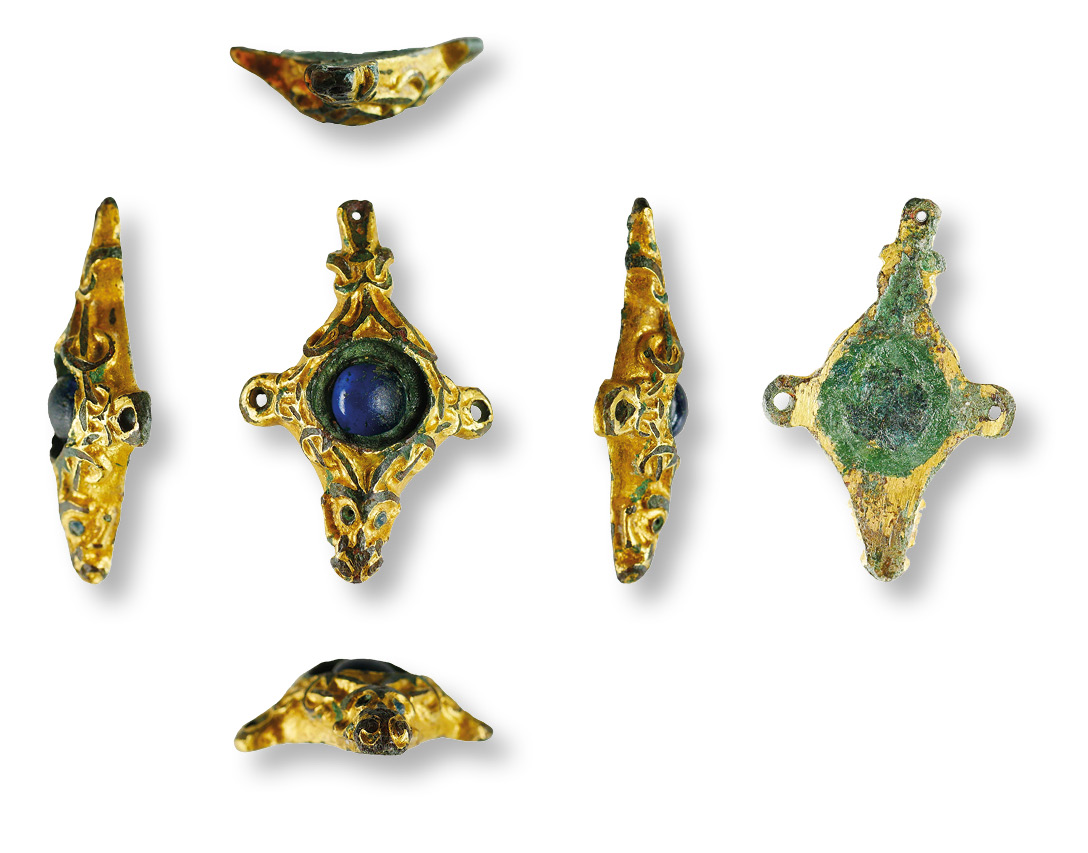
This recent addition to the Portable Antiquities Scheme’s database, originally found by metal-detectorists in Winchester in the mid-1990s and since donated to the Hampshire Cultural Trust, is a particularly eye-catching example of an early medieval zoomorphic mount. It dates to c.AD 900-1000.
Cast in copper alloy, and gilded to produce its bright gold sheen, the mount is cruciform in shape, with a striking blue-glass cabochon set into the centre. This element was originally found loosely attached by soil, and has since been re-set during conservation work by the Ashmolean Museum in Oxford. The mount’s exact function is unknown, but two loops or knops flanking its body and a third perforation may have been used to secure it to an object such as a staff or bishop’s crozier using rivets.
Although the mount measures just 29.81mm in length, its metal is intricately detailed, with its terminal featuring a head with a long snout, flared nostrils, and lappets or horns, perhaps representing a dragon, serpent, or wolf, whose tail can be seen at the opposing end. The central cabochon is also surrounded by Jelling-style knotwork, a decorative style popular in Scandinavian zoomorphic art from this period.
For more information about this object, see https://finds.org.uk/database/artefacts/record/id/1201455 or search for HAMP-79FC28 on the PAS database.
The Portable Antiquities Scheme is an initiative to encourage the recording of archaeological objects found by members of the public in England and Wales. For more information on the Scheme, and to browse its database of almost 1.8 million finds, visit https://finds.org.uk. Information on this find was provided by Hampshire Finds Liaison Officers Alexandra Kendell and Anne Thom.

Text: Rebecca Preedy / Image: Portable Antiquities Scheme