Subscribe now for full access and no adverts
At first glance, it looks like an ornate coffee spoon…
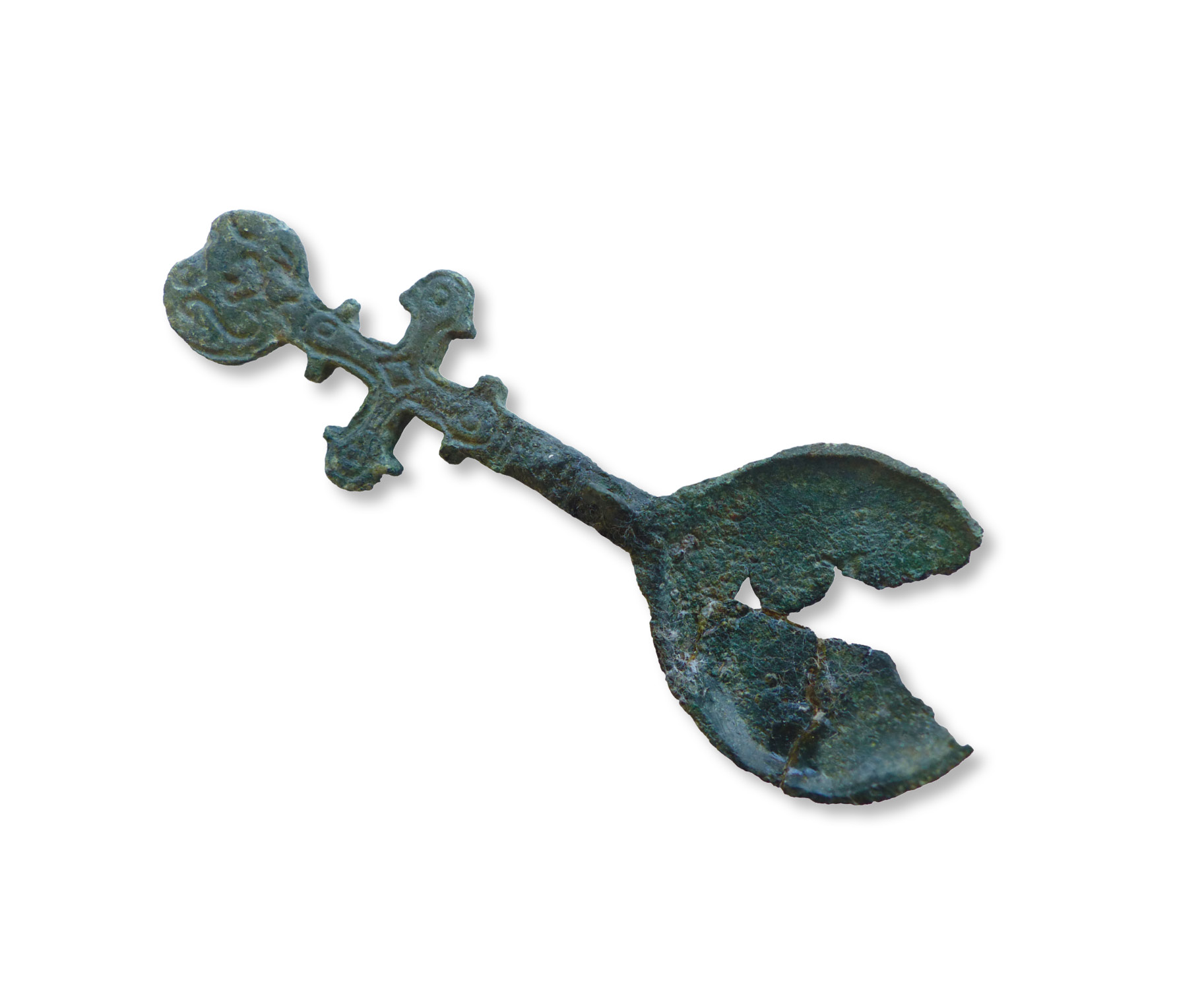
What is it?
This curious object, which looks at first glance like a large, ornate, cruciform coffee spoon, is in fact rather an elegant counterpoised coin balance. Suspended on a thread from a small, perforated lug on its stem, this was a handy pocket scales used for gauging the actual weight against the face value of a coin placed in the small round pan. The ornate crossbar and the little incised disc at the opposite terminal served as a counterpoise. This disc is weighted so that – if allowance is made for the loss of a small gash – the apparatus was perfectly in balance and level when a hyperpyron, the standard saucer-shaped Byzantine gold issue between the late 11th and the mid-13th century, weighing 4.45g, was placed in the pan.
Where was it found, and when?
The balance was found in 2008, in an extramural suburb of the ancient coastal city of Butrint in southern Albania, during student training excavations focused on a 3rd-century mausoleum and a nearby villa rustica. The context was a later rubbish midden between the two buildings, which also produced an 11th-century Byzantine lead seal, a bronze pectoral reliquary cross, fragments of fine ceramics of 12th- to 13th-century date, and a coin of Alexios I Komnenos (1081-1118). These, together with a 10th- to 11th-century finger-ring engraved with a Greek monogrammatic invocation to the Mother of God, suggest that this was a site of some standing, possibly a customs post organising long-distance trade in fish, Butrint’s principal product at this time.
Why does it matter?
Coin-balances of this kind were probably in widespread use, although few seem to have survived. Coinage has always been liable to devaluation. In pre-modern ages, coin-clipping – the trimming away of metal for underhand advantage and profit – was ubiquitous. To counteract this, the weighing of coins was a routine procedure at all levels of monetary exchange. In late Roman and early medieval archaeological contexts in the central and eastern Mediterranean, the clearest expression of this is the presence in excavations of tiny rectangular lead wafers, usually of copper alloy and marked with a Greek letter (A, B, Γ, etc), denoting numerical weight in nomismata. These were the benchmark tokens designed to check the weights of particular coins. However, while these little lead weights are quite common, the apparatuses used for the procedure are not, and the discovery of a coin-balance in a controlled archaeological context is something of an event.
What makes the Butrint balance especially interesting is that it was designed to test a particular coin, the gold hyperpyron, one of the dollars of the Middle Ages, in the words of the economic historian Robert Lopez. This was a coin that played a dominant role in long-distance trade and was accepted in markets and transactions throughout the eastern Mediterranean. Its correct weight was a condition of any regular commercial transaction.
FIND OUT MORE: The balance is currently at the on-site museum at the Butrint National Archaeological Park and in due course will be put on display there. More details about the site are available in Richard Hodges and Nevila Molla (eds) The Late Roman and Early Medieval Archaeology of Butrint, Çuka E Aitoit and Saranda (Oxbow, 2025).
Text: John Mitchell / Photo: The Butrint Foundation