Subscribe now for full access and no adverts
Culture of cattle-rearing
Measuring changes in isotopic values among cattle over a 6,000-year time span (‘New evidence for changing importance of cattle husbandry in Ireland’, CA 407) suggests several switches from closed woodland grazing to grazing in open pasture occurred from the Neolithic to early medieval period, with open-pasture grazing becoming more common during the Iron Age. The authors find themselves ‘unable to explain this change fully’ and postulate that it could be due to a reduced amount of open pasture or regeneration of woodland.
Yet this explanation lacks causality. Today, for instance, cattle are managed differently within the same landscape and, as such, help to co-create the landscape. A prime example can be found in parts of sub-Saharan Africa, where pastoralists range widely with their herds, there are field-based systems, and there is zero-grazing where food and water are brought to the animal. These systems often overlap and can cause tension. In some cases, variation in cattle-management varies by ethnic community, and the cultural values ascribed to cattle can vary enormously.
It is plausible to consider that cattle husbandry was similarly plural in character in prehistoric times onwards. In the examples given, it is possible that migratory peoples (who may have been politically marginalised) might have managed their livestock in the liminal zones between arable lands and forestry. Farmers also had to balance the value of grazing cattle on pasture or planting crops on the same. Decisions would have been partly guided by the amount of rainfall, hilliness, soil type, and so on in each location. (In Cornwall, pastureland dominates, for example, primarily for these reasons.) Other considerations include the different labour demands of different forms of cattle-management, between crops and livestock, and between farm and off-farm work – as well as the presence of local markets. Gender typically structures who does what in livestock systems, too, and so the availability of female and male labour would have been a further consideration.
Cathy Farnworth, Warleggan, Cornwall
Ultra-convenient ferrous detection
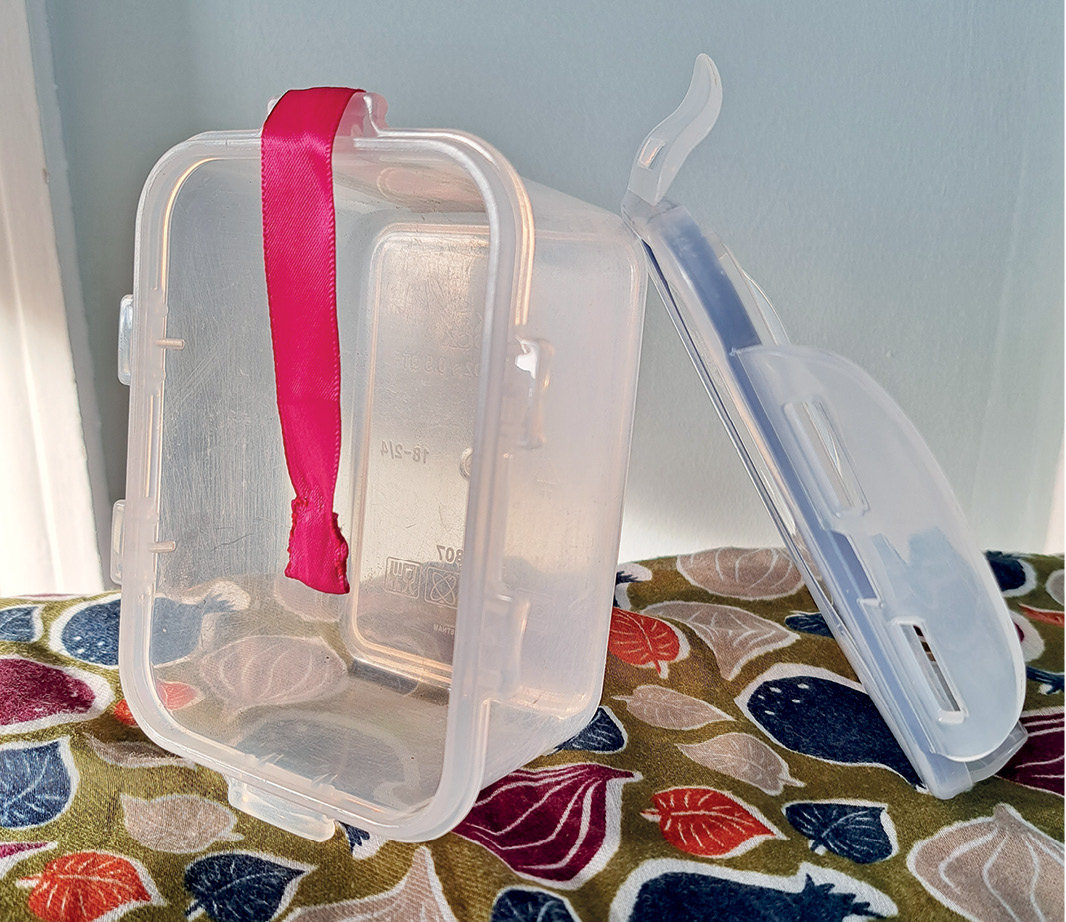
In the finds-processing area of our group (Caistor Roman Project), we used my highly sensitive ferrous detector, and it worked a treat, easily detecting ferrous content in slag and even in pottery sherds. The design was based on a disc magnet suspended on a piece of ribbon (below), as explained in my letter in CA 405. I bought a pack of 50 5mm magnets for £6.53, but any small disc magnet would do fine.
While I was making another one, I reached to put the disc magnet down on my phone, so I didn’t lose it, and suddenly it jumped out of my hand and attached itself to the clip of the phone case. Of course! Those clips contain a disc magnet, and there’s another one in the case.
So, if you are carrying your phone, you’ve got an instantly available ferrous detector. How convenient! It’s not as sensitive as a ribbon-mounted magnet, but if you want slightly greater sensitivity, open the case and place the phone face down on the table edge, with the door hanging down, and straighten the clip, so it too hangs vertically down. It works – I’ve tried it.
Paul Beverley, Norwich
Hadrian’s Wall
I think Bob Britnell missed the point of the CA 403 article to which he refers in his letter in CA 407. Not only is his a partial misinterpretation, but he fails to set it in the context of David Breeze’s extensive research of the Wall, as well as Nick Hodgson’s Hadrian’s Wall (2017). They set out quite clearly that control north of the Wall was not abandoned (at least, not before the 4th century), and that control of traffic to the north and south was indeed an essential function of the Wall through the crossing points at the forts.
Terry Lloyd, Barnet, Greater London
Wonderful Wemyss
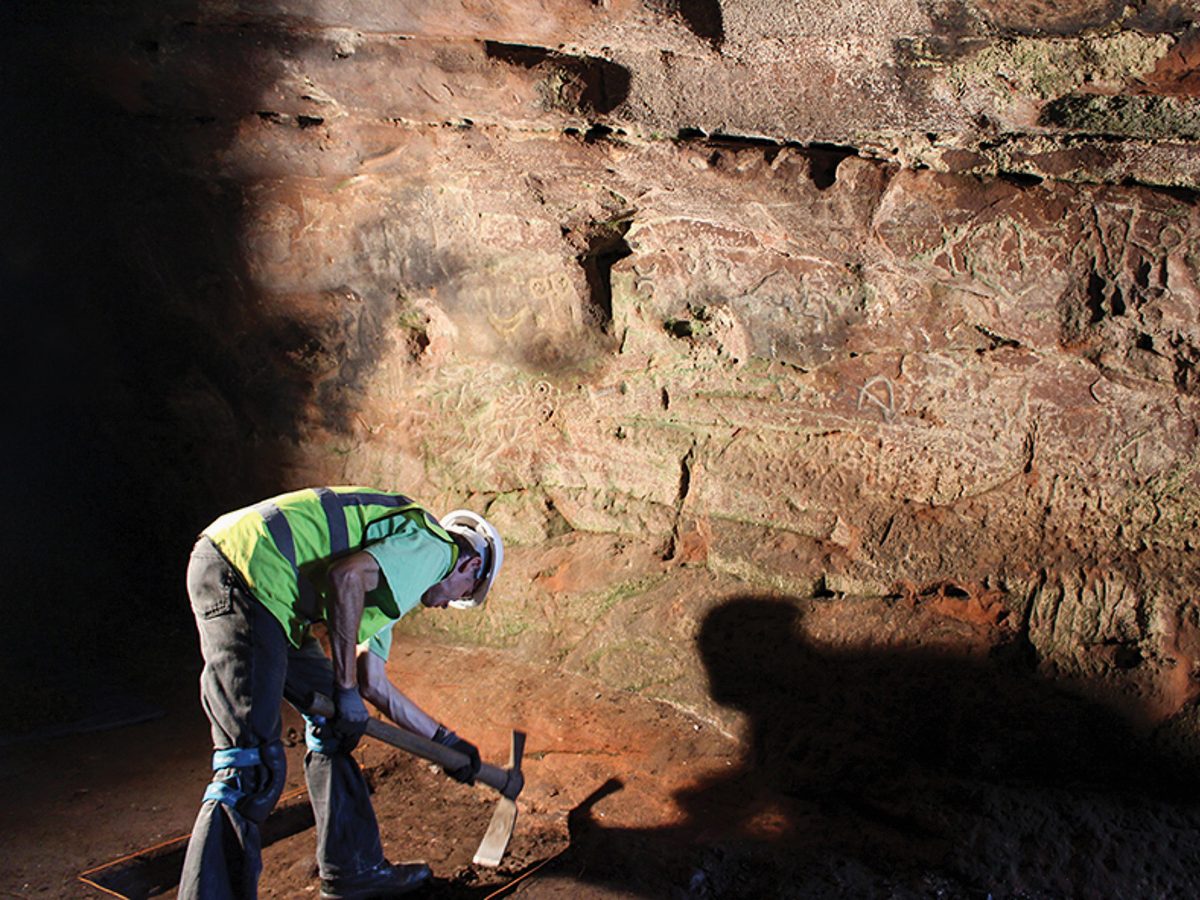
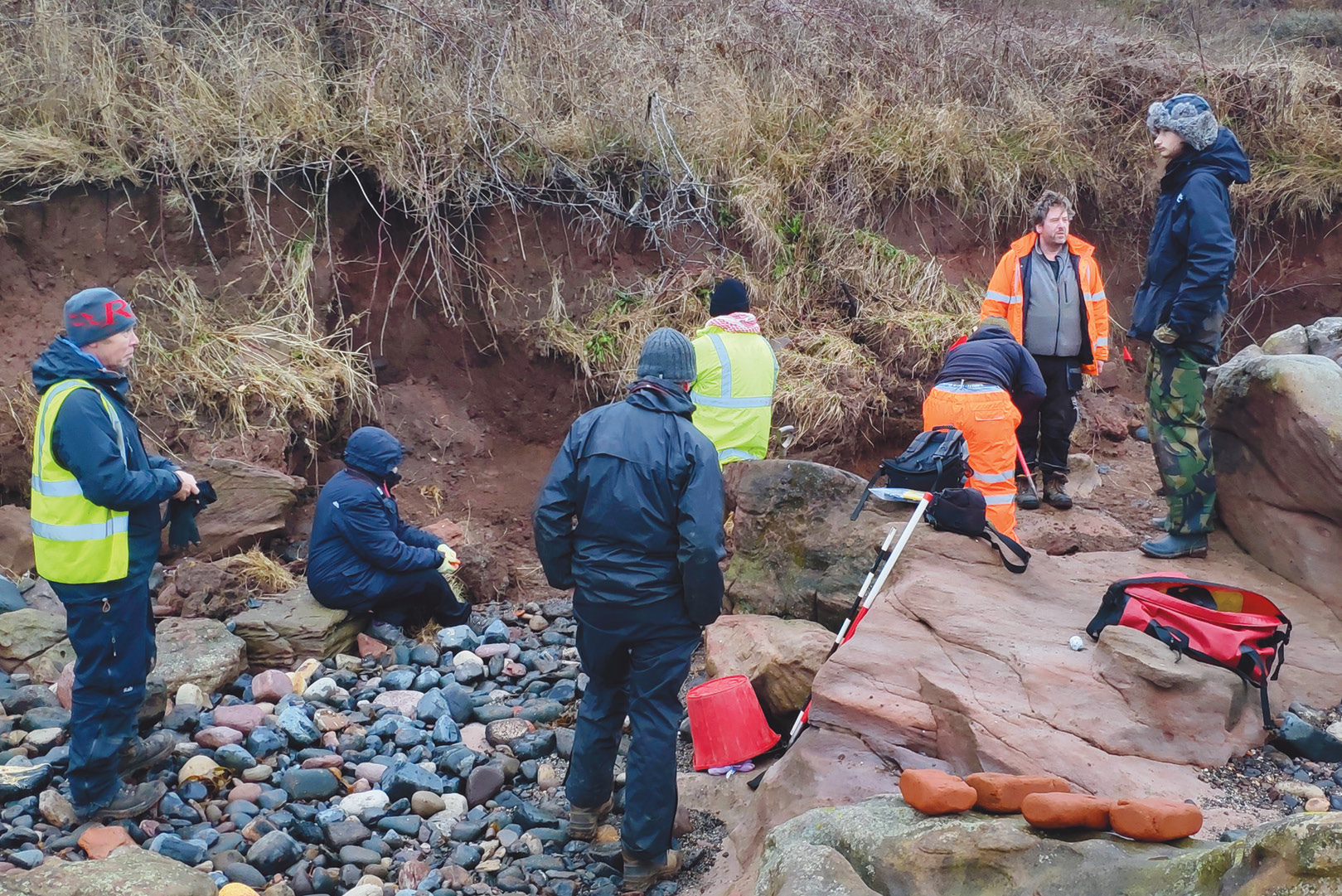
It is great to hear that they’ve now found some burials at the Wemyss Caves in Fife (CA 407; below). I met Stuart Cook when I visited, along with another member of the Society of Antiquaries (Scot.), back when I was a PhD student at the University of Edinburgh, and have only seen the caves once after that, some years later. The first visit inspired me to continue my studies in history and archaeology. I am an historian and author, interested in ethnomusicology and cultural anthropology, now residing in Oxford and researching another book, so I was thrilled to see your story – a perfect illustration of that ‘feeling’, the ‘rush’ that comes when you discover something, be it in a library, an archive, or on site. Wemyss is an important site, as the caves weren’t very accessible due to constant sea encroachment, but thanks to the efforts of the local community and others to ‘save Wemyss’ they are now a key site for sea/ocean studies. Well done, Stuart, and all!
Karen Ralls, Oxford
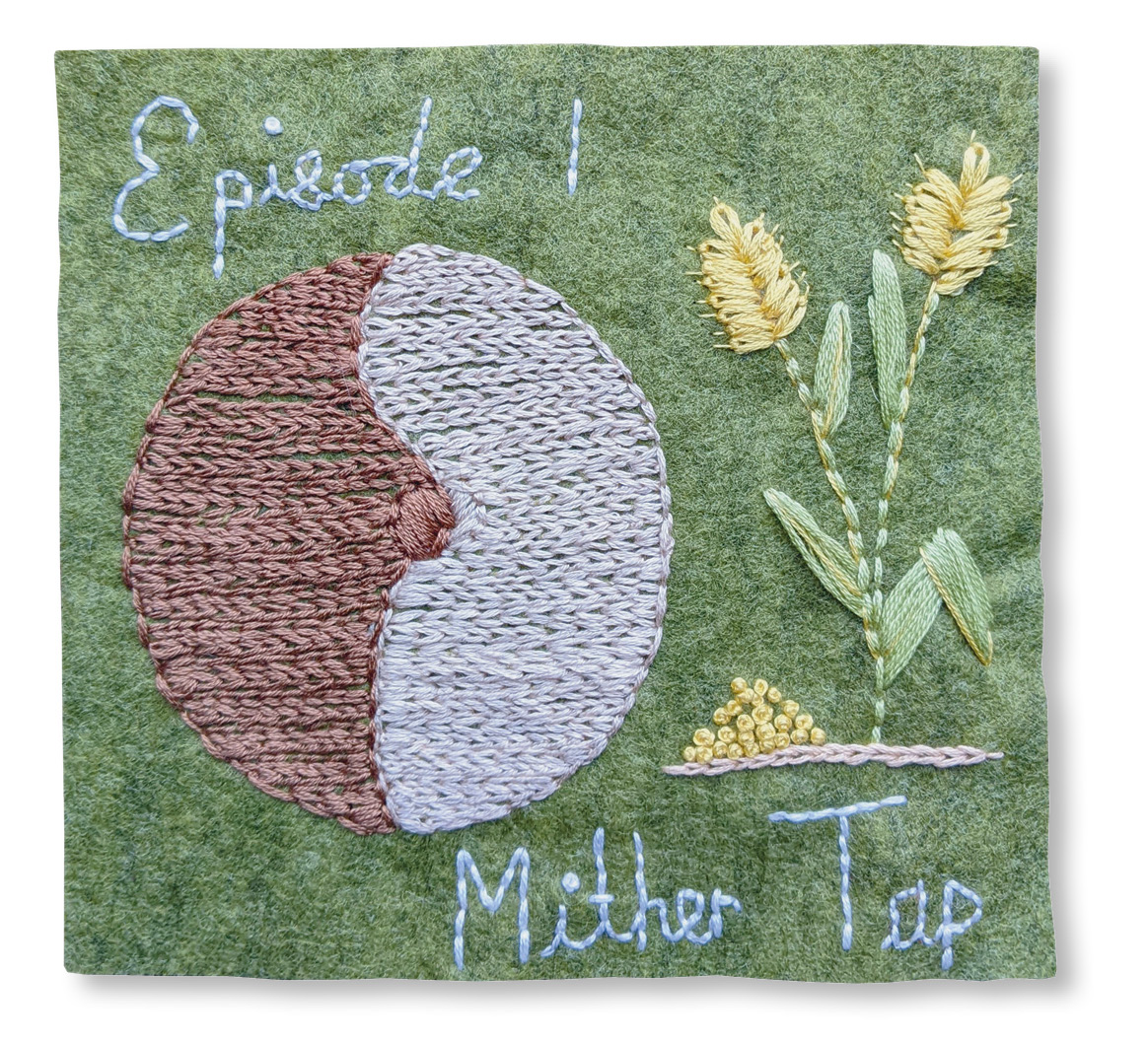
Embroidered Archaeology
Inspired by #DrawingDiggingForBritain and my own interest in embroidery, I decided to marry the two to create a piece to highlight my favourite finds from Series 11. For Episode 1, I chose the quern stone found at Mither Tap: a sign of industry, an insight into the lives of those who once lived there, and a practice that lives on today in more modern methods.
Catherine Hutchings, Wiltshire
CA ONLINE: What you shared with us this month
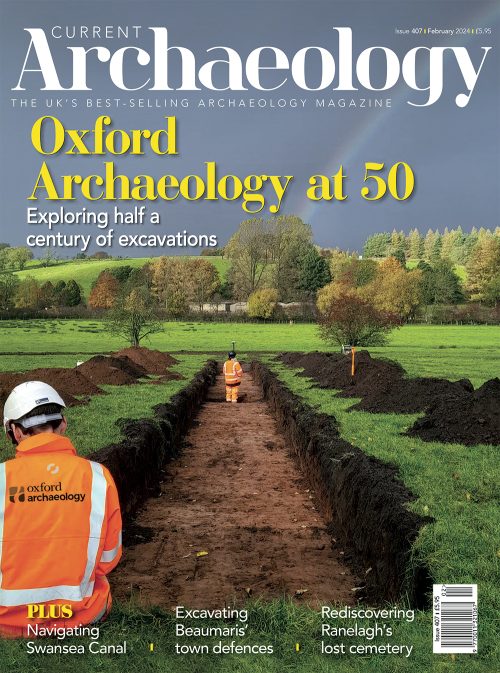
Oxford Archaeology @oatweet
Fantastic way to start 2024: a nice article reviewing our 50 years in archaeology in the latest issue of @CurrentArchaeo! Thanks to our colleagues working on the @A66NTP for this beautiful shot.
Cris Samways @AgeingLocks68
Catching up on lads’ night #DiggingForBritain and @theAliceRoberts is at Ankerwycke nunnery. And I only recently read about this in @CurrentArchaeo. Really adds to what I learnt in the magazine. Brilliant!
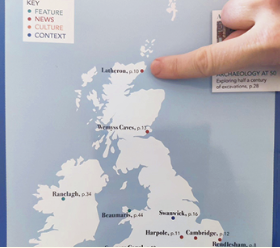
Caithness Broch Project @TheBrochProject
Our #BigBrochBuild has had fabulous national coverage lately. We featured in @heraldscotland: http://www.heraldscotland.com/news/ 24000638.caithness-broch-project-group-identifies-site-broch-replica. And recently we put Latheron on the map in the latest edition of @CurrentArchaeo! #Caithness #Brochs
Write to us at: CA Letters, Current Publishing, Office 120, 295 Chiswick High Road, London, W4 4HH, or by email to: letters@archaeology.co.uk For publication: 300 words max; letters may be edited.