Subscribe now for full access and no adverts
Current Archaeology at Chichester College
Andrew Selkirk’s ‘Last Word’ in CA 400 reminded me that in 1967 I was teaching surveying at Chichester College and one of my students was his younger brother. He told me about the forthcoming publication – under the then strange title Current Archaeology – and I was sufficiently interested to order a copy. I now have the full set.
During my time at Chichester I met Alec Downs, a prominent amateur local archaeologist, and worked with him on a number of sites. To say that he was an enthusiast was an understatement, and I remember his wife saying, ‘Politics was bad, but this is worse’.
I also became involved with Dr Armstrong – one of the driving forces behind the Weald and Downland project. At that time, there was only one completed building on the site, and a team of German specialist carpenters was preparing timbers for the next – it has changed a bit since then.
Unfortunately, the RICS decided not to continue to support classes at technical colleges, preferring the newly emerging polytechnics, so my course was wound down and I moved to Bristol. Had I stayed in Chichester, I think I would have brought the college more into the Weald and Downland project.
Peter Vincent, Cheshire
Aerial archaeology
I was interested to read the letter in CA 398 about the preservation and cataloguing of Derek Riley’s aerial photographs. As a student in the Department of Ancient History at Sheffield University in the mid 1980s (a department closed down by the university soon after my graduation, as they are now threatening to close the Archaeology Department), I studied under Dr David Kennedy, who gave a course on Aerial Archaeology, referencing largely the work of Derek Riley in the UK, as well as that of others on the limes of the Roman Empire, especially in the Roman Near East. I’m glad to hear that Derek Riley’s photographic collection was saved from a skip and is now being preserved for the future.
Will Sawers, Hatherleigh, Devon
For scale
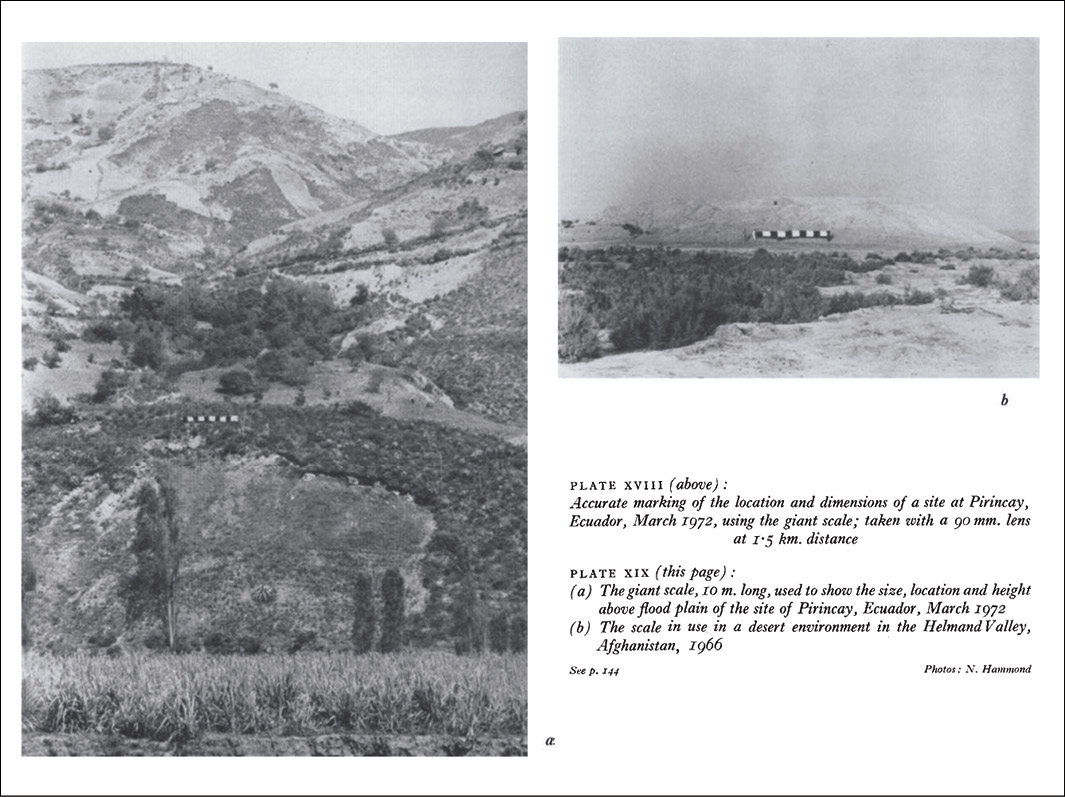
In ‘Sherds’ (CA 402), Chris Catling kindly mentioned my Giant Scale note in Antiquity (1973, vol.47: 144 and Plates XVIII-XIX). I illustrated, there, examples from my 1972 excavation at Pirincay in Ecuador, shot from 1.5km away to mark the otherwise unobvious location of the site within its overall Andean landscape (below); and of a small tepe in the Helmand Valley of Afghanistan in 1966, from which fairly precise dimensions can be measured to make a contour plan (using several shots) without arduous footwork in the 40°C heat.
Norman Hammond, McDonald Institute, Cambridge University
Happy about hillforts
I was so pleased to read in the November magazine (CA 404) the article about Welsh hillforts, as I took many happy trips in the early 1980s to Plas Tan Y Bwlch Study Centre, where Peter Crew ran a training dig on Bryn Y Castell, which was notable for its snail shape – something I think was only found in Wales. There was a special edition about it. In fact, Peter inspired me to study for a diploma in Field Archaeology. Thank you for bringing back such happy memories.
Shirley Horn, Surrey
The Bruton Abbey Project
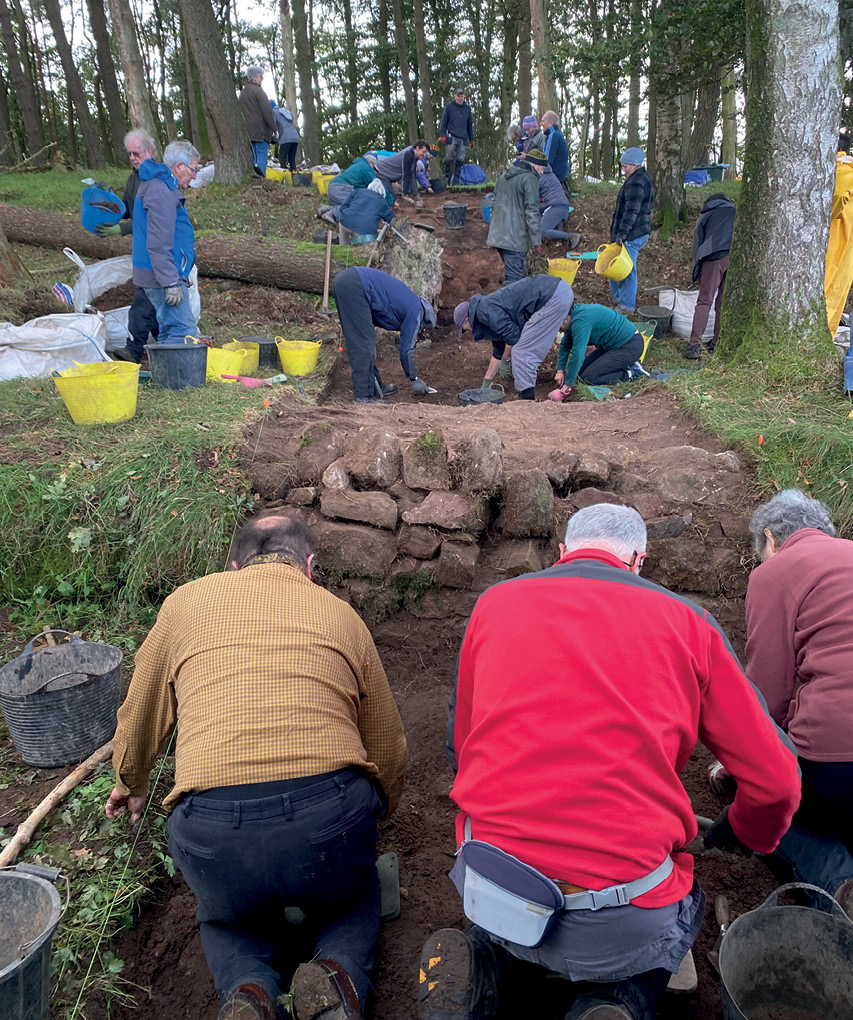
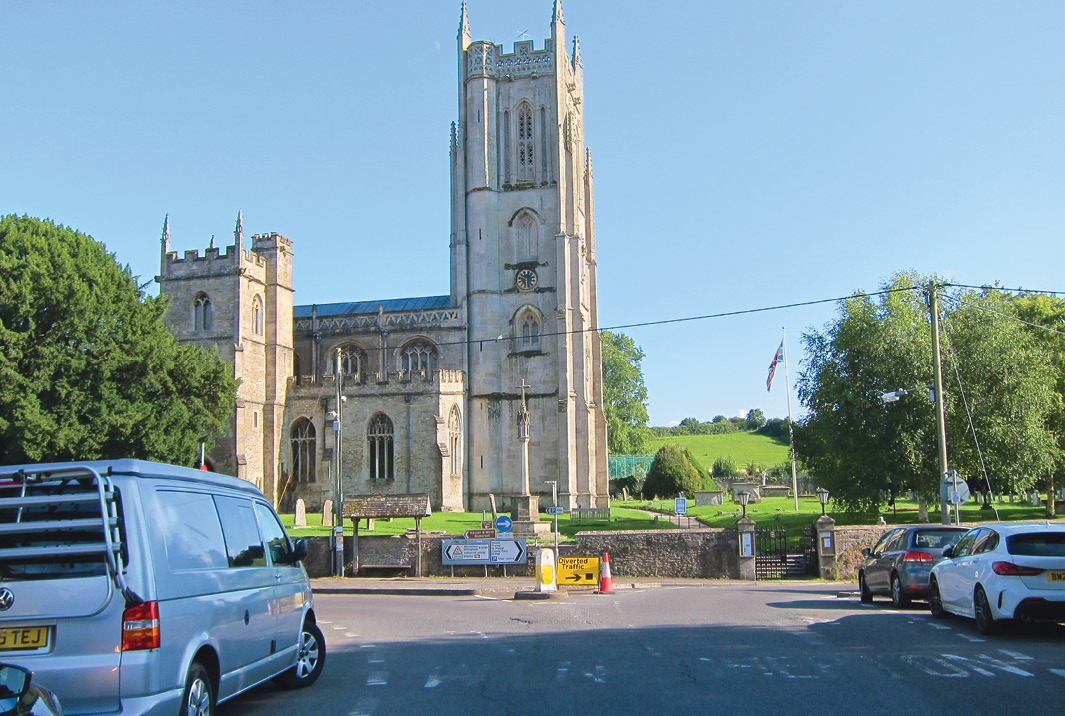
Your article on the former Priory at Ankerwycke, ‘From priory to pleasure ground’ (CA 404), gives a picture so similar to the one that has been researched in Bruton for the last 12 years. Ours would be called ‘From abbey to pleasure ground’, for we had a house of Augustinian canons who founded their priory here in 1142, on the banks of the River Brue. Having been elevated to an Abbey in 1511, it was dissolved in 1539 to be partially converted and rebuilt by Sir Maurice Berkeley, Privy Councillor and standard- bearer to Henry VIII. His mansion, inherited by his heirs, was eventually dismantled in 1786,
We still have the magnificent, mainly 15th-century abbey church for the parish (below) and a 6m-high length of roadside precinct wall. A programme of research and exploratory excavations has taken place over the last 12 years, which has been supported by GPR surveys, aerial photography, maps, plans, and some helpful scorch marks! All this has established the outlines of the monastic buildings and the precise location of the Berkeley mansion, set in its pleasure grounds.
At present, research is taking place to establish the water sources and the engineering involved to service these two large groups of buildings and the nearby town. This source would have supplied the early Saxon settlement, the monastery, Berkeley Mansion, and still some of the town’s residents today. An illustrated and referenced summary of the research will be published next year.
Roger Gallannaugh, Project Coordinator, Bruton
Caring for churches
Readers interested in the item on the National Churches Trust in ‘Odd Socs’ (CA 404) and sympathetic to the cause of churches struggling to meet the cost of repairs might also like to know that, alongside the national initiative, many counties have a trust dedicated to the support of local churches, chapels, and other places of worship.
Such trusts, like the Yorkshire Historic Churches Trust (www.yhct.org.uk), of which I am Treasurer, do not receive public or Lottery money but raise funds from subscriptions and donations from individual and church members, organising fund-raising events (such as the national Ride-and-Stride every September) and members’ activities (such as lectures and visits), and (crucially in our case) grants from other grant-giving charities, out of which we award funds to places of worship for their repair and maintenance.
I encourage anyone interested in supporting church repair to seek out and support their local county churches trust.
Richard Bailey, Treasurer Yorkshire Historic Churches Trust (registered CIO no.1175099)
Edible Archaeology
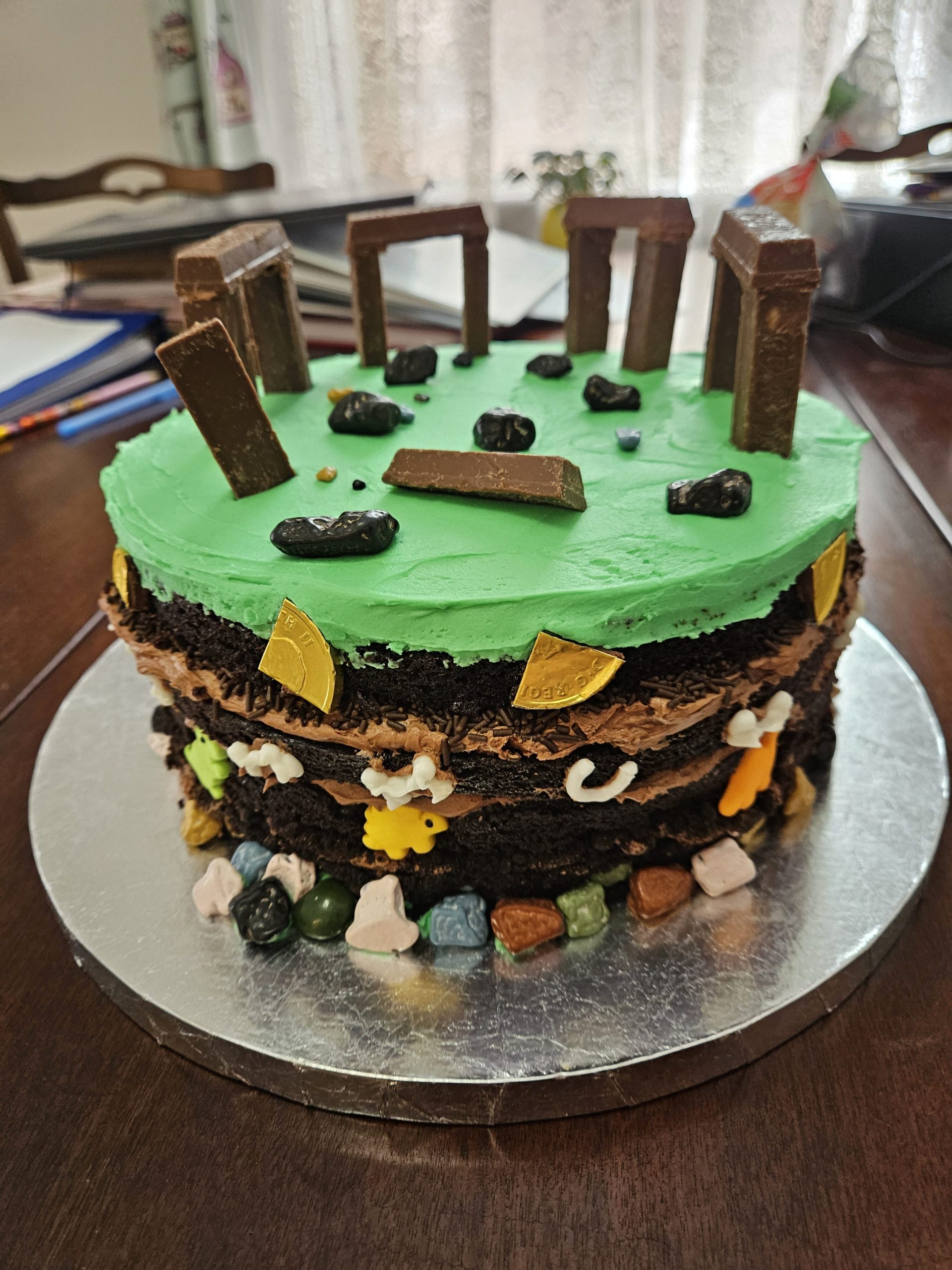
I made this archaeology cake for my cousin’s 65th birthday. The lowest geological layer contained chocolate rocks; the palaeontological layer had candy dinosaurs; the prehistoric layer had white chocolate bones; and the historic layer had chocolate coins. There were also various sediment levels (chocolate cookie crumbs, chocolate quins, and chocolate icing) – and, of course, Stonehenge on the top, made with mini KitKat bars. It was fun!
Leslie Still, Ottawa, Canada
CA ONLINE: What you shared with us this month
Adrián Maldonado @amaldon
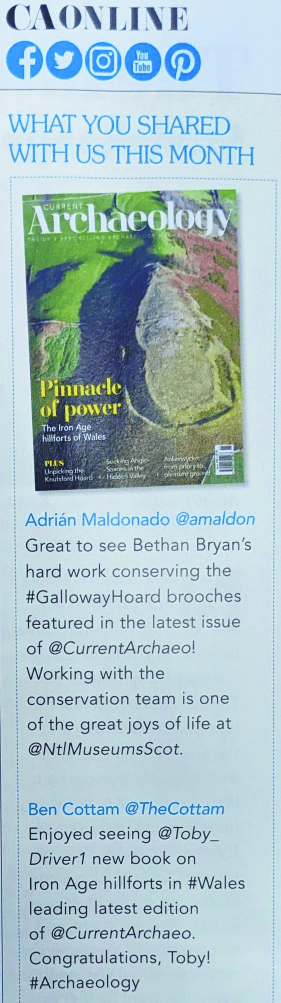
A tweet of a tweet! Made it to the letters page of @CurrentArchaeo by sharing the Galloway Hoard love. Surely world domination beckons.
Dr Toby Driver @Toby_Driver1
Hey @TheCottam – your kind Twitter comments about @Logaston Press Hillforts have been published in the latest @CurrentArchaeo – nice one!
Archaeological Research Services Ltd @CarryOnDigging
Are you a community archaeological group looking for help with your radiocarbon dating? The latest issue of @CurrentArchaeo reveals more about the exciting projects in 2022 that benefited from the CARD Fund, and we reveal how you can apply: https://archaeologicalresearchservices.com/community-
archaeology-projects-helped-by-the-card-fund-in-the-latest-issue-of-current-archaeology/
Write to us at: CA Letters, Current Publishing, Office 120, 295 Chiswick High Road, London, W4 4HH, or by email to: letters@archaeology.co.uk For publication: 300 words max; letters may be edited.