Subscribe now for full access and no adverts
Newgrange and Michael O’Kelly
Re: ‘Clare Tuffy and Newgrange’, CWA 117
I had the privilege of working with Professor O’Kelly at Newgrange in 1969. The restoration was just starting, and we were excavating around the exterior of the mound. O’Kelly was a tall, rangy man with what at first seemed an intimidating demeanour. In fact, he looked and dressed like everyone’s idea of a hardy farmer who had discovered you trespassing on his land. In reality, he viewed his University of Cork students, and the couple of us English guys who had come over from Exeter, as wayward, poorly educated, but beloved children. He was an excellent teacher, as I hope this anecdote will show.
One day we uncovered a very fine Early Bronze Age flanged bronze axe. O’Kelly assembled us all in the site hut for one of his impromptu seminars. He passed the axe around the circle, asking each of us to make an observation about it. Well of course we whipper-snappery undergraduates were all keen to show how brilliant and well-read we were in the prehistory of the British Isles. We made what I’m sure we all felt were profound and deeply insightful comments.
O’Kelly had a fine sense of the dramatic. After the axe had made its rounds and came back to him, he sat with it in his hands, his head bowed over it. The hut was hushed. After what seemed like half an hour, but was probably about 20 seconds, he lifted his head and glowered round the group.
‘Why’, he asked sourly, ‘have none of you LOOKED AT THIS THING?’ He then proceeded to point out all the things about the artefact none of us had noticed because we were too busy trying to be clever. I am forever grateful to this man.
Ian Burrow Hopewell, New Jersey, USA

Furry friends
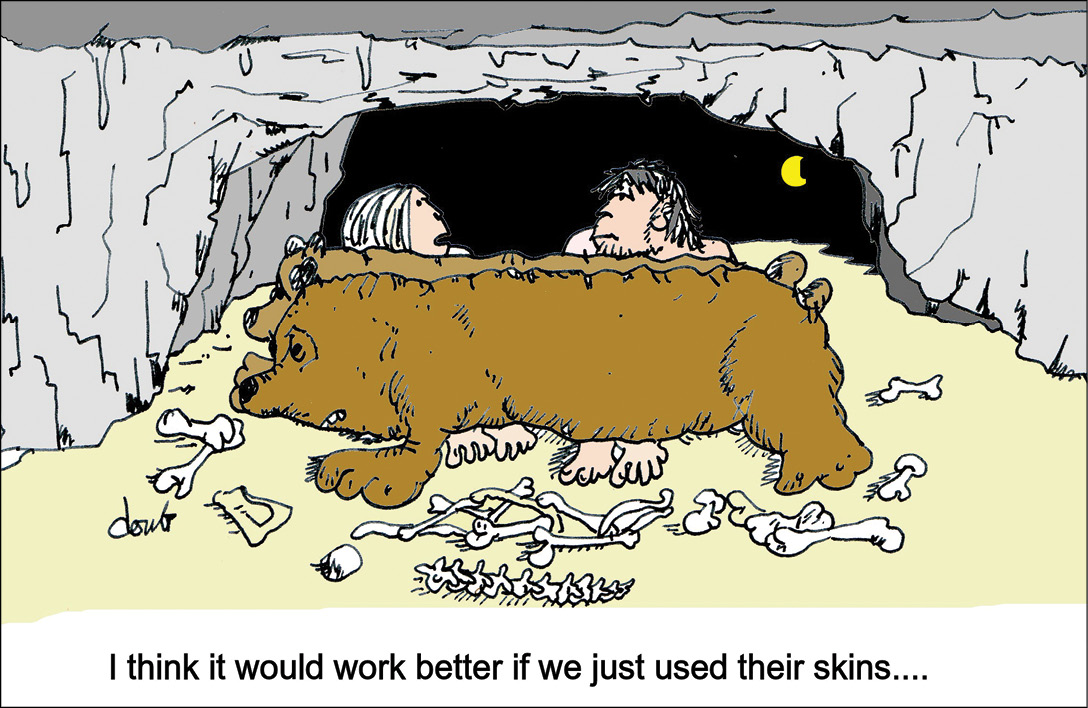
The next time Fluffbum (the feline) climbs onto my pillow at 3am, wraps himself around the top of my head, then sets to purring like a two-stroke outboard motor, I am going to show him the ‘bear’ cartoon, CWA 115, as a threat.
Graeme Innes-Johnstone, Elland, UK
Miniature pottery
On page 23 of CWA 116 (‘Glass beads, ritual deposits, and laser beams’) the authors wondered about the presence of miniature pottery at the dig site in Italy. Have they considered that these items may have been toys? The Museum of Northern Arizona in Flagstaff, AZ, includes miniature pottery of the ancestral Puebloans of the Colorado Plateau and speculates that these items could have been made as toys for children. Perhaps the miniature pots that the authors found at the site in Italy may have served the same purpose. If parents were teaching children about honouring the deities, the pots – items of value – could have been left by the children as they learned the practices of their religion. Something to consider?
Rick VanGorder, Phoenix, Arizona, USA
Exploring Roman frontiers
At CA Live! I bought from the Archaeopress stand several volumes of the ‘Roman Frontiers’ series by David Breeze and colleagues. In CWA 118, I particularly enjoyed the article on Qasr Bshir. The ‘Roman Frontiers’ series show how much I don’t know about Roman provinces apart from in Western Europe and indicates how much there is. The ‘Exploring the Roman World’ series by British Museum Publications was excellent and came to an untimely end with the premature death of its General Editor, Dr T W Potter, 30 years ago. It would be good to see the survey of the provinces of the Roman world restarted.
John Morrissey, Derbyshire, UK
Your observations, your objections, and your opinions: send them to cwaletters@world-archaeology.com
Please note: letters may be edited; views expressed here are those of our readers, and do not necessarily reflect those of the magazine.