Subscribe now for full access and no adverts
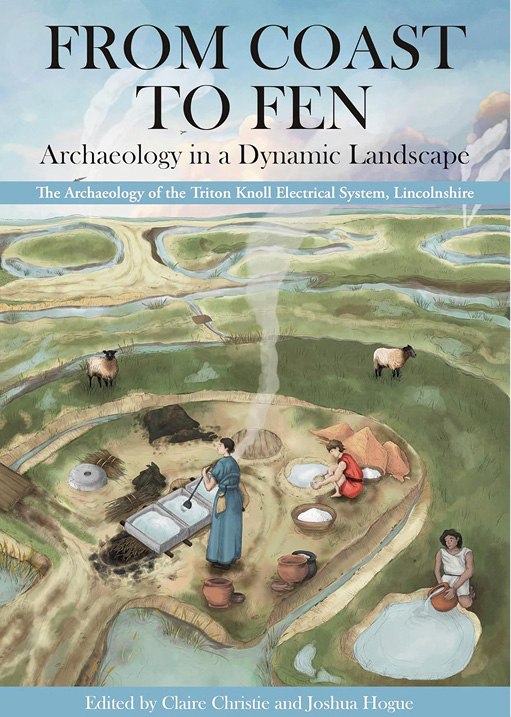
REVIEW BY JONATHAN LAST
Cable routes and similar projects are a challenge to archaeologists because their narrow footprints are not necessarily representative of the broad landscapes they pass through. Yet they often offer glimpses into areas little touched by other forms of development. This multi-authored volume, which tracks the course of an electrical system from an offshore wind farm through eastern Lincolnshire, provides the wider context via a detailed palaeoenvironmental study, facilitated by the fen deposits that comprise the ‘dynamic landscape’ of the subtitle.
Through various phases of marine transgression and regression, the roddons emerge as key dry-land locations on which settlement and agriculture are possible, most notably in the Roman period (the evidence is supplemented by stable isotope studies of plant and animal remains), filling a gap in the record of Roman Lincolnshire. An unusual sub-rectangular structure with a moat-like ditch around it provides evidence of adaptation to wetland conditions. In contrast to the inland settlements, the coastal marshes were predominantly used for salt-making, again mainly Roman. While these sites, with their tanks, ovens, and briquetage, conform to the regional pattern, they hint at a later persistence of the industry than previously recognised. There are also insights into the origins of medieval field systems, and somewhat worrying evidence of the ongoing loss of peat to post-drainage agriculture.
But does the monograph offer much more than the sum of its parts? Archaeological stories of past environmental change can be helpful for communities coming to terms with uncertain climate futures. This volume, while entirely competent, does not quite provide the necessary clarity, with its period-based sections following the standard template for a specialist report; a thematic approach might be more engaging for non-specialist audiences, even though they are not the target. And although earlier prehistoric evidence is scanty (one always wonders how closely lithics are looked for in strip-map-record exercises), there is a missed opportunity to link the ebb and flow of the sea, which had so much influence on activity here, to the submerged landscapes of the wind farm itself.
From Coast to Fen: archaeology in a dynamic landscape, the archaeology of the Triton Knoll Electrical System, Lincolnshire
Claire Christie and Joshua Hogue (eds)
Oxbow Books, £38
ISBN 979-8888571958