
Subscribe now for full access and no adverts
Mesolithic structures identified off the coast of France
A series of 11 submerged structures has been found off the coast of France, near Île de Sein in Brittany. They are believed to date to the Mesolithic period and were first identified during a LiDAR survey in 2017. Subsequent excavations between 2022 and 2024, carried out by divers from the Société d’Archéologie et de Mémoire Maritime (SAMM), determined that they were human-built linear constructions, constructed from granite in various sizes. The largest example measures 120m long (400ft), with a total mass of c.3,300 tonnes.
Although the structures now lie beneath 7-9m (20-30ft) of water, at the time that they were made they would have been on the island’s shoreline. The smaller, wall-like constructions resemble Mesolithic fish-traps, but the function of the larger ones is unknown, though the researchers suggest that they could have served as fishing weirs or as dykes to shield against heavy swells and rising waters. The excavation’s results were recently published in the International Journal of Nautical Archaeology (https://hal.science/hal-05406477).
Ancient Egyptian ‘pleasure boat’ found near Alexandria
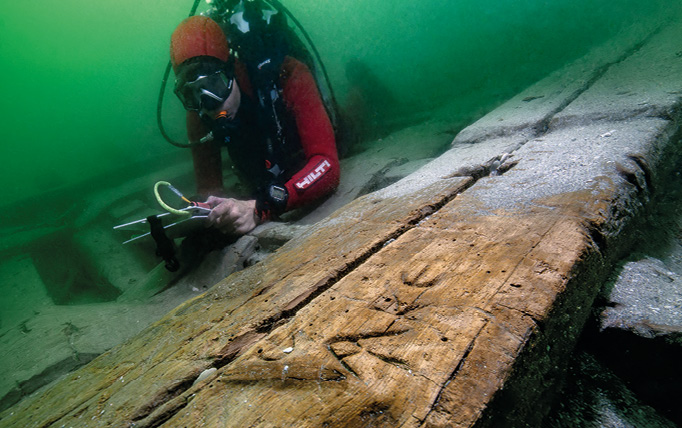
The remains of an ancient Egyptian pleasure barge, known as a thalamagos, has been discovered off the coast of Alexandria during excavations by the Institut Européen d’Archéologie Sous-Marine (IEASM).
Measuring 35m long (115ft) and c.7m wide (23ft), the vessel would have once had a lavishly decorated central pavilion. A Greek graffito on one of the timbers dates its construction to the 1st century AD. While thalamagoi are depicted in mosaics and mentioned by ancient authors, this is the first physical example to be discovered.
Neolithic dog and dagger burial uncovered in Sweden
Excavations by archaeologists from Swedish National Historical Museums at Logsjömossen, near Järna, south-west of Stockholm, have uncovered the remains of a large dog (measuring 52cm or 20in in height at the withers) that appear to have been carefully buried c.5,000 years ago.
The dog is thought to have been 3-6 years old when it died, and its skull may have been crushed before it was buried. A finely polished bone dagger had been placed beside the dog’s paws. It measures 25cm (10in) in length, with a hole cut in the shaft, which was probably made from the metatarsal (foot) bone of an elk or red deer. During the Neolithic period, the site would have been a shallow lake, and much evidence has been found to suggest that it was used for fishing at this time. Several other daggers have been found deposited in Swedish lakes from this period, but this is the first time that a dog had been buried alongside one.
Text: Kathryn Krakowka / Image: Christoph Gerigk © Franck Goddio/Hilti Foundation