Subscribe now for full access and no adverts
A Bronze Age barrow containing the cremated remains of eight individuals, who appear to have all been buried at the same time, has been found in the Nithsdale hills, south of Sanquhar, in Dumfries and Galloway.
The discovery was made by GUARD Archaeology during excavations associated with the construction of an access route to Twentyshilling Wind Farm between 2020 and 2021. Recently published post-excavation analysis (https://archaeologyreportsonline.com/reports/2025/ARO64.html) has since revealed that there were five tightly packed urns in the barrow (below), which contained the remains of at least eight individuals, dating to 1439-1287 BC. They appear to have been deposited at the same time, which could indicate a single mass burial.
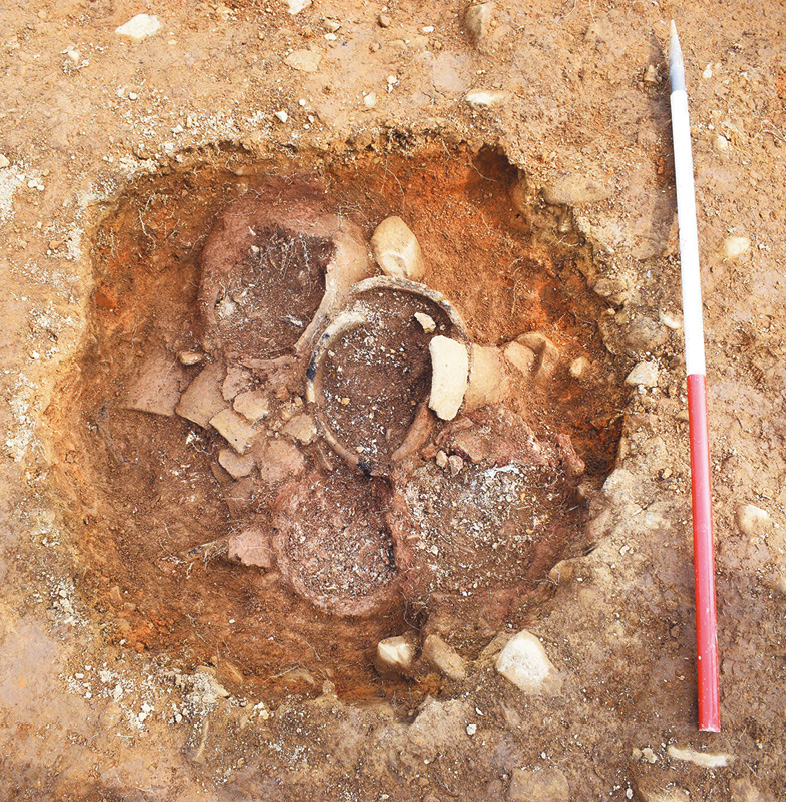
It also appeared that the bodies had not been left out for any lengthy period of time – unlike at many other Bronze Age barrow sites across Scotland, including at another example recently excavated by GUARD Archaeology at Broughton in the Scottish Borders, which had evidence of extensive excarnation prior to cremation; the urns in this burial had also been interred over a protracted period rather than all at once. This could suggest that the local community at Twentyshilling may have had less time to perform the burial rituals, perhaps due to unrest, whether through war, famine, or pestilence, which might also explain the need for a mass burial.
To the north of the barrow, a small group of three pits was uncovered, too, and they were subsequently dated to 2867-2504 BC, indicating that the site had been occupied during the Neolithic period as well. Each pit contained hearth waste as well as fragments from stone tool-making and pottery sherds, speaking of settlement activity.
Thomas Muir, the GUARD Archaeologist who led the excavation, said: ‘The discovery of a Bronze Age barrow and an earlier Neolithic pit group was a relative surprise as there was very little evidence of prehistoric activity in the immediate area prior to the Twentyshilling Hill fieldwork. This new archaeological evidence provides a unique glimpse into the prehistoric landscape south of Sanquhar, a landscape lightly peppered with unexplored and undated cairns and earthworks but until now, very little tying any specific part of the landscape to any particular period of time.’
Text: Kathryn Krakowka / Image: GUARD Archaeology Ltd