
Subscribe now for full access and no adverts
Mass graves and migration in Neolithic France
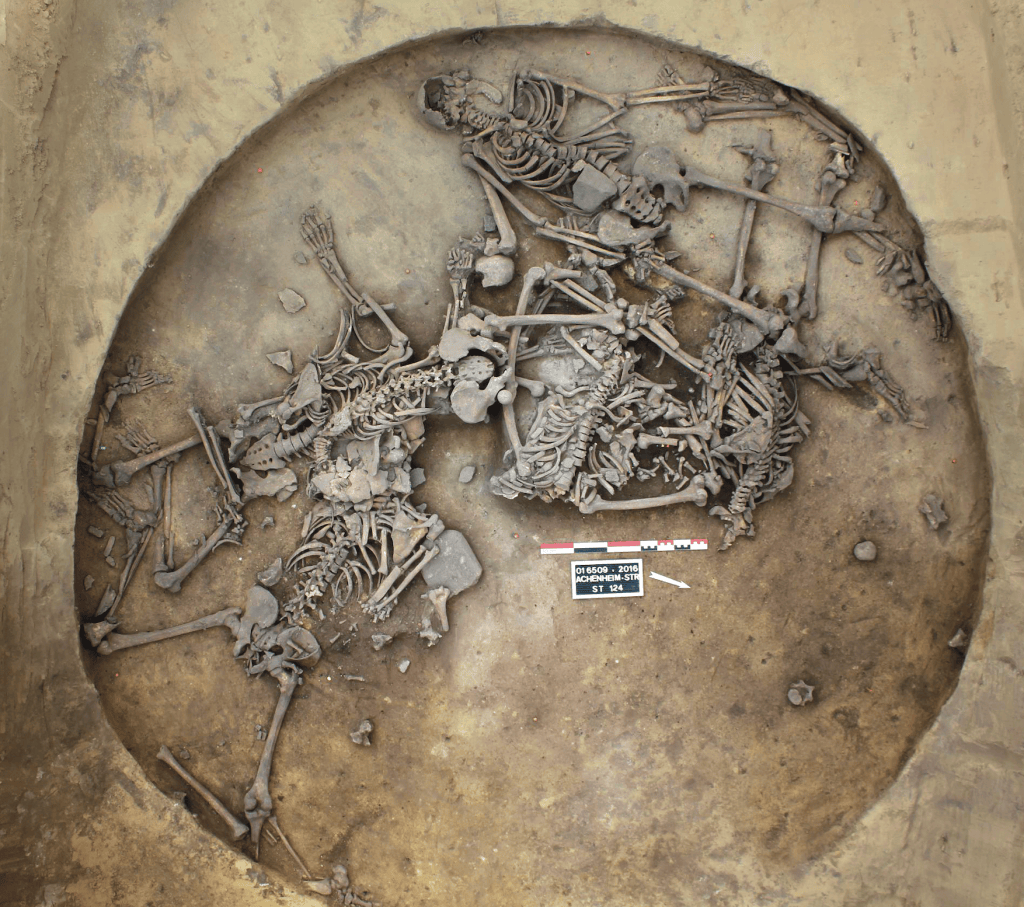
Recent isotopic analysis of human remains from Neolithic mass graves found at Bergheim and Achenheim in Alsace, France, have shed new light on the life histories of these individuals.
Each pit was found to contain a number of complete skeletons, as well as disembodied left arms that had also been interred within these mass burials. The recent research has revealed that none of these individuals are likely to have been local to the area – unlike the remains recovered from more traditional burials discovered nearby. The people from the pits had had more varied diets, too, as well as potentially higher levels of physiological stress during life compared to the local population. Interestingly, the intact individuals within the pits also appear to have come from a different location to those who were only represented by a severed limb. The researchers suggest that this could be because they had been captured alive and executed nearby, while the limbs might represent those who had been killed in a distant campaign of violence, with their arms taken as war trophies. The full results were recently published in Science Advances: http://www.science.org/ doi/10.1126/sciadv.adv3162.
Face-to-face with Neolithic Turkey
A c.12,000-year-old stone pillar carved with a distinctive human face has been uncovered at the archaeological site of Karahan Tepe in Turkey. The site represents a pre-pottery culture and forms part of a ritual complex known as the Taș Tepeler group of prehistoric sites in the hills around Șanlıurfa, which includes the UNESCO World Heritage Site of Göbekli Tepe.
Numerous T-shaped pillars have previously been discovered at Karahan Tepe, as well other Taș Tepeler sites, and some of these are decorated with human arms or hands, or wear belts or other articles of clothing. It had been suggested that they may be symbolic representations of human figures – the discovery of a pillar with a face now strengthens this theory.
Significant silver hoard found in Sweden
A large medieval silver hoard, believed to be one of the largest such assemblages ever found in Sweden, has been unearthed near Stockholm. The hoard was found by a member of the public near his summer house, and subsequent professional excavation of the site revealed a cache of just over 24,000 silver coins, as well as around 100 other objects including rings, pendants, and beads. It appears that the whole hoard had been placed inside a copper cauldron before burial. Most of the coins were produced in eastern Sweden and date to the 12th century – probably during the reign of Knut Eriksson (1173-c.1195), as the majority bear the Latin text KANUTUS – but there are also a few German, English, and Arab examples that date to the 10th century.
Text: Kathryn Krakowka / Image: P Lefranc