Subscribe now for full access and no adverts
Burials in the Arctic?
A recent re-evaluation of the Tainiaro site in Finnish Lapland, c.80km south of the Arctic Circle, suggests that it could be one of the most northernly prehistoric cemeteries known in Europe.
Although the site was first excavated in the 1980s and 1990s, the findings were never published and its potential significance remained unrecognised for decades. In 2018, however, archaeologists from the University of Oulu reassessed the archival evidence and also returned to the site to conduct a ground-penetrating radar survey, as well as small, targeted excavations. This work established that many of the ‘pits’ found in the original excavation are directly comparable to those of graves from other areas of northern Europe, and probably date to the 5th millennium BC. So far, the team suggest that around 44 of the excavated pits probably represent graves, although any human remains within them had not survived due to the acidity of the soil. Based on the total size of the site and the area excavated so far, they estimate there could be as many as 115-200 graves at Tainiaro. The full results were recently published in Antiquity (https://doi.org/10.15184/aqy.2023.160).
Beads and burial practices at Lake Turkana
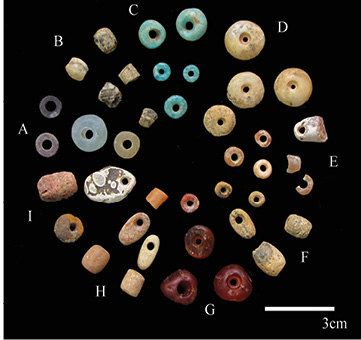
The recent analysis of stone beads found in burials at sites near Lake Turkana in Kenya is shedding new light on the different communities who inhabited this area c.5,000-4,000 years ago.
The analysed beads were found at three monumental mortuary sites – known as ‘pillar sites’: Lothagam North, Manemanya, and Jarigole. Research into their composition and origin (the results of which were recently published in the Journal of Field Archaeology: https://doi.org/10.1080/00934690.2023. 2232703) found that the beads at Lothagam North and Jarigole, despite being relatively distant from each other, were similar, being mainly colourful and shiny. By contrast, the beads from Manemanya were more muted pale pink or white calcite. They also found that while the majority of stones were probably found locally, the nearest location for two of the minerals identified – amazonite and fluorite – is more than 200km away.
Beavers at Bilzingsleben
The recent reanalysis of beaver remains from a Lower Palaeolithic site at Bilzingsleben in central Germany has indicated that they may have formed part of the hominin diet in this region.
Excavations at Bilzingsleben between 1969 and 2002 uncovered a large faunal assemblage dating to around 400,000 years ago, including the remains of the Eurasian beaver (Castor fiber) as well as an extinct species (Trogontherium cuvieri). Reanalysis of more than 2,000 of these beaver bones has revealed cut marks and other evidence of hominin butchery. Based on where the cuts were located, the team suggest that the beavers were being exploited both for their pelts and for meat and fat, making this is the first concrete evidence of beaver- hunting in the Pleistocene. The research was recently published in Scientific Reports (https://doi.org/10.1038/s41598-023-46956-6).
Text: Kathryn Krakowka