
Subscribe now for full access and no adverts
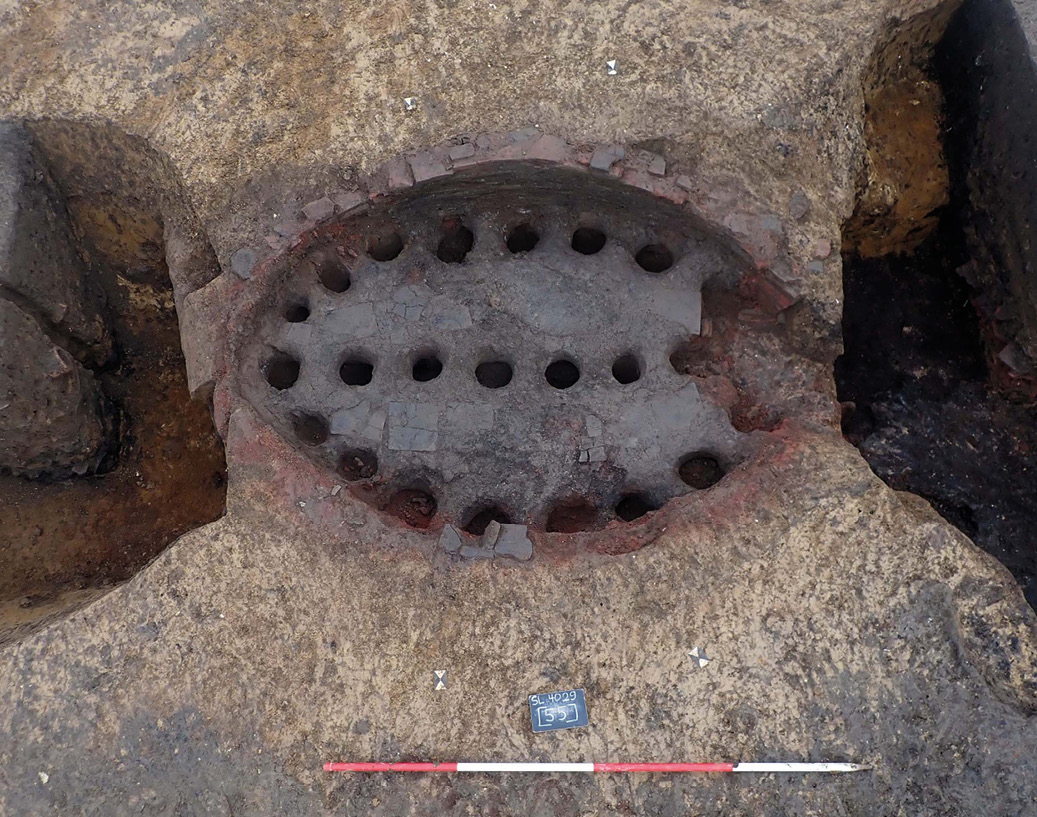
An exceptionally well-preserved example of a 15th-/16th-century pottery kiln has been excavated at Sutton V.A. Primary School in Bedfordshire.
The large, well-built kiln was discovered by Albion Archaeology. It retains its stoke-hole, floor, and flues, offering a rare opportunity to explore the details of its construction and materials, and preserving evidence of numerous firings, potentially over a period of decades.
A set of fire tongs and around half a ton of pottery were found associated with the structure; the latter has been identified as Late Medieval Reduced Ware, a ceramic that is often found in the Midlands and is usually dated to the 15th to mid-16th centuries. A more specific date for these examples has yet to be obtained through archaeomagnetic dating, but similar pottery from a kiln excavated at the nearby village of Everton in 2019 returned dates of AD 1497-1539. ‘We are provisionally guessing that it is similar in date, but it could well be earlier in the 15th century, or maybe even the 14th,’ commented David Ingham, Project Manager at Albion Archaeology.
Kilns like these were previously thought to represent rare finds in the area, but with the Sutton example joining at least two, pos- sibly three, kilns known from Everton and the tantalisingly named town of Potton, which sits between the two locations, it invites speculation that this might in fact have been one of the main production centres for Late Medieval Reduced Ware. The amount of pottery recovered from the Sutton kiln alone attests to a use that extended far beyond local subsistence production, adding valuable insights into the pottery industry in late medieval Bedfordshire.
Evidence of earlier activity was also uncovered on the site, represented by a number of small ditches and pits which appear to represent occupation around the 11th and 12th centuries.
Post-excavation analysis is now under way, working to wash and catalogue the pottery and obtain a more secure date for the kiln. Meanwhile, photogrammetry of the kiln itself is being used to create a 3D model in order to preserve it digitally for future researchers, as well as the public.
Text: Rebecca Preedy