
Subscribe now for full access and no adverts
The latest phase of excavations at Strata Florida, a former Cistercian abbey near Tregaron, Ceredigion, has uncovered a wealth of new features, some of which pre-date the abbey’s 12th-century origins.
Strata Florida was established by Cistercian monks in 1184, and quickly became one of the most-famous religious houses in Wales, second only to St Davids Cathedral in Pembrokeshire. It flourished as a cultural centre, particularly under Lord Rhys, who ruled the kingdom of Deheubarth in which the abbey was located between 1155 and 1197. By the time of the Dissolution of the Monasteries, however, the site was in decline, and – following partial dismantling in 1539 – its buildings gradually fell into ruin.

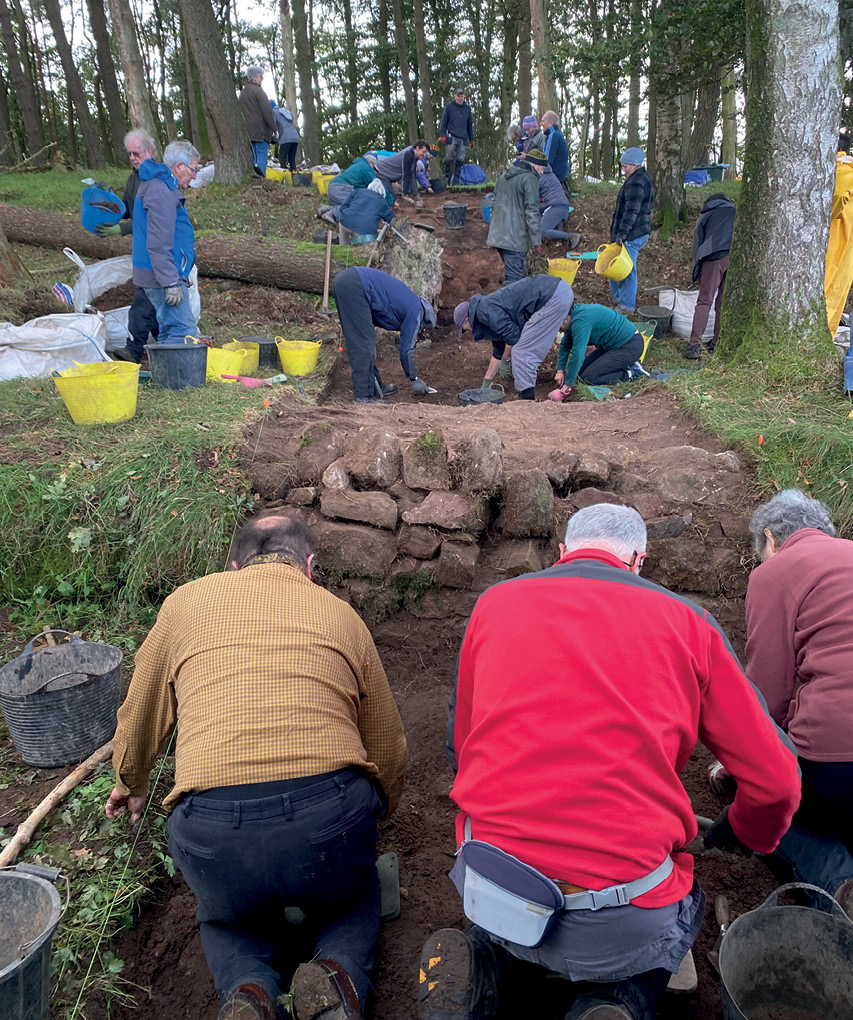
Modern excavations have been running at the abbey for more than 20 years, with the most recent digging seasons focusing on the Mynachlog Fawr farmyard, which sits adjacent to the surviving abbey ruins and is currently being restored by the Strata Florida Trust alongside their excavations. There, archaeologists have exposed the remains of three buildings, two of which were seemingly associated with the lay brothers’ dorter (dormitory) on the west side of the abbey cloister. An aqueduct or drain running through one of them also suggests that it could have served as a short-lived latrine range, and though this interpretation is far from conclusive, it would correlate with known plans of a number of other Cistercian monasteries. Analysis of samples taken from the lower deposit of the aqueduct fill indicates that the building through which it ran was likely to have formed part of the abbey’s initial construction, but with charcoal samples collected from below its stone base suggesting that this feature appears to have been constructed over the top of an earlier pre-Cistercian structure.
Other artefacts associated with the site’s Cistercian occupation that were recovered during this year’s work include coins, decorated floor-tiles, decorated window-glass, and dressed stone from the monastic buildings, as well as several kilograms of pottery spanning the 12th to 15th centuries. Other features yielded more surprising dates, however. Analysis of 11 charcoal samples have returned a variety of results, reflecting the site’s long use. Five dated to between AD 951 and 1172, before the Cistercian monks arrived on the abbey site, but one yielded a much earlier result: 5920-4758 BC, placing it in the Mesolithic period. This discovery fits well with the large number of prehistoric worked flints that have been found across the site.
Adding to this picture of activity before the abbey, the team were particularly pleased to find a section of pre-Cistercian walling. ‘This is the first real physical evidence that confirms the existence of an already established pre-Cistercian complex at Strata Florida,’ explained Richard Scott Jones, an archaeologist at the Strata Florida Trust, and coordinator of radiocarbon dating on the site.
While it is currently unclear what this structure was for, or how the site was being used before its monastic phase, it is hoped that further excavation will help to provide some answers. ‘This now opens up a whole new set of social, political, economic, and religious questions that need to be explored archaeologically,’ Richard commented.
Excavations will continue this year, and the Strata Florida Archaeology Field School will run from 16 June to 14 July 2025. For more information, see http://www.strataflorida.org.uk/archaeology-field-school.html.
Text: Rebecca Preedy