Subscribe now for full access and no adverts
A collection of more than 500 Bronze Age finds, hailed as ‘one of the most significant hoards ever found in Scotland’, has been saved for the nation and acquired by National Museums Scotland.
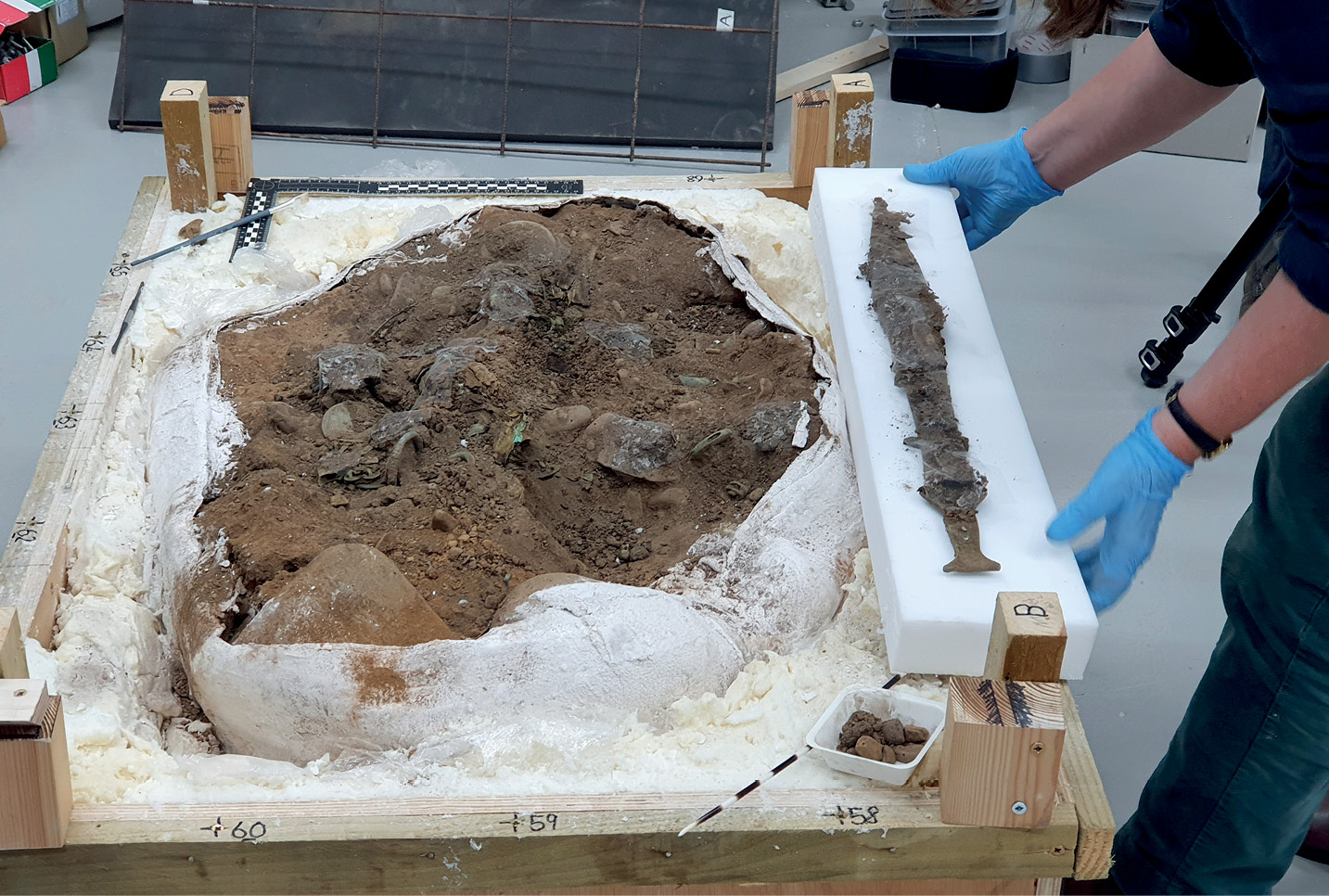
Dating to c.1000-800 BC, the Peebles Hoard was discovered in the Scottish Borders in 2020 by metal-detectorist Mariusz Ste˛pien´. As he immediately reported his find to the Treasure Trove Unit (see ‘Further information’ below), archaeologists and conservators at the National Museum of Scotland were able to recover the entire cache in a single block of earth. This enabled excavation and analysis to continue under laboratory conditions – invaluable for understanding its contents. The Peebles Hoard contains artefacts never discovered before in Scotland, many of them unique, as well as exceptional organic preservation of material that does not usually survive. Here was a chance to capture important information.
The block was initially CT scanned by µ-VIS X-ray Imaging Centre, University of Southampton, a partner institution of the National Research Facility for Lab-based X-ray Computed Tomography. This captured crucial details of the hoard’s make-up and the relationships between its contents in situ. These scans also revealed that some of the hoard’s metal objects had been produced using ‘lost-wax casting’: this technique is rarely seen in Bronze Age Britain, and the Peebles Hoard represents some of the earliest evidence of its use in Scotland.
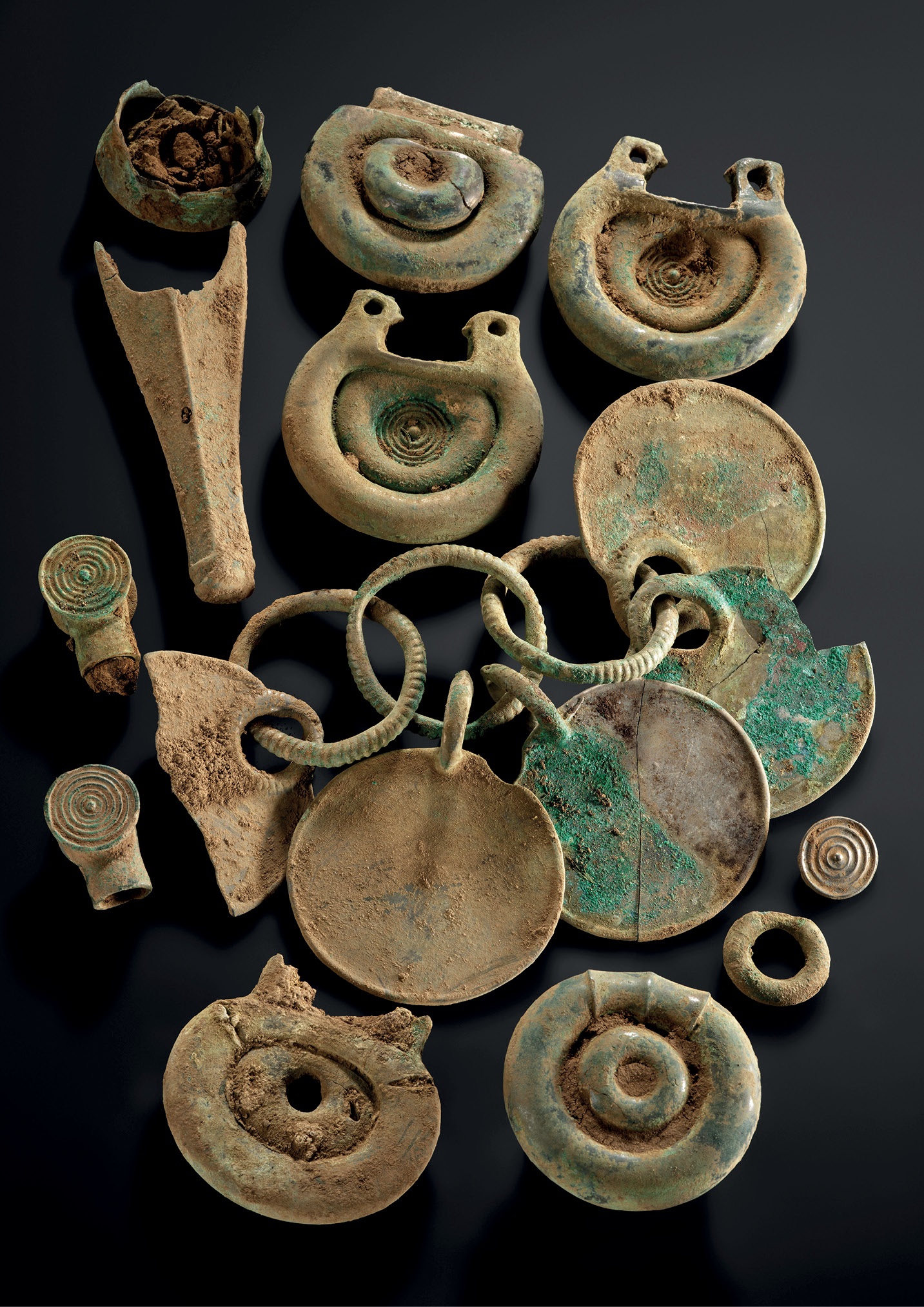
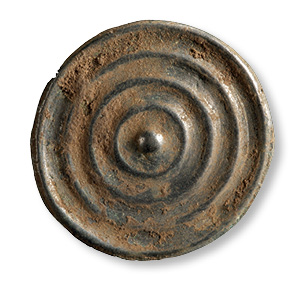
Next, the soil block was carefully transported to the National Museums Collection Centre in Edinburgh, where micro-excavation brought its unusual contents to light for the first time in over 3,000 years. These include a sword still enclosed by its wooden scabbard, decorated bronze fittings, and a number of small, looped bronze buttons on cords. Other rare survivals include an array of minute bronze pins, studs and bosses embedded in wood or leather, and the remains of complex decorative straps which have survived mostly articulated, offering invaluable insights into how they fitted together.
Unprecedented insights
A particularly intriguing element of the collection are two ‘rattle pendants’, created from interlinked bronze rings and pendant plates; they would have been suspended from a horse or wooden vehicle, making distinctive sounds as they moved. Such items are otherwise unknown in Scotland, but are more commonly found in Denmark, northern Germany, and northern Poland, highlighting Bronze Age Scotland’s position within an international network of connections across the North Sea. Some of the hoard’s other components are unique, and while their purpose is yet to be determined, they have the potential to offer new insights into life in Bronze Age Scotland.
The hoard was allocated to National Museums Scotland through the Treasure Trove process, with an ex-gratia payment made to its finder. The many unique survivals in the Peebles Hoard, most notably fragments of fragile organic material, require essential conservation to prevent further deterioration and to carry out critical research. To this end, National Museums Scotland is launching a fundraising campaign to support the urgent costs of conserving the Hoard and unlocking its enormous research potential.
We will bring you a feature with more detailed explorations of the Hoard and its contents in next month’s issue of Current Archaeology – watch this space!
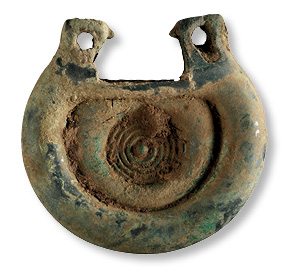
Above & below: A decorated bronze fitting and a bronze button (not to scale; you can see their relative sizes in the main image).
Further information:
• Under Scottish law, archaeological finds made in Scotland by chance, by metal-detecting, or through archaeological excavation may be ‘Treasure Trove’, and as such are claimable as property of the Crown, regardless of their age or material composition. (The law is different for discoveries in England, Wales, and Northern Ireland, which are covered by the 1996 Treasure Act; see http://www.finds.org.uk/treasure and http://www.communities-ni.gov.uk/articles/advice-finders-treasure-northern-ireland for more details.)
• Scottish finds are recorded by the Treasure Trove Unit, which is based at National Museums Scotland, and assessed for significance to decide whether the object will be claimed and offered to museums, or disclaimed and returned to the finder.
• For more information about Treasure Trove and how to report discoveries, see https://treasuretrovescotland.co.uk/information/information-for-finders/.
All images: National Museums Scotland, unless otherwise stated