Subscribe now for full access and no adverts
When you imagine the specimen stores of natural history collections, you might picture rows of jars containing mysterious samples suspended in an even more mysterious liquids. We might assume that these fluids are far less mysterious to those who work within the collections departments of museums and similar institutions. However, while it is common knowledge that these liquids are frequently made up of mixtures of various alcohols, some specimens were collected so long ago that the composition of the liquid preserving them is unknown even to their curators.
Understanding which liquid preserves specimens is an important aspect of caring for natural history collections: by understanding and conserving the fluids themselves, curators can maintain the integrity of the specimens held within. Over time, the chemicals can degrade as a result of a variety of factors: environmental conditions such as temperature, light exposure, and humidity; contamination from outside the containers; or evaporation due to inadequate jar sealants. Interactions between the specimen itself and the preservative fluid can also cause a change in the chemical makeup of the liquid. All of these can compromise the preservation of the specimen.
So, how can museum collections professionals examine the chemical makeup of these fluids? Current methods include gas chromatography coupled with mass spectrometry, or measuring the density of the fluids using digital density meters, which allows researchers to determine concentrations of ethanol or formaldehyde. However, these methods require the specimen jar to be opened, which poses multiple risks, potentially harming the specimens by exposing them to oxygen, or harming the handler if the unidentified mixture of chemicals proves to be toxic. Furthermore, adding fluids, transferring the specimen to different fluids, or changing the concentration of the fluids, can damage the specimen suspended within.
With this in mind, recently published analysis by researchers from the Central Laser Facility at the Science and Technology Facilities Council, the Natural History Museum, the ISPC-CNR in Milan, Italy, and Agilent Technologies LDA gives the results of a proof-of-concept study that identified a new method for determining the chemical mixtures within preservation fluids, using advanced spectroscopy technology and negating the need to open the specimen jars.
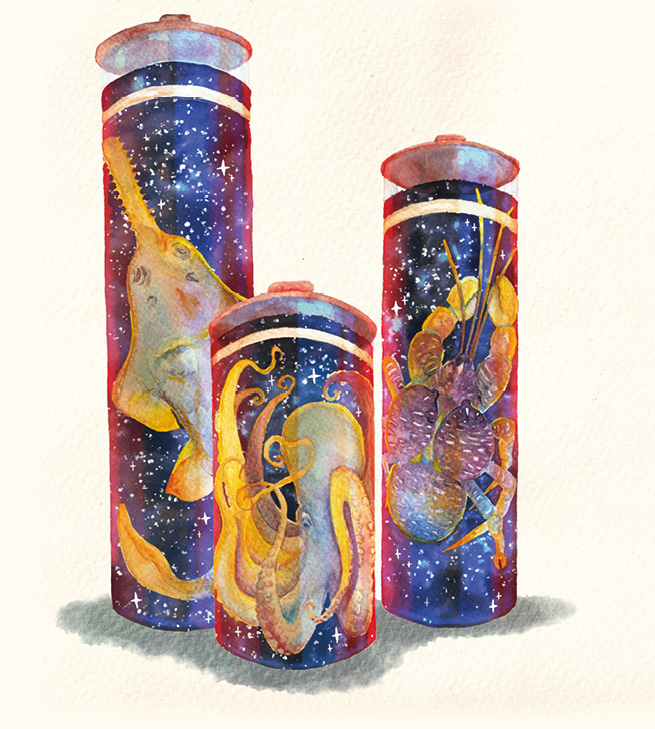
The researchers decided to investigate the potential of Raman spectroscopy – a technique that measures the energy of vibrations in a molecule or compound when a light source such as a laser is applied to it. These vibrations give off individual results, allowing specific chemical substances to be identified – and a new development of this technique, known as ‘spatially-offset Raman spectroscopy’ (SORS), enables the subsurface composition of chemicals to be determined through transparent and opaque containers, such as specimen jars.
This technique has already been applied in many fields, including airport security, detection of falsified COVID-19 vaccines, and even in the authentication of UK honeys. When combined with the use of microscopes, the method has also been used to reconstruct painted layer sequences and hidden texts non-invasively, as well as taking measurements in situ in museums. In these cases, portable micro-SORS devices have been employed – however, their use had not previously been explored to the same extent within cultural heritage settings.
The research team experimented with using a handheld SORS device to examine the fluid contents of specimen jars, hoping that this method would eliminate the need to open the container, as well as allowing the sample to be studied without transportation, minimising the risk of accidental breakage.
To carry out the tests, the team created solutions of different concentrates in ultrapure water using formaldehyde, ethanol, glycerol, and methanol. These were intended to represent typical formulations and concentrations that can be found in fluid collections, and/or simulate the potential cross-contamination that can occur in specimen jars over time due to their being topped up with incorrect solutions. When measured with a commercial handheld SORS device, each produced a unique Raman spectrum – a graph which shows how light scatters when the substance is hit by a laser – allowing each to be differentiated within the tested solutions.
The solutions were first measured in vials made of borosilicate, a type of glass created to be more resistant to thermal shock, and then in a pre-Second World War jar provided by the Natural History Museum, in order to simulate a typical historic specimen.
Both types of glass produced clear results that allowed for the identification of individual chemicals within the test solutions, demonstrating that the method can be used successfully on multiple containers. The new application of the SORS method therefore has very good potential for use within natural history collections to identify unknown chemical compositions of preserving fluids, and could help to maintain these collections for years to come.
The results have been published in full in the American Chemical Society’s journal Omega as a free, open-access article: https://pubs.acs.org/doi/10.1021/acsomega.4c11521.
Text: Rebecca Preedy / Image: Helen Towrie, STFC Central Laser Facility