Subscribe now for full access and no adverts
A recent project has set out to rediscover the archaeology and history of the textile mill complex in Bannockburn, Stirling. In its heyday during the late 18th and 19th centuries, it was one of the largest producers of tartan, furnishing many of the Highland Regiments with their uniforms.
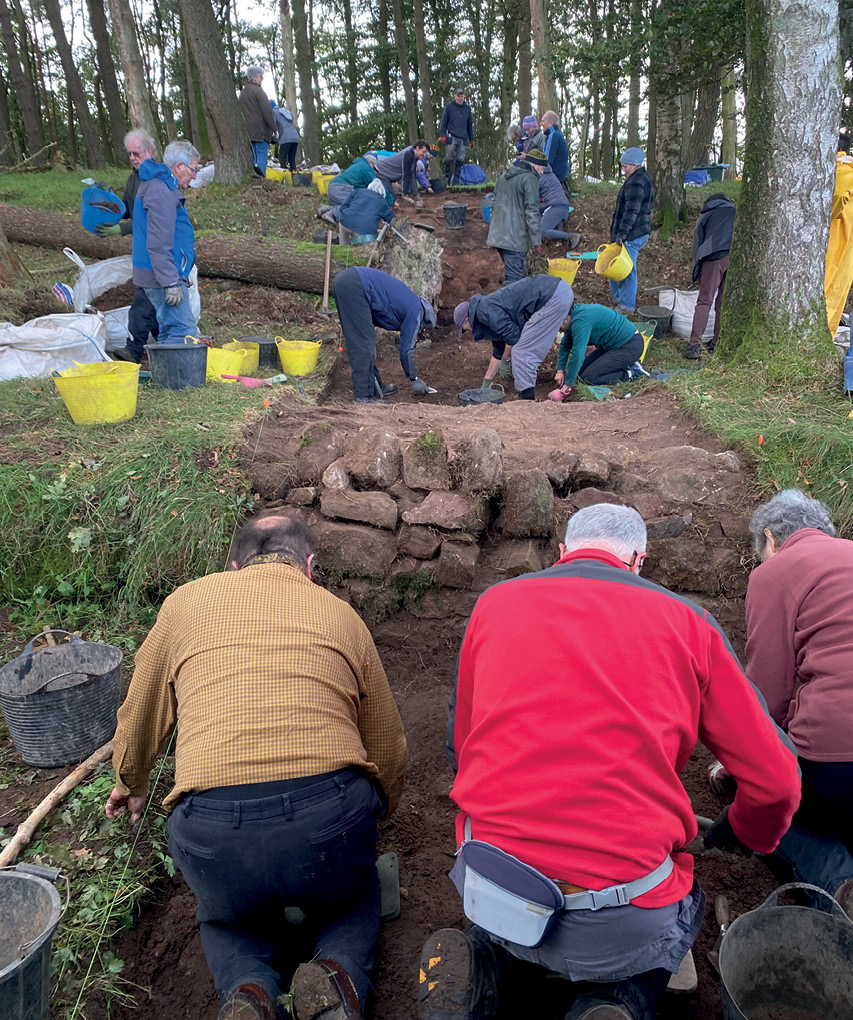
The initiative, led by Murray Cook from Rampart Scotland, began in 2022 in celebration of the 200th anniversary of George IV’s visit to Scotland, which helped kick off ‘tartan-mania’, and increased demand for the product. Last year saw a small excavation of the site, which is located at the Haugh in Bannockburn, while another investigation was conducted this past August and September. The work revealed the foundations of several mill buildings as well as some of the slum dwellings where workers were housed by the mill company. Both digs also revealed that, despite the site being demolished in the 1950s, many of the foundations and original floors had survived. In some cases, walls over 1m deep have been found. Several cellar dwellings, consisting of one room with no windows, were discovered too, attesting to the poor living conditions for mill workers. Built on a flood plain, there was evidence as well of the floors of some of the mill structures having to be raised several times over its tenure.

The mill complex was founded by William Wilson in the late 18th century, and was one of the first factories in Scotland to mass-produce tartan. Through securing military contracts to supply the Highland Regiments with their tartan uniforms, the factory quickly expanded during the first half of the 19th century, spreading across either side of the Bannock Burn. The Wilson family soon made a fortune, purchasing the nearby Bannockburn House. By the start of the 20th century, however, the business started to decline. The house was then sold, and the factory eventually demolished.
With the help of the local community, the project is set to continue, with more excavations planned for next year, along with a full survey of the site. This will be combined with photographs and oral history to help bring these long-forgotten mills back to prominence once more. It is hoped that the site, which is owned by Stirling Council and is otherwise unused, will eventually be turned into an open-air museum.
Image: Rampart Scotland