Subscribe now for full access and no adverts
An ongoing project at Navan Fort, led by Dr Patrick Gleeson and Dr James O’Driscoll, is providing new evidence on the long-term evolution of the site and how it fits into the wider archaeological landscape.
Navan Fort is a hilltop enclosure with prehistoric origins, but is famous in literature as Emain Macha, the legendary capital of the province of Ulster, and the setting for some of Ireland’s most important epics and tales, such as the Táin Bó Cúailnge. Excavations in the 1960s and 1990s – led by Dudley Waterman, Chris Lynn, and James Mallory – had established the complex and multi-period character of Navan Fort itself, within a much larger landscape. Outside the enclosure and earthworks of Navan Fort are a number of significant archaeological sites, including the late Bronze Age hillfort of Haughey’s Fort, the Creevroe Earthworks, King’s Stables (a late Bronze Age votive pool), and Loughnashade (a natural lake used for votive deposition in the Iron Age).
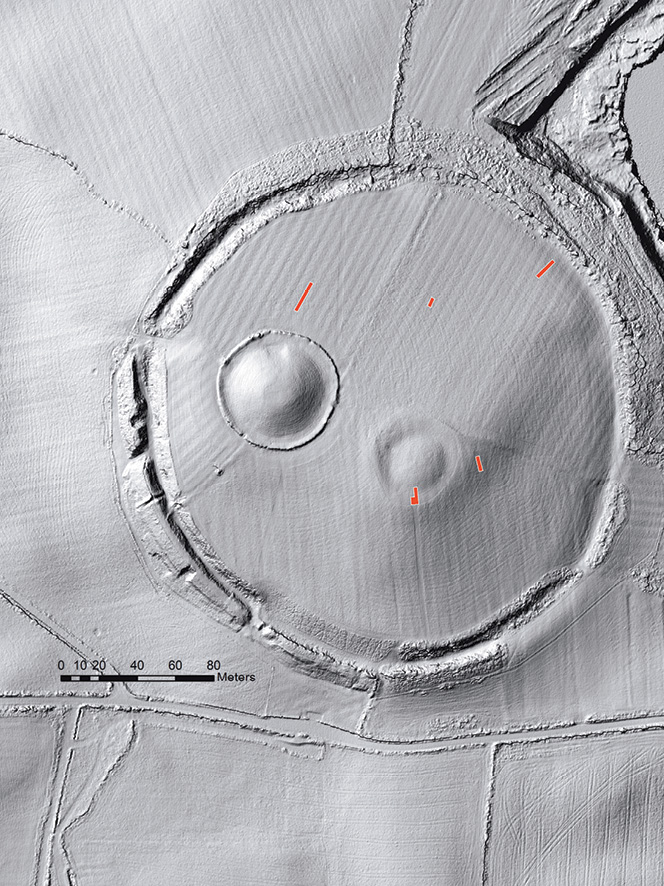
This most recent project at Navan Fort first embarked on a programme of large-scale multi-method geophysical survey, including comprehensive magnetic gradiometry, electrical resistance, and ground-penetrating radar survey, giving an unparalleled insight into the complex and its features (see CA 367). After this was completed, the team then began targeted excavation in order to date features identified in the geophysical surveys, with the aim of better understanding the phasing of the complex, and fitting it within the wider landscape. A first trench was dug in 2022, followed by four trenches this past summer.
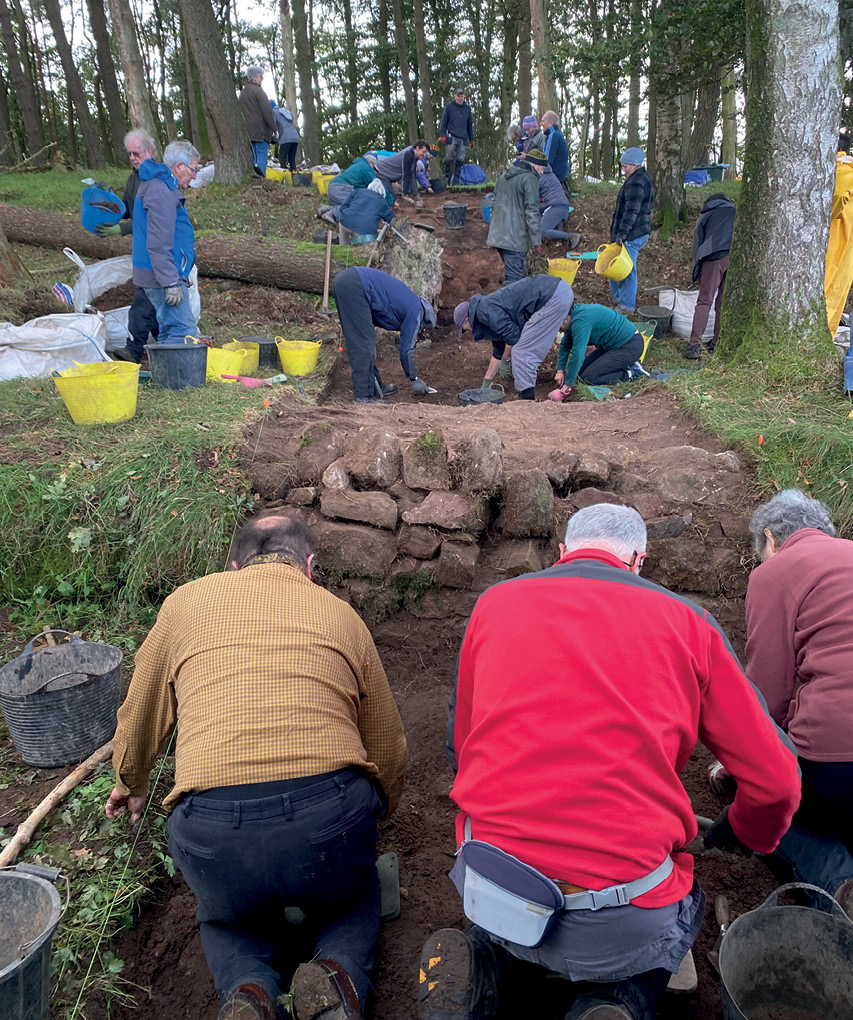
Of the four trenches excavated in August, three uncovered significant archaeology (above). The first, a large trench near the perimeter of the site, uncovered four concentric enclosures, some of which appear to pre-date the monumental earthwork enclosure that now defines the site. The initial hypothesis was that these were a series of consecutive enclosures connected to activity on the hilltop, but, interestingly, the format and morphology of each was very different. The team await radiocarbon results in order to disentangle their phasing and chronology.
The second principal trench was located across the ditch of what is known as Site A (a ring-barrow-like earthwork near the centre of the larger enclosure), in order to explore some anomalies found abutting it. While the interior of Site A was previously excavated in the 1960s, the structures uncovered, and their nature, are poorly understood. This most recent trench uncovered the remains of at least one feature – a large pit – to the south, and excavated a section across the ditch. Although this monument appears to be a ring-barrow morphologically, perplexingly there is currently no evidence for burial associated with it. The team were able to obtain a great sequence of activity from the ditch, however, including a series of charcoal and animal bone-rich layers; it is hoped that their chronology will be resolved by radiocarbon dating. Finds included medieval and post-medieval artefacts, which represent an important addition to the understanding of the site and its long-term evolution through the 1st and 2nd millennium AD.
The last principal trench was excavated over an L-shaped enclosure to the east of Site A, where the team uncovered an earthen bank and retrieved some samples for dating. On the north, upslope side of the bank, two post-holes were discovered, which may be part of a slot cut by the earthwork, running approximately east–west. To the south of this, a large pit was found with a post-pipe that suggests a previously unknown monumental structure or enclosure in this area.
Together with the results of excavation in October 2022, preliminary indications suggest an entirely new timber monumental horizon at the site in the early Iron Age. This could provide crucial context for the buildings excavated under Site B (a 40m-diameter structure to the west of Site A) by Dudley Waterman in the 1960s, and important new evidence for continued use of the site well into the 1st millennium AD, when the site is associated with kingship in early literature.
Photo: James O'Driscoll Text: Patrick Gleeson & James O'Driscoll