Subscribe now for full access and no adverts
‘Their trumpets are of a peculiar barbaric kind; they blow into them and produce a harsh sound which suits the tumult of war.’ So wrote the ancient historian Diodorus Siculus in the 1st century BC. He was describing a carnyx (plural: carnyces), a distinctive kind of musical instrument used by Iron Age peoples across Europe – and his is just one of a number of Classical accounts attesting to the psychological impact that they had on the battlefield. Carnyces were held vertically, with a tall pipe rising like a periscope from the mouthpiece, terminating in a bell shaped like a wild animal, serpent, or sharp-beaked bird. The sonorous notes that boomed from this ‘mouth’ would have thrilled onlookers and terrified enemies alike.
Images and excavated examples of carnyces attest to their widespread use from Scotland to Switzerland, France to Romania – but whenever physical remains of these instruments are uncovered, they tend to be tantalisingly fragmentary. Many appear to have been deliberately dismantled before burial, and often key parts are found to be missing. Now, however, a significant new addition to our understanding has emerged in west Norfolk, during an excavation by Pre-Construct Archaeology (PCA) on the site of a new housing development.
Blast from the past
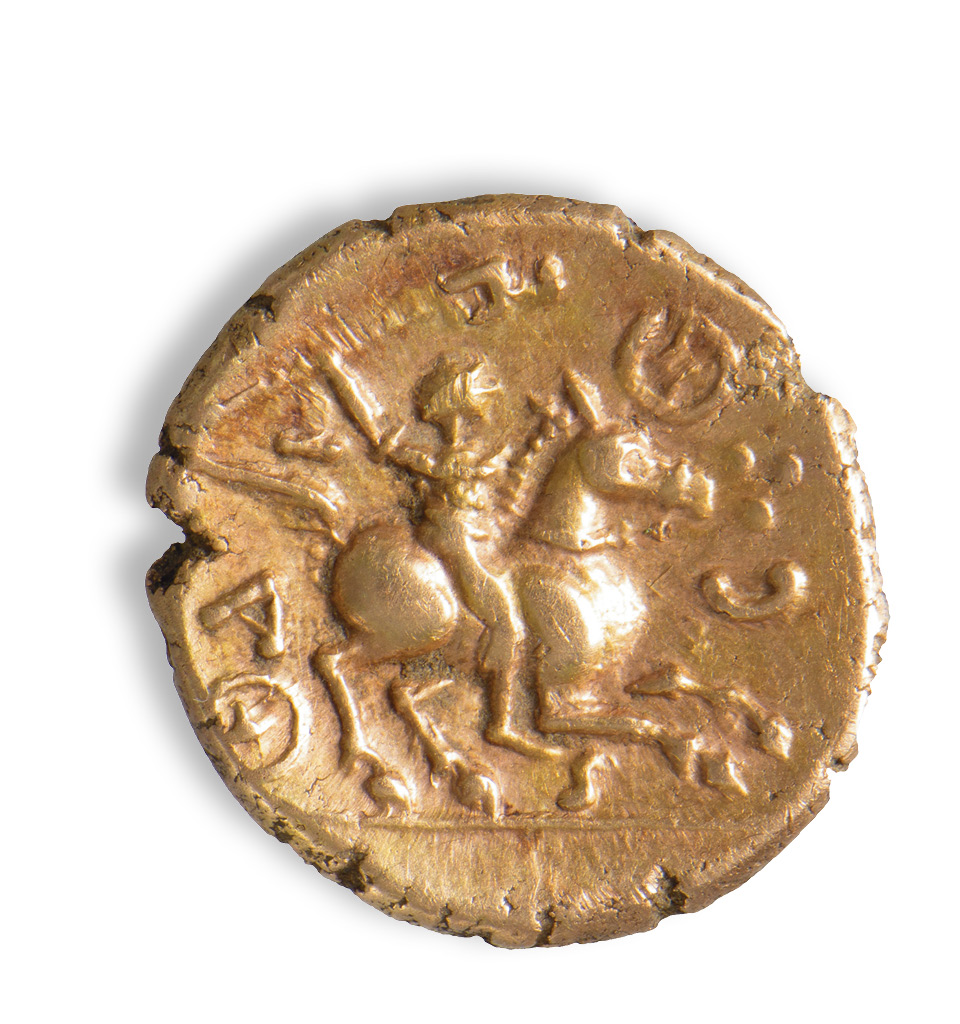
Before we delve more deeply into the new discovery, let’s first place it in its historical context. Today, carnyces are an immediately recognisable icon of the Iron Age, and these towering trumpets held a similar symbolic significance for the Romans. They appear on coins that were minted to celebrate military victories against Iron Age peoples, and are also often included in the friezes depicting amassed war trophies (representing defeated enemies) that appear on monuments from triumphal arches to the base of Trajan’s Column. These Roman representations show carnyces as exotic but inanimate objects: silenced, separated from their players, and reduced to a symbol of submission. We have images from the Iron Age world, though, which offer a very different view. A number of coins from Britain and Gaul depict carnyces in the hands of elite mounted warriors: an image of martial prestige, not surrender.
Moreover, while Roman sources generally focus on the use of carnyces in battle – no doubt because of the context in which they encountered them – they may have been played in peacetime, too, perhaps with a ceremonial role. One of the most-famous depictions of a carnyx is found among the ornate decorations around the inside of the Gundestrup Cauldron from Iron Age Denmark. Its elaborate imagery includes a trio of carnyx players standing behind a line of warriors who are queuing to be submerged in a waiting cauldron – a scene that feels more ritual than martial.

The Gundestrup Cauldron is thought to represent a votive offering, having been placed in a bog in the 1st century BC, and the only two carnyces previously found in Britain were also recovered from watery resting places. The first was dredged from the River Witham in 1768, at Tattershall Ferry, Lincolnshire. Unfortunately, it was melted down for metallurgical analysis shortly after its discovery, and today we have only a handful of drawings and engravings to attest to the object’s appearance. A rather happier story is told, though, by the Deskford Carnyx, which was found in a bog in what today is Moray, north-east Scotland, in around 1816, and today resides in the National Museum of Scotland (see CA 360). Only the bell of this instrument survives, but this head is wonderfully complete and characterful, depicting a stylised boar whose gaping mouth contains a flapping tongue mounted on a spring for extra resonance.
Another key discovery comes from Tintignac, near Limoges in France, where a metalwork hoard discovered within a Gallo-Roman temple complex in 2004 was found to include pieces from seven carnyces – all deliberately broken apart, but collectively representing all the major pieces needed to reconstruct a whole instrument. Finds like these have been used to create experimental instruments, allowing us to explore how they may have sounded. Professional trombonist John Kenny has become renowned for his performances using a replica carnyx; you can see him in action on National Museum Scotland’s YouTube channel: http://www.youtube.com/watch?v=auR-lJfzTeY. The carnyx recently excavated by PCA had also been dismantled before it was committed to the Norfolk soil, but, while analysis is ongoing, it is already known to be one of the most complete examples discovered in Europe.

A unique discovery
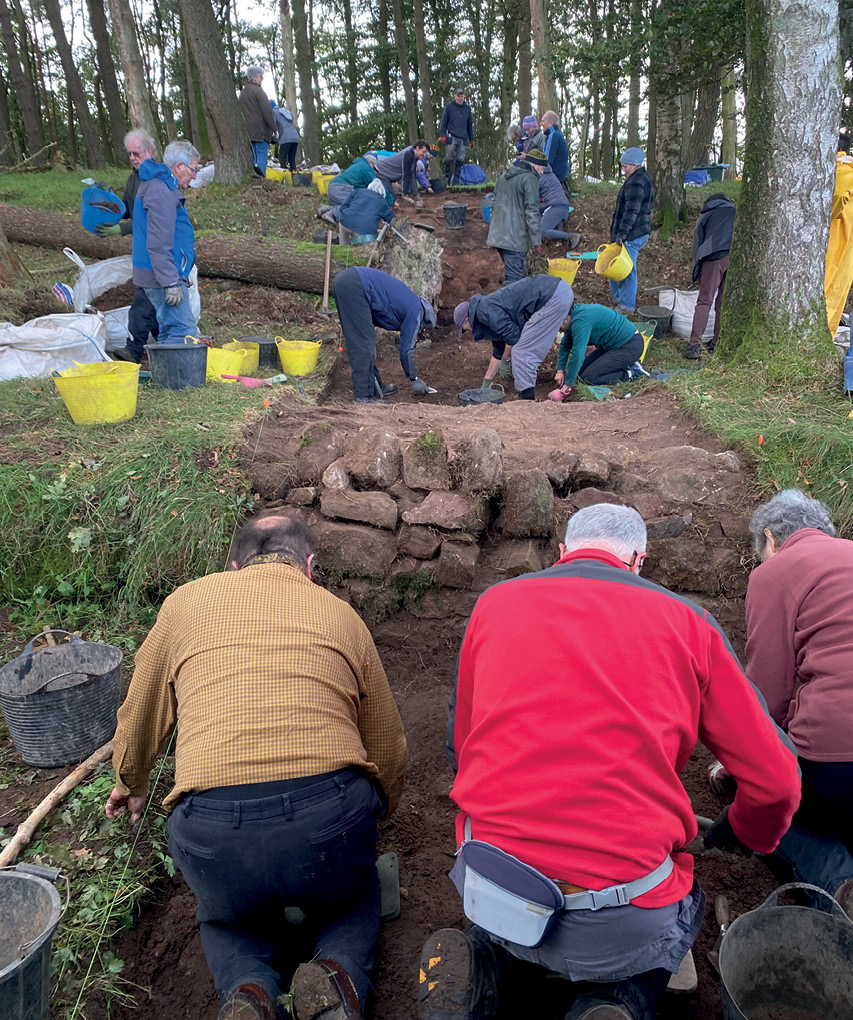
Returning to the unnamed site near Thetford where the Norfolk carnyx was found, the first clues came when when the PCA team (led by Project Manager Peter Crawley) uncovered what they recognised to be a hoard of prehistoric metalwork. The closely packed collection was carefully block-lifted with its surrounding soil so that it could be scanned and then painstakingly teased apart in controlled laboratory conditions, preserving as much information as possible about how each artefact related to each other, and the circumstances of their burial.
Mark Hinman, Chief Executive of PCA, said: ‘Before this dig began our Project Manager had “a feeling” that this site would be special. We are so impressed with the team responsible for this find. They discovered something completely unexpected, paused for breath, then followed best excavation practice to recover these rare and fragile objects. We would particularly like to thank our colleagues at Norfolk Museums Service and National Museums Scotland for their ongoing help and support in caring for this unprecedented find.’
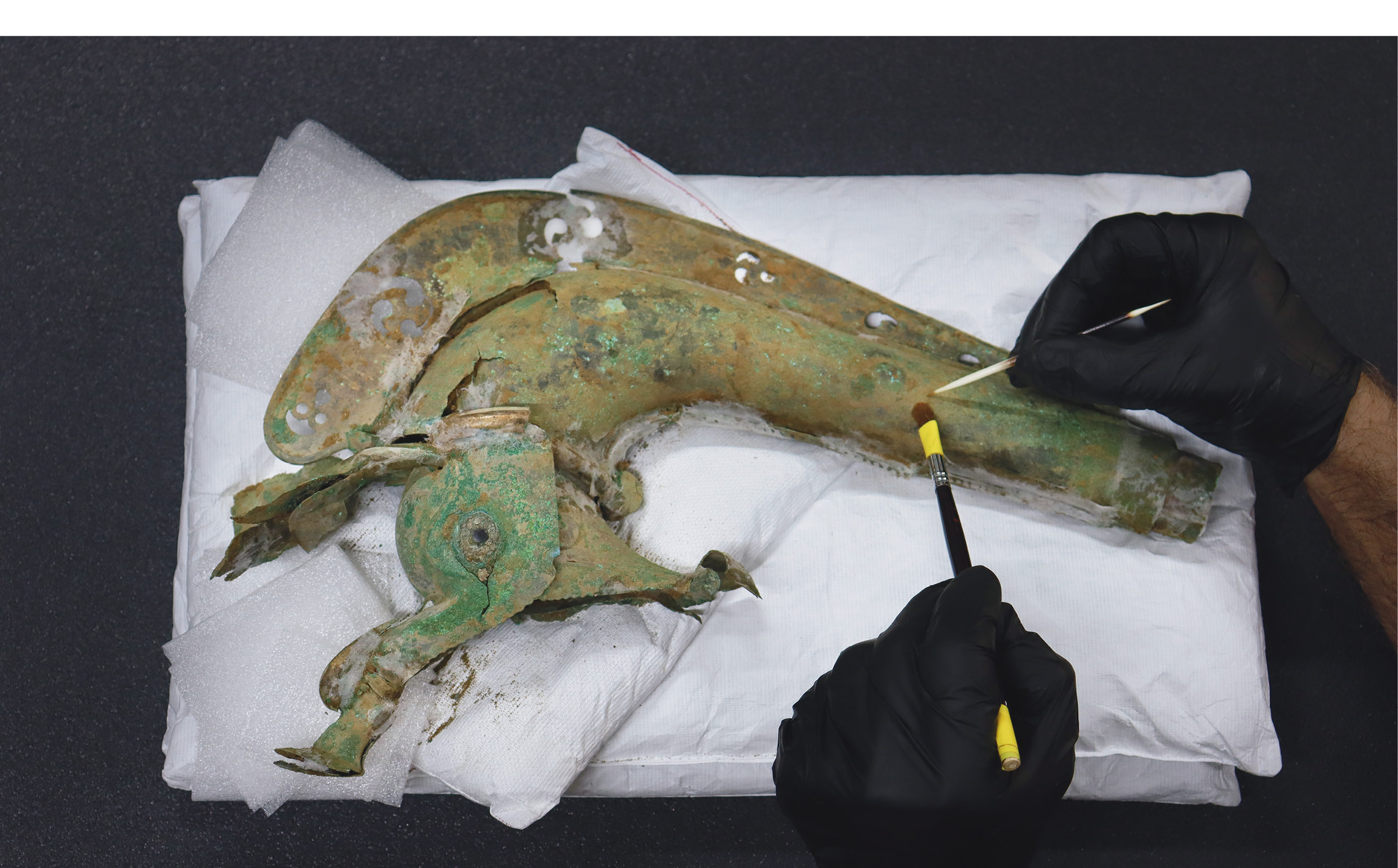
Initial X-rays revealed the dense composition of the hoard, and for a clearer view of its components it was sent to a local hospital out-of-hours to be CT scanned. The resulting images revealed its make-up in vivid detail, creating digital ‘slices’ through the soil block that showed the presence of a near-complete carnyx with its mouthpiece, pipe, and beast-like bell all intact, complete with a crest adorned with intricate openwork decoration. There were also a number of shield bosses, some of which had been arranged over the carnyx bell; part of a second carnyx; and an Iron Age object which was previously unknown in Britain, but which was familiar from examples excavated on the Continent: a boar standard that would have been carried as a military or ceremonial emblem. Its well-preserved face shows the attention to detail in its design, depicting the animal’s eyes, tusks, and a snout wrinkled in a snarl.

Dr Fraser Hunter, Iron Age and Roman curator at National Museums Scotland, and a leading authority on carnyces, said: ‘This extraordinary find will add enormously to our understanding of the Iron Age world. I’ve looked at carnyces from around Europe, and the full research and conservation of these incredibly fragile remains will reshape our view of sound and music in the Iron Age. The carnyces and the boar-headed standard are styles well known on the Continent and remind us that communities in Britain were well-connected to a wider European world at this time.’
The soil block was then carefully micro-excavated by expert conservators at Norfolk Museums Service. Preliminary examination suggests that the carnyx dates back c.2,000 years to a time when the area in which it was found formed part of the territory of the Iceni (an Iron Age people best-known for the uprising that their queen, Boudica, led c.AD 60/61) and when contact and conflict with the Roman world was changing their way of life forever.
Dr Tim Pestell, Senior Curator of Archaeology for Norfolk Museums Service, said: ‘This find is a powerful reminder of Norfolk’s Iron Age past which, through the story of Boudica and the Iceni people, retains its capacity to fascinate the British public. The Norfolk Carnyx Hoard will provide archaeologists with an unparalleled opportunity to investigate a number of rare objects and, ultimately, to tell the story of how these came to be buried in the county 2,000 years ago.’
The thin sheet metal of the carnyx and standard has become very fragile with the passing of centuries, and requires extensive stabilisation work prior to more detailed research. Historic England is now working with Pre-Construct Archaeology, Norfolk Museums Service, and National Museums Scotland to coordinate research on, and conservation of, the finds. In a joint statement, Claudia Kenyatta and Emma Squire, co-CEOs of Historic England, said: ‘This remarkable discovery is hugely significant for our understanding of ancient British culture. We’re pleased to be working with Pre-Construct Archaeology, Norfolk Museums Service, and National Museums Scotland to progress the research and conservation of these rare and fragile objects and to ensure their stability and protection for the future. We look forward to uncovering and sharing the story of the Norfolk community that owned and used these items.’
As the hoard comprises two or more base-metal prehistoric objects in a single find, it constitutes potential Treasure under the 1996 Treasure Act, and the local coroner will determine the objects’ legal status. We will bring you a fuller feature from PCA once the Treasure process has been completed.