
Subscribe now for full access and no adverts
Analysis of human remains from Winterborne Kingston in Dorset (see CA 281) has revealed evidence of female-centred societal structures in this area of Iron Age Britain, as well as genetic links to Continental Europe.
Matrilocality, a societal pattern whereby marriage sees the new couple moving to live close to the wife’s family, rather than that of the husband, is a somewhat rare occurrence in modern ethnographic databases. Recent excavated evidence from Winterborne Kingston has shed light on how these practices may have functioned in prehistory.
Late Iron Age human remains are relatively rare in Britain, perhaps owing to a predominance of cremation, excarnation, or wetland deposition in funerary rites of the period. This limits the data available to analyse genetic relationships between contemporary communities, and to speculate on how social groups were formed. Winterborne Kingston offers a rare opportunity to investigate this more closely – as a study published this year in Nature attests.
The Durotriges, who inhabited this area, are notable in their use of formal cemeteries featuring large numbers of flexed inhumations, several of which have been uncovered by Bournemouth University archaeologists. Samples taken from some of these skeletons have been compared to human remains from other sites spanning six millennia of European history, allowing geneticists from Trinity College Dublin and archaeologists and anthropologists from Bournemouth University to piece together clues about how the community that these individuals belonged to was structured.
The study, which focused on 57 ancient genomes from Winterborne Kingston, including from Durotrigian contexts, set out to analyse whole genomes, including the individuals’ mitochondrial haplotype variation – that is, a loop of DNA inherited by the child from their mother, therefore providing a marker for female-line ancestry. Analysis of the whole genome revealed that 34 individuals from Winterborne Kingston had at least one relative of the seventh degree or closer, indicating that the burial ground was centred around a large kin group.
Closer examination of their DNA also showed that 24 out of the 34 identified relatives belong to a rare mitochondrial lineage, which has not been previously observed in ancient sampling, and has a frequency of just 0.00003% in modern datasets. This lineage splits into four further sub-lineages that are unique to the Winterborne Kingston site, and the study estimates that at least 420 female births to lineage mothers would be needed to achieve this. This tells us that women were staying put through the generations, with the majority of individuals related through their mother’s line.
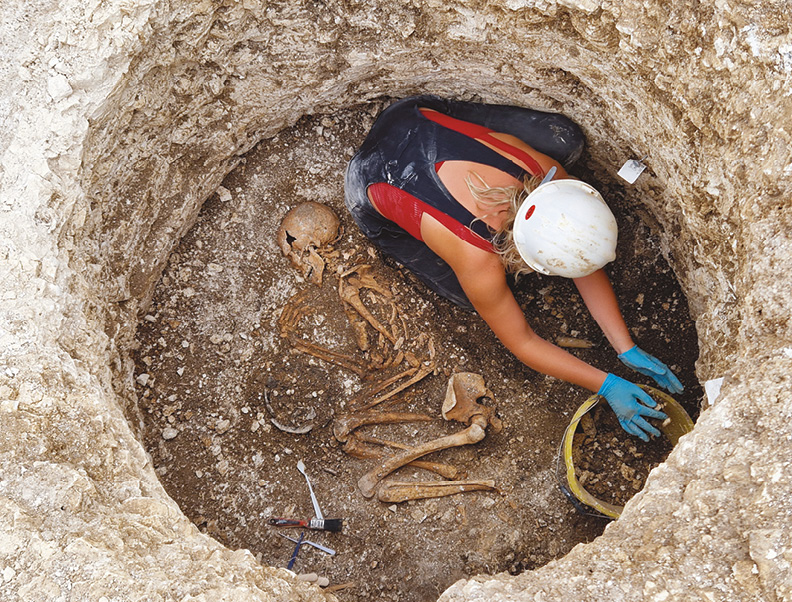
The researchers found, too, that Y-chromosome diversity, inherited by sons from their fathers, was relatively high within the dataset, indicating that the majority of male partners had come from elsewhere. When comparing this data to surveys of modern populations, as well as to models of potential ancient migration patterns, these findings correlate with typical matrilocal customs, pointing to a female-centred lineage within the Durotriges community. It also indicates that the society had an awareness of their own genealogies since, while marriages between distant branches of the same family may have been preferred, close inbreeding was avoided.
The artefacts placed with Durotrigian burials are revealing as well. Occurrences in the region of more elaborately furnished graves are generally those of women, suggesting that women had a relatively high status within the community, and contributing to images of a female-focused society. This way of living may not have been unique to Iron Age Dorset, however: data from genetic surveys across Britain have revealed similar patterns within other groups of this period, with sites in Somerset, Oxfordshire, Cornwall, and Yorkshire also displaying evidence of long-lived matrilocal communities, whose origins may lie in the Bronze Age. However, the majority of early Bronze Age sites studied in Britain and Germany appear to have practised patrilocality as the norm; it could be, then, that some of these societies later transitioned into matrilocal ones.
Another insight offered by the study was evidence of Continental European migration into southern England. The Iron Age genomes from southern coastal regions were found to show a greater degree of Continental ancestry, which indicates increased movement of people between southern Britain and the Continent during the later Iron Age.
Might the Durotriges’ matrilocal tendencies have been influenced by Continental traditions? Previous studies have proposed a similar societal structure for Celtic societies in mainland Europe. Other potential factors, though, include patterns of warfare; specifically, external warfare encourages male absence and increases female involvement in farm labour, and could therefore have emphasised female lineages. Archaeological and written evidence both indicate that societal violence was fairly common in Iron Age Britain, further implying that this is a plausible contributing factor.
To read the research in full, see http://www.nature.com/articles/s41586-024-08409-6 (free, open access).
Text: Rebecca Preedy