Subscribe now for full access and no adverts
Research recently published in the journal Britannia has proposed a way to estimate the possible population of Roman Silchester (Calleva Atrebatum), in Hampshire, suggesting that the town may have included many more residences than have yet been identified.
As a greenfield site, Silchester offers a rare opportunity to examine a Roman town that has not been disturbed by centuries of subsequent development, and decades of excavations (led by Mike Fulford and Amanda Clarke at the University of Reading; see CA 250, 300, 343, and 358) have shed vivid light on its layout and buildings.
One point that is still not fully understood, however, is the settlement’s population density. As the University of Reading excavations have demonstrated, many of the town’s buildings would have been made of wood, and would therefore not have been picked up by the extensive aerial and geophysical surveys that have been used to create the present ‘map’ of the site.
Now new research by Scott Ortman from the University of Colorado Boulder and John Hanson from the University of Oxford has put forward a possible solution. Using an estimate of five people per dwelling, they argue in a study recently published in Britannia (https:// doi.org/10.1017/S0068113X23000375) that the 186 properties identified on the current map of Roman Silchester suggests a population of just 930 people, or approximately 22 people per hectare. This would make it a very low-density centre, particularly compared to other Roman towns either in Britannia or elsewhere in the Empire, where estimates usually range between 100 and 500 people per hectare.
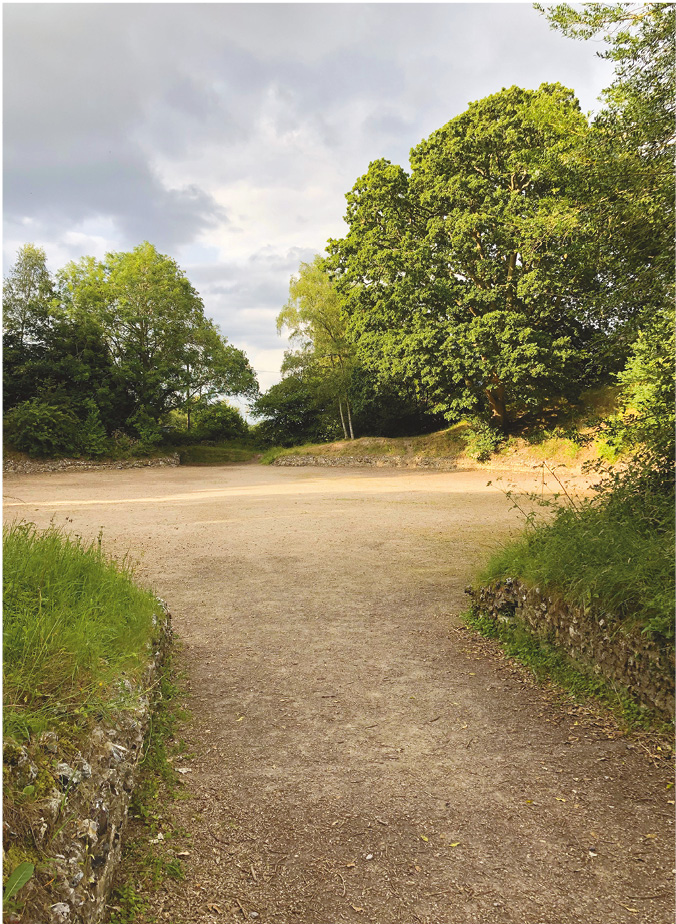
The apparent ‘empty’ space in the settlement grid could mean that Silchester was unique for some reason, perhaps acting as a focus for government and administration instead of habitation – something that might explain why it did not continue to be occupied after formal Roman administration of Britain ended. A more likely scenario, Ortman and Hanson argue, is that the current ‘gaps’ on the map would have been filled by timber buildings, which do not survive as well archaeologically as stone structures, and have therefore not been identified in past surveys.
To assess whether this might be the case, Ortman and Hanson developed a new population estimate for the Roman site, taking into account a multitude of factors, including: (1) the known inhabited area, (2) the area of the forum, (3) the area of the street network, (4) the seating capacity of the amphitheatre, and (5) the total width of the gates.
Combining these different data suggests that the total number of residences for Silchester was in fact around 1,115. This would mean that 83% of residences in the city have not been picked up by surveying, presumably as they were constructed from timber. This would not be unprecedented. At Neatham, a small Roman town near to Silchester, 92% of buildings were found to be made of wood.
If Ortman and Hanson’s estimate is correct, this would suggest that Silchester’s overall population was about 5,500 people (with a 95% confidence interval of a total between 4,500 and 6,900 people). This gives a population density of approximately 130 people per hectare – a figure more in keeping with other urban centres of the period.
These estimates, of course, do not take into account any fluctuations that may have occurred over time, and Ortman and Hanson acknowledge that the Silchester site is extremely complex. The next step in analysis, they suggest, would be to attempt a chronological assessment based on the palimpsest of structures that are present on the site.
Text: Kathryn Krakowka / Photo : John Hanson