Subscribe now for full access and no adverts
Excavations at Crowland, in Lincolnshire, have revealed new evidence of how this landscape was used over the millennia – from the Neolithic to the post-medieval period – and in particular how it continued to be seen as a sacred place throughout that time.
Today, Crowland – especially the site known as Anchor Church Field – is agricultural in nature, but in the past it would have been on a peninsula surrounded by wetlands. It is most famous as the site of St Guthlac’s Hermitage, to which he absconded after deciding to leave a more traditional monastic life. In the following centuries, documentary evidence suggests that the site continued to be the focus of religious activity surrounding the saint and his equally venerated sister Pega. Until recently, however, this landscape had not been explored in depth. English Heritage carried out a geophysical and aerial survey in 2002, while Archaeological Project Services undertook a programme of fieldwalking and a small evaluation excavation two years later; these found that structures remained, but no clear chronology was determined.

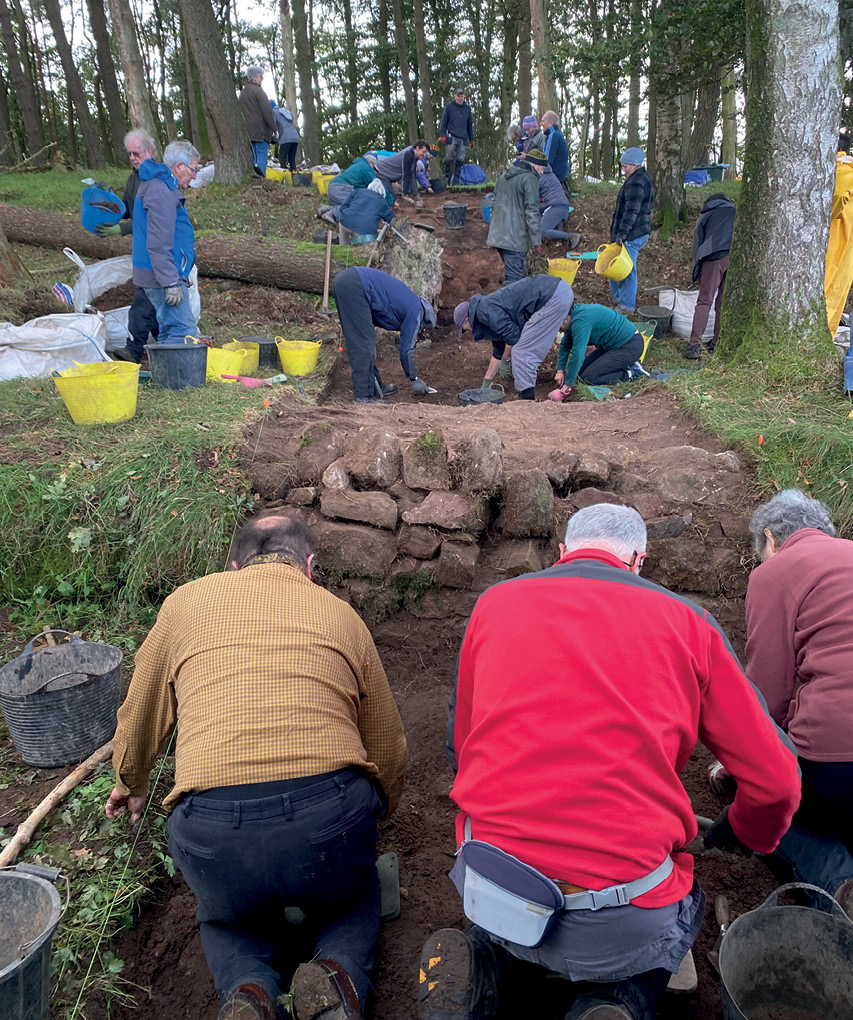
To rectify this, two seasons of excavation were carried out at Anchor Church Field between 2021 and 2022, led by Duncan Wright from the University of Newcastle and Hugh Willmott from the University of Sheffield. We reported on the initial findings in CA 388, and fuller results have now been published in the Journal of Field Archaeology (https://doi.org/10.1080/00934690.2024.2332853). While medieval activity on the site was indeed found, the team also revealed evidence of a more ancient landscape. In the first trench, they uncovered a large ditch and bank which, based on size and form, look to be the remains of a large henge monument. While there were no dateable features in the ditch itself, a post-hole cut into its upper layers contained waterlogged wood that yielded a middle Bronze Age result, c.1502-1323 BC. This suggests the henge was earlier in date, possibly late Neolithic or early Bronze Age. Henges are not common in this part of England, and those that are found are generally small. The probable size of this one would make it one of the largest yet to be identified in the Fens.
The monument, together with possible later features such as a middle Bronze Age timber circle and barrow cemetery, would have still been visible at the time of Guthlac’s occupation – could these very features have drawn early medieval activity to the site? While specific evidence for the presence of Guthlac could not be identified, finds – including a substantial quantity of Maxey Ware and glass fragments from high-status thin-walled drinking vessels – attest to activity between the 7th and 9th centuries AD. No structures from this period were found, but the presence of reworked Roman materials suggests that buildings may have been made from this debitage.
Further phases of activity, including later medieval structures that may have constituted a monastic hall and chapel (above), indicate the significance this site carried in collective memory over many centuries. Overall, this site is an illuminating example of how certain landscapes can continue to be viewed as significant, even if the reasoning behind that significance evolves over time.
Text: Kathryn Krakowka / Photo: University of Newcastle