Subscribe now for full access and no adverts
An anonymous shipwreck discovered off St Alban’s Head in Dorset more than 30 years ago has finally been identified by marine archaeologists from Bournemouth University.
Found in 1990 at a depth of c.27m, the 24m-long vessel was nicknamed the ‘Pin Wreck’ after the hundreds of metal bolts lying around its remains. The craft could not at that stage be linked to a specific ship, but it appeared to be of naval origin, as one of the other finds recovered by former Bournemouth University employee Nigel Bryant was a ceramic fragment, attached to a large pulley block, marked ‘Portsmouth Dockyard’.
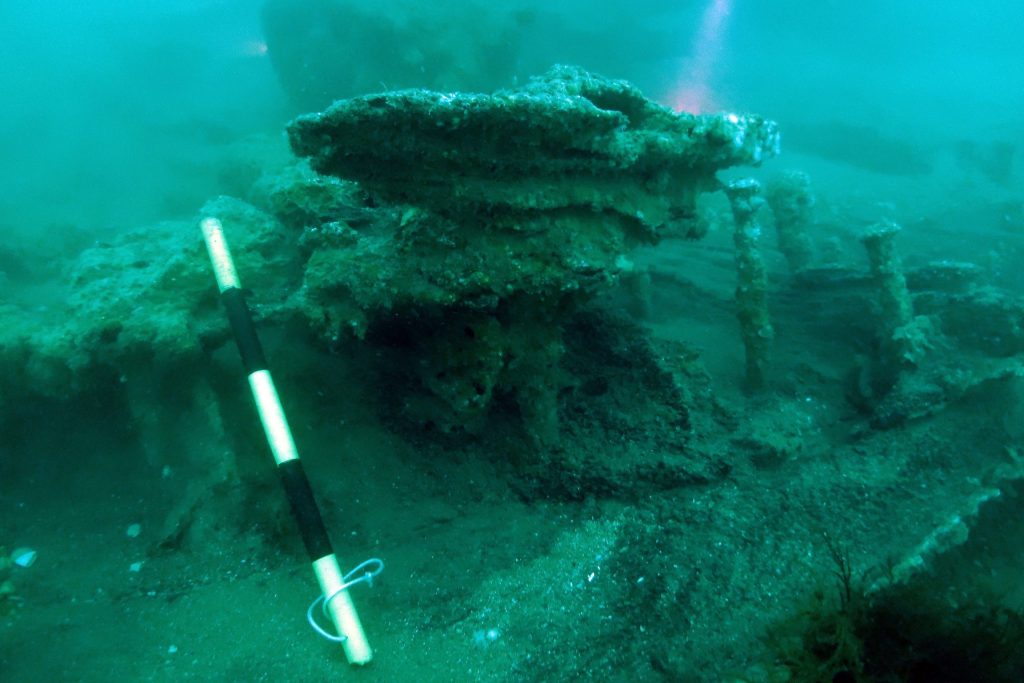
After reviewing Nigel’s finds, in 2019 Bournemouth University marine archaeologists returned to the wreck, establishing from its layout that it was probably a mooring lighter – a towed vessel containing machinery for moving heavy loads, laying moorings, and in salvage work. The Pin Wreck had a large steam engine-powered capstan, as well as admiralty mooring buoys, chains, and anchors, and the bow had an additional horn and roller systems, allowing heavy objects to be drawn up beneath it.
With the ship’s identity now narrowed down to a probably mid-19th-century naval mooring lighter, the team were able to explore known wrecks of this type. Back on dry land, research in the National Archives highlighted two possible matches: YC5 and YC8, identical mooring lighters once located at Portsmouth Dockyard. Another vital clue came in the form of the 11 September 1903 edition of the Shipping Gazette, which reported the sinking of a mooring lighter off St Alban’s Head during unfavourable conditions. Additional research confirmed that this was YC8, an 1866 mooring lighter that had been used in efforts to salvage HMS Eurydice – a training ship that capsized off the Isle of Wight during a heavy snowstorm in 1878, with the loss of all but two of the more than 300 people on board; its sinking is counted as one of Britain’s worst peacetime naval disasters.
Now that the wreck’s identity has been pinned down, hopes of protected status for the site are spurred. Dave Parham, Professor of Maritime Archaeology at Bournemouth University and leader of the research, highlighted the importance of the wreck as a rare example of its type. ‘There are no other examples that I am aware of that contain the machinery and working equipment,’ he explained. ‘The fact it appears to have been lost in service and was carrying substantial haulage equipment means it could offer valuable insight into the role these craft played in our maritime history.’
Text: Rebecca Preedy / Photo: Bournemouth University