Subscribe now for full access and no adverts
Excavations at Wrexham, in north-east Wales, have revealed further traces of a known Roman settlement and the unexpected remains of an early medieval longhouse.
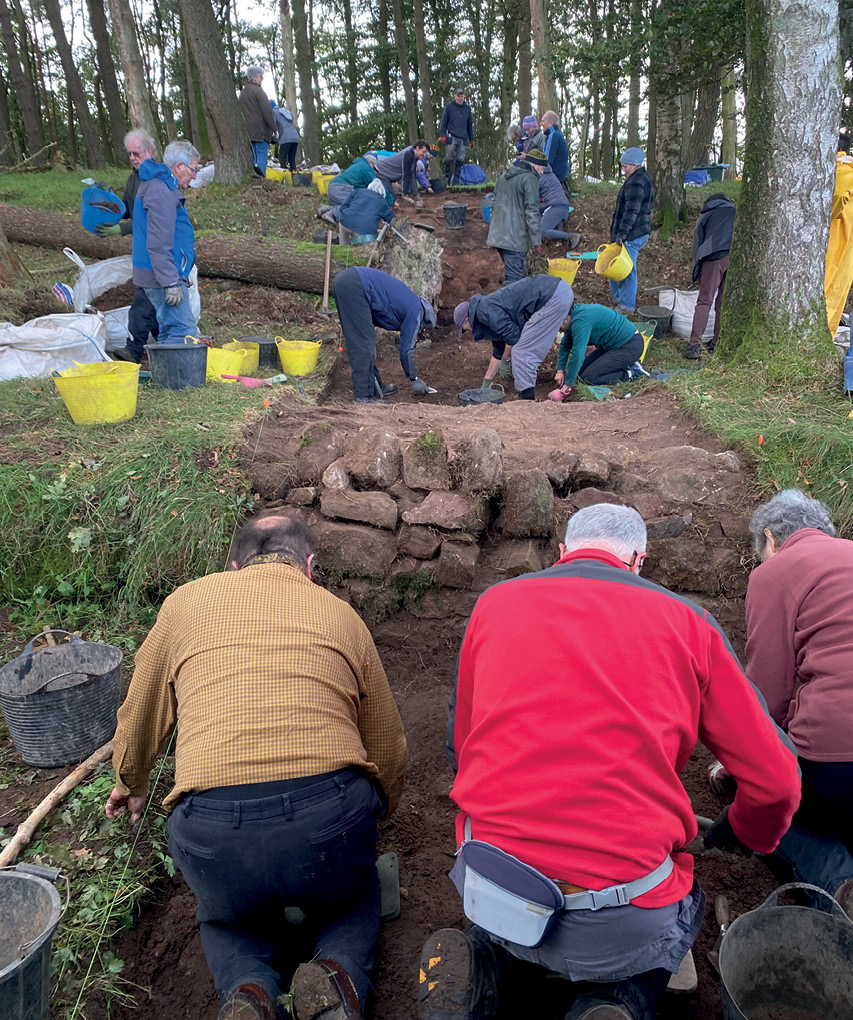
Geophysical surveys in 2023 and 2024 had mapped a settlement with a clear grid plan, as well as roads and rectangular structures outside the main occupation area, following the site’s discovery by Holt Local History Society; 2020 also saw the discovery of the region’s first Roman villa (see CA 371). Given the wealth of Roman remains, archaeologists from the University of Chester, in partnership with Heneb: the Trust for Welsh Archaeology and the Portable Antiquities Scheme, had high hopes that excavations this summer would prove illuminating. They were not disappointed.

This year, a trackway, further structures, and fragments of building materials were identified, adding to the team’s understanding of the settlement and probably representing an area of occupation spanning the 1st and 2nd centuries AD, and possibly continuing into the 3rd century. As the site lies close to the Holt Roman tile and pottery works (an extensive site comprising kilns and a workshop), it has been suggested that the Wrexham remains might represent the principal settlement associated with this complex. Evidence of this connection came in the form of pottery finds, which included large quantities of orange wares produced at the pottery works. Among these was a fragment of a Holt fabric tile preserving a partial stamp reading ‘LEG’. When complete, it would most likely have spelled ‘LEG XX VV’, indicating it had been made by the 20th Legion Valeria Victrix.
While the ceramic finds were not surprising for the team, an unexpected aspect of the 2024 excavation was the discovery of early medieval remains interpreted as a longhouse, which appeared to be using the trackways and boundaries of the Roman settlement to situate itself within the landscape. Longhouses of this period are extremely rare in north-east Wales, and it is currently unclear whether the long, narrow building – likely used as a communal living space – was part of a larger settlement. Dating samples are currently being processed, but are expected to line up with the peak of early medieval activity in the area, in the 8th to 9th centuries.
This summer’s excavations were part of a wider project by the University of Chester, aiming to understand more about Wrexham’s Roman past. ‘Over the last few years sig-nificant Roman sites have been found in Wrexham County, suggesting that this is an area that has been overlooked in terms of its significance during the Roman period,’ Chris Matthews, project archaeologist for Heneb, explained. It is hoped that further funding will allow excavation on this and other sites to continue next year.
Text: Rebecca Preedy / Photo: courtesy of Heneb