Subscribe now for full access and no adverts
Archaeological work on the site of a Victorian workhouse and hospital has revealed the remains of almost 4,500 individuals, offering a rare opportunity to study the lives and deaths of the institution’s residents.
Blackberry Hill Hospital was originally founded as Stapleton Prison, a camp housing thousands of mostly sailors captured during Britain’s wars with France, Spain, Holland, and America in the late 18th and early 19th centuries. The site was then appropriated as a hospital during an 1832 cholera outbreak. Within five years, it had been converted once more, this time into a workhouse, a role in which it continued throughout the Victorian period. From the early 20th century, it made a gradual transition back into a hospital, becoming part of the new NHS after the Second World War.
Excavations by Cotswold Archaeology (funded by, and undertaken on behalf of, the Vistry Group) have now uncovered thousands of burials associated with the site. The majority were found within defined burial grounds in a discrete part of the site, and are known to be those of the workhouse population, the cemetery for which was in operation from the 1830s to the 1890s.
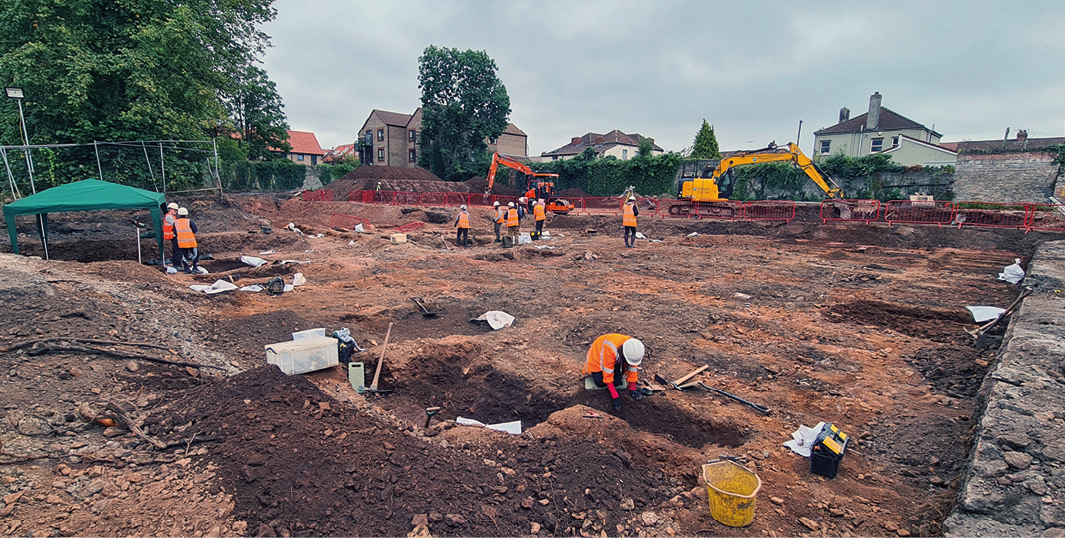
Among the finds, iron nails and coffin fittings were abundant, and some fully intact coffins were excavated too, preserved by waterlogging which, in some areas, also led to the survival of organic materials including fabric and leather from clothing and other personal items. ‘The clothing potentially includes workhouse uniforms. This material has enormous value in the rarity of its preservation, and in that it is from the poorest in Victorian society,’ said Andrew Pearson, Post-Excavation Manager for the site.
Some other burials may be those of the original prison population. They were found away from the workhouse cemetery, within areas that later became parts of the workhouse. Historical records mention the burial of prisoners of war within the prison grounds, and this is thought to be the most likely explanation for these remains.
A sample group of 502 individuals will be further analysed in order to establish, among other things, their geographical origins. While the 454 individuals taken from the workhouse cemetery are expected to have been born in Bristol and Gloucestershire, as historical records imply, the 48 from the site’s prison phase are likely to have come from further afield, and testing may therefore be able to associate them with specific conflicts.
The workhouse burial assemblage will make a significant contribution to the historical and archaeological records of Bristol and beyond. ‘Workhouse cemeteries have been archaeologically excavated in Britain before, but this work has been limited in extent. The Blackberry Hill Hospital cemetery therefore has very great potential to contribute to the national and regional data for this type of institution and the Georgian/Victorian poor/destitute population more generally,’ Andrew said.
All remains that have not been selected for further analysis have been reinterred, and a memorial service is planned on the reburial of the final individuals after post-excavation work has been completed.
Text: Rebecca Preedy / Photo: Cotswold Archaeology