Subscribe now for full access and no adverts
Silent guardians
The original mud-plaster sealings that secured the burial chambers of King Tutankhamun’s tomb have been placed on public display for the first time. The sealings are made of a Theban plaster material traditionally known as habiya – a mixture of calcite and clay combined with natural additives like sand, vegetal fibres, and gypsum – and bear official necropolis seals reflecting royal funerary rituals and administrative authority connected with the burial of the young pharaoh. They were broken by Howard Carter during his excavation of the tomb in 1922; he subsequently collected the fragments, but no record was made of their original positions. Since 2025, an Egyptian scientific conservation project led by Dr Abdel Ghaffar Wagdy has been working to document, conserve, and reconstruct these unique archaeological remains. Now a large, reassembled section of the sealings is on show at the Luxor Museum.

Before Hadrian’s Villa
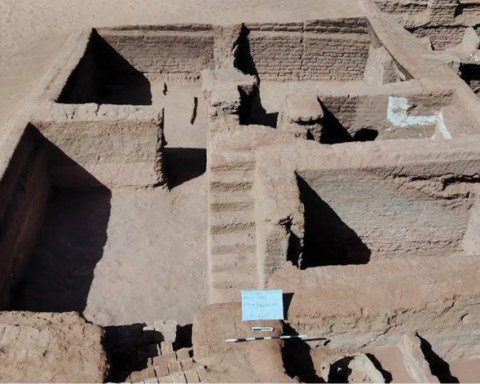
Excavations at the Villa Adriana, the lavish palace complex built by Emperor Hadrian at Tivoli in the 2nd century AD, have uncovered a hypogeum (underground chamber) that pre-dates the imperial residence. The subterranean space, which was discovered by archaeologists from the Universidad Pablo de Olavide in the palazzo of the Villa Adriana, is believed to have been used as a silo or storage area connected to a Republican villa that stood on the site before the construction of the palace complex. The hypogeum appears to have been abandoned during the Republican period and filled with construction debris and ceramic materials, including a collection of architectural terracotta pieces decorated with animal figures. The discovery represents the oldest documented architectural evidence found to date at this important site.
Preserving potatoes
Two rare c.500-year-old freeze-dried potatoes have been discovered at the Inca site of Tambo Viejo, in coastal southern Peru. Known as chuño, this staple food, which remains a popular way of preventing food waste today, was traditionally made at high altitudes in cold mountain regions through cycles of freezing in the frosty nights and thawing in the sun, before being trampled and dried, resulting in a product that could be stored for years. The two chuño at Tambo Viejo must, therefore, have been transported a considerable distance across the Inca empire from the freezing peaks of the Andes to the coastal Acarí Valley. They were found in a ceramic jar set into the floor, alongside a broken piece of pottery and a spindle whorl, which confirmed the probable 15th- or 16th-century date for the potatoes. Despite the importance of chuño in antiquity, very few survive in the archaeological record: the only comparable example was found over a century ago. Research on the new discovery has been published in the Journal of Field Archaeology (https://doi.org/10.1080/00934690.2026.2658319).
Text: Amy Brunskill