
Subscribe now for full access and no adverts
Exploring the archaeology of Sandwich Bay
The Nautical Archaeology Society has launched a new project: ‘Coastal Pasts – Connecting Community with Coastal Heritage at Sandwich Bay’. This initiative, largely funded by a recent National Lottery Heritage Fund grant, will create a self-sustaining community group in charge of protecting, investigating, recording, and promoting the unique coastal heritage of Sandwich Bay in Kent. Its archaeology – including 11 wooden wrecks – is significant and under threat from climate change and human activity. The group’s work will include regular low-tide walks, artefact identification sessions, training in conservation and photogrammetry, the excavation of a shipwreck, archival research to identify the wreck, and school activities. For more information about how to get involved, see http://www.nauticalarchaeologysociety.org/sandwich-flats-foreshore-fieldwork.
Calls for a centralised human remains database
A recent study led by researchers from the Universities of Reading and York investigated how human remains are stored and curated. They found that the present location of almost 25,700 examples excavated in the UK between 1869 and 2008 is unknown. At the same time, they suggest, much of the current work on human remains is focused on the same well-known collections, leading to biases in research and potential damage through overuse. The creation of one centralised database would mean that the locations of all skeletal collections are known and recorded, leading to better research outcomes and more ethical treatment of human remains. The study was recently published in Antiquity: https://doi.org/10.15184/aqy.2026.10328.
Sutton Hoo clue from Kent
An Anglo-Saxon die stamp, found by a metal-detectorist near Lynsted, Kent, hints that the Sutton Hoo helmet, and objects like it, could have been made in Britain.
Measuring 42.1mm by 32.8mm (1.7in by 1.3in) and dating to c.AD 550-650, the stamp is thought to have been used to make decorative metal foils for high-status military equipment. Analysis by Kent County Council and the British Museum shows that its imagery is strikingly similar to the running or dancing horned figures seen on the Sutton Hoo helmet. As the only confirmed example of its kind found in Britain, the stamp sheds new light on such helmets’ possible origins, as it was previously suggested that they could be Scandinavian imports (similar dies are known from Denmark and Sweden).
We will bring you a fuller description of the stamp, which was recently declared Treasure, in next month’s CA.
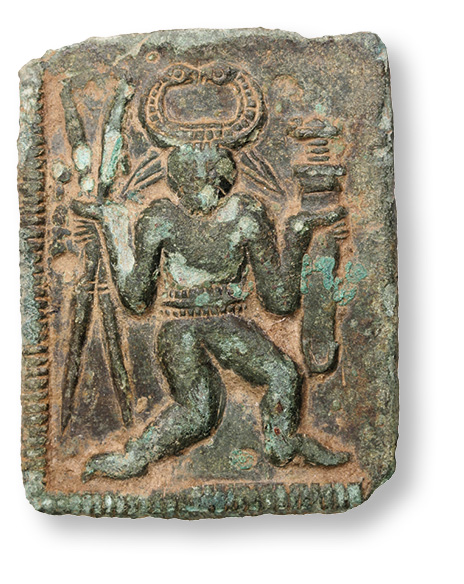
Text: Kathryn Krakowka / Photo: The Portable Antiquities Scheme