Subscribe now for full access and no adverts
In rural north Norfolk, where green farmland falls away towards the coast, imposing twin earthworks rise from the grass to form an impressive circuit of concentric Iron Age banks and ditches. Anywhere else in the country you might call this monumental enclosure a hillfort, though, in the famously flat landscape of East Anglia, Warham Camp lies at just 15m OD. All things being relative, however, the site – which is located near Wells-next-the-Sea, about 35 miles north-west of Norwich – does occupy a fittingly defensible vantage point, with sweeping views across its surroundings. It was built by the local Iceni people, centuries before the Roman occupation that would ultimately trigger the famous uprising led by their queen, Boudica, in AD 60/61, but a more precise chronology for the site has historically proven challenging to pin down.

Warham Camp is one of five, possibly six, Iron Age ‘forts’ known in Norfolk, and the best-preserved of the set, though its once circular footprint is now a horseshoe, having been truncated by 18th-century landscaping works that rerouted the River Stiffkey (pronounced ‘stookey’) in order to improve the view from nearby Warham Grove House. Today, the monument’s interior appears as a sea of empty grass, but over the course of the last 90 years archaeologists have been striving to shed light on how the site evolved and how it may have been used.
Previous investigations led by Harold St George Gray (in 1914) and Rainbird Clarke (in 1959) revealed that the fort’s surrounding banks had once been crowned by a tall timber palisade with a wooden platform to the rear. Both excavations produced pottery sherds attesting to Iron Age and Roman activity taking place within its bounds (further fragments have been recovered as stray finds in more recent years, after being brought to light not by archaeologists, but by resident populations of moles and rabbits); what those activities were, however, remained obscure.
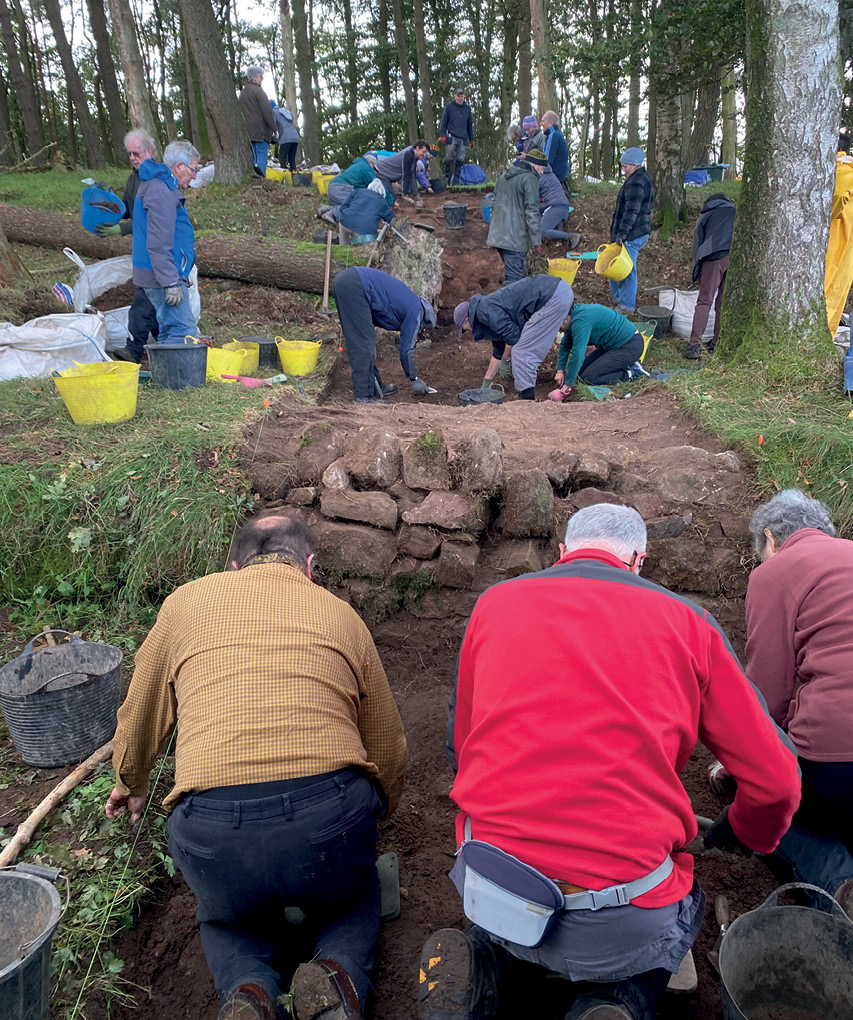
Now a team of archaeologists and local and international volunteers, led by Dr Andy Hutcheson of the University of East Anglia’s Sainsbury Institute for the Study of Japanese Arts and Culture, and Dr Matt Brudenell and Mark Knight of the Cambridge Archaeological Unit, have set out to learn more about the site’s character and possible purpose. Running through last July, their investigations form Phase 2 of the wider Later Prehistoric Norfolk Project, which is reinvestigating certain previously excavated sites in the county in order to place their stories in an international context. Japanese partners from a range of universities have taken part in this work, and the LPNP is part of an initiative to examine later prehistory in both places through a comparative framework.

Phase 1 took place at Arminghall Henge, a late Neolithic site that lies south-east of Warham, just the other side of Norwich, and which had also been originally investigated by Rainbird Clarke (albeit 20 years before Warham, and this time working with Grahame Clark). During the modern investigations, the LPNP team were able to establish a new chronology for the features, using scientific dating techniques that had not been available to their predecessors, and to tease out the story of a mighty timber monument that had later evolved into a henge, before apparently meeting a fiery fate during later prehistory. Working with a team of volunteers, made up of members of the Restoration Trust, locally interested people, and high-school and college students from the mid-Norfolk Synergy Multi-Academy Trust, the project is anchored in the community. The Archaeology 4 Wellbeing initiative seeks to involve people challenged by poor mental health in archaeological projects. The project is providing high school and college students with their first taste of archaeological research, too. Since the excavation at Warham, four of the college participants have applied to study archaeology at university.
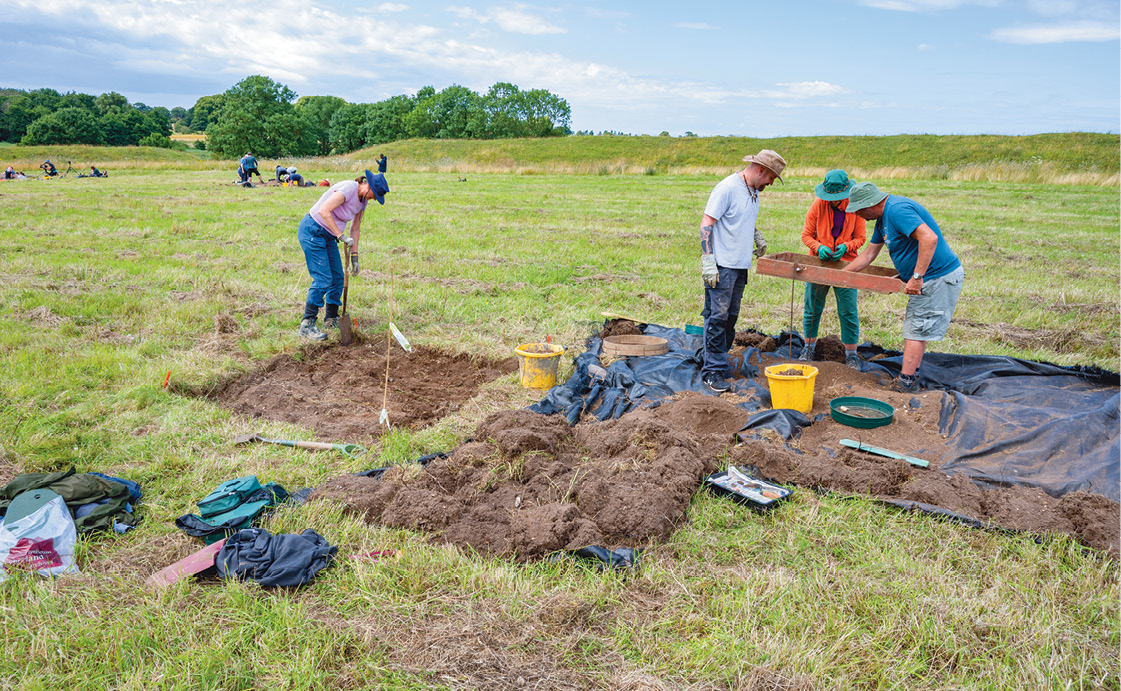
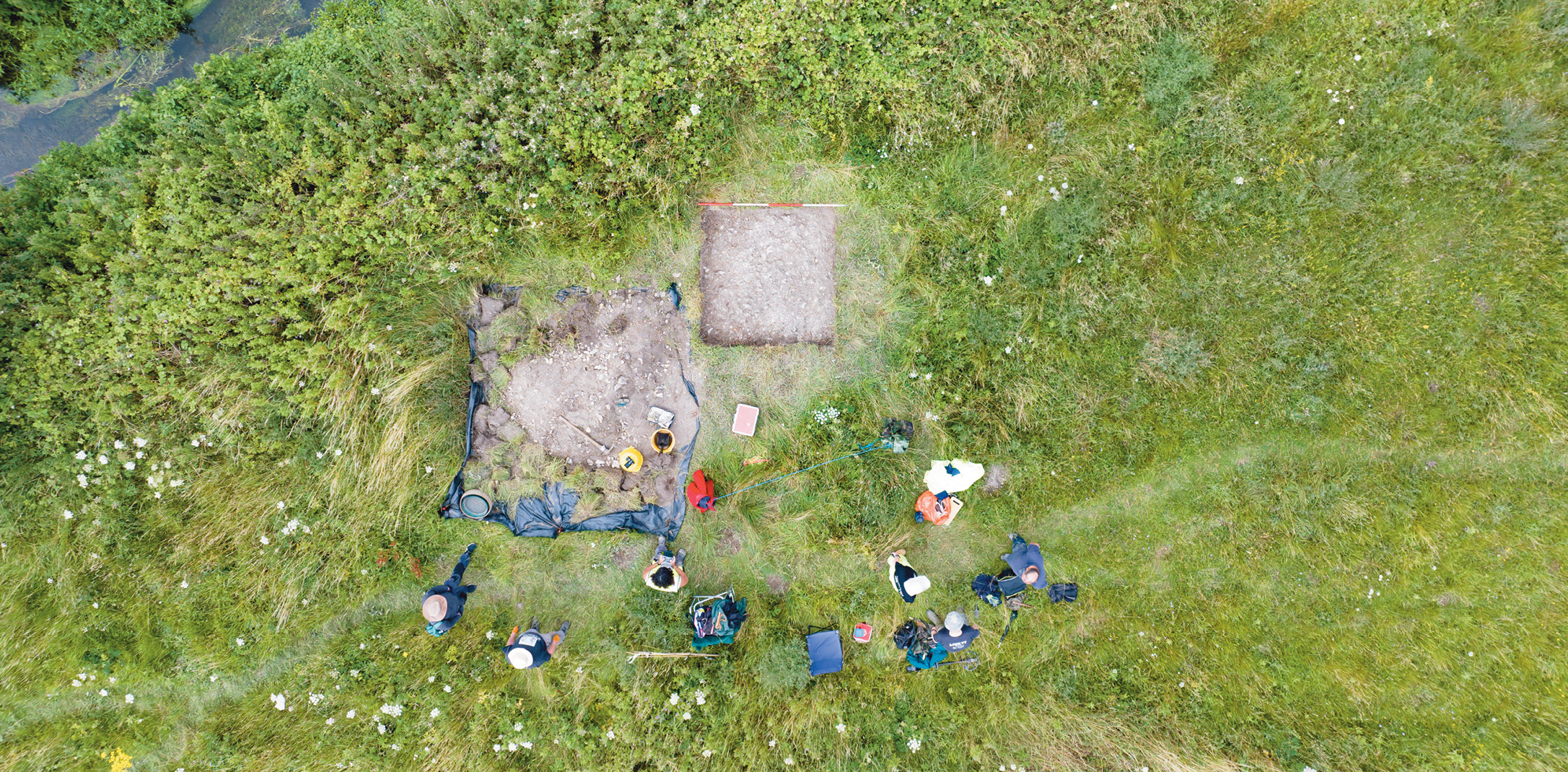
Devising Phase 2 required some careful planning, as Warham Camp is not only a Scheduled Ancient Monument but also a Site of Special Scientific Interest and an important breeding ground for the Chalkhill Blue butterfly. The team were, naturally, keen to minimise any lasting impact on the monument from their work; they had originally considered reopening one of Rainbird Clarke’s trenches across the ramparts to ‘check his working’, Andy said, but as the banks are still scarred from this exploration more than six decades later, they decided not to add to this damage. Instead, their investigation of Warham Camp’s ramparts mainly involved working in the ditches, with a particular focus on the area of earthworks that had been levelled in the 18th century. The project also saw 21 test-pits opened across the fort interior, hoping to gain a more representative snapshot of what was going on inside the monument than Harold St George Gray’s excavation, where long, thin trenches had mainly been concentrated in the very centre of the site. So, what did they find?
Down by the riverside
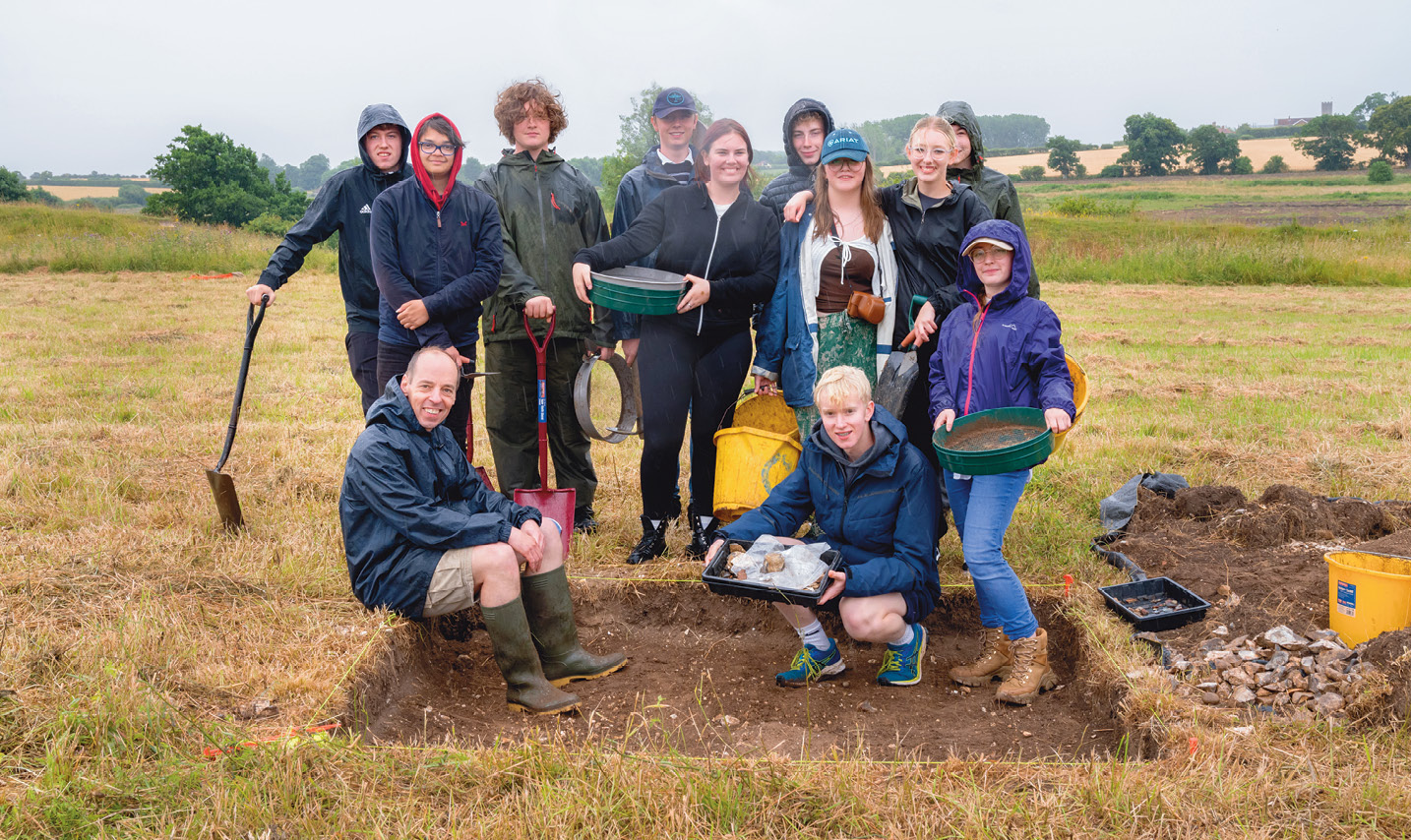
Although the excavation took place in the summer, it proved challengingly wet, both in terms of the weather (as the rain-spattered notes from my site-visit attest) and the proximity of the water table in the trenches that were opened closest to the river. Nevertheless, a host of illuminating clues emerged during the course of the investigations.
Trenches 23 and 24 were dug within the area of ramparts that had been demolished by Georgian landscapers and, while the team confirmed that these works had removed all trace of the bank (in places the modern excavators came straight down on to natural chalk), in Trench 23 they found an intriguing cobbled surface underlying the layer where the earthwork would have stood. It is not yet clear whether this represents a previously unknown early phase of the monument, or if it indicates that Warham Camp was built over an already significant site, but it raises thought-provoking questions about this area’s use before the earthworks were constructed.
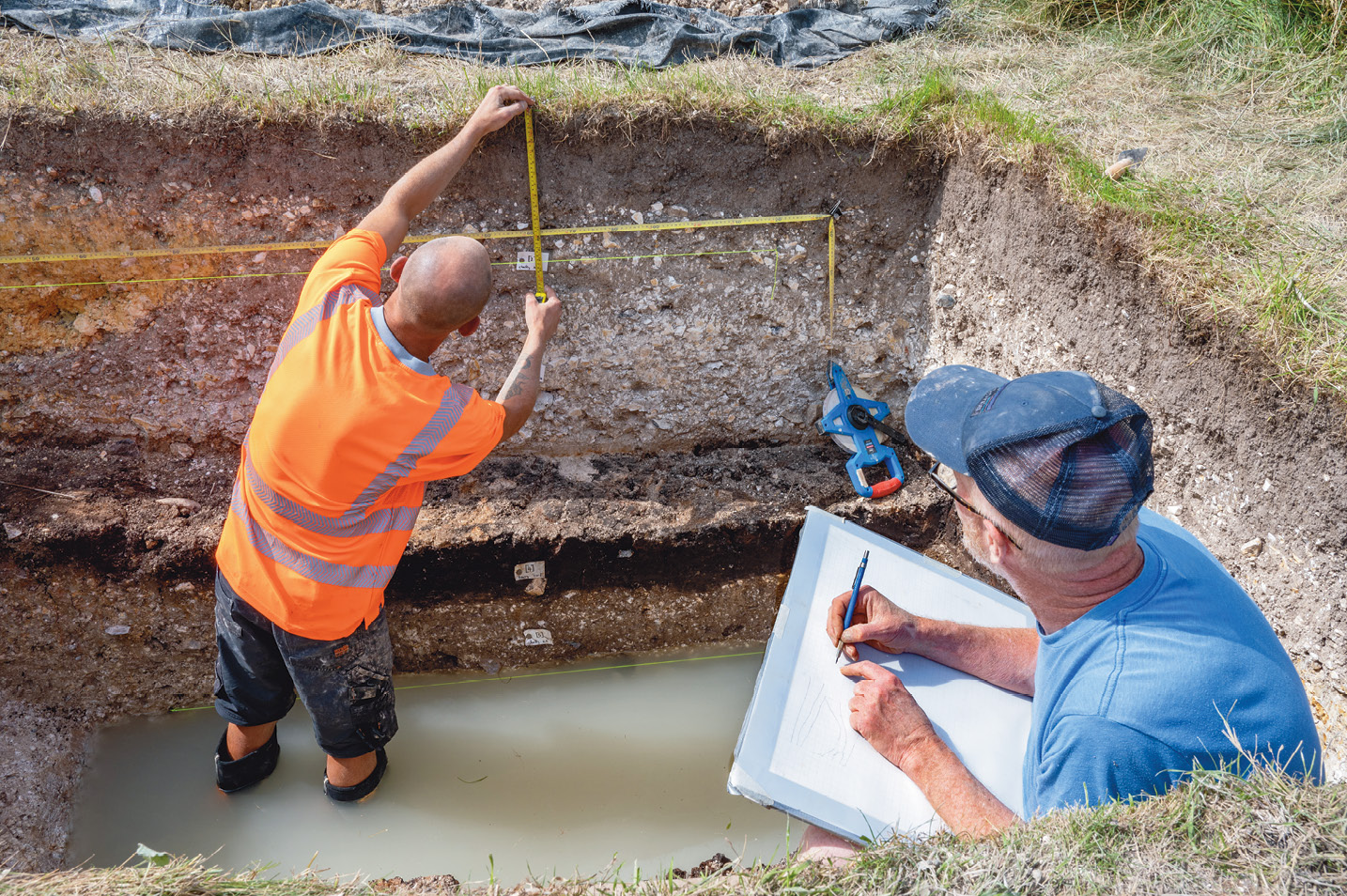
The ditch that had accompanied the bank, meanwhile, was much better preserved, and in Trench 24 the team succeeded in finding its base. Just above this were a couple of organic layers, from which samples were taken for radiocarbon dating. At the time of writing, analysis of these was ongoing, but they will provide invaluable information about the monument’s chronology.
These were not the only insights to come from the land beside the river. At the same time as the excavations were taking place, the Norfolk Rivers Trust were hard at work nearby, engaged in an initiative to restore the canalised waterway’s natural meander. While the new channel was being dug, they had exposed a chalk platform that aligns with a raised linear feature that can be seen running towards the fort in LiDAR. Possibly deliberately constructed above the natural peat of the river channel, it may have served as some kind of ford or causeway, Andy suggested – and while today its angle looks slightly odd and oblique to have been an approach to Warham Camp, our perceptions of its orientation might be skewed slightly by the monument’s truncation.

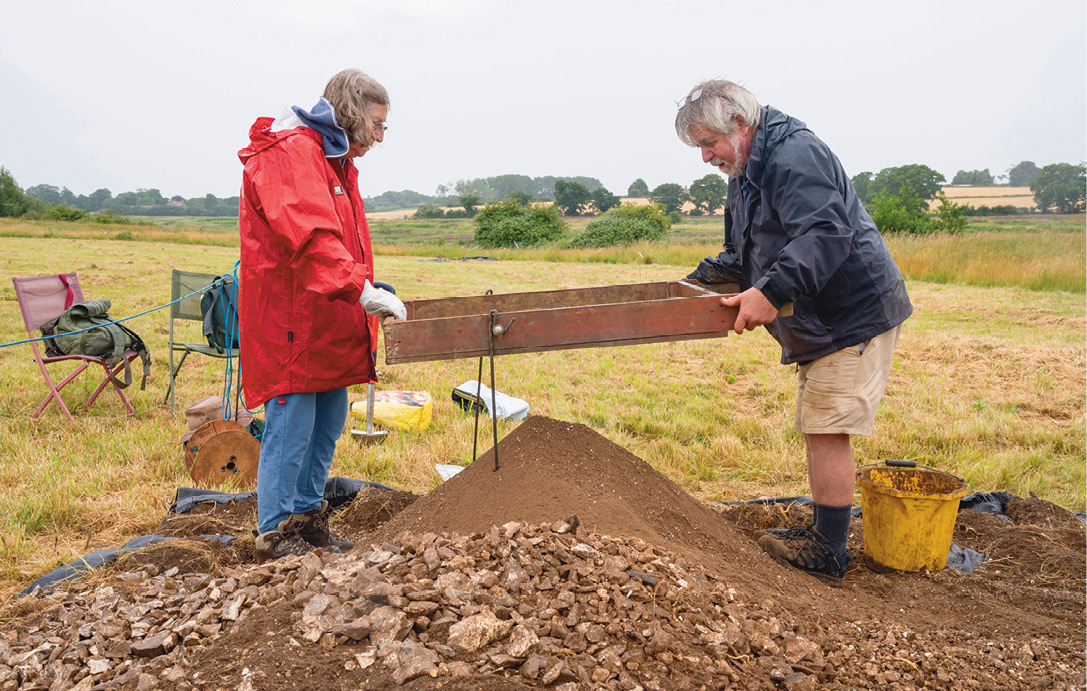
On the rather drier ground of the fort’s interior, contents of all the test-pits were carefully sieved and recorded. The bulk of finds recovered in this way were, surprisingly, dated not to the Iron Age but to the later Roman period, reflecting the 3rd and 4th centuries AD. These included hobnails from boots and 12 Roman coins, which could have been lost by casual or more purposeful visitors to the site; clearer evidence of longer-term activity, however, was present in the form of large quantities of hammerscale that effectively filled the soil within a concentrated area towards the edge of the interior. It appears that – centuries after the Iceni rebellion had been subdued, its people had adopted elements of the empire’s material culture, and towns like the regional capital of Venta Icenorum (c.30 miles south-east of Warham at modern Caistor St Edmund; see CA 406 and 270) had been established in the area – the Iron Age monument had taken on a new role as an out-of-town blacksmith set up their forge within its bounds.

No sign of a permanent structure associated with this work was identified, however – indeed, no trace of any building, pit, or other dug feature dating to the Roman period was excavated by the team at Warham Camp. Magnetometry survey of the fort’s interior also found no clear features, although it did show an enigmatic fan of striations (visible in aerial photos, too) which might represent traces of ridge-and-furrow farming or (more probably, as no other evidence of medieval activity has been observed) 19th-century ploughing.
Iron Age structures were conspicuous by their absence as well. While many other southern hillforts like Maiden Castle and Danebury are peppered with the remains of roundhouses and other features hinting at more established occupation, Warham Camp’s interior remains curiously sterile. Like the Roman finds, all of the Iron Age material recovered by the team has come from the topsoil rather than any features cut into the chalk, and these items are even fewer in number, comprising fragments of pottery and a decorative button-and-loop toggle. This latter find is potentially significant, however: it is adorned with coral in a way reminiscent of some of the grave goods from Wetwang’s middle Iron Age chariot burials. At this site (far to the north of Warham, in the East Riding of Yorkshire), domed studs, strips, and inlays of coral have been used to decorate horse fittings like terrets (rein rings), as well as a woman’s brooch.
Exploring interpretations
Given the huge effort that would have gone into constructing Warham Camp, the paucity of features in its interior is a perplexing puzzle. What was the monument used for? In its flat setting, Warham’s mighty ramparts would have been visible for miles around – particularly when they were freshly built and gleaming with white chalky soil – presenting an imposing and impressive sight. Hillforts (and their lower-lying equivalents) are traditionally interpreted as defensive strongholds, but while we have been following convention in referring to Warham Camp as a ‘fort’, its apparently empty interior might hint at an alternative role.
Perhaps, Andy suggests, it instead served as a seasonal meeting-place, hosting large gatherings of people who were either accommodated outside the monument’s banks during their stay, or who may have lived in tents or other temporary structures that have left no trace. The motivation behind such gatherings could have been local or regional assemblies, religious or ceremonial events, or marketplaces – perhaps the monument’s ambitious design was intended to reflect the site’s prestige, rather than to intimidate or repel would-be attackers.
As for why the site was ultimately abandoned, the jury is still out – though it does not necessarily have to have been due to Roman influence in the area. The presence of a second enclosure a short distance away at Warham Burrows might suggest a change of emphasis within the landscape that took place during the Iron Age. Warham Burrows was first identified in the 1950s after it was spotted in aerial photos, and it, too, was excavated by Rainbird Clarke. Its outline is very different from that of its neighbour, forming a 70m by 80m rectangle with entrances to the east and west. The relationship between the two sites remains difficult to define but, significantly, Clarke’s excavations reportedly recovered only Iron Age pottery from the lower fills of the enclosure bank at Warham Burrows, with Roman material only appearing in its middle fills.
The working hypothesis, therefore, is that Warham Camp is the earlier of the pair, with Warham Burrows being built some time later. It will be intriguing to see how this interpretation – and our understanding of Iron Age activity in the area – will evolve as post-excavation analyses of pottery (including, Andy hopes, material from Warham Burrows) and dating samples progress.
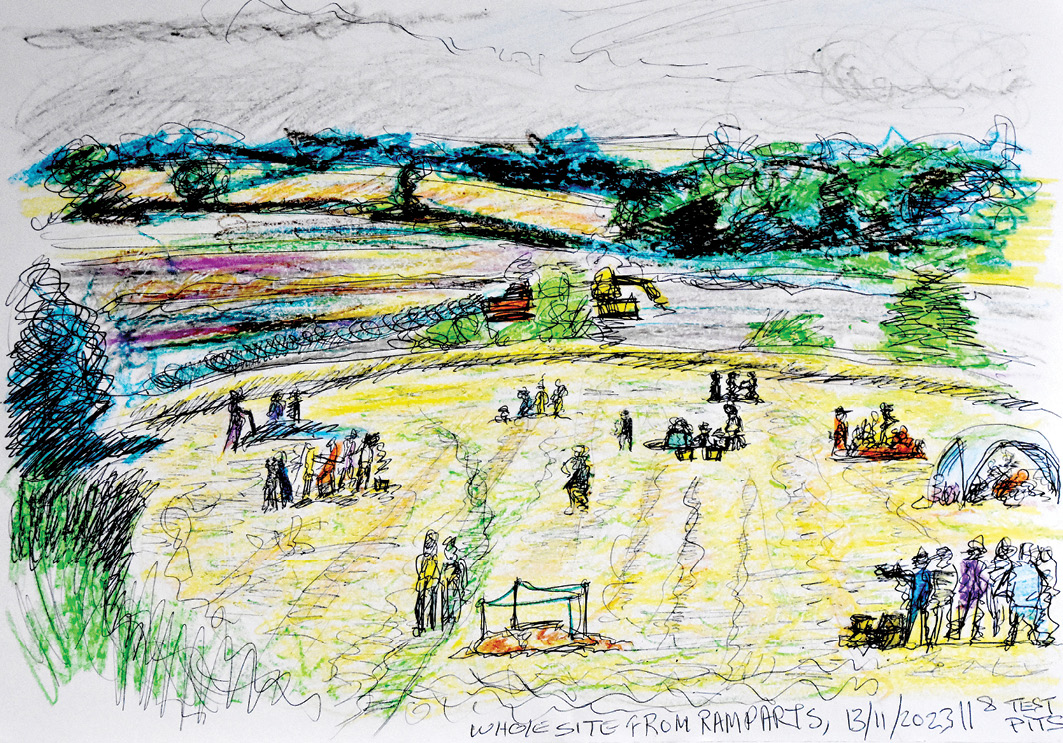
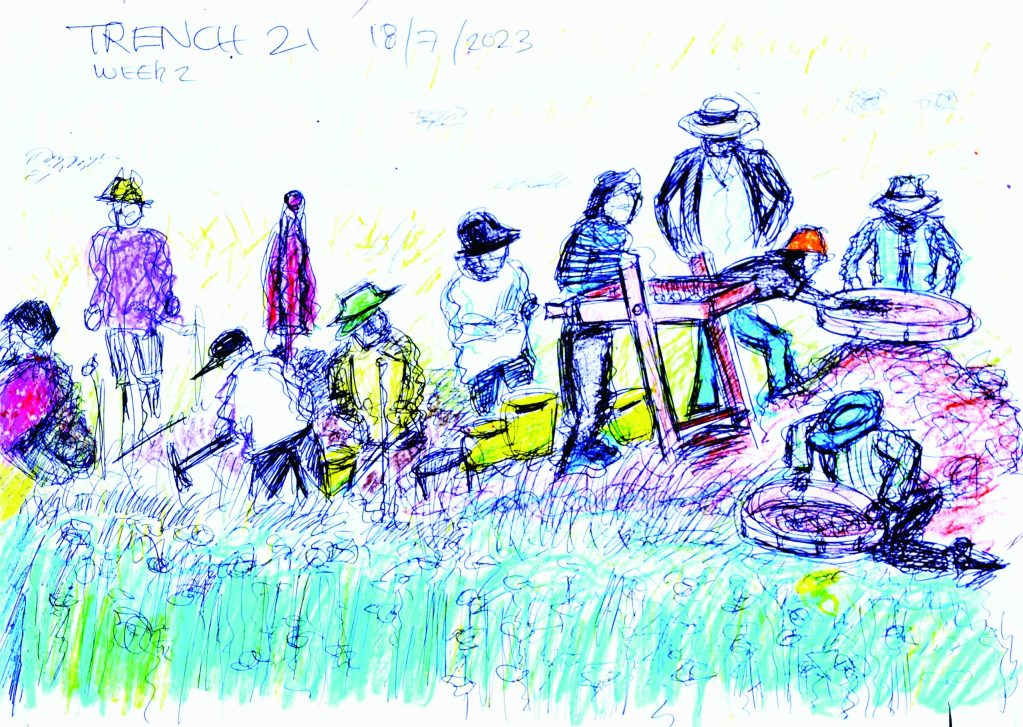
Above & below: Robert Fairclough’s sketches documenting the latest work at Warham Camp. Images: Robert Fairclough
Norfolk’s ‘hillforts’
‘Hillforts’ in East Anglia seem to have been a fairly localised tradition, with a number of examples recorded for Cambridgeshire but none in Suffolk. In Norfolk, we know of five (possibly six), mainly concentrated in the same area as Warham Camp, and while this latter site is one of the smallest in the set, enclosing c.1.5ha, none of the others are as well preserved.
Thetford was once home to an imposing Iron Age monument, thought its ramparts are today hard to discern as they were incorporated into a motte-and-bailey castle in the late 11th century. Meanwhile, Holkham’s roughly oval ‘fort’ (formed by a bank and ditch enclosing an area of c.2.5ha) has been largely swallowed by salt marsh. At Narborough, a single bank and ditch form a large oval measuring around 2ha, but its western portion was demolished in the 19th century and much of the remainder is obscured by trees.
Bloodgate Hill, at South Creake, is the largest of Norfolk’s Iron Age ‘forts’, enclosing an area of 3.5ha, although its upstanding earthworks have been completely flattened by ploughing and 19th-century agricultural activity. Its outline can still be seen, however – thanks in no small part to the initiative of the Norfolk Archaeological Trust, who purchased 7ha around the monument in 2003 and took the site out of cultivation.
The ‘possibly sixth’ site is found at Tasburgh, home to a roughly oval earthwork enclosure. Its remains are impressive in scale, with ramparts surviving in places to 3m in height, and with an area of 6.2ha it is a worthy challenger to Bloodgate Hill’s crown – but it is not officially classed as a hillfort as it is not certain whether the earthworks actually represent an Iron Age monument, or if they are the remains of an early medieval burh.
All Images: Cambridge Archaeological Unit, unless otherwise stated