Subscribe now for full access and no adverts
At the outbreak of the British Civil Wars – the intertwined series of conflicts also known as the Wars of the Three Kingdoms, and sometimes simply as the English Civil Wars – the antagonists attempted to seize existing stores of arms, munitions, and equipment. Parliament took the great arsenals of the Tower of London, Hull, and Dublin – but smaller magazines existed in towns throughout the country, and many aristocrats had personal arsenals, while even the merchant guilds had their own armouries. Armies had to be fed and armed, while equipment had to be maintained and transported, and everything had to be produced or procured.
By the mid-17th century, the major centres of English arms production centred on London and Kent, the West Midlands and the Severn Valley. In Scotland, production was based largely in the central belt, chiefly in Edinburgh, while Ireland was reliant on imported arms and munitions. So, for an effective war-effort, all sides needed first to establish the necessary machinery to resource, produce or otherwise acquire the necessary materials. And then they needed to be able to transport those materials from one place to another. As Cardinal Richelieu observed at the height of the Thirty Years War: ‘history knows many more armies ruined by want and disorder than by the efforts of their enemies, and I have witnessed how all the enterprises which were embarked on in my day were lacking for that reason alone.’
The price of war
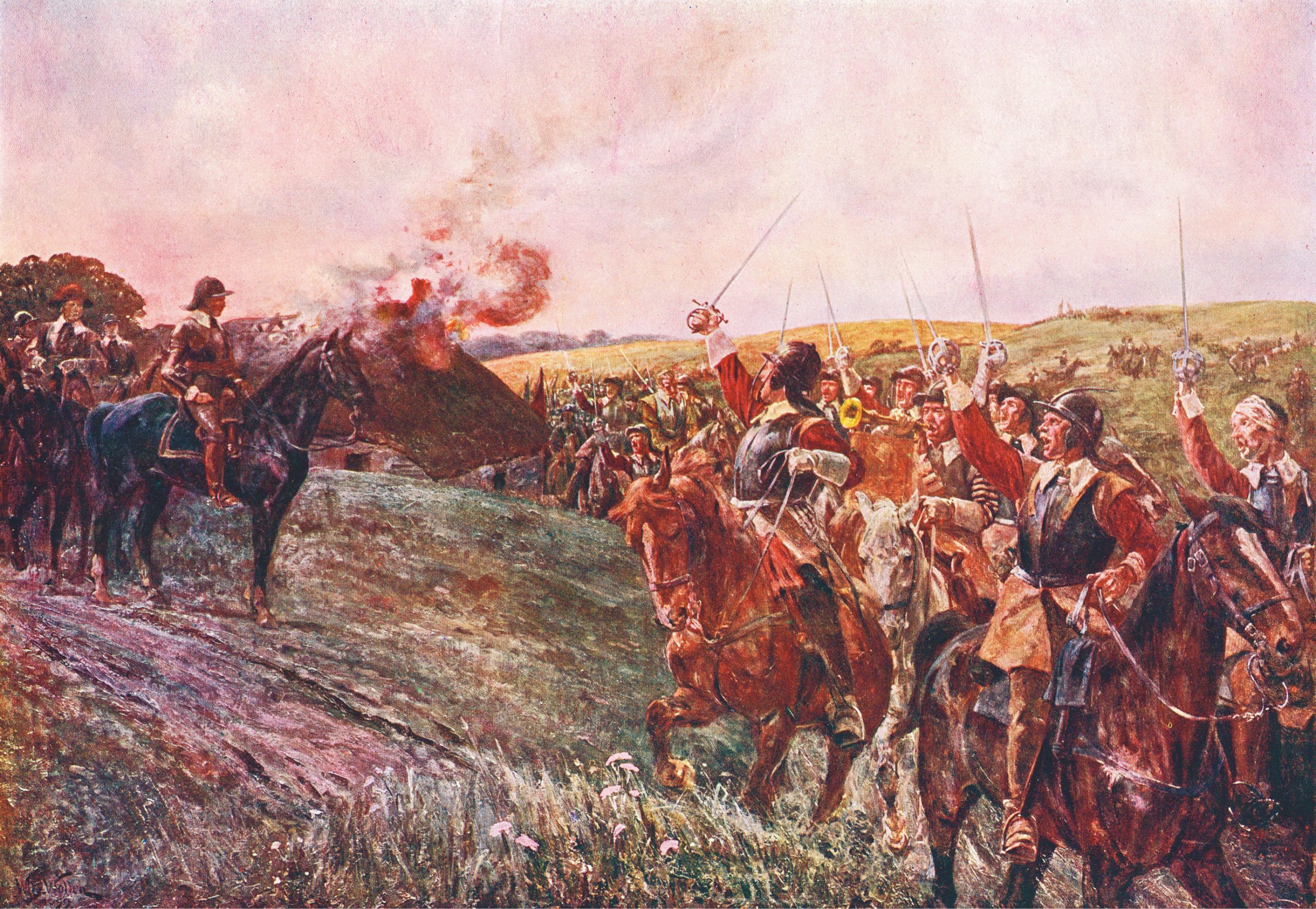
Parliament held most of the aces – yet, despite their resources, even the Parliamentarians struggled to finance their war-effort: between 1645 and 1649, Parliament’s annual military expenditure was £1.7 million, but its revenue was £1 million a year. While less ruthless, the Royalist financial administration was operating relatively efficiently by 1643, and was managing to keep pace with Parliament. But with the more limited resources at his disposal, the King was forced to compensate merchants who were paying suppliers from their own pockets through the creation and extension of monopolies.
Royalist efforts were weakened by the fact that more of the fighting took place in Royalist territories, preventing them from maintaining effective financial machinery. The resulting insecurity had an impact on the revenue that could be raised, and necessitated increasingly extreme measures: free quarter, special levies, requisitioning, and then ultimately the looting and robbing of their own shires, rendering the countryside incapable of paying the taxes on which the Royalist war-effort depended.
The need for armies to live off the lands through which they passed placed a considerable strain on local communities; goods and services (including accommodation) would have to be paid for, normally by a system of vouchers that could be redeemed for cash. Some did get their money (Parliament’s Eastern Association probably had the best record in this respect, as ‘householders seldom had to wait for more than a year for payment’, according to one account), but the Royalist record was poorer and got worse as their cause deteriorated, until ultimately their vouchers were worthless. In Ireland and Scotland, the need to live off the land was even more pronounced: the ‘scorched-earth’ tactics of the Scots in the face of the Cromwellian invasion in 1650, for instance, almost spelt disaster for the English army.
A capital asset
Parliament’s greatest asset was London, and its ability to manufacture and supply weapons, ammunition, uniforms, and military equipment made a fundamental contribution to the Parliamentarian war-effort.
Although gunpowder was originally produced in the Tower of London, by the middle of the 17th century this industry had moved eastwards to the River Lea – with the curate of Waltham Abbey, Dr Thomas Fuller, noting that ‘more is made by the mills of late erected on the River Lea, betwixt Waltham and London, than in all England besides’. The production of iron cannon was centred in the Kent and Sussex Weald, although the capital’s foundries tended to produce the more expensive brass ordnance. In what is now Vauxhall, a facility for the development and manufacture of light artillery was set up, and in 1631 was under the ownership of James Wemyss, who later supplied light cannon to Parliament.
Surviving contracts demonstrate the importance of London’s industries to Parliament’s military successes: during 1645-1646, the first year of existence for the New Model Army (Parliament’s hugely effective standing army, formed in February 1645 under the command of Sir Thomas Fairfax, with Oliver Cromwell appointed to command its cavalry a few weeks later), expenditure on equipment was £117,000 – the vast majority of this on contracts awarded to around 200 London suppliers (some of whom worked for the Ordnance Office, too).

These orders included gunpowder, musket- and cannon-shot, granadoes (mortar bombs) and match, as well as firearms, pikes, and swords. There were shoes and every item of uniform clothing (of a ‘red colour’), coming from Suffolk, Coventry, and Gloucestershire. Drums, ensigns, and polearms were also ordered, as was hardware of every kind, including tools, wagon spares, horseshoes, and nails. Most of this equipment was delivered directly to the Tower of London for onward supply to the armies. Requirements went beyond clothing, footwear, arms, ammunition, and saddlery, however, with food, drink, and a range of other goods and services also procured from rope-makers, coopers, vintners, apothecaries, surgeons, and carters. The purchase of horses was less centralised, and while some were bought from Smithfield dealers, they were normally obtained locally, while on campaign.
Despite its advantages, Parliament struggled at times. When the New Model Army was sent to besiege the Royalist stronghold of Oxford in May 1645, there were delays in ordering munitions, and the ordnance had to be sourced from a number of locations: Northampton, Windsor, Cambridge, and King’s Lynn. The order came to 1,500 spades and shovels, 500 pick- axes, 200 scaling ladders, 500 barrels of powder, 40 tons of match, 30 tons of bullets, 600 granado bombs, 1,000 hand grenades, and 50 tons of round shot, together with 20 carriages of provisions. As it transpired, the siege was raised before the supplies were ready. Regardless of these occasional difficulties, London was at the heart of supply to Parliament’s armies, as producer, importer, and distributor.

Royalist Oxford
Several Royalists left the Ordnance Office in London and joined the King in Oxford as soon as it became his capital in November 1642. They formed the nucleus of the Royalist Ordnance Office, which requisitioned a number of university buildings to accommodate its various functions: the main armoury was established in New College, while a magazine was set up in the Schools Tower (now part of the Bodleian Library). The artillery park was located in Magdalen College Grove, which also housed the Royalists’ pool of wagons and carts, and associated workshops and forges. Oxford’s Music School and adjoining Astronomy School housed the stores of soldiers’ ‘apparrell and coates’.
In response to the Royalists’ acute shortage of ordnance, iron and brass were donated or requisitioned, melted down, and then recast at the new foundry that was established at Christ Church (a city watermill was then used to bore the new cannon). Cannon were cast elsewhere, too, although arguably the Royalists’ best guns were those captured from the Parliamentarians. Oxford’s own gunsmiths seemed to have concentrated more on repairs than the manufacture of new firearms (for instance, between 12 January and 23 October 1643, William Standinought, an Oxford smith, repaired 505 muskets but only definitely manufactured four). In the villages surrounding Oxford, local blacksmiths manufactured pike heads.
From an ordnance perspective, the most important function of Oxford’s watermills was in the production of gunpowder. The city’s location, with rivers on three sides, meant that a number of mills were utilised to grind gunpowder by the Ordnance Office. Even with the construction of new mills, however, production couldn’t keep pace with demand: while the production target was 50 hundredweight of powder per week, between April and July 1644 the New College armoury only received a total of 242 hundredweight. The manufacture of match cord for both match-lock muskets and artillery linstocks (a type of staff used in firing cannon) got under way early in 1643, although a shortage of local supplies meant that hemp or flax was brought in from Shrewsbury (match cord was being produced at Abingdon and Bristol as well).
The Royalists’ main centres of production of cannonballs were Gloucestershire’s Forest of Dean and the West Midlands. In late April 1643, for instance, Oxford received nearly 5,400 rounds from Worcester, followed on 20 June 1643 by 765 roundshot and eight (unspecified) pieces of iron ordnance. Although some iron cannonballs were produced in Oxford itself, lead shot and bullets proved easier to manufacture. While musket bores could be standardised, the fact that cavalry troopers would often supply their own firearms lead to a greater variety in bore and ball sizes, and thus further complicated manufacture. Lead was another raw material to be sourced, and while early on in the war the Royalists obtained a limited supply by stripping roofs, after the fall of Bristol (to a Royalist army under Prince Rupert in July 1643) lead mined in the Mendip Hills of Somerset was conveyed to Oxford via Bristol.

‘Money, arms, and ammunition’
The shortage of supplies resulting from the lack of preparedness on the part of all the protagonists was initially offset by supplies from abroad. But even as domestic production got under way, imports were still vital, especially in Scotland and Ireland. ‘Our wants are money, arms, and ammunition,’ admitted the Irish Confederacy. ‘These we have no way to provide for, the country being exceedingly exhausted, unless we may be assisted by those who wish well unto our cause beyond the seas.’ Parliament’s control of the navy enabled it to blockade Royalist and Irish ports, although ships carrying arms and munitions regularly got through.
The Royalists obtained cannon from France and the Netherlands, while ordnance was shipped to the Irish Confederates from the Spanish Netherlands and from Spain. In 1640, the Scots Covenanters imported 12 brass cannon of a mixture of calibres from the Netherlands. Sweden was another source of ordnance, particularly for the Scots. Despite the existence of merchants operating out of home ports, the majority were foreign merchants, and the profits tempted many to involve themselves in the risky business of gunrunning: it was said that it was as profitable travelling to Ireland as it was to the East or West Indies. Not only were the Royalists and Irish Confederates more dependent on imports, they were also less confident in their delivery – added to which, the ports they held were further away from the sources of supply.
Paying for the imports was yet another issue. While there were partisans among the merchants, for most it was business, and profits had to be made. Imports from abroad would require a return cargo, and thus the Scottish Covenanters traded coal for arms with the Dutch, while on the other side Royalists traded Cornish tin with France.

Transport issues
Given the state of 17th-century roads, it is no surprise that movement by water was the most efficient way to transport anything – and here Parliament’s command of the sea gave them a distinct advantage. For instance, the North Sea port of King’s Lynn, with its connection to a network of inland waterways, was the supply depot of Parliament’s Eastern Association, even supplying the allied armies besieging York in 1644 (this included the Scottish army, whose supply lines were significantly longer than those of their Parliamentarian allies). The Royalists’ most important artery was the Severn, Great Britain’s longest river – although their failure to capture Gloucester, which lies on its banks, had a significant impact on this. The Cromwellian conquests of both Ireland and Scotland were also made possible by water-borne communications (a fleet of at least 20 ships crossing back and forth kept the army supplied during the Irish campaign of 1649-1653, while 140 or more were used in Scotland).
Sooner or later, however, there would be no alternative but to move supplies by land – commonly by four-wheeled wagon, two-wheeled cart, or packhorse. Wagons were the most efficient way of moving supplies, but the packhorse was more flexible. For the Royalists at Oxford, carts were under the overall command of the Wagon Master General, whose establishment included horses and oxen. Their numbers could be expanded as required through hirings and requisitions from the surrounding countryside.
All armies were heavily reliant on horses, and not just as mounts for cavalry, dragoons, and officers. Despite the impact of the fighting and the strain placed on resources, as the historian Peter Edwards concludes, ‘given the scale of demand, the horse trade is one of the success stories of the Civil Wars’. In April 1644, the Parliamentarian Committee of Both Kingdoms (created to manage the war-effort of the Anglo-Scottish allies) averaged a price of £7 per horse for the 800 ‘horses and mares’ required for ‘the train of artillery and carriage of victuals’. A year later, the loss of heavy draught animals following Cromwell’s campaign around Oxford was a blow to the Royalists, resulting in a drastic reduction in the size of the train that left Oxford, and which ultimately met disaster at Naseby, the battle on 14 June 1645 which ended any real hope of Royalist victory.
Keeping horses adequately fed was another challenge. It was not just a matter of putting warhorses out to graze, however: it has been calculated that a serviceable horse would require a daily ration of 6.4kg of hay, 3.2kg of straw, 9l of oats, and 4.5l of peas. So even if an army was able to pay for its fodder, its descent on an area would create problems – with its members at best eating up all the available fodder required by the inhabitants’ own animals, or at worst laying waste to the countryside they passed through.
The typical diet for an infantryman was bread (or biscuit), cheese and beer, occasionally augmented by meat bought (or looted) from the local populace. The daily ration for Cromwell’s infantrymen in Scotland in 1650-1651 was between 454g and 680g of bread, and between 227g and 340g of cheese, with each man carrying about a week’s supply in his knapsack. As one contemporary commented: ‘Nothing is more certain than this: that in the late wars, both Scotland and Ireland were conquered by the timely provisions of Cheshire cheese and biscuit.’ Provisioning, therefore, was another significant undertaking. It would take approximately 283g of flour to make a 454g (1lb) loaf, and, according to one contemporary calculation, a single wagon could carry 340kg of bread flour – enough to make several hundred loaves.
An army might move around 12 miles a day. The Parliamentarian force that Robert Devereux, Earl of Essex, assembled near Bicester on 1 September 1643 to march to the relief of Gloucester numbered 15,000 troops and included an artillery train of 48 guns. Slowed down by the guns, the column extended an estimated five miles, and therefore the myth about a column where its head makes camp before the tail had left the previous night’s camp isn’t so much of an exaggeration. Perhaps the most famous munitions convoy of the entire war was that led by Henrietta Maria, the French wife of King Charles I, who arrived at Bridlington with a convoy of supplies from the Netherlands on 22 February 1643. Two weeks later, the arms and munitions (including 30 brass and iron cannon, and enough weapons to equip an army of 10,000 men) were transported in some 500 carts to York, where they were to remain until July, when most went to Oxford.
If the condition of 17th-century roads slowed the progress of an army, then a river could halt it altogether – and for this reason ‘boats to make a bridge’ were a necessary component of the artillery train (for example, 12 large leather boats from Shrewsbury were part of the original composition for the Oxford Army’s train in the spring of 1645). Not only was the movement of equipment and munitions by land slow, but it was also hazardous, with the result that convoys had to be escorted by large bodies of soldiers, thus reducing the number of soldiers available for active duty. In March 1644, for instance, a Parliamentary convoy travelling between London and Gloucester left Warwick protected by 3,150 horse and 3,500 foot, a force far larger than the Parliamentarian Sir William Waller had under him at the battles of either Lansdown Hill or Roundway Down the previous year.

Conclusion
London was the key to Parliament’s victory: not only was it the economic, political, and manufacturing powerhouse behind the Parliamentarian war-effort, it was also the single most important arms and munitions supplier in the country. Within its boundaries were the Armoury, the Honourable Artillery Company, and the Ordnance Office. Therefore, it was with some justification that the poet John Milton described the capital as ‘the shop of war’. But the Scots and the Irish, as well as the Royalists, all lacked an equivalent.
For the Royalists, arguably their greatest triumph of the Civil Wars was not won on the battlefield, but in their ability to overcome their material disadvantages to equip and maintain several armies. Despite Parliamentarian command of the seas, they were still able to import arms and munitions, to which would be added whatever could be captured. In fact, shortages were more likely due to distribution problems, rather than difficulties with manufacture. The issue of transport would have been eased with better access to the sea, and so, with hindsight, perhaps the King should have moved his capital from Oxford to Bristol following its capture by Prince Rupert on 26 July 1643 – even though Bristol was further from London, and proved difficult to fortify adequately.
Oxford was close to the actual fighting, with short supply lines to nearby garrisons, and control of a significant military thoroughfare. But Oxford was vulnerable, too, and by closing in on the city, the Parliamentarians were able to disrupt Royalist military traffic. Ultimately, however, the Royalists couldn’t match the relative security of the Parliamentarian territories. With the City of London at its heart, the Parliamentarian war machine was more robust, and the greater certainty of its tax revenues proved a crucial factor in its success. MHM
David Flintham is a military historian specialising in Civil War fortifications. His latest book, The Town Well Fortified, was published by Helion in 2023.
Further reading:
• Dealing in Death: the arms trade and the British Civil Wars 1638-1652 (Peter Edwards, Sutton Publishing, 2000)
• Soldiers and Civilians, Transport and Provisions (Glenn W Price, Helion, 2023)
More on the British Civil Wars: For a review of Oliver Cromwell: Commander in Chief, the second volume of Ronald Hutton’s major new biography, see here.