Reaching the zenith

In the second part of our series on Napoleon’s rise and fall, Graham Goodlad analyses his extraordinary run of military successes in the decade between 1800 and 1810.
Start
This article is from Military History Matters issue 143


Subscribe now for full access and no adverts

The opening decade of the 19th century saw Napoleon at the height of his power, in control of an empire that stretched from the Channel coast to the borderlands of Russia. Only from 1809 did his ascendancy begin to decline. He was without question the dominant figure of his age, admired and reviled in equal measure by his contemporaries. Two centuries on, the debate continues about the reasons for Napoleon’s exceptional run of military victories. He had few rivals in his capacity for forward-planning, his intuitive grasp of the nature of the battlefield, and his ability to lead and motivate an army. A more critical view is that he lacked originality and was a hasty improviser who was lucky to encounter less able opponents.
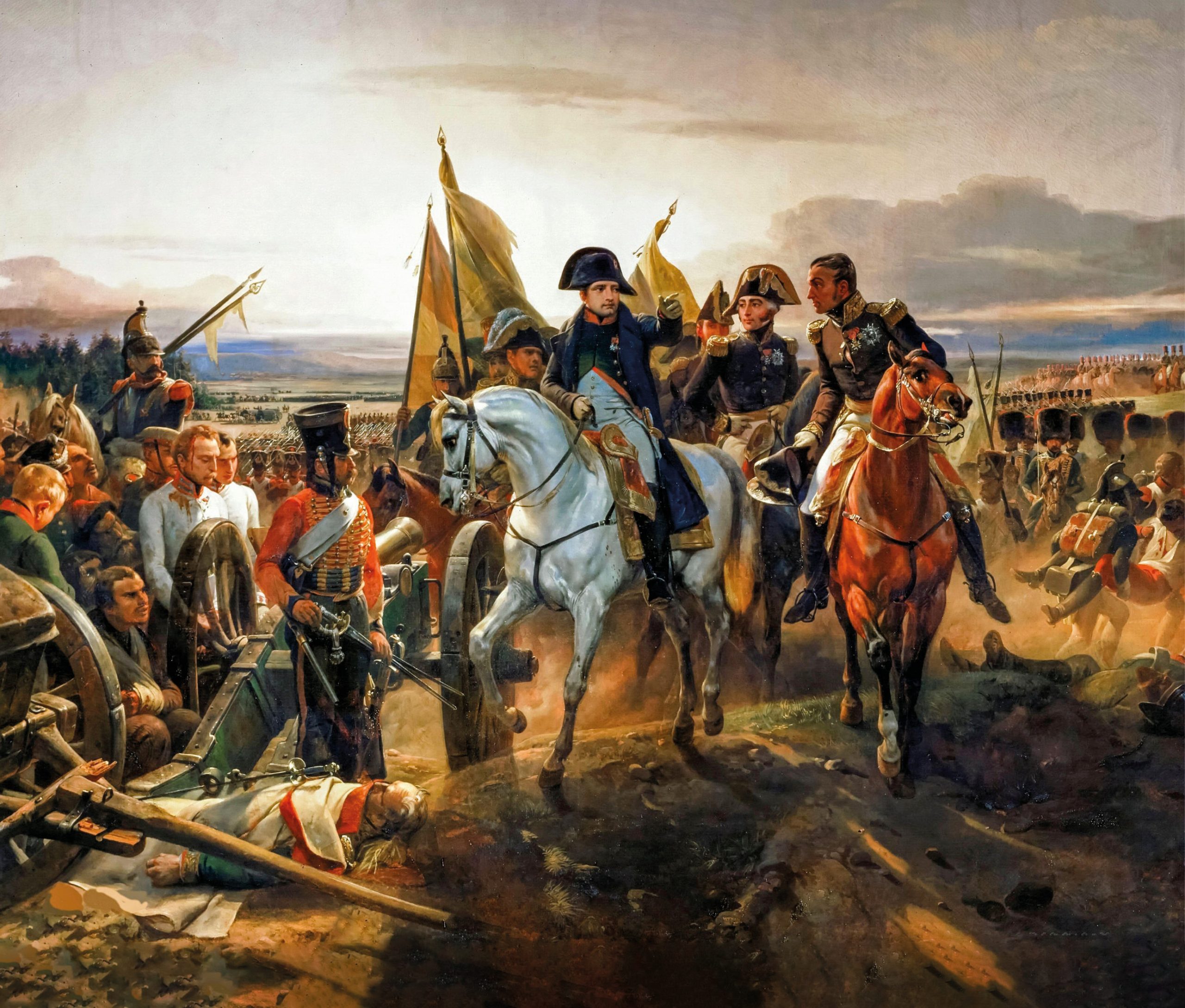
Napoleon at the Battle of Friedland, 14 June 1807. Victory here over Russia’s armies paved the way for the Treaties of Tilsit, often regarded as the pinnacle of his achievement. Image: Alamy

Controlled aggression

Napoleon was an active practitioner with little time for military theory. His written statements on the nature of warfare are sparse and uninformative, going little beyond the need to exploit circumstances as they arise. ‘There are no precise or definite rules,’ he once declared. ‘The art of war is simple, everything is a matter of execution.’ At the heart of Napoleon’s thinking was a ruthless belief in offensive action. The aim was to engage and smash the main enemy force in a decisive battle. Sieges and prolonged occupations of cities or territory were distractions from the main purpose.

The classic illustration of this approach was the campaign that Napoleon undertook in the second half of 1805, when he set out from France to crush the forces of Habsburg Austria. The good roads of western and central Europe enabled the 176,000-strong Grande Armée to make rapid progress. In October, barely seven weeks after leaving the camp at Boulogne, it surrounded General Karl Mack’s 33,000-strong army at Ulm in southern Germany, leading to a practically bloodless capitulation. Five weeks later, after marching a further 500 miles to the east, the French defeated a combined Austro-Russian force at Austerlitz in the present-day Czech Republic. This was an even more remarkable victory, achieved in the depth of winter at the end of extended lines of communication.

At Austerlitz, widely regarded as Napoleon’s masterpiece, he induced Emperor Francis II and Tsar Alexander I to accept battle on his own terms. By withdrawing his troops from the Pratzen Heights, a plateau that dominated the battlefield, Napoleon created a false impression that he was ordering a retreat. In fact, it was a manoeuvre designed to lure his opponents on to ground that he had chosen. He deliberately overextended his right wing, encouraging the enemy to concentrate their attack there, only for the French to be reinforced by fresh troops arriving under the command of Marshal Louis-Nicolas Davout. Meanwhile, taking advantage of the mist that covered the low ground, two French divisions emerged to retake the heights, driving the allied forces off in confusion. The victory was complete when Napoleon ordered his artillery to fire on the enemy as they retreated across the adjoining frozen lakes, breaking the ice and sending many soldiers to a watery tomb. Together, Ulm and Austerlitz effectively gave France control of central Europe.

Critical to Napoleonic campaigning was an emphasis on rapid movement and the concentration of force. Important units were sometimes moved by wagon, as in 1809 when the French had to mobilise quickly to meet a revived Austrian threat. However, the wagons’ limited carrying capacity, and shortages of vehicles and horses, meant that forced marches were the usual mode of transport. ‘The emperor has discovered a new way of waging war,’ his soldiers famously observed, ‘he makes use of our legs instead of our bayonets.’ This was not, of course, the whole story. After closing with the enemy, French infantrymen were expected to hold their positions, often at great cost, while awaiting the arrival of the rest of the army.

The need for speed was dictated by the increased size of armies since the start of the French Revolution. The opposing sides at Austerlitz had upwards of 70,000 men each; four years later, at Wagram, more than 300,000 soldiers took part. Historian Jonathon Riley described Napoleonic armies as ‘moving cities’ which, like their civilian counterparts, consumed vast amounts of food, water, and medical care. The 18th- century agricultural revolution had led to major improvements in food-production. Even so, an army had to keep moving, as it would quickly strip an area of its natural resources if it stayed still for long. The problem was worsened by dependence on horsepower, with the daily food consumption of a horse being ten times that of a soldier.
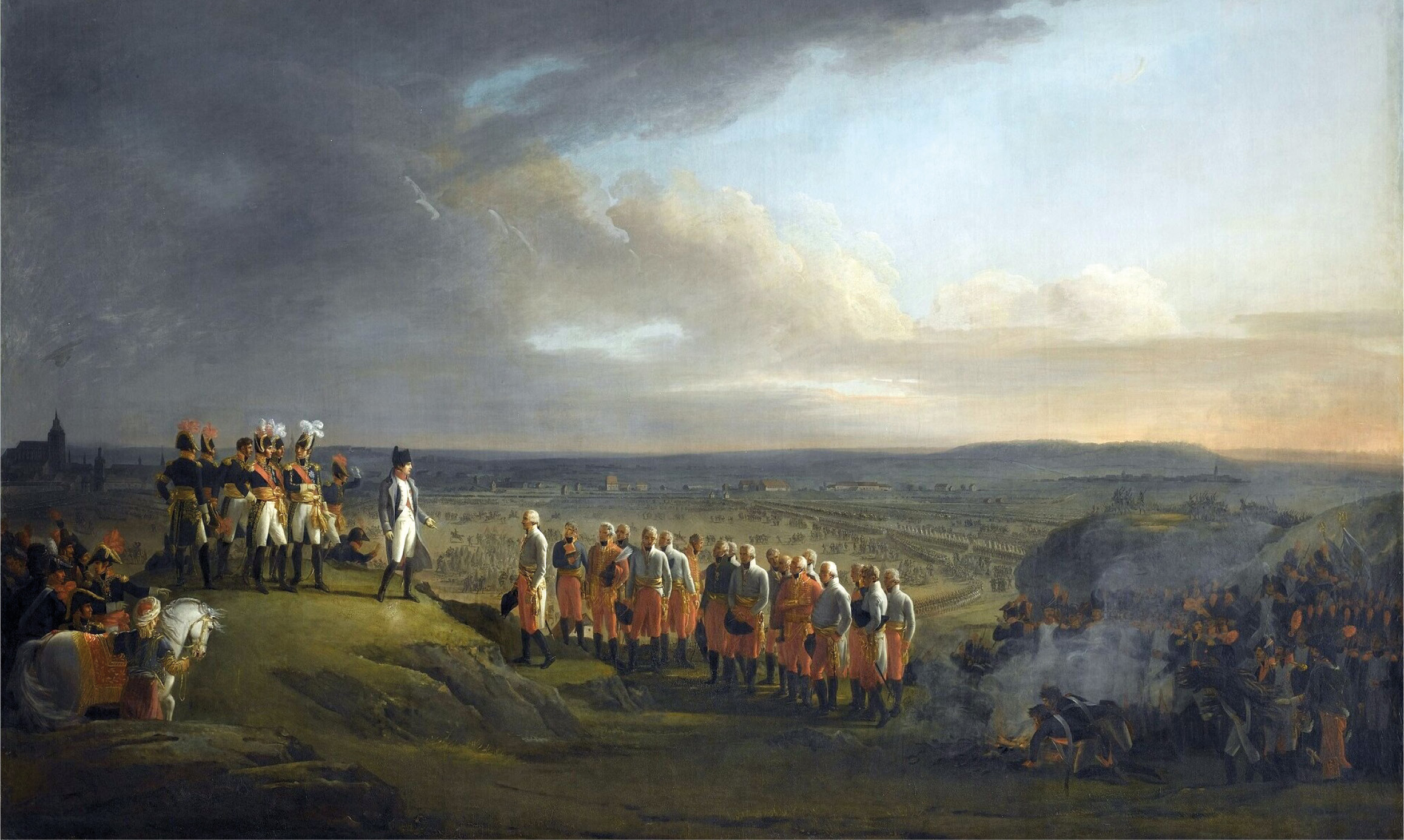
Napoleon accepts the surrender of the Austrian army under General Karl Mack at Ulm, southern Germany, 20 October 1805.

Napoleon’s success rested on an intensely personal style of command. As we have already noted, he famously claimed that ‘one bad general is worth two good ones’. Combining the twin roles of supreme commander and head of state, he had no peers, only subordinates. The imperial headquarters evolved into a complex staff apparatus, but its role was essentially to implement the master’s will. Napoleon’s long-serving chief of staff, Marshal Louis-Alexandre Berthier, made himself indispensable by his ability to carry out instructions with immense attention to detail – a task that entailed deciphering the emperor’s notoriously difficult hand-writing. Berthier willingly recognised his subordinate status, telling Marshal Ney in 1807 that ‘the emperor needs neither advice nor plans of campaign. No one knows his thoughts and our duty is to obey.’

The Battle of Austerlitz, on 2 December 1805, was Napoleon’s masterpiece. Victory here over a combined Austro-Russian force gave France control of central Europe. 

Accounts of Napoleon’s working habits all stress his application to work and his indifference to physical discomfort. The emperor’s excellent memory made it possible for him to maintain oversight of complex troop movements over long distances. Effective intelligence, supported by accurate and detailed maps, enabled him to keep track of enemy troop movements. Napoleon further masked his plans by keeping a tight grip on the spread of news before the start of a campaign, censoring the press, closing borders, and detaining travellers.

Napoleon discusses peace terms with Francis II, the last Holy Roman Emperor.

Napoleon’s ability to direct and coordinate his forces was impressive in an age when the fastest means of communication was the galloping horse. Although systems of semaphore towers were available from the 1790s, their usefulness for military purposes was limited by their static nature and the vagaries of climatic conditions. Fog, cloud, and darkness rendered the signalling technology practically inoperable. The invention of the electric telegraph lay more than two decades in the future, after the end of Napoleon’s career.

Manoeuvring to victory

Napoleon was not an original thinker, but he was highly competent in implementing and perfecting tried-and-tested methods. An artillery officer by training, he was familiar with the improved gunnery adopted by the late ancien régime-era French army. He also had to hand an improved model of army organisation, developed during the revolutionary decade of the 1790s. This was the so-called ordre mixte, combining light skirmishing infantry, dense columns for marching and attack, and linear formations. Nor did he invent the idea of dividing an army into several self-contained, mutually supporting corps, each consisting of infantry, cavalry, and artillery units. His personal contribution was to impose much stronger central control as they moved towards their objective.

The corps system proved fundamental to Napoleon’s success. The self-sufficient units would follow separate but parallel routes, no more than a day’s march apart so that they could come to each other’s assistance if required. Ahead of the main force, a cavalry screen gathered intelligence and created uncertainty about Napoleon’s intentions in the minds of his opponents. Once the enemy had been located, the corps would come together in a loose quadrilateral known as the bataillon carré, bringing overwhelming force to bear as the battle began.

Napoleon made use of several different battle plans. Against an enemy with superior numbers, he employed the tactic of the ‘central position’. The object was to divide the opposing forces into several parts and defeat each in detail. While part of Napoleon’s forces engaged a section of the enemy force, he would turn his main body against the other part and smash it. The bulk of the army would then rejoin the pinning force to complete the victory.

In another variant, one part of the army would engage the enemy front, while another launched a crushing attack on one of the flanks. In the so-called manoeuvre sur les derrières – used frequently by Napoleon in this most successful phase of his career – it could become a full-scale envelopment. The first corps that encountered the enemy would seek to pin them, while the main French force would attack the rear. With their lines of communication threatened, the enemy faced an unenviable choice between surrender and giving battle without a secure line of retreat.

 The Battle of Wagram, 5-6 July 1809. At the time, it was the largest battle in European history, with more than 300,000 soldiers taking part. 

A good example of this method is the Russian defeat at Friedland in June 1807. The town is situated on the River Alle, 30 miles south of Königsberg (now Kaliningrad), a key Baltic port (see also our feature ‘Germany’s “Little Dunkirk”’ here) through which Russian forces were supplied. Here a corps headed by Marshal Jean Lannes held the Russian commander, General Count Bennigsen, until reinforcements appeared. Lannes’ action required considerable skill to disguise the numerical inferiority of his force – he had just 16,000 troops, rising to 35,000 after further units arrived, facing 60,000 Russians.

Bennigsen ill-advisedly decided to cross to the left bank of the river to engage Lannes’ troops. He found himself in an untenable position when Napoleon arrived, bringing total French numbers to 80,000. With his opponents now outnumbered, Napoleon launched an intense assault on the Russian left flank, followed by a thrust in the centre, which pushed them into the bend of the Alle. Fighting continued into the night, with parts of Friedland on fire as the Russians tried to escape across the river. The victory paved the way for the Treaties of Tilsit with the tsar and the Prussian king, often regarded as the pinnacle of Napoleon’s achievement.

 The charge of the French 4th Hussars at Friedland. The scale of the Russian defeat convinced the tsar to enter peace negotiations.

This grasp of strategy was complemented by a remarkable capacity to inspire and motivate. Known affectionately as le petit caporal (‘the little corporal’), Napoleon made a point of staying close to his soldiers and impressing them with his recall of their personal circumstances. The issuing of rewards and honours allowed him to get away with making exceptional demands on them. He also appealed to a sense of pride in their achievements. After Austerlitz, for example, he told his men: ‘You have decorated your eagles with an immortal glory… it will be enough for you to say, “I was at the Battle of Austerlitz” for people to reply, “There goes a brave man.”’

Napoleon promoted officers strictly on merit, prizing courage and a proven track record over seniority. He did, however, show favour to old campaigners who had served with him in Italy and Egypt before 1799. The emperor’s charisma was an unquantifiable asset. The Duke of Wellington insisted that his presence on the battlefield was worth 40,000 men.

Success and failure

Napoleon owed most of his victories to a capacity to grasp the essentials of a situation and then to mount a rapid and comprehensive response. Careful though his preparations were, he was always ready to modify his plans as circumstances changed. During his exile on St Helena, he stated that the mark of a great general is the ‘courage to improvise’. Prior to his encirclement of Mack at Ulm, for example, Napoleon drove his army beyond the enemy’s main position, to the south bank of the Danube, before he discovered that the Austrians were behind him on the north bank. He then ordered much of his army back across the river to trap the Austrian forces.

Napoleon also benefited from the assistance of able subordinates. One instance is the encounter with the Prussians at the linked battles of Jena and Auerstädt in October 1806. Napoleon opened in characteristically bold manner, seeking to crush the Prussians at Jena before their Russian allies could join the battle. He mistakenly believed that the 40,000-strong Prussian force he encountered there constituted the enemy’s main body. The truth was that Marshal Davout, whom he had dispatched to the north, had in fact met the bulk of the Prussian army 15 miles away at Auerstädt. Although outnumbered two to one, Davout brought his three divisions into line to check the enemy’s advance. He then launched a ferocious counter-attack, causing the Prussians to break and flee towards Jena, where the other wing of their army was disintegrating.

 Napoleon and Tsar Alexander I meet to discuss the first Treaty of Tilsit, 7 July 1807. Regarded as the high point of Napoleon’s career of conquest, the agreement was signed on an ornate raft in the middle of the River Neman. Image: Alamy

Like many successful commanders, Napoleon was adept at exploiting the mistakes and failings of his adversaries. At Austerlitz, an inexperienced Tsar Alexander rejected the advice of his best-qualified commander, General Kutuzov, allowing himself to be drawn into a trap. The disorganised, divided nature of the Prussian high command contributed to the outcome of Jena–Auerstädt – a weakness that the state’s government was belatedly to address after 1806 with the introduction of a new form of general staff. At Friedland, General Bennigsen unwisely chose to fight with his back to the River Alle, limiting his room for manoeuvre when the main French army arrived.

In 1809, Napoleon remained a formidable force on the European continent. A revived Austrian challenge was checked in July – albeit at considerable cost – by his decisive victory at Wagram. As part of the alliance subsequently forced on the Habsburg monarchy, Napoleon married the Austrian ruler’s 18-year-old daughter, Marie-Louise, who soon produced an heir for him. It would be another four years before Prussia had recovered sufficiently from Jena–Auerstädt to challenge French hegemony.

Even so, while still at the height of his power, the seeds of Napoleon’s eventual downfall were being sown. The excessively centralised command structure that he created would prove a source of weakness as the French empire became overextended. Campaigns in far-flung, hostile territories – notably in Spain and Russia – tested the Napoleonic system to the limit. The emperor’s restless quest for dominance created an increasingly effective opposing coalition, whose members had learned vital lessons from their bruising encounters with him. These developments, and their consequences for Napoleon, will be the subject of the final instalment in this series of articles. MHM

Further reading:
Napoleon: Volume 2 – The Spirit of the Age (Michael Broers, Faber & Faber, 2020)
The Art of Warfare in the Age of Napoleon (Gunther E Rothenberg, Spellmount, 1997)

In the next issue of MHM: Napoleon’s decline and fall, 1810-1815
All images: Wikimedia Commons, unless otherwise stated

By Country

Popular
UKItalyGreeceEgyptTurkeyFrance

Africa
BotswanaEgyptEthiopiaGhanaKenyaLibyaMadagascarMaliMoroccoNamibiaSomaliaSouth AfricaSudanTanzaniaTunisiaZimbabwe

Asia
IranIraqIsraelJapanJavaJordanKazakhstanKodiak IslandKoreaKyrgyzstan
LaosLebanonMalaysiaMongoliaOmanPakistanQatarRussiaPapua New GuineaSaudi ArabiaSingaporeSouth KoreaSumatraSyriaThailandTurkmenistanUAEUzbekistanVanuatuVietnamYemen

Australasia
AustraliaFijiMicronesiaPolynesiaTasmania

Europe
AlbaniaAndorraAustriaBulgariaCroatiaCyprusCzech RepublicDenmarkEnglandEstoniaFinlandFranceGermanyGibraltarGreeceHollandHungaryIcelandIrelandItalyMaltaNorwayPolandPortugalRomaniaScotlandSerbiaSlovakiaSloveniaSpainSwedenSwitzerlandTurkeySicilyUK

South America
ArgentinaBelizeBrazilChileColombiaEaster IslandMexicoPeru

North America
CanadaCaribbeanCarriacouDominican RepublicGreenlandGuatemalaHondurasUSA

Discover more from The Past

Subscribe now to keep reading and get access to the full archive.

Continue reading