Subscribe now for full access and no adverts
Church doors are among the most numerous examples of the joiner’s craft to survive from the medieval period, so it is high time they were given the attention they deserve. Step forwards Warwick Rodwell, whose more-than-60-year career as an architectural historian and archaeologist has included excavations at the Church of St Botolph in Hadstock, Essex, and serving as Consultant Archaeologist at Westminster Abbey. Both buildings possess doors long recognised as being of considerable antiquity, but only with recent developments in dendrochronology (analysis of tree rings within their timbers) has it been possible to date them precisely.
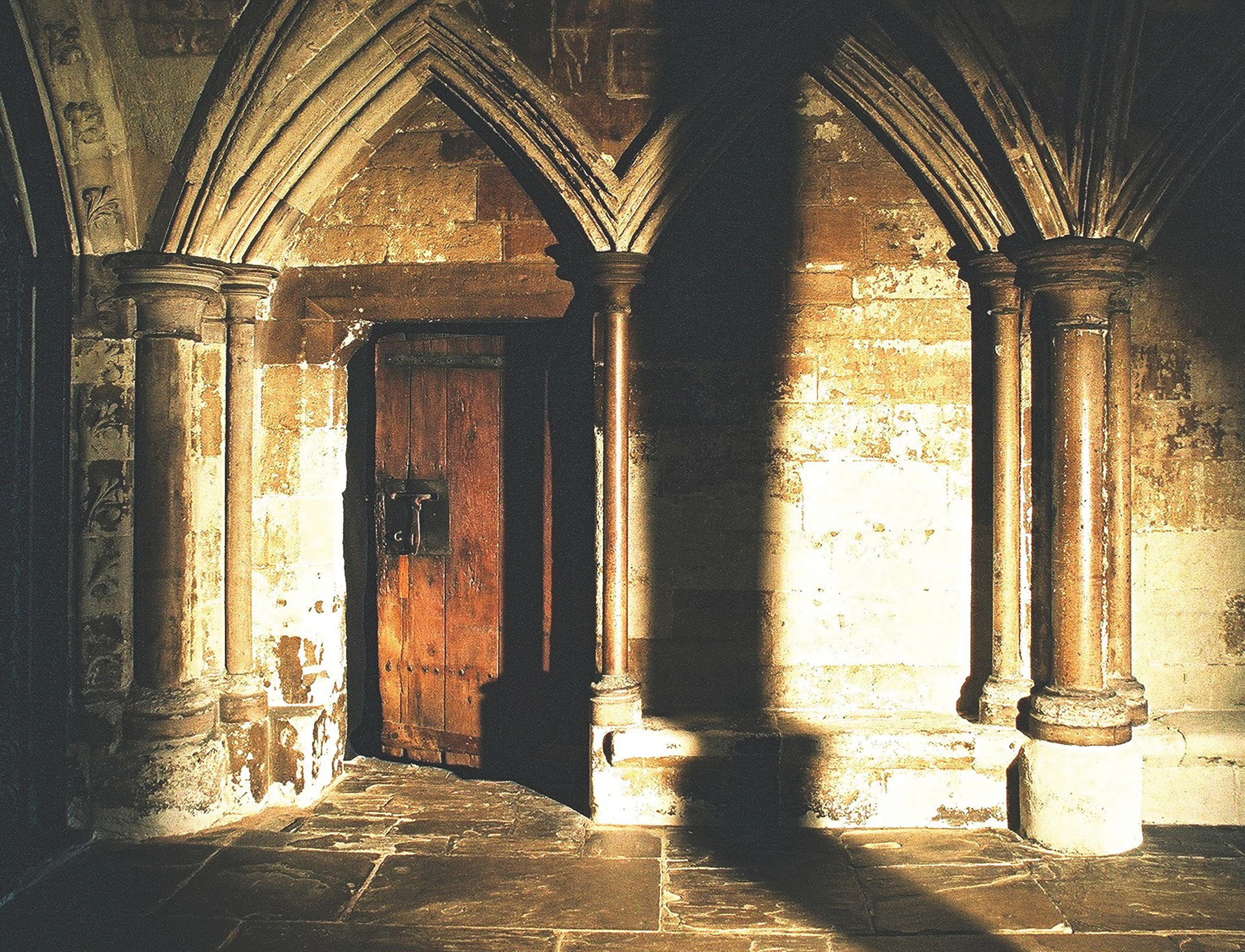
In 2005, for example, it was revealed that the door in the vestibule leading to the chapter house at Westminster Abbey was made from timber felled after AD 1032. The door itself was constructed sometime in the 1050s, during the reign of the Abbey’s founder, Edward the Confessor (r. 1042-1066), and Westminster Abbey itself was consecrated in December 1065.
At St Botolph’s Church in Hadstock, samples taken from the north door in 2003 were used to establish a felling date for the oak timber between 1034 and 1042. Tighter dating was not possible in this case due to the absence of the sapwood (or outermost) rings, which provide an anchor for the most recent five years of a tree’s growth, but a broad date in the 1060s and 1070s would be consistent with the architectural evidence provided by the Romanesque mouldings of the north doorway’s stone arch.
In this way, 21st-century science has brought accurate dating to earlier antiquarian speculation about the age of these doors, which had been based in part on their carpentry and ironwork. We also now have a date for Gundulf’s Door (named after the Norman bishop, c.1024-1108) at Rochester Cathedral: its timber was felled in 1075-1107, the door itself probably made in the 1080s-1090s. A further 35 doors in churches in England and Wales could well date from the 11th and 12th centuries based on their context, construction, and ironwork.
In his newly published study of these doors (see ‘Further reading’), Warwick Rodwell credits Cecil Hewett with being the instigator of in-depth research into the timber components of parish churches and cathedrals (for example, his 1974 work on Church Carpentry), revolutionising the dating of timber-framed buildings through his study of jointing techniques and recognition that doors deserve academic attention in their own right. At the same time, Jane Geddes began pioneering research in 1973, identifying the ironwork motifs that were likely to date from this early period (work that formed the basis of her book Medieval Decorative Ironwork in England in 1999).

Macabre myths
Older by far than the research mentioned above was the folk belief that the Hadstock and Westminster doors, as well as others from the period, had once been covered in ‘Dane skin’ derived from Vikings caught in the act of raiding the churches and subjected to a grisly punishment for their sacrilege. The Hadstock example in particular has been most strongly linked to this legend, referenced on innumerable occasions in both antiquarian literature and folklore. Lending credibility to the myth was the association of Hadstock with Cnut’s victory at the Battle of Assandun in 1016, at which Cnut defeated Edmund Ironside to become King of England (see CA 321). Cnut founded a church at or near the site of the battle as an act of thanksgiving for his victory (possibly the predecessor to the one that stands at Hadstock today).
As for other doors, Samuel Pepys was the first person to leave a written record of the belief that some were covered with human skins. Having visited Rochester Cathedral on 10 April 1661, he wrote in his diary that he had observed: ‘the great doors of the church, which, they say, was covered with the skins of the Danes’. Another early reference is found in Richard Newcourt’s Repertorium ecclesiasticum parochiale Londinense (1710), in which he wrote the following about Copford Church in Essex: ‘the Doors of this Church are much adorn’d with flourish’d Iron-Work, underneath which is a sort of skin taken notice of in the year 1690, when an old Man at Colchester, hearing Copford mentioned, said that, in his young time, he heard his Master say that he had read in an old history that the church of Copford was robb’d by Danes and their skins nail’d to the Doors’. William Stukeley, too, did much to embed the idea with his Itinerarium Curiosum (1724), subtitled ‘an account of the antiquities, and remarkable curiosities in nature or art, observed in travels through Great Britain’, which he undertook between 1720 and 1724. Visiting Hadstock, he wrote that ‘they talk of the skin of a Danish king nailed upon the church-doors’.


As Warwick Rodwell wryly observes: ‘the notion that the hides were human skin clearly appealed to a credulous sector of the population because it was enthusiastically repeated through generations of guidebooks and county histories’. A typical example is the 1901 guide to St Mary’s Church in Pembridge, Herefordshire, written by the Reverend J B Hewitt, who noted that: ‘behind the ironwork of the knocker is a leathery substance – much decayed and covered with paint, but suggestive of the awful fate reserved for Danes and those caught red-handed in sacrilege’. And, indeed, Westminster Abbey chapter house guidebooks were still stating, well into the 20th century, that the vestibule door ‘was covered with human skin, of which fragments remained until a few years ago; it was put there as a warning to thieves’.
As many as 12 church doors, at ten locations in England and one in Wales (Llanaber, Gwynedd), have been linked in the past to Danish invaders, and in every case the attribution can easily be disproved. Scraps of leather surviving under hinges, nails, and decorative ironwork show that the skins were applied to the doors during their construction, not afterwards, and some of these doors also post-date the era of Viking incursions by some centuries – although antiquaries have sought to bridge this gap by claiming the doors were reused from earlier churches. Alternatively, the skin has been attributed to later miscreants, such as the robber who tried to steal from the royal treasury in the Westminster Abbey cloister in 1303. The antiquary who donated a piece of skin from a Worcester Cathedral door to the Society of Antiquaries c.1840 said it was that of a man (date not specified) ‘who had stolen the sanctus-bell from the high altar’; examining the skin in 1894, the historian W S Brassington wrote that ‘it might be mistaken for a piece of old boot; it is of rusty brown colour, and the man from whose body it came must have been an exceedingly thick-skinned person’.

Scientific identification had to wait until 2001, when a sample of the Hadstock skin, now preserved in Saffron Walden Museum, was subjected to DNA testing for the BBC documentary series Blood of the Vikings, which revealed it to be bovine. This was confirmed in 2020, when Dr Ruairidh Macleod (a contributor to Warwick’s book; see also ‘News’ in CA 390) used the unique fingerprint of the sequence of peptides in animal collagen to identify conclusively that the skins from the Hadstock and Westminster doors were cow hide.
Further tests in 2025 then identified the leather from the doors in Copford (Essex) and Worcester Cathedral as horse or donkey hide. These discoveries all bear out what Theophilus Presbyter wrote in his treatise De diversis artibus (‘On various arts’), composed in 1110-1140. Regarding the fabrication of church doors and chests, he said: ‘the panels should be covered with the raw hide of a horse or an ass or a cow, which should have been soaked in water. As soon as the hairs have been scraped off, a little of the water should be wrung out and the hide, while still damp, laid on top of the panels with cheese glue’.
Warwick Rodwell believes that the true number of doors in medieval England that were once covered in hide probably ran into the hundreds, and that this kind of door covering was used throughout Europe in the Middle Ages. The natural decay of organic materials has deprived us of most of the physical evidence, though pieces occasionally survive as skin trapped beneath iron fittings. Recorded occurrences suggest that hide coverings ranged widely in date, from the 11th century to the 14th century (at Pembridge) and 15th century (at Hertford Castle), and were geographically widespread, from Kent to Merionethshire (now part of Gwynedd and Denbighshire) and to North Yorkshire.

Commendable carpentry
The reason for covering a door (or a chest) with hide was to enhance its appearance, disguising the joints, toolmarks, and natural blemishes in the wood, and providing a smooth surface for further decoration. Copford Church has the most extensive samples of hide covering, with three fragments held on site and two in Colchester Museum. In two of these samples, vermilion paint survives on top of a white undercoat, while patches of red paint can also be seen on the scraps of hide from Westminster Abbey.
Theophilus Presbyter gives the impression that red was the normal colour for church doors, and he provides a formula for using linseed oil to achieve this effect on doors that do not have a hide covering. Scant remains of red paint on a white ground have been found on the Rochester door, and a door fragment from Worcester Cathedral, dating from the 12th century, bears the remains of a ‘barber’s pole’ design of diagonal red and white bands.
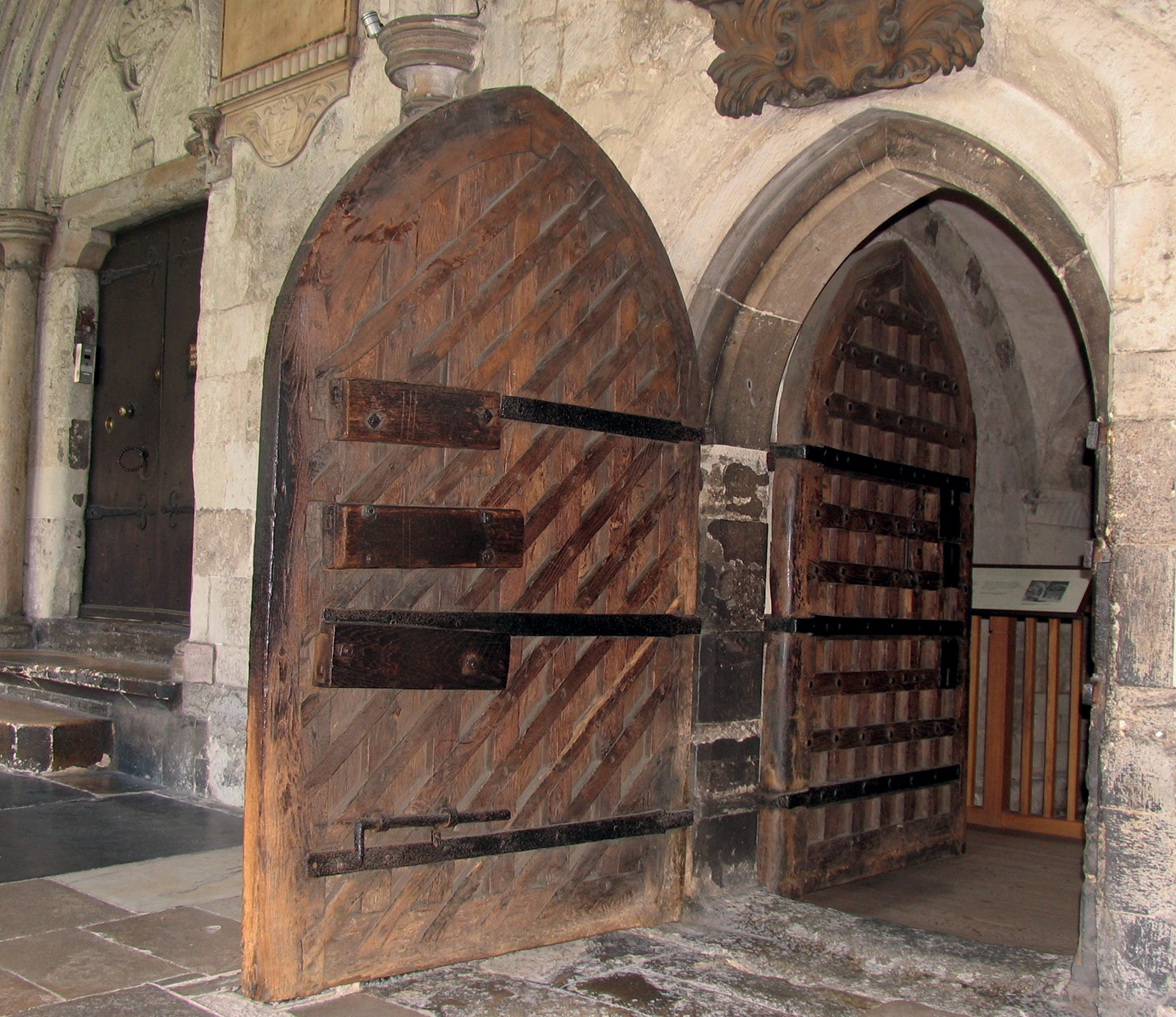
Thus far, the attributes shared by these various early doors have been emphasised – hide-covering and red paint – but the doors are very different in their joinery techniques, displaying differing levels of technical virtuosity. The Westminster door is the most impressive, and a chapter in Warwick’s book, by Peter Massey and Paul Reed, explains how the door was manufactured and the many types of tool used by the highly skilled carpenters who made it.
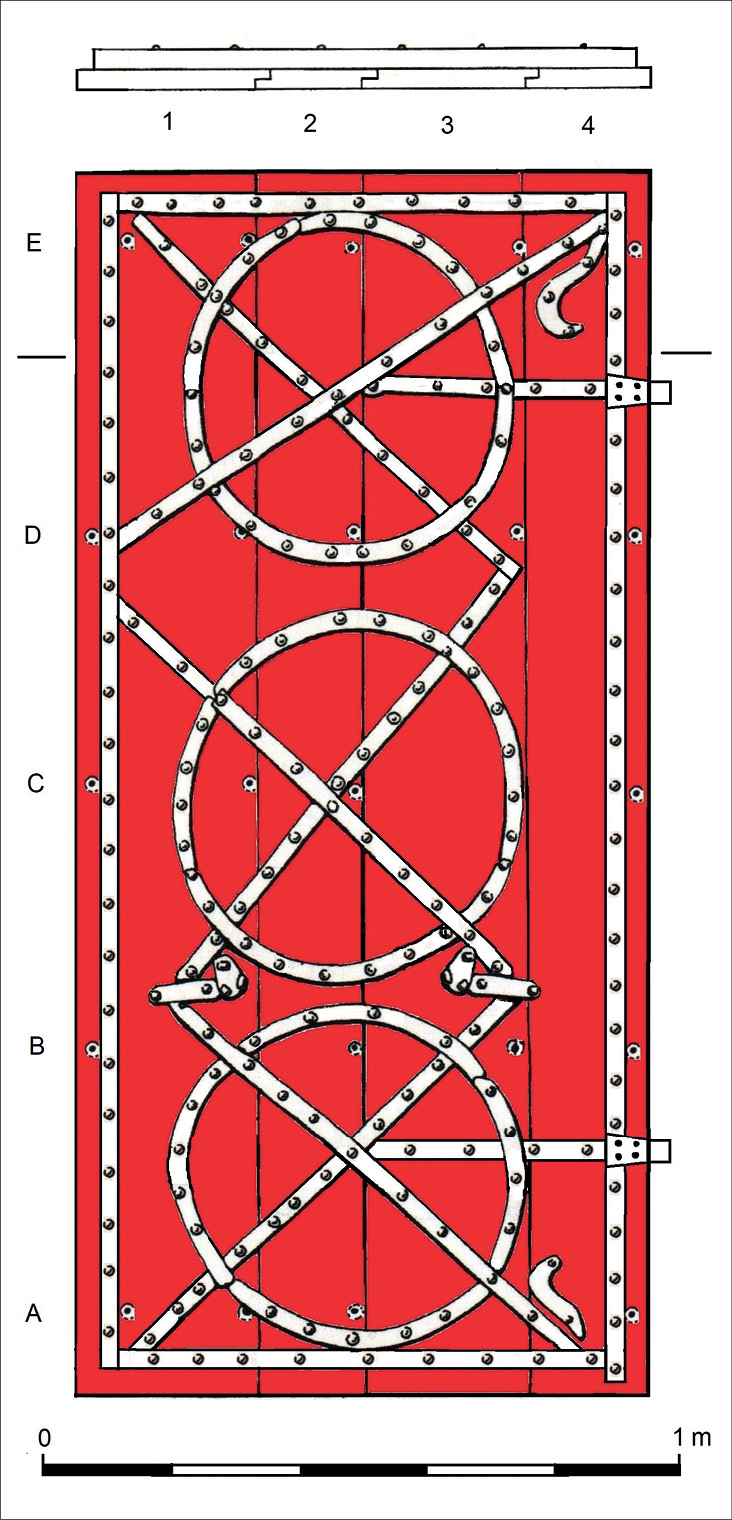
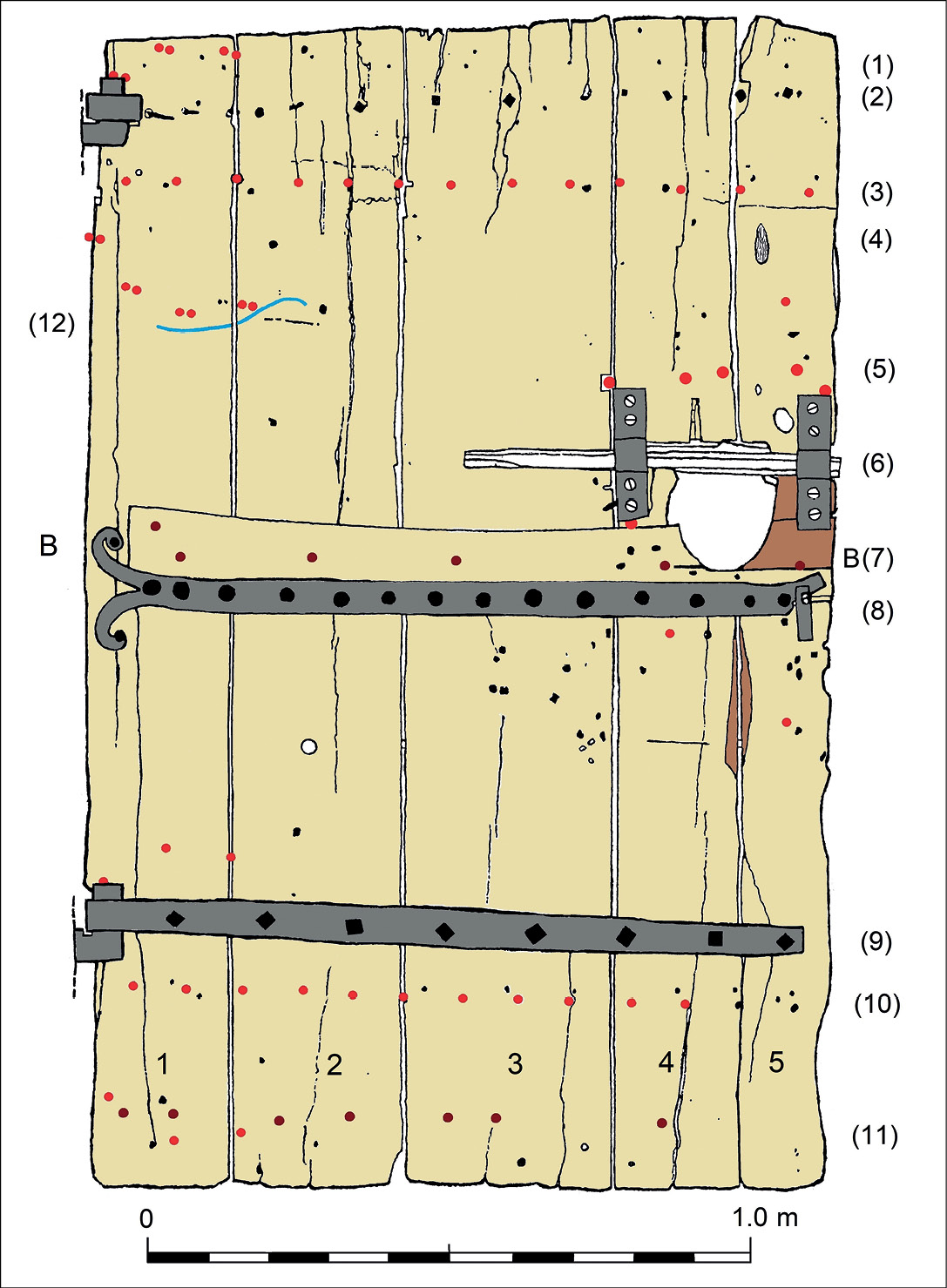
The door consists of five vertical oak boards, 40mm (1.6in) thick and varying in width from 225mm (9in) to 390mm (15in), making a total width of 1.27m (4ft) and a height of 1.98m (6.5ft). Felling- and lopping-axes were used to cut down the tree and square up the round logs. The timbers from quays, jetties, and causeways of this period were generally produced by splitting the logs using a broad axe, leading to the orthodox view that the carpenters did not use saws. These timbers, however, have marks showing that the trunk was cut into planks over a pit with the saw set at an angle of 55° to 60° to the axis of the trunk – evidence that 11th-century blacksmiths could produce steel saw blades over a metre in length.
After seasoning for at least two years, the long edges of the boards were then made straight using saws and planes, and the planks assembled on sturdy benches. Rebates were cut in each edge to a depth of 35mm (1.4in) using a rebate plane, like the one recovered from a 6th-century grave at Sarre (Kent). These rebates enabled the edges of the boards to lock together and reduced the chances of individual boards twisting.

An auger (boring tool) was used to drill two holes into the edges of each of the boards to receive pegs that locked the rebated boards together when they were assembled on a bench. A curved shaving tool was used to smooth both faces of the boards (though some saw marks were missed in the finishing process). The door was next strengthened to hold the boards together tightly and prevent them from spreading laterally. Starting in the early 13th century, this was achieved by attaching a rigid framework to the back of the door – either of small squares or a diamond lattice. Earlier doors, however, were fixed by adding ‘ledges’, or horizontal pieces of board – a technique with a long history, as it was used, for example, on the 1st-century AD Roman door from Drapers’ Gardens, London.
The three Westminster examples – two ledges on the back of the door and one on the front – are remarkable for being countersunk (or ‘trenched’) into shallow housings of the exact same shape cut into the boards. They are thus perfectly flush with the faces of the door and, rather than being rectangular, they are slightly concave along their long sides – an elegant shape that must have increased the level of skill needed to mark out the shape and cut the trenches to receive the ledges.
There is little room for doubt that joiners of the period were highly skilled and possessed a toolkit that would be familiar to a modern cabinet maker.
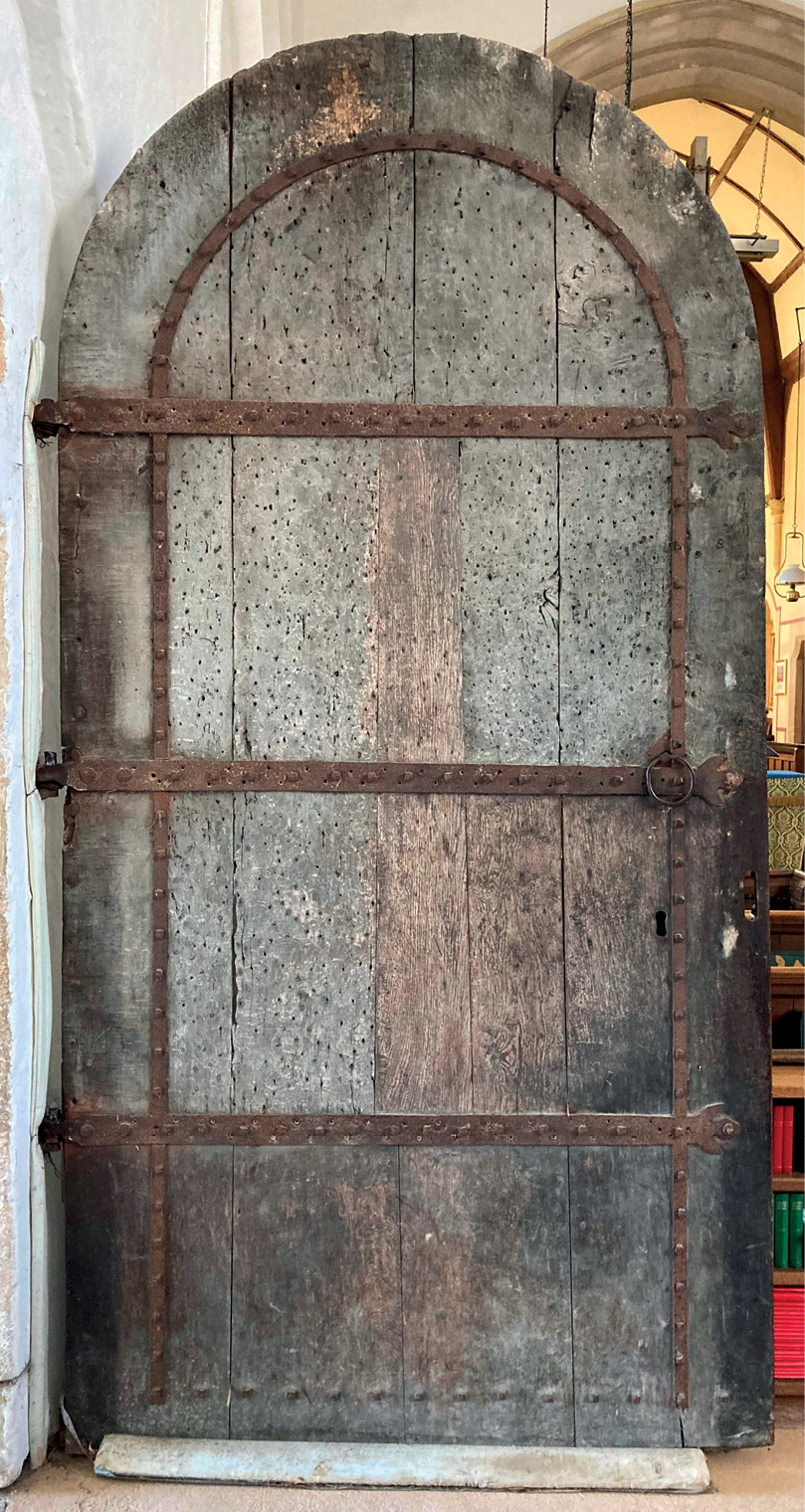
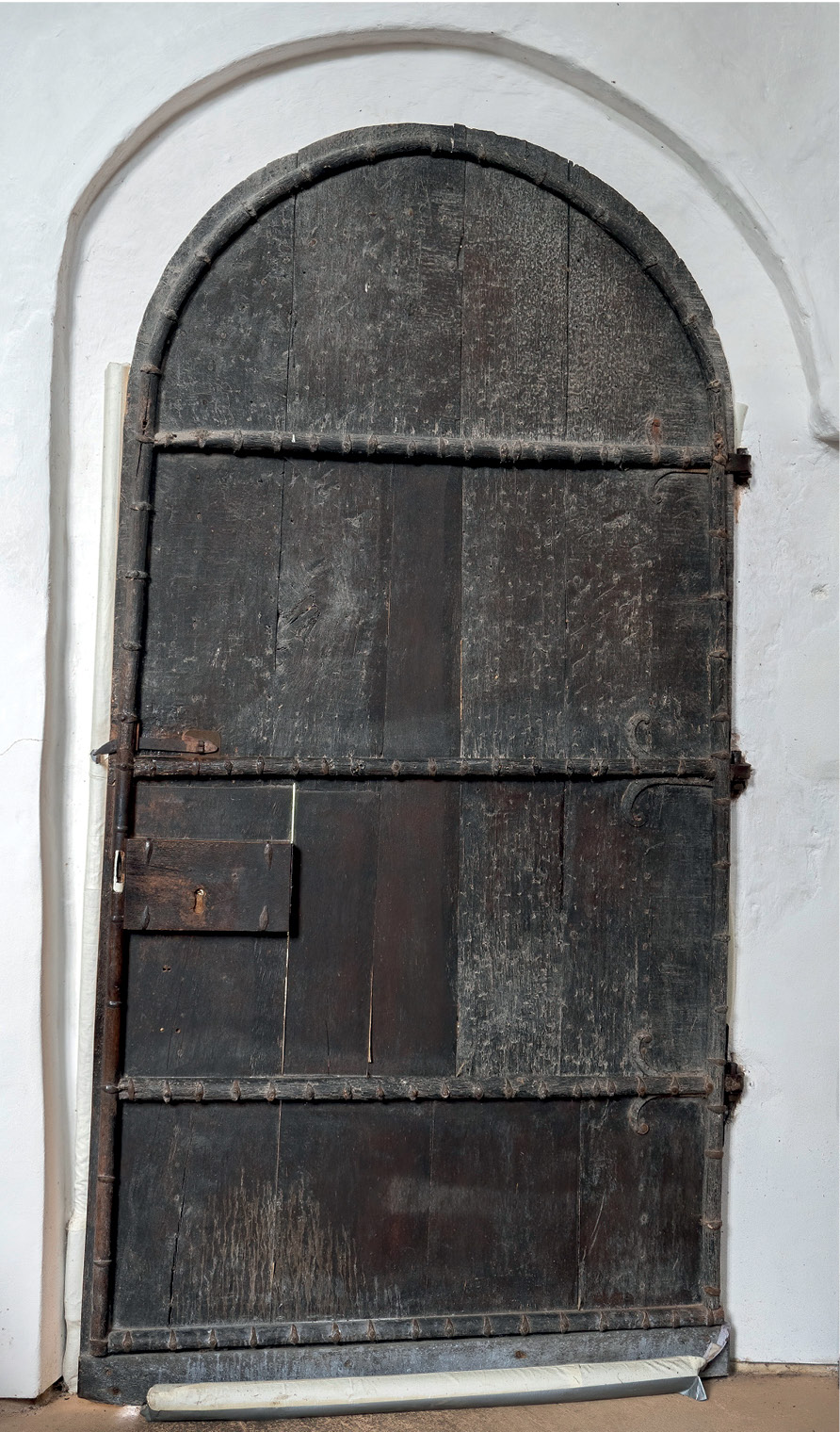
The use of flush ledges has no parallel in medieval Britain, and no 11th-century doors have survived in France to provide a comparison, but such high-quality joinery would have required a range of knives, chisels, routers, and gauges. Elsewhere, ledges were surface-mounted and project from the boards. Typically, three to five well-spaced ledges were used for each door (for example, at Rochester) and were fixed using clenched nails. At Hadstock, in addition to the four ledges on the rear of the door, which coincide with the positions of the hinges on the face, there is also a large timber hoop, steam-bent and U-shaped in cross-section, that runs up both edges of the door and around the semicircular head. Above all, the sophistication of the carpentry represented by all these early doors leaves little room for doubt that joiners of the period were highly skilled and possessed a toolkit that would be familiar to a modern cabinet maker.
Examining ironwork
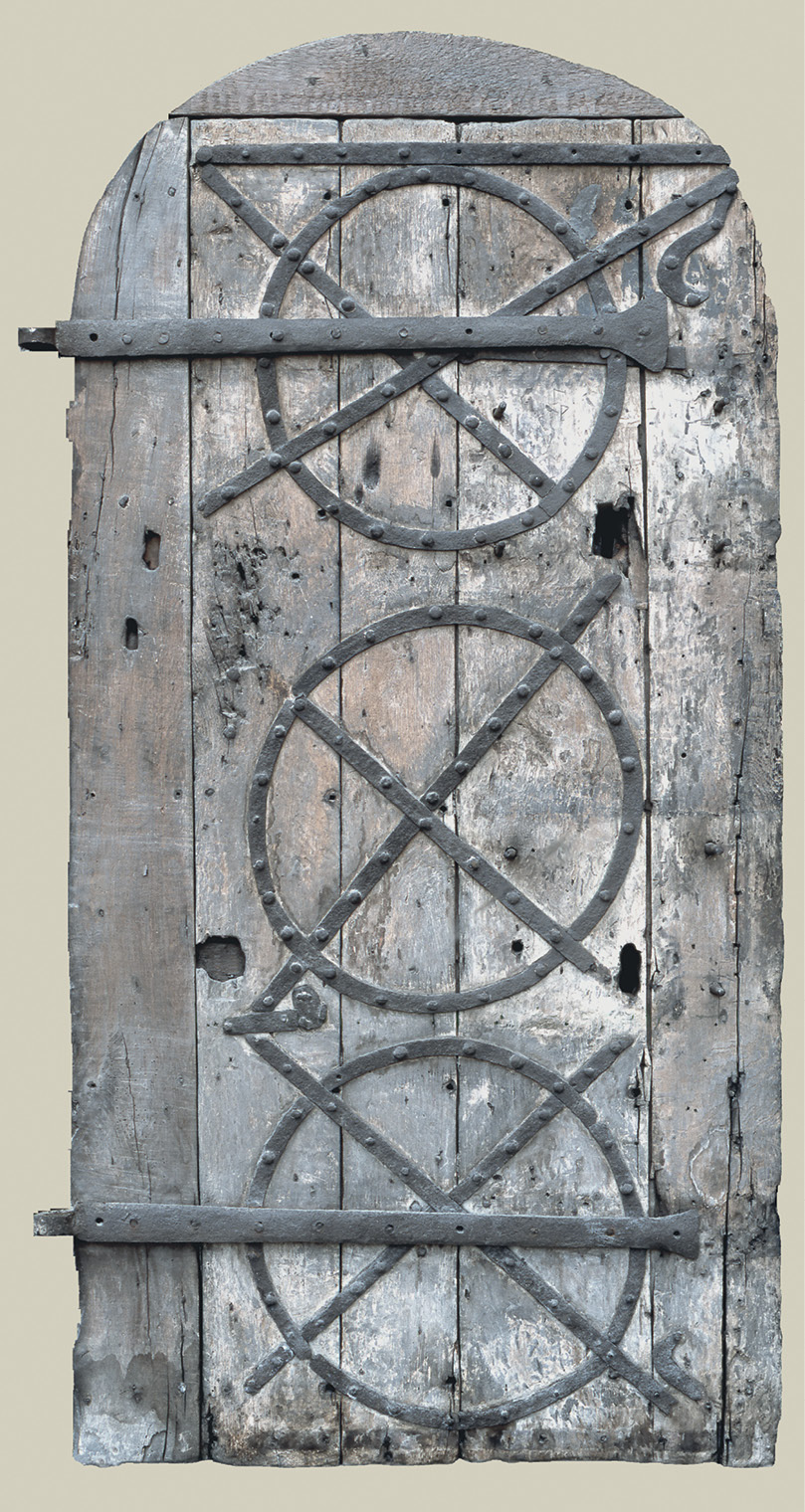
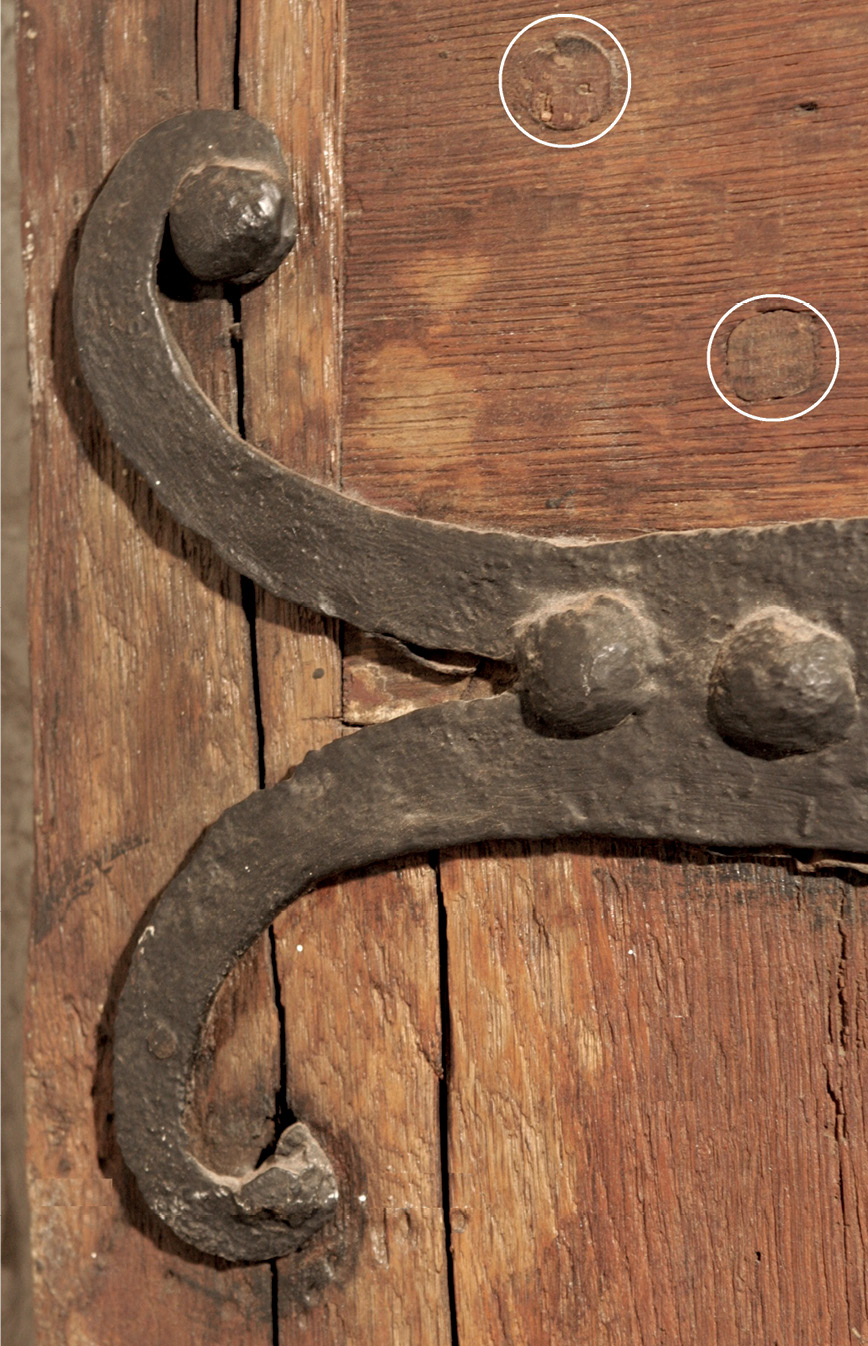
The ironwork of these doors was no less elaborate and refined, whether in the form of functional hinges, nails, roves, and rivets, or purely decorative scrollwork. In some cases, while the ironwork has gone, the pattern can still be recreated by studying the holes made by the nails used to fix the metal to the door planks. Thus, we know that the Westminster door originally had strap hinges with split-curl terminals.
The same door has the earliest-known examples in Britain of C-scroll hinges, a Norman innovation whose introduction to England is traditionally assigned to the period AD 1145-1155, which is the date at which they begin to be depicted in English manuscript illustrations, such as the door of Noah’s ark in the Caedmon manuscript from Canterbury. Their occurrence at Westminster on a door firmly dated to the 1060s, combined with its unique recessed ledges, leads Warwick Rodwell to raise the question of whether Norman craftsmen were involved in its construction.
Westminster Abbey is, it has been argued, a Norman building constructed in pre-Norman England, to a Romanesque design, having much in common with the abbey church at Jumièges. The influence of that church on Westminster is not surprising when you consider that Robert Champart, Abbot of Jumièges, was an advisor to Edward the Confessor, who subsequently appointed him Bishop of London in 1044 and Archbishop of Canterbury in 1051. It is highly likely, too, that the tradesmen who worked on Westminster Abbey included people of Continental origin. Indeed, the master mason (effectively the architect), who was handsomely rewarded for his work by the grant of an estate at Shepperton (Surrey), was called Teinfrith, a name of Germanic origin.
It is clear, however, that local carpenters, joiners, and metalworkers possessed the skills necessary to produce high-quality doors, even if Norman craftsmen were employed to instruct them, and the door itself must originally have hung in a place of some importance. Warwick suggests it formed the original door to the chapter house. Its current location, in the chapter house vestibule, results from Henry III’s rebuilding of the abbey from 1245, focusing the new Gothic structure around the shrine of Edward the Confessor, Henry’s patron saint. The retention of the door arguably represents a deliberate decision to emphasise the continuity between the abbeys of Henry and Edward.
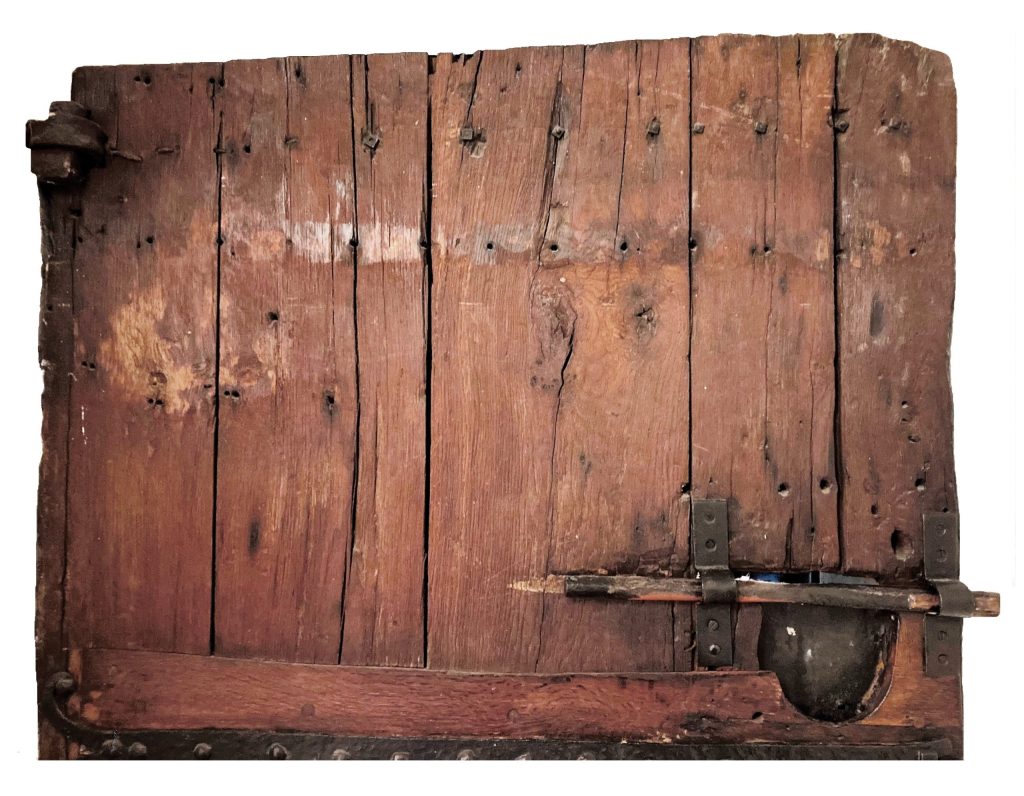
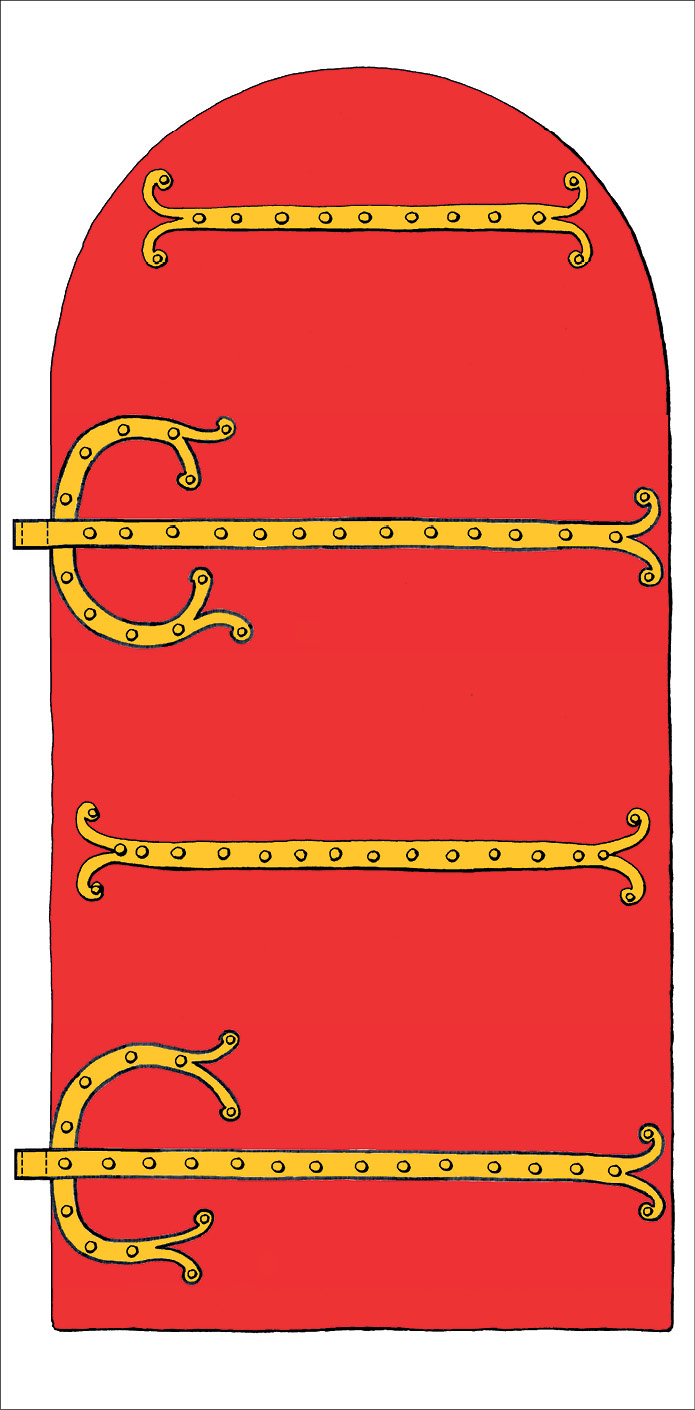
Hadstock’s north door is more typical of English design from this period, and the numerous nail holes testify to an appearance that was once even more visually striking. The four long strap hinges originally terminated in pairs of flamboyant S-scrolls, which divided the door into four rectangular panels that were filled with elaborate scrollwork. These are all now lost, but they were similar in their geometrical elaboration to the embellishments shown in contemporaneous manuscripts, such as the depictions of the doors of heaven and hell in the Last Judgement scene in the Liber Vitae, produced at Winchester c.1031. A very similar door to that at Hadstock occurs in the Bayeux Tapestry, where it symbolises the town gate at Hastings.
This style continued well into the 12th century. A similar door once closed the west end of the church of St Peter-in-the-East in Oxford. Discarded during 19th-century restoration work, the door is known from J C Buckler’s drawing, c.1820. This is undated, but another door that has much in common with Hadstock has a timber-felling date of 1156.
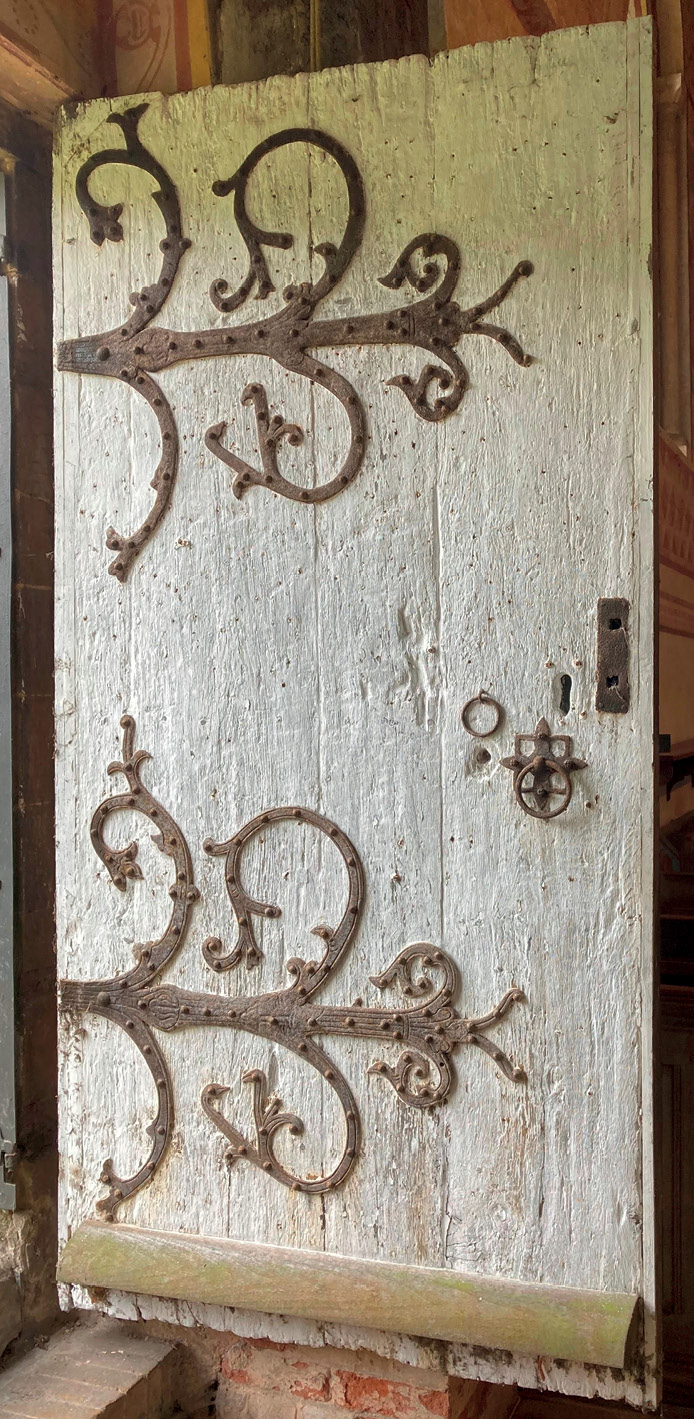
Many questions about the history of medieval doors – ecclesiastical and secular – remain to be answered, and Warwick Rodwell argues for a much wider study than he has been able to make. The subject needs systematic searches to identify more doors dating from the 11th to 13th centuries in Britain, France, and Scandinavia. Warwick also identifies several churches with doors currently assigned to the 12th century that might, when dated by dendrochronology, prove to be earlier – including those at Elmstead and Heybridge (Essex), Sempringham (Lincolnshire), Little Hormead (Hertfordshire), Steyning (West Sussex), and Manningford Bruce (Wiltshire).
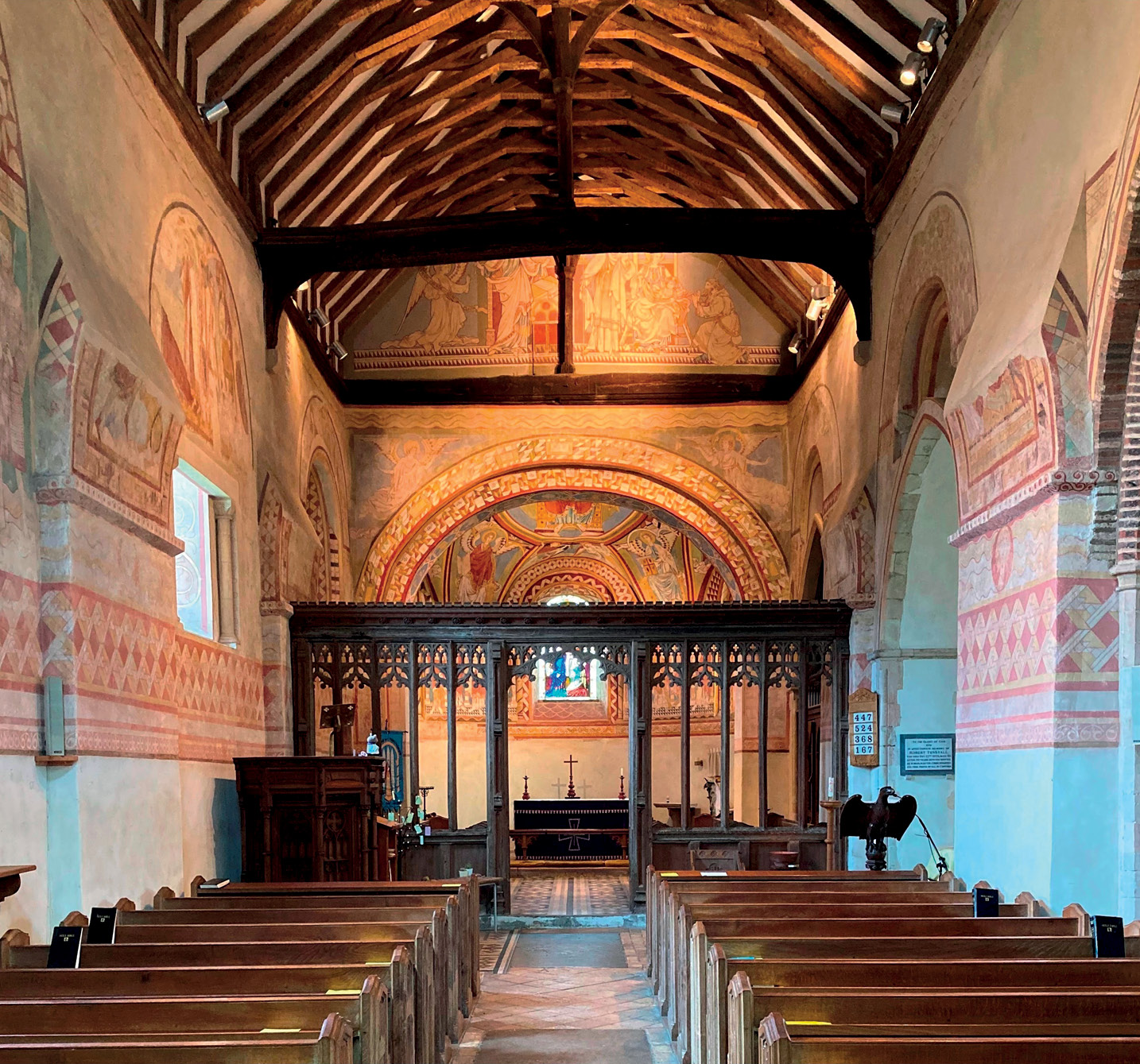
Fresh studies to look for scraps of hide in museum collections would tell us more about the decoration of these doors, and another unanswered question is whether the ironwork might have been gilded before weathering, rust, and the actions of Victorian restorers destroyed the evidence. Such evidence as we have suggests that we should no longer think of doors as humble and functional. On the contrary, adorned with ornate gold metalwork on a red background, they formed part of the polychromatic decoration that once made medieval churches so vibrantly colourful compared with their much more sombre character today – though the early 12th-centry wall paintings at Copford Church do give us taste of what we have lost.
Further reading:
Warwick Rodwell (2025) Archaeology of Britain’s Oldest Church Doors: Westminster, Hadstock, and ‘Dane Skins’ (Oxbow, ISBN 979-8888572290, £24.95).
All images: Warwick Rodwell © Dean and Chapter of Westminster, unless otherwise stated