Subscribe now for full access and no adverts
The Roman army, as we know it, has its origins in the reign of the first emperor, Augustus (r. 27 BC-AD 14). While Republican Rome had been a deeply militarised society, with all males of noble birth serving as part-time soldiers, in order to shore up the empire’s ever-expanding territories and conquer more, it needed a dedicated professional force. Rome’s first full-time career soldiers comprised around 300,000 men – half of these were legionaries, a status limited to Roman citizens; non-citizens could only be auxiliaries, who were mostly on worse pay. (At the time of Trajan, r.AD 98-117, auxiliary infantry were paid 250 denarii per year, compared with 300 for citizens.) If they were part of the lucky 50% who survived to the end of their 25-year service, however, there were life-changing prizes to be won. In lieu of the pension given to retired legionaries (worth ten years’ pay), auxiliaries were granted something even more valuable: Roman citizenship. As a citizen, they would pay less tax, enjoy full protection under Roman law – and, most importantly, could pass on this status to their descendants. A mid-2nd-century gravestone from Croy Hill fort in North Lanarkshire reflects the significance of this social transformation and what it meant for families: the memorial depicts three men, possibly a father and two sons, who are all shown proudly grasping the distinctive javelins and long shields of legionaries.

Entry to the Roman army had an upper age limit of 35, but boys as young as 13 could sign up so long as they met the minimum height requirements (172cm or 5’7”). To join a legion, however, a citizen also needed letters of recommendation from individuals of suitable social status (and, written sources suggest, money for bribes). A papyrus archive from Karanis, Egypt, preserves letters from Claudius Terentianus, a soldier in Trajan’s army, who faced such a dilemma – he was a citizen but lacked suitably influential contacts to support his application. Accordingly, he initially ended up in the lower-status and less-well-paid marines on the strength of recommendations from two friends (even for marines, letters of recommendation were seemingly needed, just not such prestigious ones). These auxiliary units, which contained both non-citizens and, as Terentianus shows, citizens with insufficient social connections, worked on ships and on shore. Their peacetime roles included building roads, guarding harbours, and acting as a kind of police- and fire service in urban environments – they were also tasked with furling and unfurling the awnings at amphitheatres that shaded spectators from the sun.
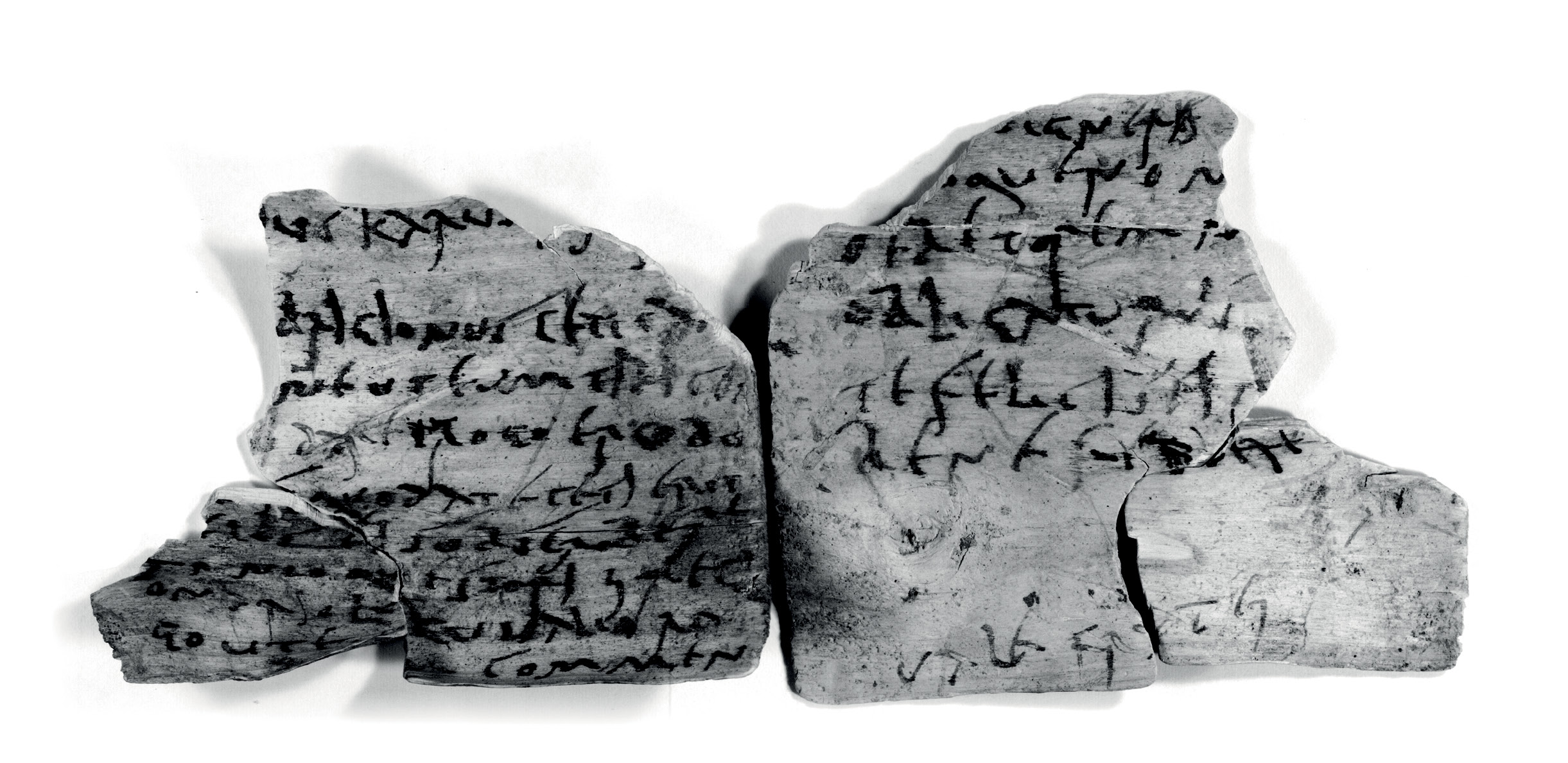
Another example of a soldier seeking help from high places is preserved in one of the Vindolanda tablets. Addressed to Flavius Cerialis, prefect of the ninth cohort of Batavians, it was sent by a man called [—]ius Karus (possibly Claudius Karus, as a man of this name writes to Cerialis on another tablet) in support of a soldier hoping for a position at Carlisle. ‘Brigionus has requested me, my lord, to recommend him to you,’ Karus writes. ‘I therefore ask, my lord, if you would be willing to support him in what he has requested of you. I ask that you think fit to commend him to Annius Equester, centurion in charge of the region, at Luguvalium.’

Toy or training tool? This wooden sword from Carlisle may have been used by new recruits learning combat skills. Image: Tullie House Museum and Art Gallery Trust
In the army now
Once a soldier had enlisted, his status was formalised in a sacred oath – after which he was bound to serve for at least 25 years, with an early exit only offered by poor health, dishonour, or death. Life in the army was relentless: on the march, soldiers were expected to carry packs weighing 27kg and a shield weighing at least another 5.5kg, and in camp much of their time was spent in combat training. This included wielding wooden weapons against timber posts and other artificial enemies – something possibly reflected by the humanoid wooden target dating to AD 72-83 that was found at Carlisle. It was evidently later reused as flooring, as its surface bears scars from being trampled by hobnail boots, and it is now held by Tullie House Museum and Art Gallery in Carlisle – as is a wooden sword that has been interpreted as a practice weapon or possibly a toy. Recruits also had to learn how to use ranged weapons – suggestions of this kind of target practice come from Vindolanda, in the form of an ox skull pockmarked with distinctive square holes from artillery bolts – and, as well as constant route marches and weapons drill, basic training even involved lessons in swimming and horse-riding. Soldiers also occupied their days with manual labour and mundane chores.
The promise of regular, reliable pay (including a sign-up bonus covering expenses incurred during their journey to enlist) must have been a tempting incentive to embark on such an arduous life – to say nothing of the promise, however distant, of a pension or citizenship. Out of these wages, though, soldiers had to buy their own weapons, armour, and other kit. The miserable marine Terentianus writes home to ask for sandals and socks, as well as a ‘battle sword’, various tools including a grappling iron for marine combat, and a cloak, tunic, and even his own left-behind trousers. Footwear, he bitterly notes, wore out twice-monthly. For a British counterpart, the text of Vindolanda Tablet 346 (not included in the exhibition), acknowledges a similar request from a soldier on the northern frontier: ‘I have sent you… pairs of socks… two pairs of sandals, and two pairs of underpants [and] two pairs of sandals’. Those who were able to write for help were at a distinct advantage to their comrades – not just in terms of being able to cadge extra equipment, but because, in a largely illiterate world, only those who could read and write orders were likely to be promoted.
As for how the army was organised, eight soldiers (milites; singular, miles) shared an A-frame tent, eating and sleeping together. This group of tent-sharers was called a contubernium, and ten contubernia made up a century, which was commanded by a centurion – the highest rank that an ordinary soldier could aspire to, earning 15 times the standard pay and, if very senior, up to 60 times this amount. Six centuries formed a normal cohort, and ten cohorts combined with some 120 cavalry made up a legion, normally overseen by a senatorial-ranked legate (who had to be of aristocratic birth).
Kitted out
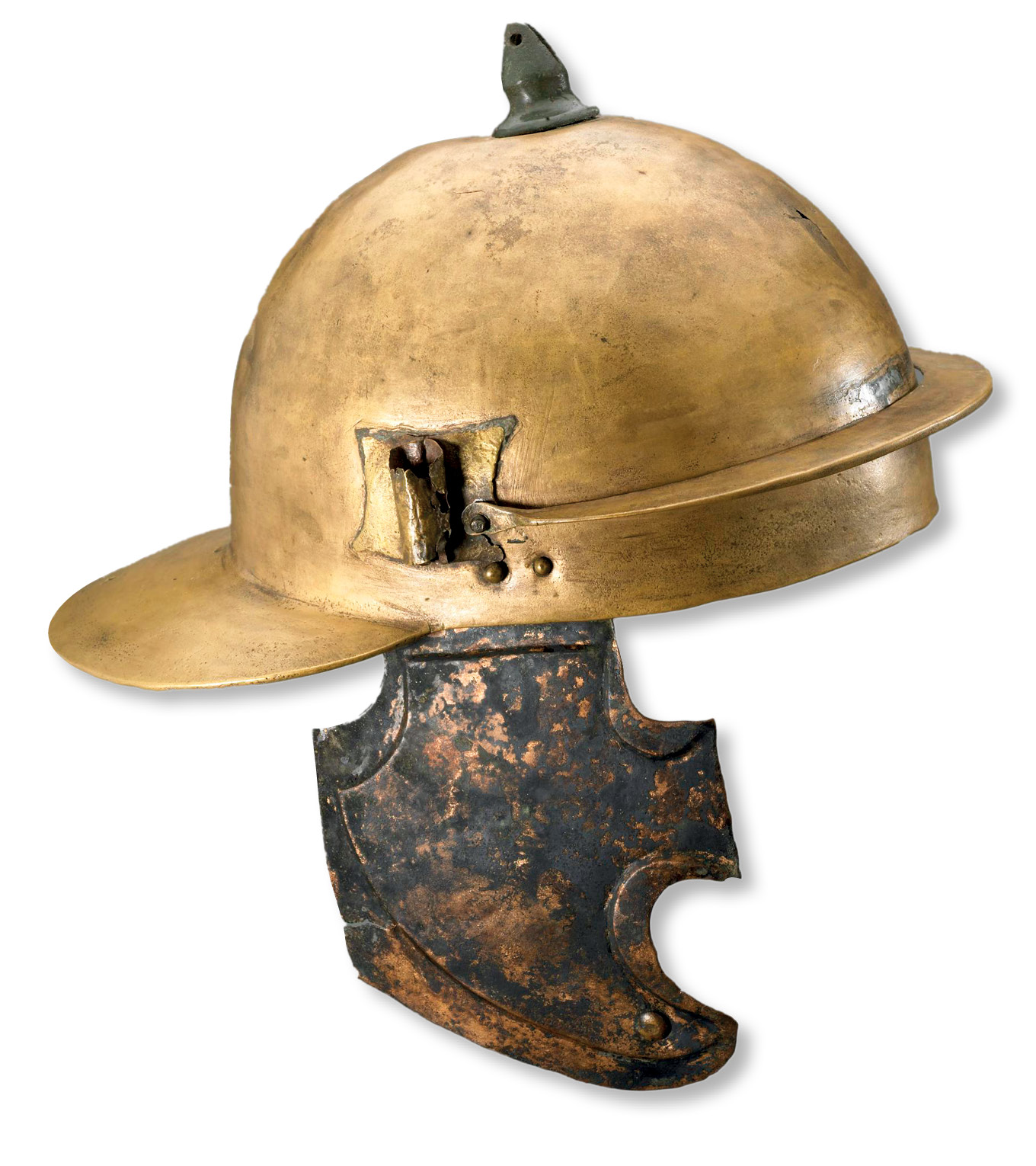
A standard-issue legionary helmet, made of copper-alloy. Image: Copper alloy Roman legionary helmet © The Trustees of the British Museum
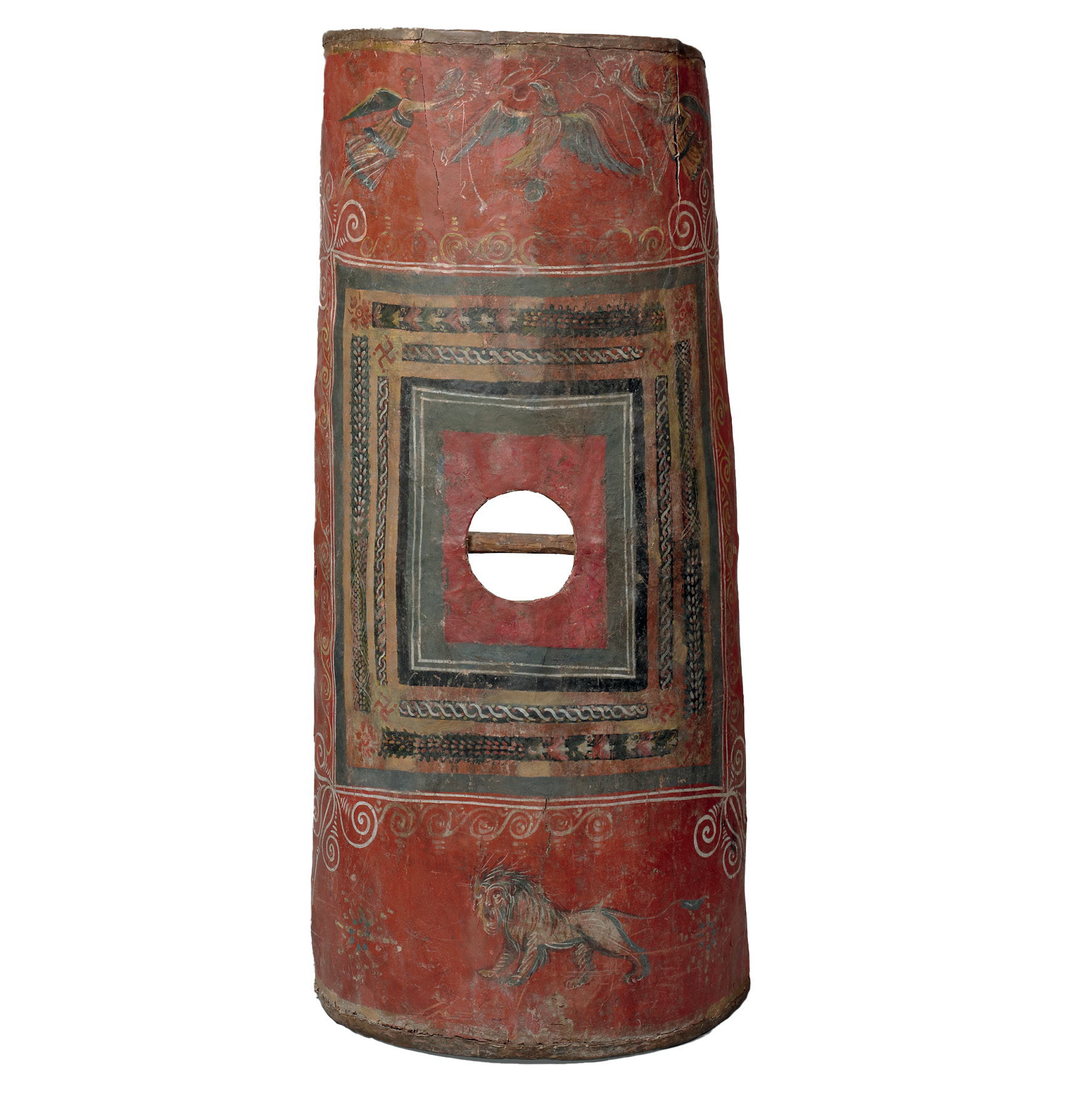
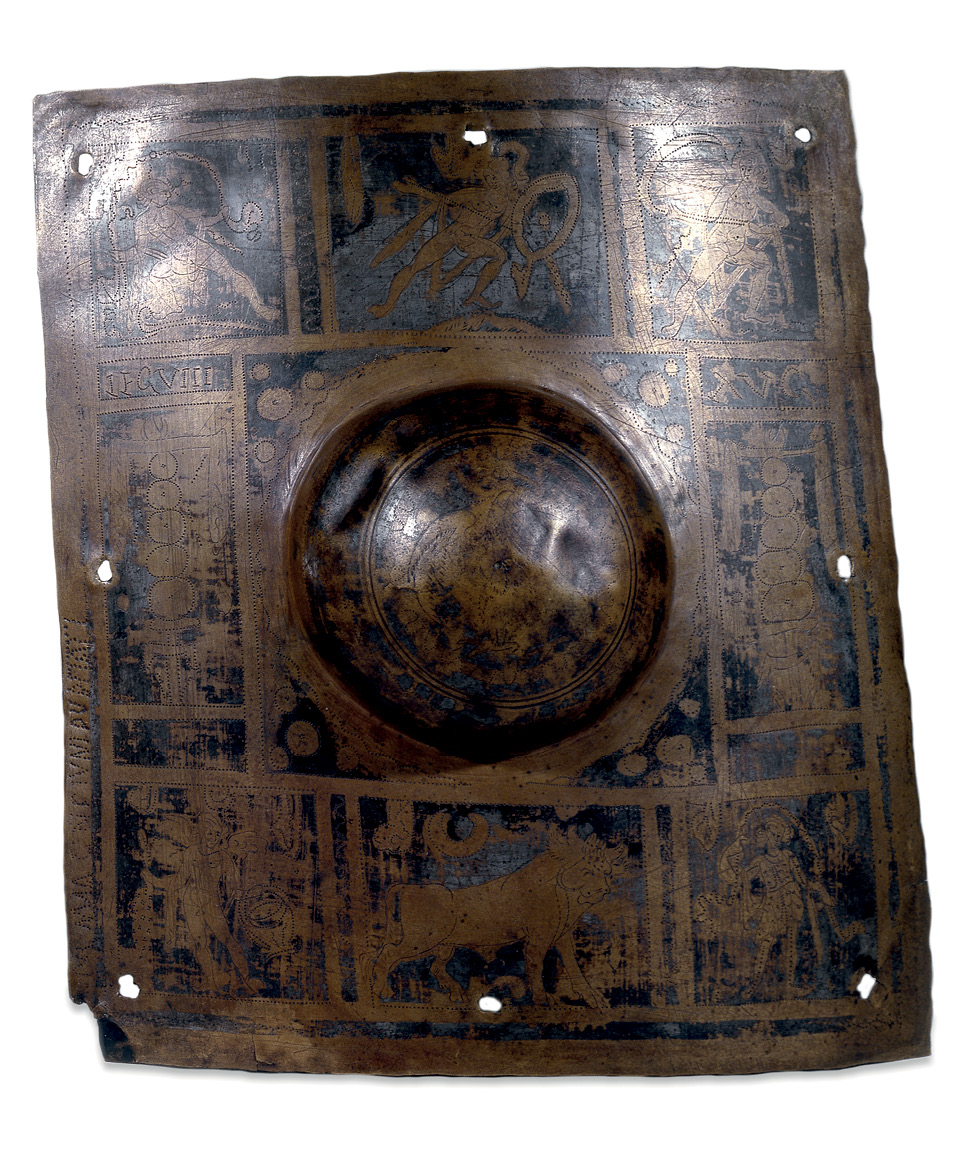
Legionaries and auxiliaries could be easily distinguished by their equipment. Citizen soldiers carried long, heavy javelins called pila (singular: pilum), whose pyramidal heads could punch through enemy shields. They were also armed with short stabbing swords and long shields (scuta; singular scutum) whose curved profile allowed legionaries to lock together in formations like the famous ‘tortoise’ manoeuvre. By contrast, the shields carried by auxiliaries were smaller, flat ovals, and they had simple spears in place of javelins. Given the vast numbers of scuta that must have been manufactured to supply such a large fighting force over the centuries, it seems astonishing that only one has survived intact to the present day: from Dura-Europos in modern Syria, where the dry climate has preserved the shield’s wood and its colourfully painted leather surface. It has no central boss (the shield may have been a spare part that was never fitted with one), but in the exhibition this is remedied by displaying the scutum alongside a shieldless boss that was recovered from the River Tyne. Dating to the early 2nd century, its metalwork is decorated with images including a bull, which was the regimental badge of Legio VIII Augusta.
Thanks to the waterlogged environment of sites like Vindolanda, we have a rich array of objects to help illuminate the other, non-metal, equipment used by Roman soldiers – including the leather outer sheath of a scabbard, and a soldier’s sandal, studded with hobnails to act like rugby boots in the scrum of battle. Adding to this picture is a leather cover for an oval auxiliary shield, which was excavated at Bar Hill Fort in East Dunbartonshire, and a leather quiver once used by an archer based at Birdoswald Fort on Hadrian’s Wall.

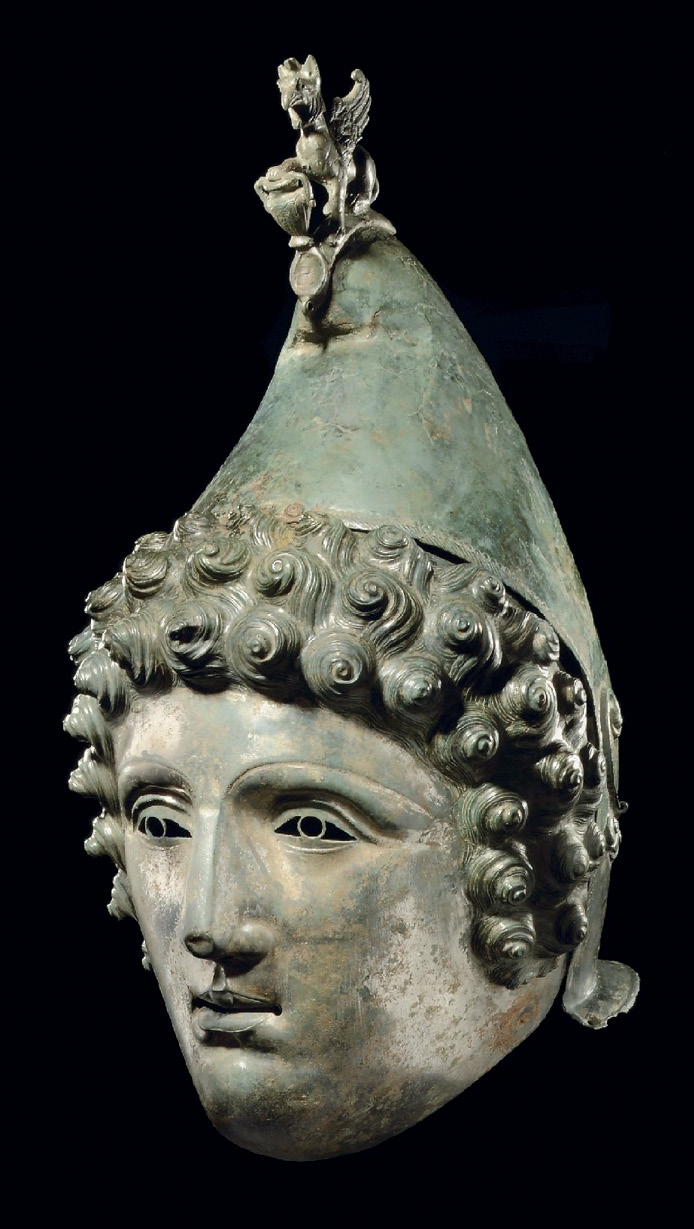
Above & below: The elaborate Ribchester and Crosby Garrett helmets were not worn in battle but for mock combat displays of horsemanship. Images: Christies Inc, CC BY 2.0 DEED
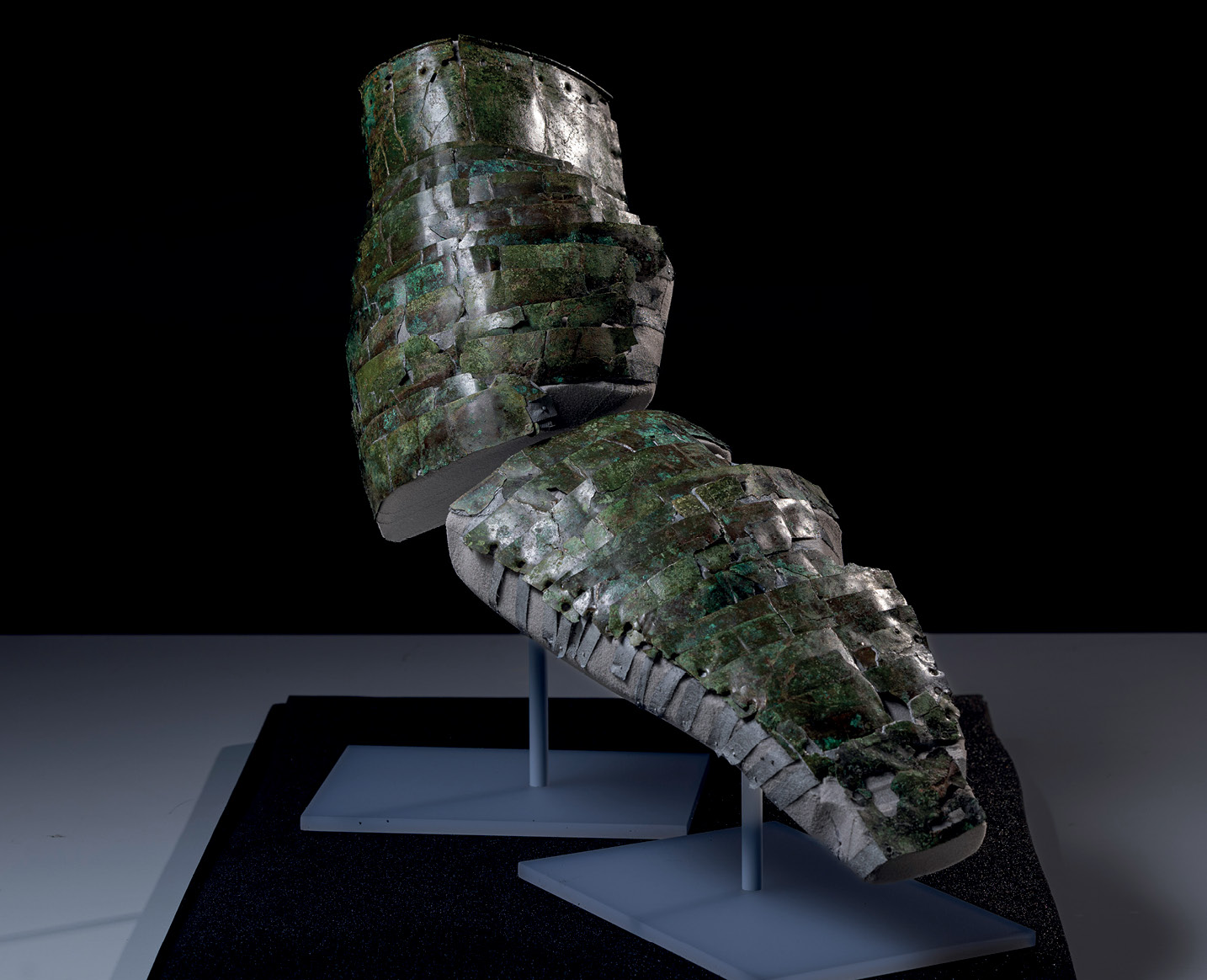
The design of ‘standard-issue’ legionary helmets is immediately recognisable, with its domed cap and flat neck- and brow-guards, but Roman soldiers actually had no formal uniform other than the belt denoting their military status, meaning that units probably had a much less standardised appearance than traditional images suggest. In the exhibition, a diverse range of armour is on display, including an impressive brass arm-guard (found in more than 100 fragments but recently reconstructed; see CA 408) whose design mimics protection used by gladiators in the arena. It was worn by a soldier stationed at Trimontium Fort, near Melrose in the Scottish Borders. The arm-guard is displayed alongside the remains of segmented armour from the same site, which contrasts with a chainmail shirt found in the barracks at Arbeia Fort in Tyneside, which was probably worn by a member of the 5th cohort of Gauls. Arbeia was located at what today is South Shields, just beyond the eastern end of the Wall; about 25 miles to the west, another frontier fort at Corbridge produced fragments of another form of body armour: a segmental cuirass. Originally made of 40 articulated plates, it would have offered similar protection to an iron breastplate, but much greater flexibility.
Weapons and protective gear could be purchased from fort armouries or inherited from veteran relatives, but some soldiers chose to source their kit from local craftsmen. Such items often represent intriguing blends of imperial and indigenous styles: for example, a helmet from an unknown British findspot whose familiar Roman shape is decorated with swirling ‘Celtic’ designs, and a Roman sword, found at Hod Hill in Dorset, which was modified by adding distinctive Celtic-style fittings to its handle. Might these hybrid items have been commissioned by soldiers with British origins, or could they have been owned by legionaries from elsewhere, who admired insular artistry?
Specialist roles
As well as infantry, the Roman army was made up of archers and cavalry. This latter group supported foot soldiers in battle and mopped up retreating foes, and were also often sent on risky scouting missions – but the danger inherent in such tasks was compensated by the glamorous status of mounted soldiers, who enjoyed extra pay, too, to maintain their horses and associated equipment, and the service of a (typically enslaved) groom. Their helmets have a distinctive design, lacking the projecting rear guards of the infantry, which might break their neck in a fall from height.
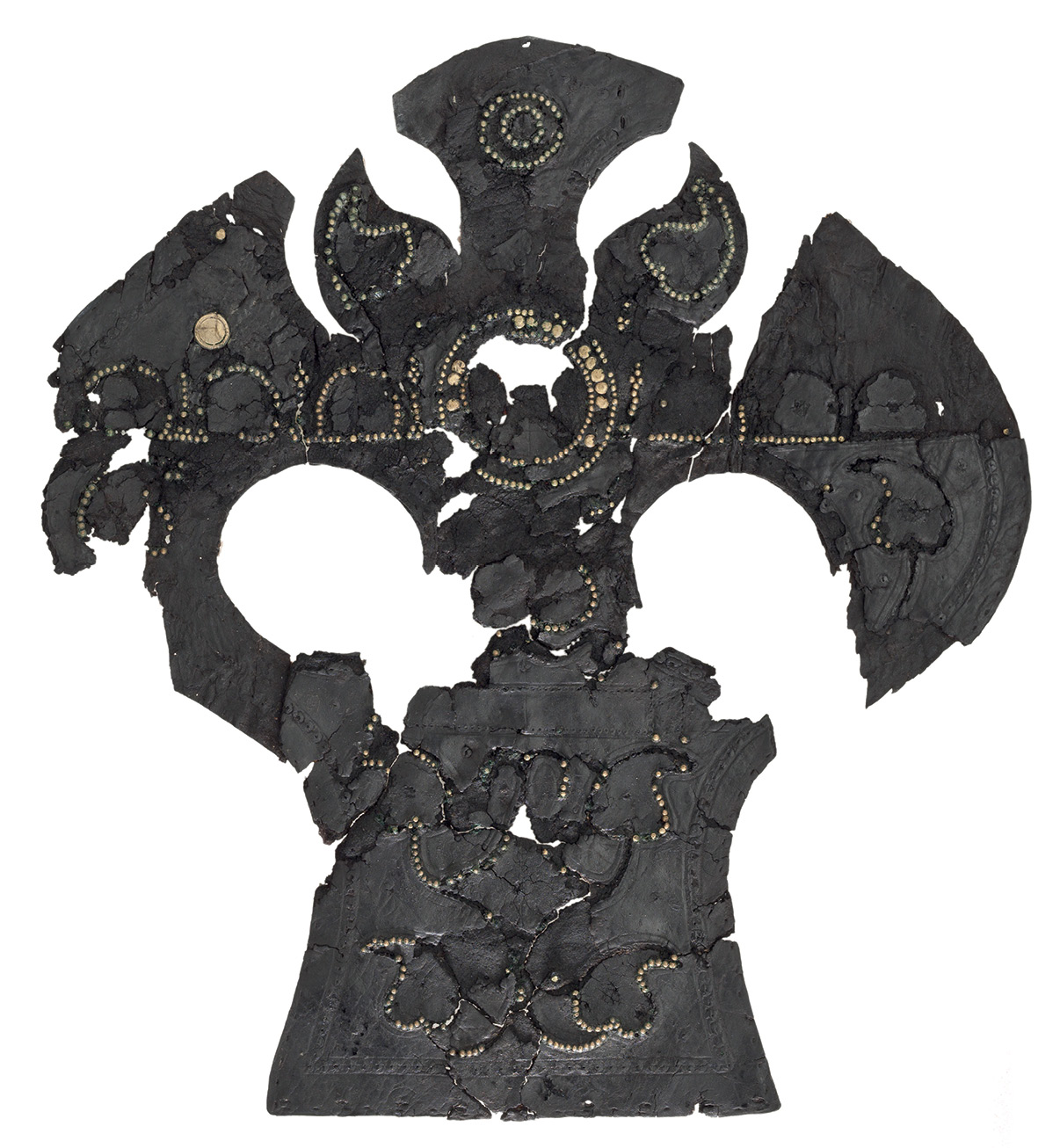
A protective leather mask for a cavalry horse, found at Trimontium. Image: National Museums Scotland
Other headgear associated with the cavalry was far more elaborate, however. Enclosing the whole head, they were impractical for martial use, but instead probably worn during mock-combat displays of horsemanship known as hippika gymnasia. Flamboyantly theatrical examples of such parade gear include the Crosby Garrett Helmet – found near Brough, an auxiliary fort 20km south of Hadrian’s Wall, in Cumbria – which depicts a youthful Trojan warrior wearing a characteristic ‘Phrygian cap’ (see CA 287), and the Ribchester Helmet, which perhaps depicts a warrior from Classical Greece and was found as part of a hoard of metalwork at the eponymous Roman cavalry fort in Lancashire. The ‘skin’ of both faces was originally silvered, topped with bronzed curls of hair. The Ribchester hoard also contained a pair of sieve-like eye guards for a cavalry horse: reminiscent of insect eyes, these would have been mounted on a leather mask (chamfron), an example of which, found at Trimontium, is shown beside them.
Drawn from across the Empire, the Roman army was strikingly diverse, and this was reflected in the troops that were posted to Britain. Inscriptions and other written sources testify to the presence of archers from Syria and infantry from various parts of North Africa on Hadrian’s Wall; Sarmatian cavalry from the Black Sea area are thought to have been stationed at Ribchester (CA 408). Some of these auxiliaries, such as the Sarmatians, were recruited from erstwhile foes, harnessing their particular skills to the Roman cause.

There were also specialised roles within regiments of both auxiliaries and citizen soldiers. A standard-bearer (signifer) received double pay and a distinctive uniform with a lion- or bear-pelt hood, but in return they had to lead the troops into battle, risking their lives at the front of the fighting. They also had to be numerate, as they served as their unit’s treasurer, keeping track of pay and expenses. Each century had its own standard, which served as a rallying point on the battlefield – like modern regimental colours, it was a treasured symbol of the group’s identity, and fiercely protected. Other symbols borne aloft for larger groupings included the vexillum, or banner, denoting a detachment and carried by a vexillarius; the image of the emperor, typically a 3D bust or a roundel relief, which was carried by an imaginifer; and, surpassing all others in prestige, the legionary eagle, or aquila, carried by an aquilifer.
Trumpeters also had a vital signalling role (reflected in the fact that they, too, wore animal hoods), as their instruments helped to convey commanding officers’ orders in the chaos of combat. One more key figure was the army doctor. Aided by bandage-men – soldiers excused from usual chores to nurse their comrades – these were skilled figures who carried out first aid and even surgery during and after battle, and treated everyday illnesses and injuries back at base. The tombstone of one such medic, Anicius Ingenius, has been found at Housesteads fort on Hadrian’s Wall, while a much smaller stone find from Bedfordshire is a stamp that was used to mark sticks of eye ointment, bearing the names of two ‘occulists’ (eye specialists). Far to the north, records from Vindolanda attest that contagious eye problems were a particular issue among the troops in their crowded barracks.
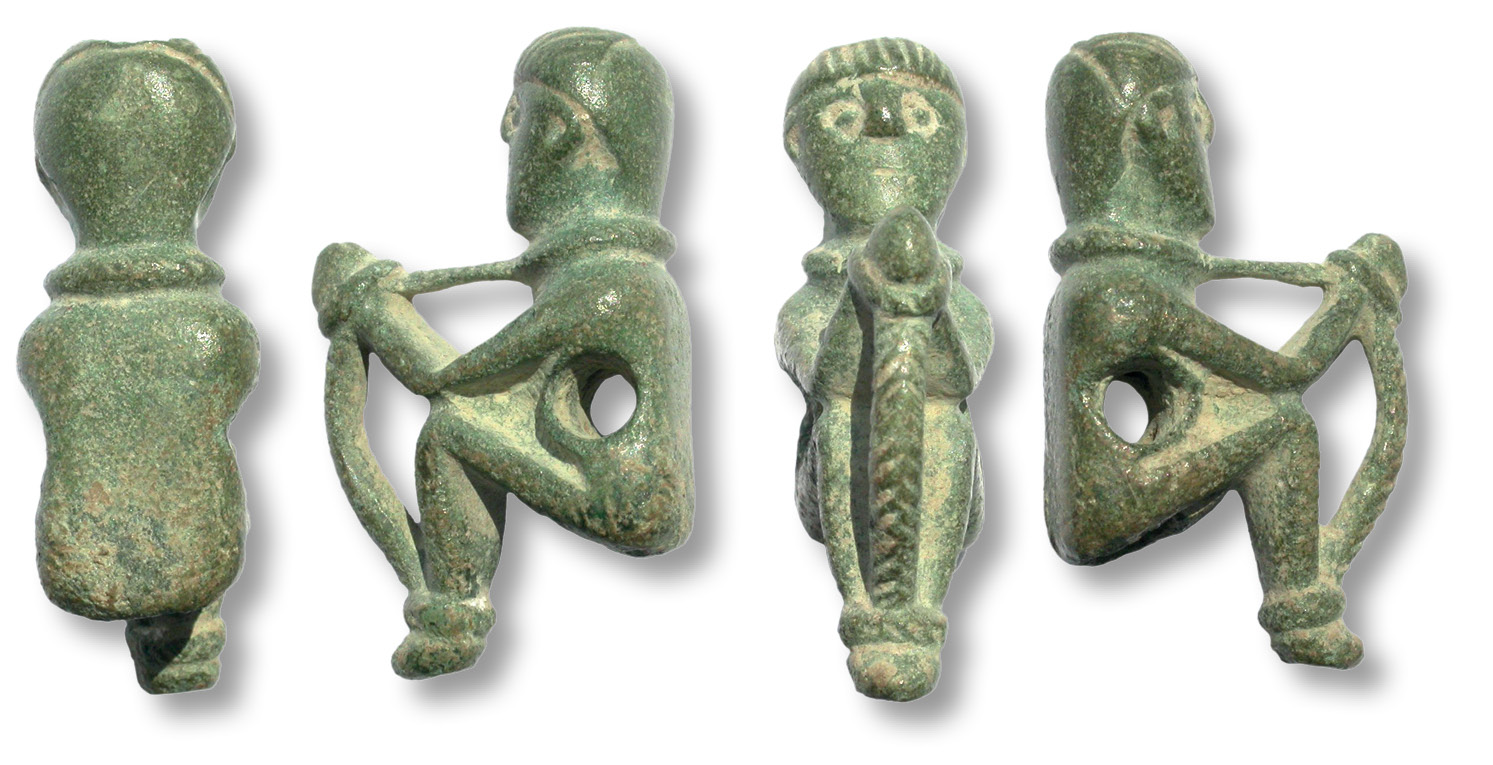
Fighting in a foreign field
On campaign, soldiers lived in camps protected by turf ramparts and wooden stakes. These were basic settlements lacking even the most rudimentary sanitation, and during their stay soldiers lived in leather, traditionally goatskin, tents (which also had to be paid for out of their wages, splitting the cost eight ways with the rest of their contubernium). Remarkably, elements of one such tent can be seen in the exhibition: the serviceable parts of a near-complete example that has survived to the present day, preserved amongst a mass of worn-out leather goods that had been dumped in a storeroom at Vindolanda. These panels would have formed part of the shelter’s roof and sides, and they are displayed alongside some of the many wooden pegs found at the site, which would have held guy ropes in place.
Camps were only intended to be short-lived, and – where a more permanent military presence was required – the Roman army constructed forts. Life within these regimented spaces was not all drill and military routine, however: excavations at sites like Vindolanda have found plentiful evidence of how soldiers spent their leisure time, including wooden clogs worn when visiting the bathhouse, and gaming boards and counters. Complementing these British finds is a turricula, or dice tower, which was found near Cologne in Germany. Such items were intended to prevent cheating in dice games (you can’t manipulate your throw, having to drop your dice into the box-like tumbler). This one is particularly illuminating for our exploration of the impact of the Roman army specifically on Britain, as an inscription on its front reads: ‘The Picts have been defeated… the enemy has been destroyed… play in safety!’
Forts were not only the preserve of soldiers. They were accompanied by extramural civilian settlements hosting bustling industries, shops, and pubs to support the soldiers’ activities and encourage them to spend their wages. Men, women, and children inhabited these spaces – some of whose connection to the military population was more personal than commercial. Soldiers below the rank of centurion were not allowed to marry, but many created unofficial families with local women, or took enslaved captives as concubines. Officers, by contrast, were permitted to live openly with their wives and children within the fort itself.
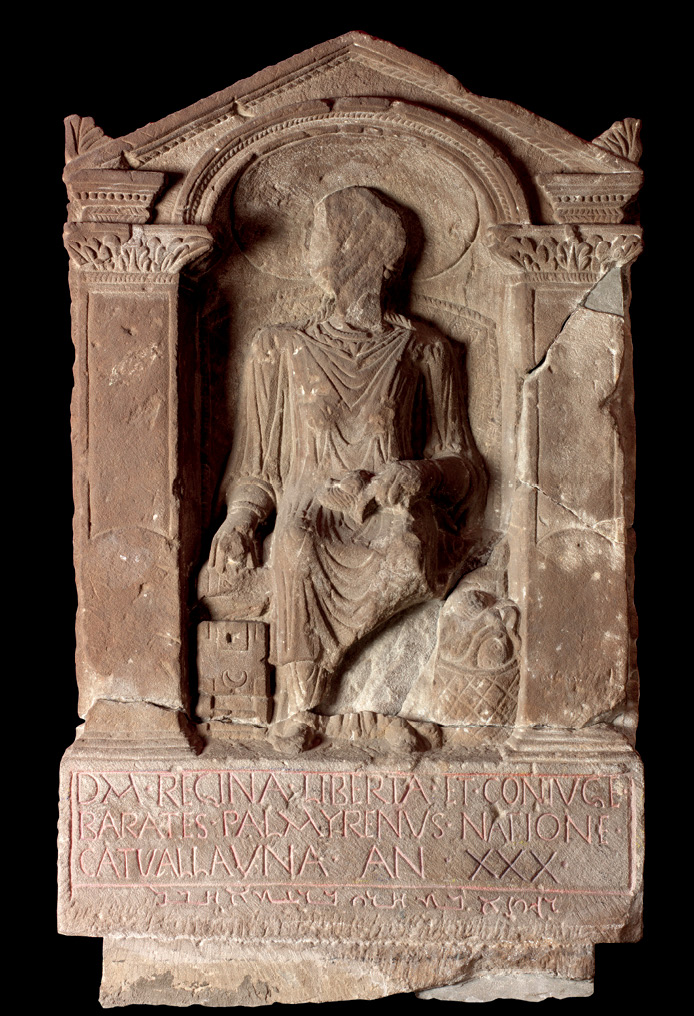
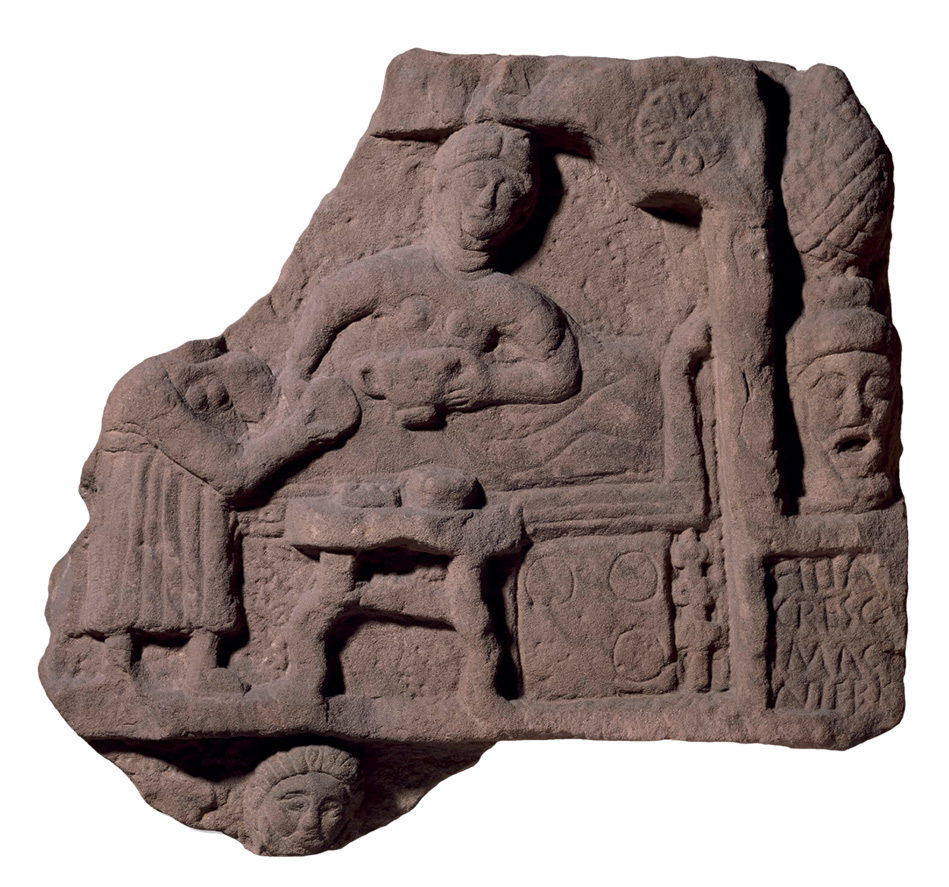
Image: Colin Davison
For a striking portrayal of how women’s experiences could differ in such spheres, look no further than two gravestones included in the exhibition. One, from Arbeia Fort, commemorates a woman called Regina. She had been born far from her final resting place, among the Catuvellauni people in the south of England, and was the wife of Barates, an auxiliary soldier from Palmyra in Syria. As the memorial describes Regina as a freedwoman – formerly enslaved – she may have initially been a concubine as described above, but the expensive monument attests to her having become a woman of means, and she is shown peacefully spinning thread from a basket of wool – a Roman symbol of wifely virtue. Close by, visitors to the exhibition can see the fragmentary gravestone of a woman whose name has been lost, but who was the daughter of an imaginifer called Crescens. Found at Kirkby Thore in Cumbria, its subject reclines on a couch with a goblet and a gaming board, while a servant offers her food.
The auxiliary fort commander, an aristocrat of the rank of tribune or prefect, was also allowed to have his family with him in his official residence, the praetorium. At Vindolanda, the wife of Flavius Cerialis (to whom the letter of recommendation was sent), Lepidina, created correspondence of her own, and her surviving letters testify to a lively social life among the upper echelons of the frontier community, as they include an invitation to a friend’s birthday party, which was sent by Claudia Severa, the wife of another commander.
Moving further still up the social scale, the wives of emperors are known to have occasionally accompanied them on campaign – among them Faustina II, who travelled with Marcus Aurelius (r. AD 161-180), and Julia Domna, who went with Septimius Severus (r. 193-211) to York. Contemporary troops affectionately called both mater castrorum (‘mother of the camp’) – a title proudly used on coins issued in their name.

Rebellion and resistance
What of the indigenous inhabitants of the lands that the Roman army conquered? Those who cooperated could enjoy access to new trade routes and exotic imports, while their leaders were granted luxurious residences like the palace inhabited by Cogidubnus (or Togidubnus) at Fishbourne in West Sussex in return for acting as client kings. Where material enticements were insufficient, however, occupation was brutally enforced. Written sources speak of beatings and summary justice, while rebels and criminals were publicly put to death to deter others. The Romans also introduced savage new punishments such as crucifixion – an agonising fate reserved for slaves, free non-citizens, and army deserters – and the remains of a man from Fenstanton in Cambridgeshire, whose ankle bone is pierced by an iron nail, is thought to represent the only probable crucifixion victim known from Roman Britain.
Further evidence of the contempt that some soldiers felt for the conquered is preserved in one of the Vindolanda tablets. Possibly a military memorandum or an intelligence report describing the Britons’ fighting tactics, it uses the official term Brittones, but also the condescending Brittunculi, which we might translate as ‘little/wretched Brits.’
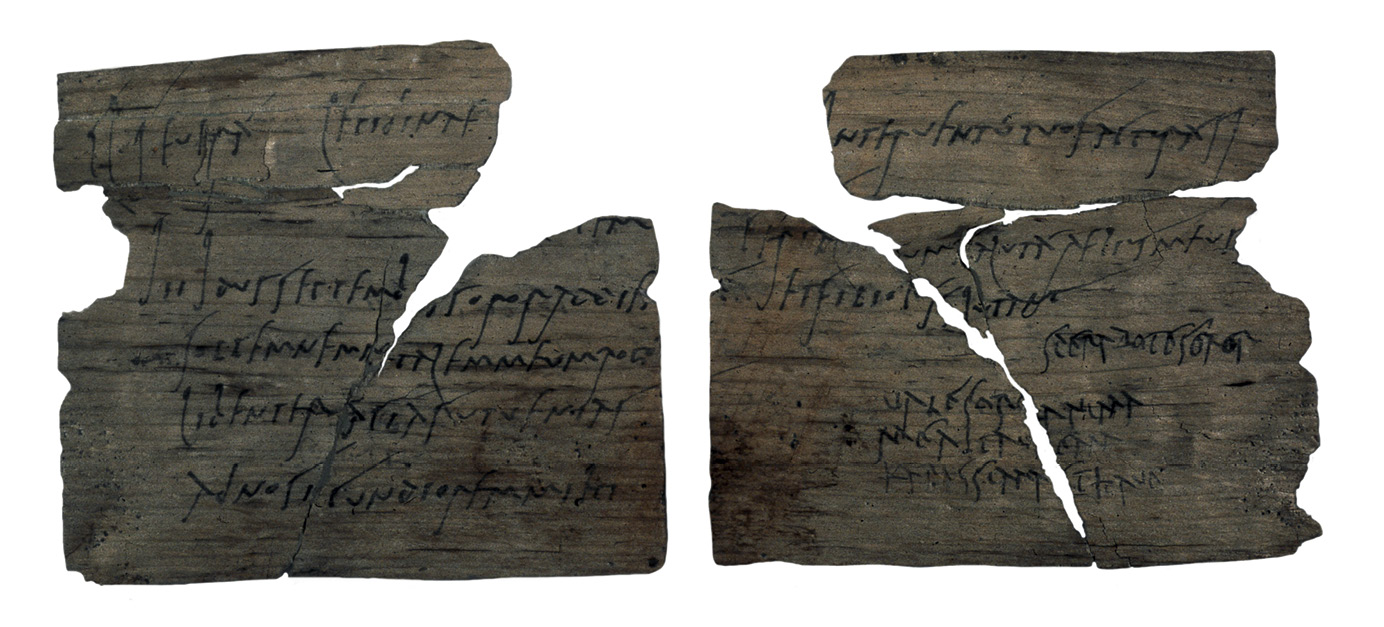
Claudia Severa’s birthday invitation.
One of the ways in which occupied populations were taxed was by requiring them to supply grain to the army – but it appears that the soldiers overseeing this process were not averse to swindling the local people. At Carvoran fort on Hadrian’s Wall, a measuring vessel bears an inscription stating that it holds 17.5 sextarii (just over half a litre). In fact, it could contain 20.8. Mistreatment would have bred resentment, and occasionally outright rebellion. Boudica of the Iceni famously led an uprising in AD 60/61 that razed three Roman towns – Colchester, London, and St Albans – but less well-known discoveries also hint at how hazardous policing occupied territories could be.
In 1977, excavations in Canterbury uncovered the skeletons of two men who had been thrown into a pit (CA 62). The presence of military fittings, hobnailed boots, and two long swords identified them as soldiers – probably cavalrymen, given the length of the blades – and the sword types and radiocarbon dating revealed that they had died in the later 2nd century. The hasty burial suggested foul play, though their bones preserved no signs of violence. Might these soldiers have been murdered on duty, and their swords thrown into the grave to hide the evidence? Or could the blades have been cast into the pit as a gesture of contempt for the regime that they represented?
Further information: Legion: life in the Roman army runs at the British Museum until 23 June. See http://www.britishmuseum.org/legion for more details about the exhibition
Images: Trustees of the British Museum, unless otherwise stated