Subscribe now for full access and no adverts
Two thousand years ago, the roads leading out of London were lined with sprawling cemeteries, in keeping with the Roman taboo against burying their dead within town walls. A portion of one of these sites has now been uncovered by MOLA (Museum of London Archaeology) at Holborn Viaduct, revealing the resting places of some of Londinium’s first residents, preserved 6m below modern street level.
The Western Cemetery was located 170m outside Roman London, having grown up on both sides of Watling Street – a major road running north-west to other important towns such as Verulamium (St Albans) and Viriconium (Wroxeter). The area excavated by MOLA, however, is where the road crossed the valley of the River Fleet, meaning that the ground was very wet: ideal conditions for the preservation of organic materials. Sure enough, as well as numerous inhumations and cremation burials, the team have uncovered rare wooden finds including oak coffins and what has been interpreted as a funerary bed.
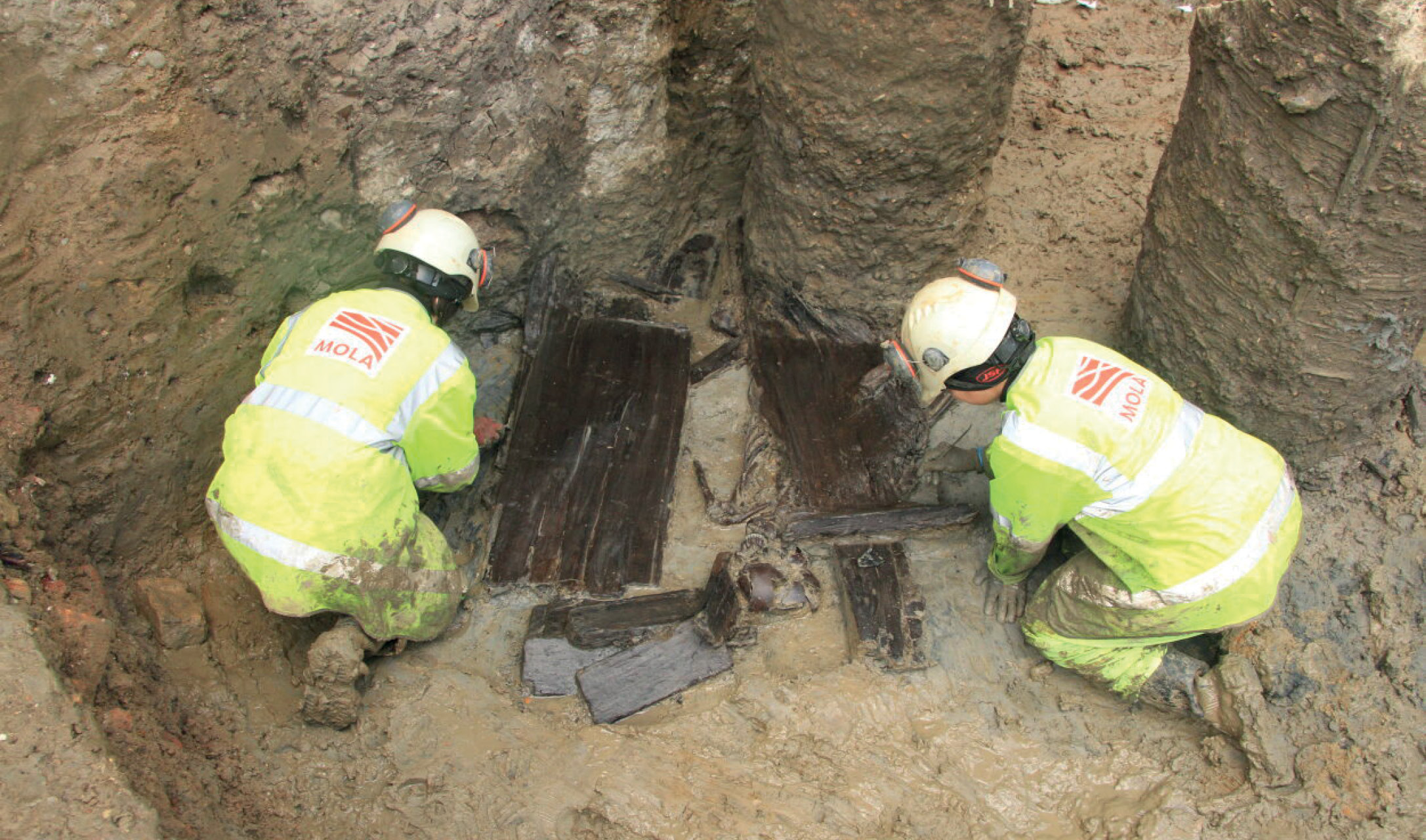
Very few examples of coffins are known from Roman London: in fact, only three adult examples have previously been found (two excavated by MOLA at nearby Atlantic House, also on Holborn Viaduct, and one by Pre-Construct Archaeology in Southwark), together with a handful of burials containing timber planking, and three infant burials using coffins or repurposed boxes. The new excavations have now added five more to this total.
The coffins were all fairly crudely made, but preserve a variety of designs: some were simple boxes made from planks nailed together; some had vertical or horizontal support slats; and one had a base made of a few very thin slats, spaced at a distance from one another, which were nailed to three battens affixed to thin panels at the head, foot, and side. It is thought that this last example would probably not have been strong enough to hold it aloft with the deceased inside, so the team suggest it could have been placed empty into the grave first, and only then was the body laid inside, as if it were a timber-lined cist-burial.

Laid to rest
The other star find from the site was a wooden frame known to the Romans as a lectus (plural: lecti). These were used for various purposes including sleeping (lectus cubicularis), dining (lectus tricliniaris), and burial (lectus funebris). While this last option seems to be the most appropriate interpretation at the Holborn site, for now the MOLA team are simply calling it a ‘bed’.
Depictions of beds being used as part of funerals are common across the Roman world, and fragments of other possible examples have previously been found in London, Colchester, and St Albans. These generally seem to reflect a different design, however, where turned wooden pieces were slotted on to a reinforced iron frame, much like more intact examples known from Herculaneum. The funerary bed found at Holborn is the first complete example ever discovered in Britain, allowing the team to examine its design in detail.

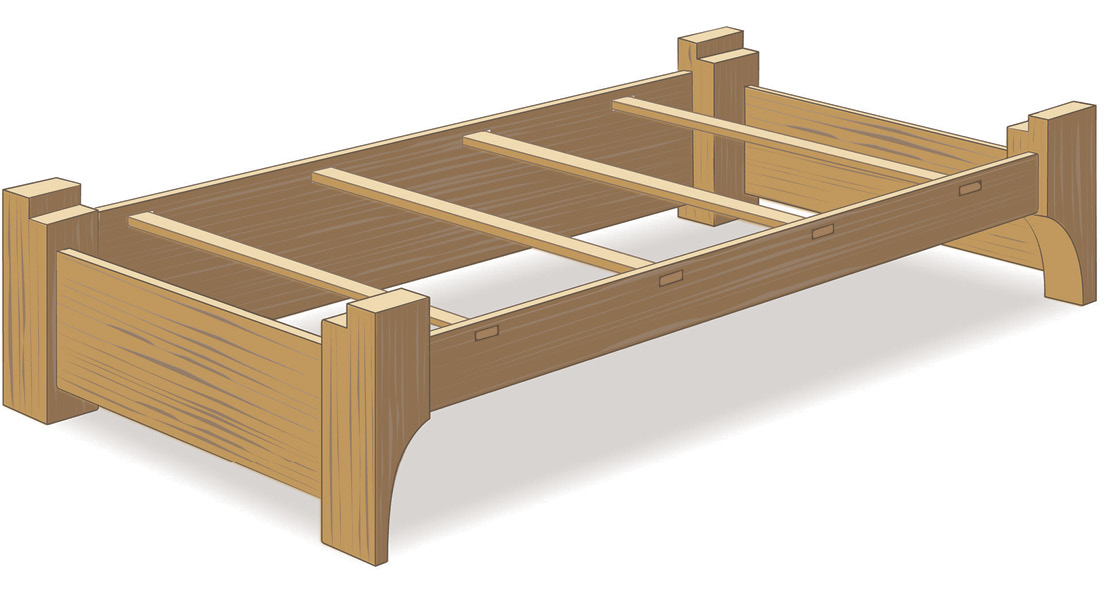
The frame had been dismantled and neatly stacked over the remains of a young man aged about 26 to 35 – it is suggested that it could have been used to carry him to the grave before being taken apart and placed within the burial so that it could be used in the next life. It was made of high-quality straight-grained oak heartwood, and analysis of its materials indicates that it had been made in Britain rather than imported from the Continent. Thanks to their damp, muddy surroundings, the timbers are so well-preserved that you can still see tool marks left by a smoothing plane and a froe (paling axe), as well as the blind mortice and tenon joints that held the frame together, some secured with small wooden pegs.
The bed had solid, carved feet, and decorative ‘beading’ moulding is still visible on the head- and footboards and the side rail. Those head- and footboards are very wide, indicating that they had been cut from trees of a very large diameter, the team notes. This might indicate that wild wood was used in their creation, and reflects a degree of refined woodworking that has not been previously seen in Roman Britain. It also represents a rare example of joinery and medium-scale carpentry (as opposed to large undertakings like buildings and revetments) that adds invaluable information to our understanding of such industries in Britannia.
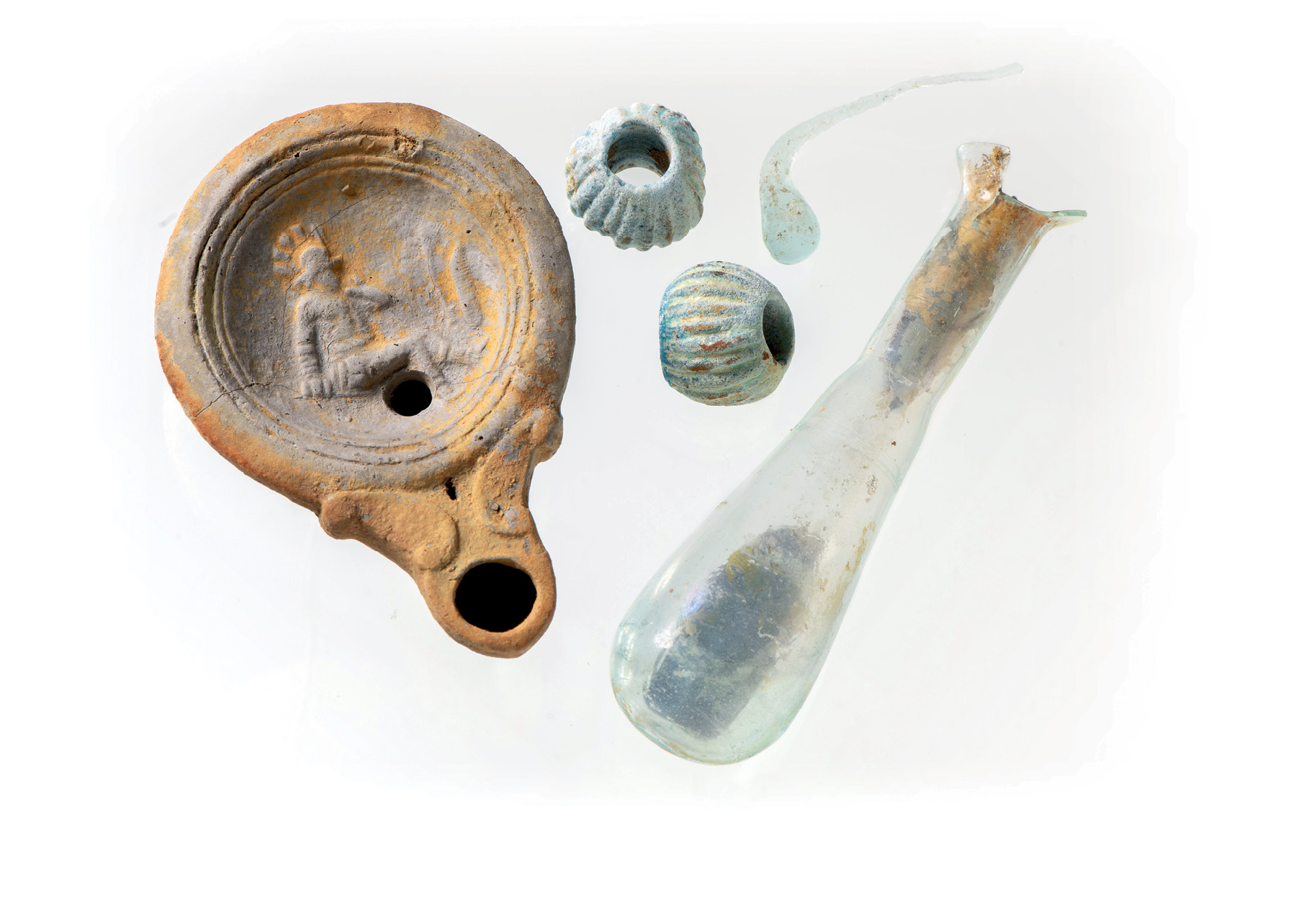
Excavations are ongoing, as is analysis of the burials, but funerary activity is thought to have grown up around the road from the mid-1st century AD, not long after Watling Street itself was created, and to have continued throughout the Roman period. Some of the burials can be quite closely dated, thanks to the grave goods that they contain: one of the earliest identified so far is a richly furnished bustum cremation that was accompanied by faience melon beads, and glass and pottery vessels including an oil lamp depicting a defeated gladiator. Similar objects to this latter find are known from other Roman burials in Britain, both within London (for example, Southwark) and further afield (Colchester), and it has been suggested that the fallen gladiator motif might have been deliberately chosen for funerary use, as it evokes ideas of mortality.
Despite these British parallels, however, the assemblage as a whole is more in keeping with Continental finds, the team say – highlighting the cultural impact that the Roman conquest was already having on Britain. The cremation is thought to date to AD 48-80, soon after the Claudian invasion and the foundation of London itself, when a high proportion of the town’s population would have been newcomers. Its contents reflect funerary traditions with origins in the Mediterranean area, and highlight that, as well as an influx of new people, this period also saw the arrival of innumerable new ideas, customs, and material goods.
Other burials were found to include coins, dice, and personal items including jewellery using expensive jet and amber beads. As post-excavation analysis begins to conserve and closely examine these finds, it is hoped that scientific dating techniques, together with analysis of artefacts and the stratigraphy of the site, will help to clarify the cemetery’s chronology and perhaps show how its burial rites evolved over time.
Post-Roman to present
It was not only evidence of Roman activity that was uncovered on the site: the team found chalk floors and wells lined with reused barrels, too, which are thought to represent the remains of a 13th-century tannery mentioned in historical documents. This area was also (from the 12th century onwards) part of the parish of St Sepulchre, and it appears that in the late 15th-16th century the site regained its earlier funerary role, being again used as a cemetery. Another well-preserved wooden feature reflected this period of the site’s past: part of a ship’s pump, which had been repurposed as a Tudor wastewater pipe emptying into the river.
There were brick floors as well, from 16th- and 17th-century buildings including inns and workshops, which appear to have survived the Great Fire of London in 1666 only to be destroyed during the construction of Victorian warehouses, and in the latest chapter of its life, the site is now being transformed into office space for the global law firm Hogan Lovells. Once complete, it is intended that some of the archaeological finds will be displayed at the building.
Source: Gwilym Williams is a Project Manager at MOLA. Alex Blanks reported on the ‘bed’, and Michael Marshall commented on the grave goods.
All images: MOLA