Subscribe now for full access and no adverts
Edinburgh is celebrating 900 years of city status this year, having been created a royal burgh in 1124, the first year of the 29-year reign of King David I (1084-1153). Historians refer to the establishment of a network of burghs and markets and the foundation of monastic institutions that occurred during his reign as the ‘Davidian Revolution’.
Markets and monasteries
Markets and monasteries were very much connected because when, in 1128, King David donated one of his favourite hunting grounds for the foundation of the Augustinian abbey of the holy rood, or crucifix, his grant included the right to establish a trading burgh just outside the monastery walls – today’s Canongate. Among the other benefactions were fishing rights on the River Tweed; half of the tallow, fat, and hides from beasts slaughtered for the king in Edinburgh; funds from the port of Perth to pay for vestments; the teinds (tithes) from some 27 parish churches; and the authority to take timber from royal forests for building purposes.
The partially excavated footings of the first monastic church indicate that it was a relatively modest structure. It was colonised from Merton, in Surrey, being the third of Merton’s seven daughter-houses, and there are strong similarities between the main churches of the two institutions. Both had small cruciform churches, without aisles but with shallow transepts and a rectangular presbytery. Merton had two chapels projecting from the eastern side of each transept, whereas Holyrood had just one on each side.
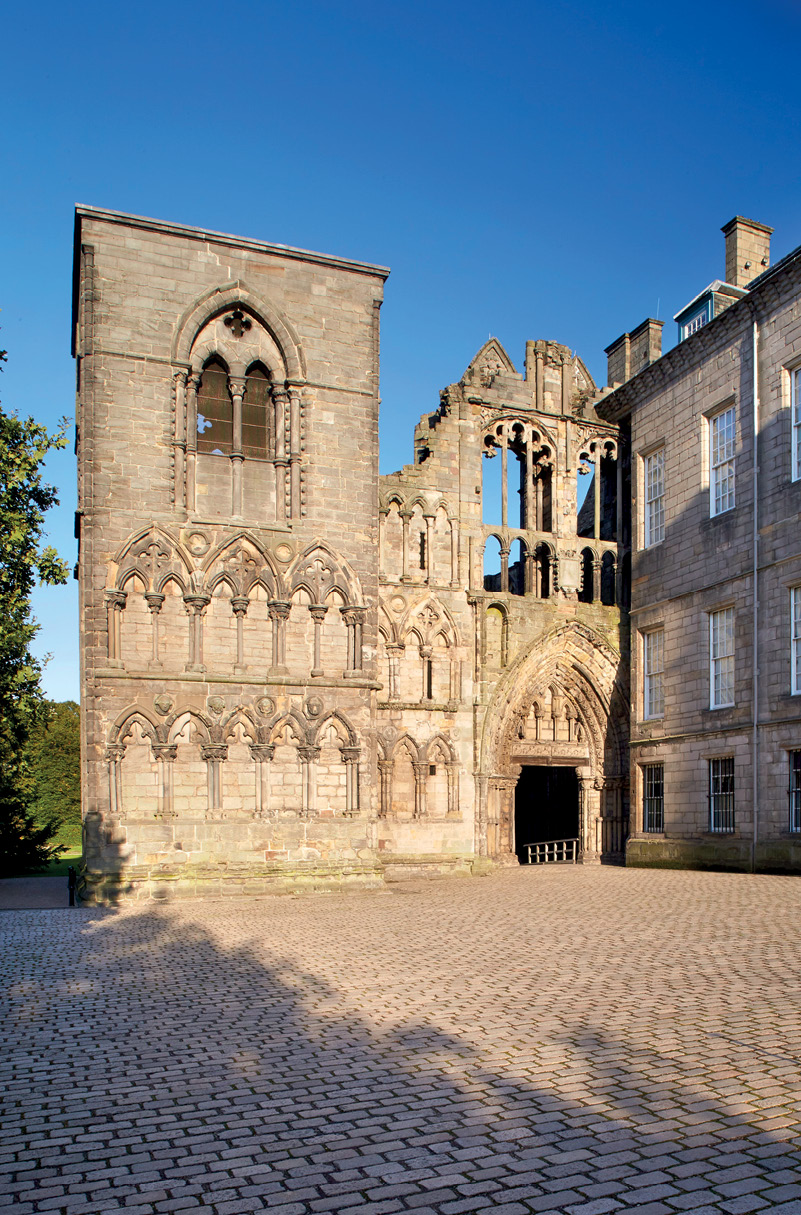
Above ground, the only feature to survive from that first church is a round-arched chevron-decorated doorway that was moved in the 13th century to a new position, where it marked the entrance to the cloister from the church nave; it might have served the same function in the first church, too. The doorway is similar in design to the chancel arch of the chapel of similar date in Edinburgh Castle, which could be the work of the same mason.
Over the next 400 years, Holyrood grew to be one of the finest medieval abbeys in Scotland, and the substantial ruins of later monastic buildings survive alongside today’s palace. A royal guest house had long existed within the precincts of the abbey, and these royal lodgings were preferred by the Stewart kings of Scotland in the 15th century to the cramped and cold accommodation at Edinburgh Castle. James II (r. 1437-1460) was born, crowned, married, and buried in the abbey, and his son James III (r. 1460-1488) married Margaret of Denmark there in 1469.
The building blocks of marriage
It was James IV (r. 1488-1513) who made the decision to transform the guest house into something more substantial, embarking on a major building programme occasioned by his impending marriage to Margaret Tudor (1489-1541), eldest daughter of Henry VII of England (r. 1485-1509). This long-negotiated match formed part of the Anglo-Scottish peace treaty of 1502 (the ‘Treaty of Perpetual Peace’), also known as ‘the union of the thistle and the rose’. It was eventually to pave the way for James VI of Scotland, the great-grandson of Margaret and James, to be crowned James I of England, which in turn led to the Union of the Scottish and English Crowns.
The wedding took place in Holyrood abbey church on 8 August 1503, by which time the first phase of the new palace was largely completed. Nothing survives of the building (partly because the present palace, built in the 1670s, occupies the same site and is laid out on the same footprint). We do know from contemporary descriptions and financial accounts that the accommodation was arranged around a quadrangle, with a grand entrance and outer gateway, painted and gilded with the king’s arms. Suites of apartments for the king and the queen were located on the first floor, and a tower stood near the south-eastern corner, with additional accommodation for the king.
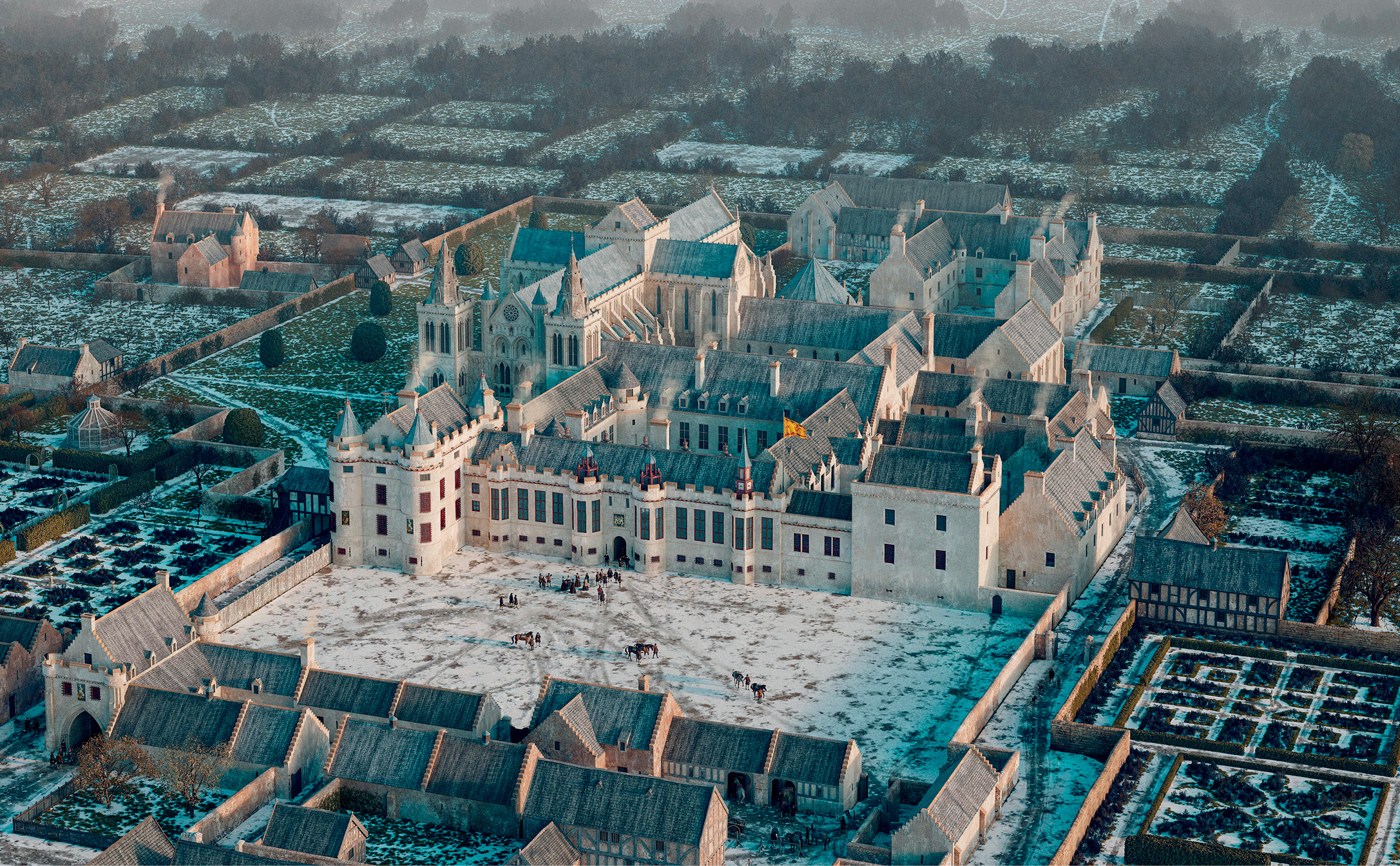
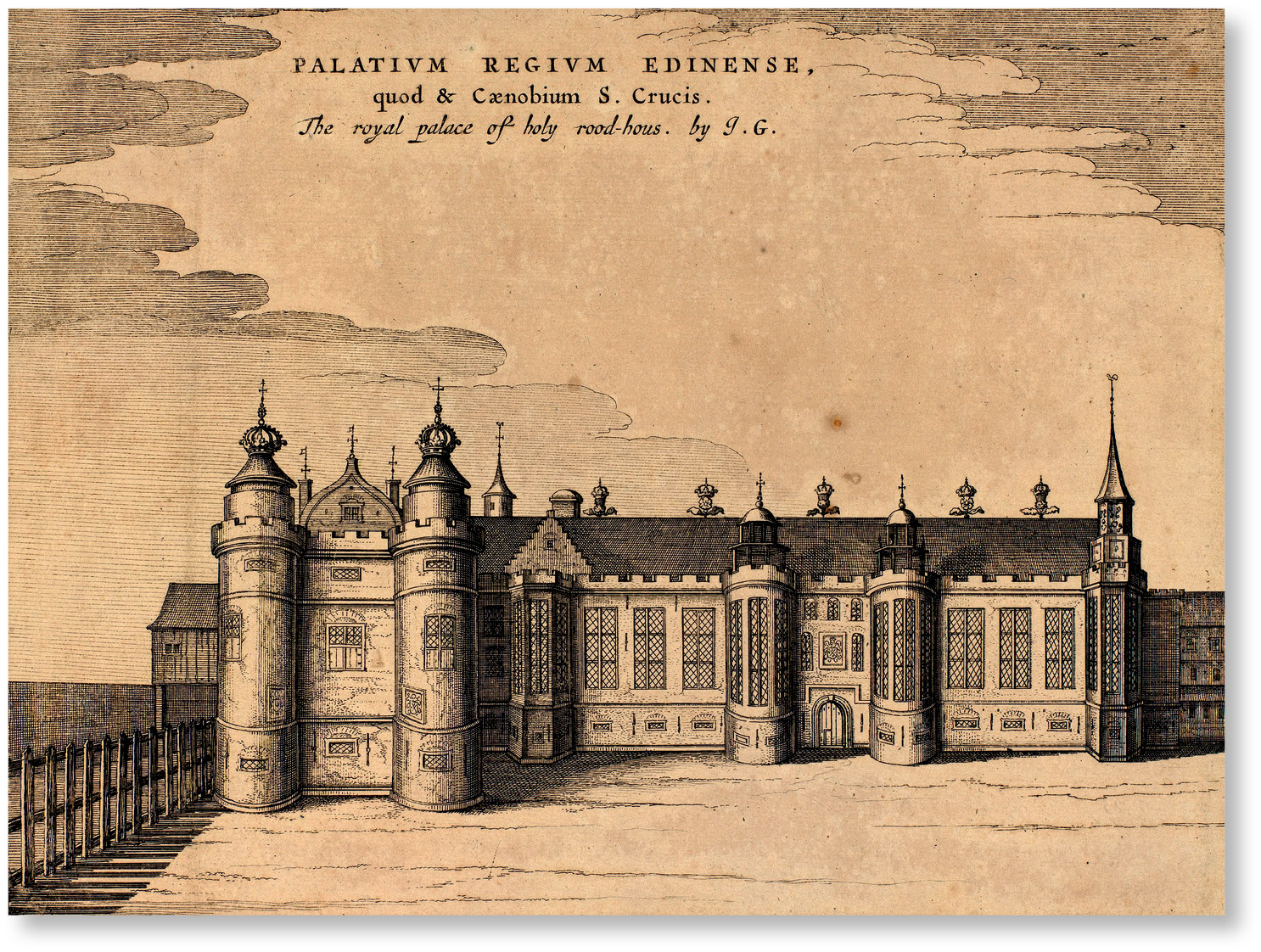
James V succeeded to the throne at the age of 18 months, after the death of his father in 1513 at the Battle of Flodden. Coming of age in 1528, he immediately began remodelling his father’s palace. A massive new tower was erected in the north-west corner, initially conceived as a free-standing structure containing lodgings for the king on the first floor and for a future queen on the floor above.
At that stage, marriage was still theoretical, but in 1436 James V travelled to France and agreed to marry Madeleine, daughter of Francis I of France; he also fell in love with the new Renaissance architecture of the Loire Valley palaces, including Amboise, where James met Madeleine for the first time, and Blois, where the marriage contract was signed. In honour of his bride, to uphold the prestige of the Scottish monarchy, and to house Madeleine in the style to which she was accustomed, he had the west range of his father’s palace demolished and rebuilt as quickly as possible, using an army of more than 80 masons and 20 wrights and carvers, making use of some building materials from the old structure as well as newly acquired timber, stone, and slate.
The resulting façade is strikingly reminiscent of contemporary Tudor palaces, such as Henry VII’s Richmond Palace and Henry VIII’s Hampton Court, with its large windows, projecting bays, and double-towered gateway set with a stone panel bearing the royal coat of arms.
James married Madeleine at the Cathedral of Notre-Dame in Paris on 1 January 1537, and brought her to Holyroodhouse in May. Unfortunately, she was already suffering from poor health following a bout of tuberculosis, and it deteriorated on the journey to Scotland. She died only a few weeks later, and was buried in the abbey church.

It was thus James’ second wife, Marie de Lorraine, also known as Mary of Guise, who enjoyed the newly built palace. The marriage took place on 17 June 1538, further cementing the Franco-Scottish alliance, and Mary was crowned at Holyrood Abbey on 22 February 1540. Their two sons died in infancy and were buried at Holyrood. Their only surviving child, Mary, was born on 8 December 1542. Six days later, James V died, and his newborn daughter succeeded to the throne of Scotland as Mary, Queen of Scots (r. 1542-1567). The king’s body was interred in the abbey church, close to the high altar, making him the last Scottish monarch to be buried at Holyrood.
Dynastic marriages thus played a crucial role in the way that abbey and palace developed side by side, with the Palace of Holyroodhouse (so named to distinguish it from Holyrood Abbey) growing in scale to match the grandeur of the abbey, and the abbey increasingly being treated as a private royal chapel.
Tudor terror
It was another marriage proposal that then led to the beginning of the abbey’s decline, for the late medieval church suffered more damage from the ‘Rough Wooing’ than it did from the iconoclasm of the Reformation. This bitterly ironic name refers to the eight years of conflict that resulted from Henry VIII’s declaration of war on Scotland in 1543 – his way of trying to persuade the Scottish Parliament to agree to a merger of the two kingdoms, to be sealed by the marriage of the English heir apparent, the six-year- old Prince Edward, and the infant Mary, Queen of Scots.
By 1544, the English army, under the direction of the Earl of Hereford, had reached Edinburgh, where they camped just outside Holyrood. The fighting that ensued left the eastern arm of the abbey church in ruins. At the same time, the font, lectern, and abbey treasures were looted, and in 1546 the roofs were stripped of lead and the bells taken.
Mary, meanwhile, took refuge in France, where she married Francis, Dauphin of France (1544-1560) in 1558, and when the French king Henry II died the following year, the 15-year-old Francis and 16-year-old Mary became king and queen of France. Francis then died in 1560 and Mary returned to Scotland, living at Holyroodhouse. Her subsequent marriage to her half-cousin Henry Stuart, Lord Darnley, in February 1561, his jealous murder of her private secretary David Rizzio, his own subsequent assassination, Mary’s abdication and escape to England, and her execution by her own cousin, Elizabeth I, in 1587 have all been the subject of folk song, romantic biography, stage plays, and film. Holyroodhouse was the location for a number of the controversial events of Mary’s six- year residence, and many visitors today visit the palace specifically to see what is claimed to be the bloodstain on the floor of the queen’s apartment resulting from Rizzio’s murder in 1566.
Henry Stewart, Lord Darnley (d. 1567), was buried in the ruins of the monastic presbytery, but in 1570 Bishop Adam Bothwell (d. 1593) was given the task of demolishing what remained of the east end. A new vault was constructed in the south nave aisle to hold Darnley’s remains and those of James II (d. 1460), James V (d. 1542), and his wife Queen Madeleine (d. 1537), all relocated from their original graves near the monastic high altar. The stone from the cleared presbytery was then used to construct a new wall blocking the western crossing arch, leaving the intact nave to continue in use as the post-Reformation parish church.
Mary’s abdication in 1567 led to the succession of her 13-month-old son, James VI, who was brought up at Stirling Castle, but moved to Holyroodhouse in 1579 to occupy the apartments built by his father in the north-west tower. After James’ marriage to Anne of Denmark and her seven-hour coronation ceremony in Holyrood abbey church, Holyroodhouse became their primary residence, as well as that of their seven children and a court of around 800 servants, family members, and retainers.
All this changed when, on 24 March 1603, Elizabeth I died childless at Richmond Palace in Surrey, and Sir Robert Carey raced north to Scotland for an audience with James at Holyroodhouse. There, on 31 March, he was proclaimed King of Scotland, England, France, and Ireland. James left Edinburgh for London five days later; Anne and the majority of the royal court followed shortly after, and with them went nearly all the furniture, tapestries, paintings, jewellery, clothing, and plate in the palace.
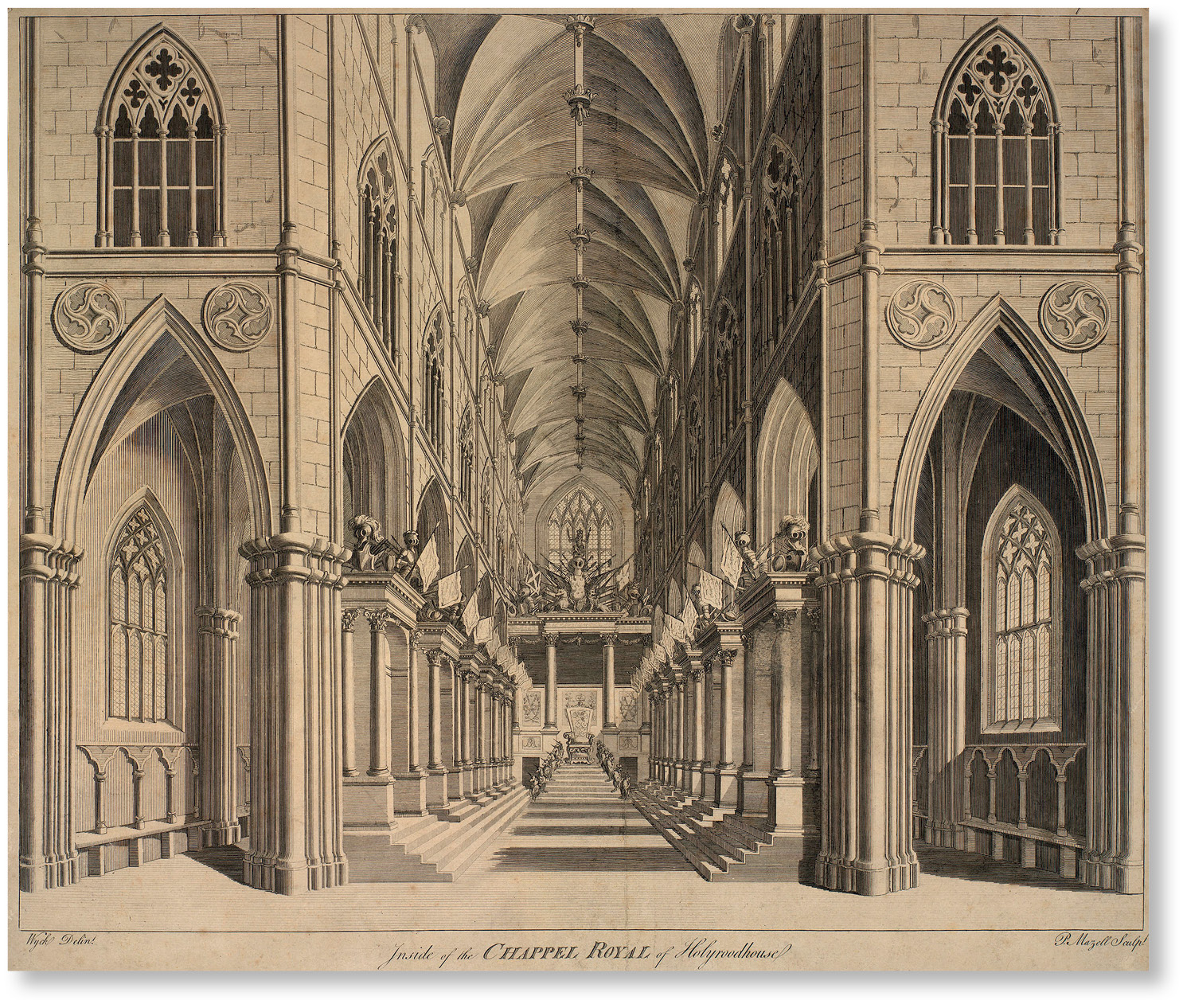
Holyroodhouse was never again to be a permanently occupied royal residence, but Scotland’s Parliament and Privy Council continued to meet regularly in the palace. On his departure for London, James promised to visit Scotland every three years, but he only returned once, in 1617. Ominously, the king found himself unpopular with Scottish ministers because of the services that took place in the palace chapel. David Calderwood, a leading figure in the Scottish kirk, deplored the choral singing, the vestments, the organ music, not to mention the chapel furnishings, with pews carved with figures of apostles and evangelists by the English sculptor Nicholas Stone, and a painted and gilded interior, the work of decorative artist Matthew Goodrick.
From reformation to restoration
Further extravagant ceremony took place in 1633, when the abbey was chosen as the venue for the Scottish coronation of Charles I. In preparation for the event, the solid east wall was given a magnificent new traceried window and the west front of the abbey was remodelled, including a new west doorway created for the king’s royal progress. Above the doorway, a tablet within a strapwork frame states (in Latin) that: ‘the most excellent King Charles restored this half-ruinous church in the year of our Lord 1633’.
In 1646, Charles I appointed William Hamilton, 2nd Duke of Hamilton, premier peer and former Secretary of State for Scotland, as Hereditary Keeper of the Palace, and it was under the care of the Dukes of Hamilton that the palace and abbey survived the English Civil War unscathed until, in 1650, Oliver Cromwell arrived in Edinburgh with an English army, some of whom were quartered at Holyroodhouse. On 13 November fire broke out and, according to the contemporary Scottish chronicler John Nicoll: ‘the hail Royall pairt of that Palice wes put in a flame, and brint to the ground on all pairtes thairof… except a lytill’.
The damage caused by the fire led to the next phase in the history of the palace, when the building was almost completely rebuilt. The architect chosen for the new work was Sir William Bruce (c.1625-1710), who was appointed Surveyor General and Overseer of the King’s Buildings in Scotland in 1671, at an annual salary of £300.
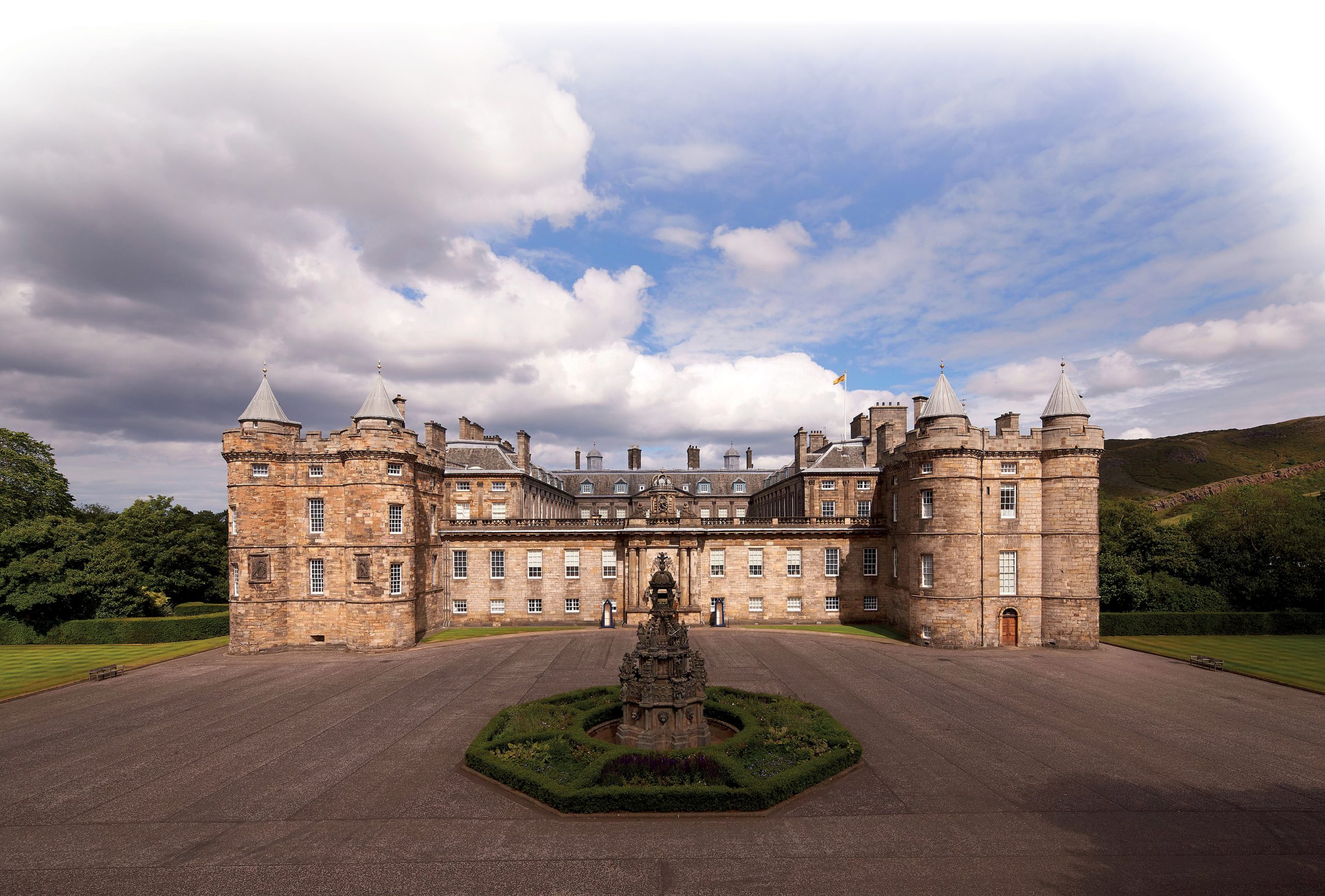
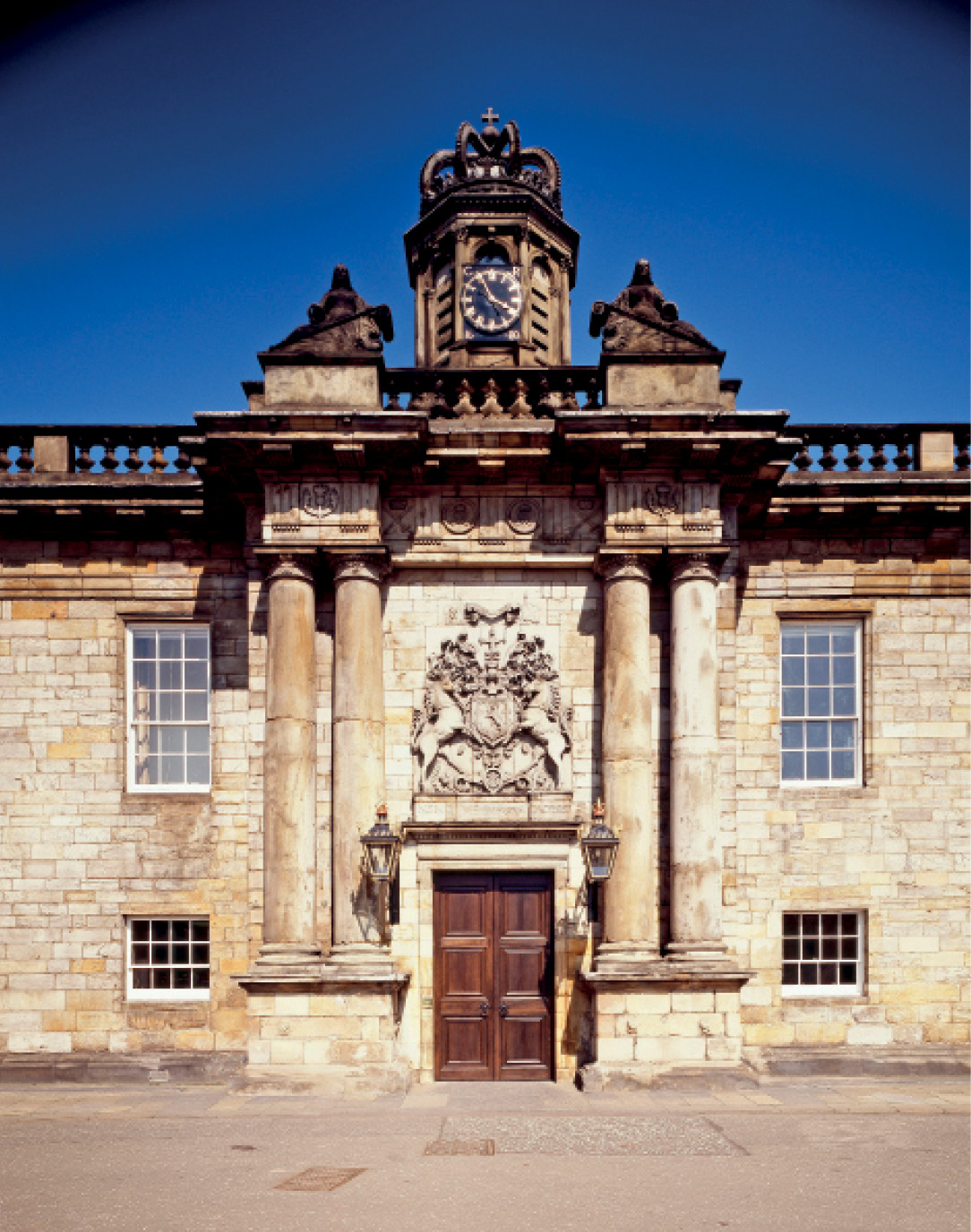
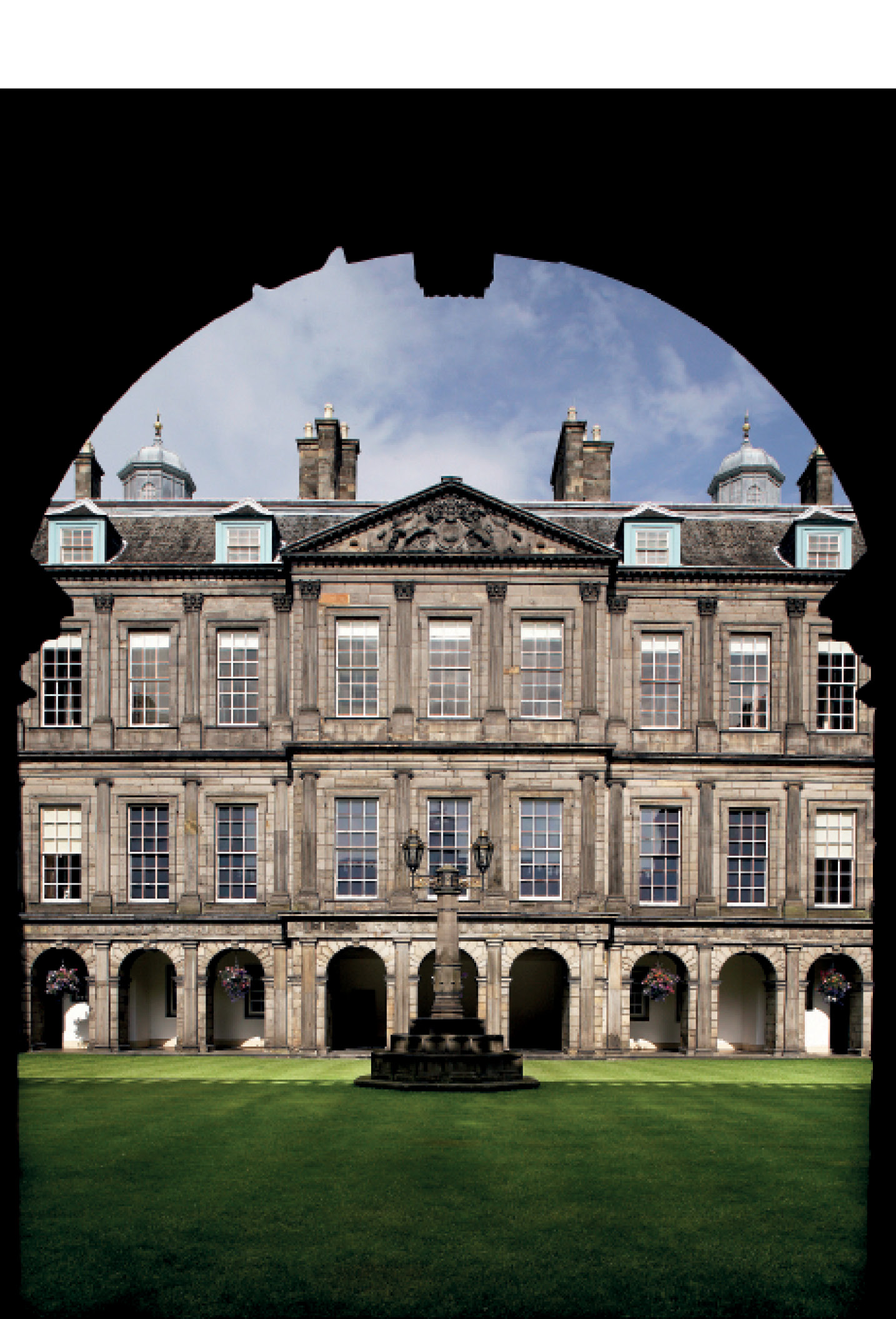
The 16th-century north-west tower built by James V was retained, to be balanced by a new, matching south-west tower, giving a symmetrical appearance to the façade and maintaining the look of a Scottish castle. The quadrangular plan of the earlier palace was retained, and the arcaded cloister-like ground floor reflected the palace’s monastic origins. Classical elements, including Doric, Ionic, and Corinthian columns and pilasters, were deployed on the upper storeys and to flank the main west entrance, with its cupola and royal coat of arms.
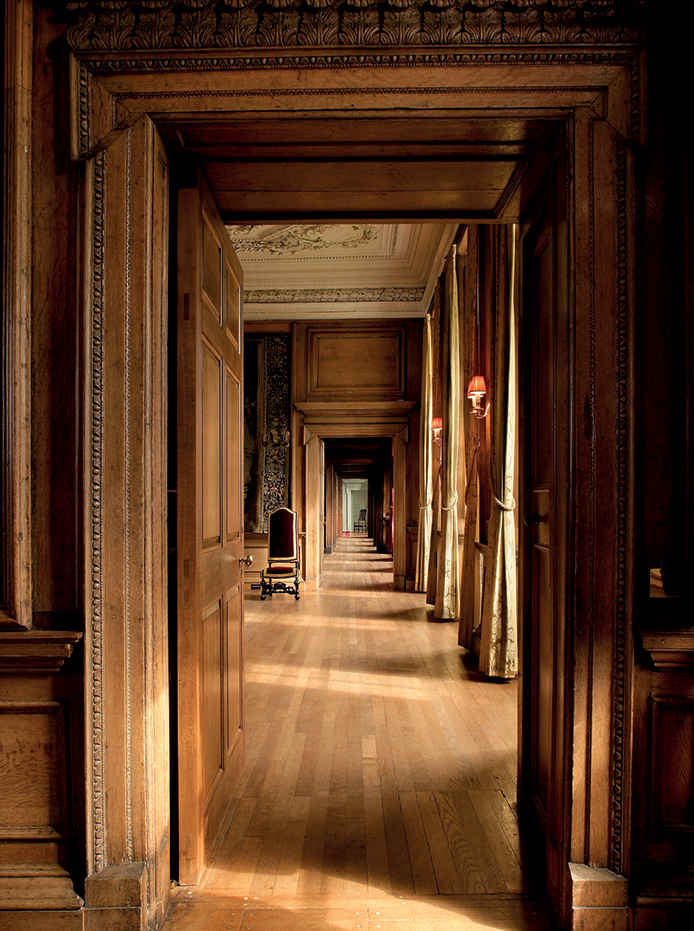
The exterior, built of grey sandstone quarried from the nearby park, is relatively sombre, but the interiors are richly decorated, with coloured marble chimneypieces framed by Classical pilasters, integrated with carved woodwork and panelling, and elaborate, high-relief plasterwork ceilings designed to frame decorative paintings.
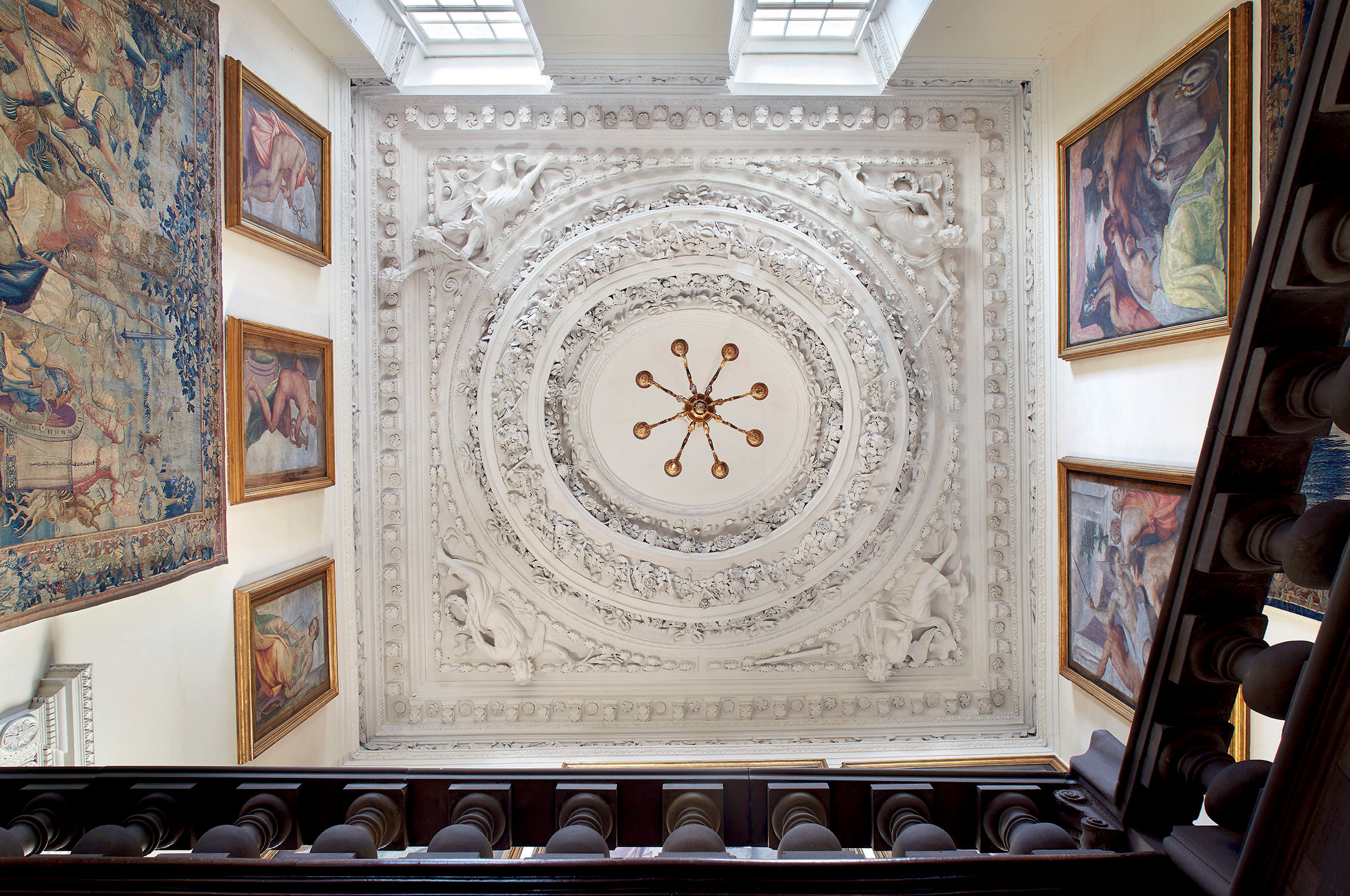
The Great Stair, which is entered from the south-west corner of the Quadrangle, provided the first taste of the extravagant baroque interior of the palace. The partially cantilevered stair, seeming to be without supports, was at the forefront of building technology at the time, while life-size plaster figures at the ceiling corners bear the crown, sceptre, staff, and sword of Scotland’s royal regalia.
Wet paint
One of the most important and significant interiors in the palace was the last to be finished. In 1684, Jacob de Wet was commissioned to paint a series of portraits of 110 monarchs of Scotland to hang in the Great Gallery. Based largely on the Rerum Scoticarum Historia of 1582, by George Buchanan, the intention was to demonstrate the antiquity of the Scottish kingdom and the seamless line of succession since Fergus I, who was, according to legend, crowned in 330 BC. Eighteen of the ‘most famous’ (mainly recent monarchs) were painted as full-length portraits, while ‘lesser Characters’ were painted as three-quarter lengths. The uneven quality of the portraits shows that de Wet painted them quickly and subcontracted some of them to workshop assistants.
James VII and II (r. 1685-1688) succeeded Charles II on 6 February 1685. At Holyrood, he established a chapel for Catholic worship in the Council Chamber, and when he instituted the chivalric Order of the Thistle in 1687, six of the eight knights elected to the Order were Catholics. He removed the parish congregation from the abbey, building for them a new church in Canongate. This was designed by James Smith, who then adapted the abbey nave for use as a private chapel for the Order of the Thistle, complete with fine new wooden stalls for the Knights of the Order and altar carvings by Grinling Gibbons.
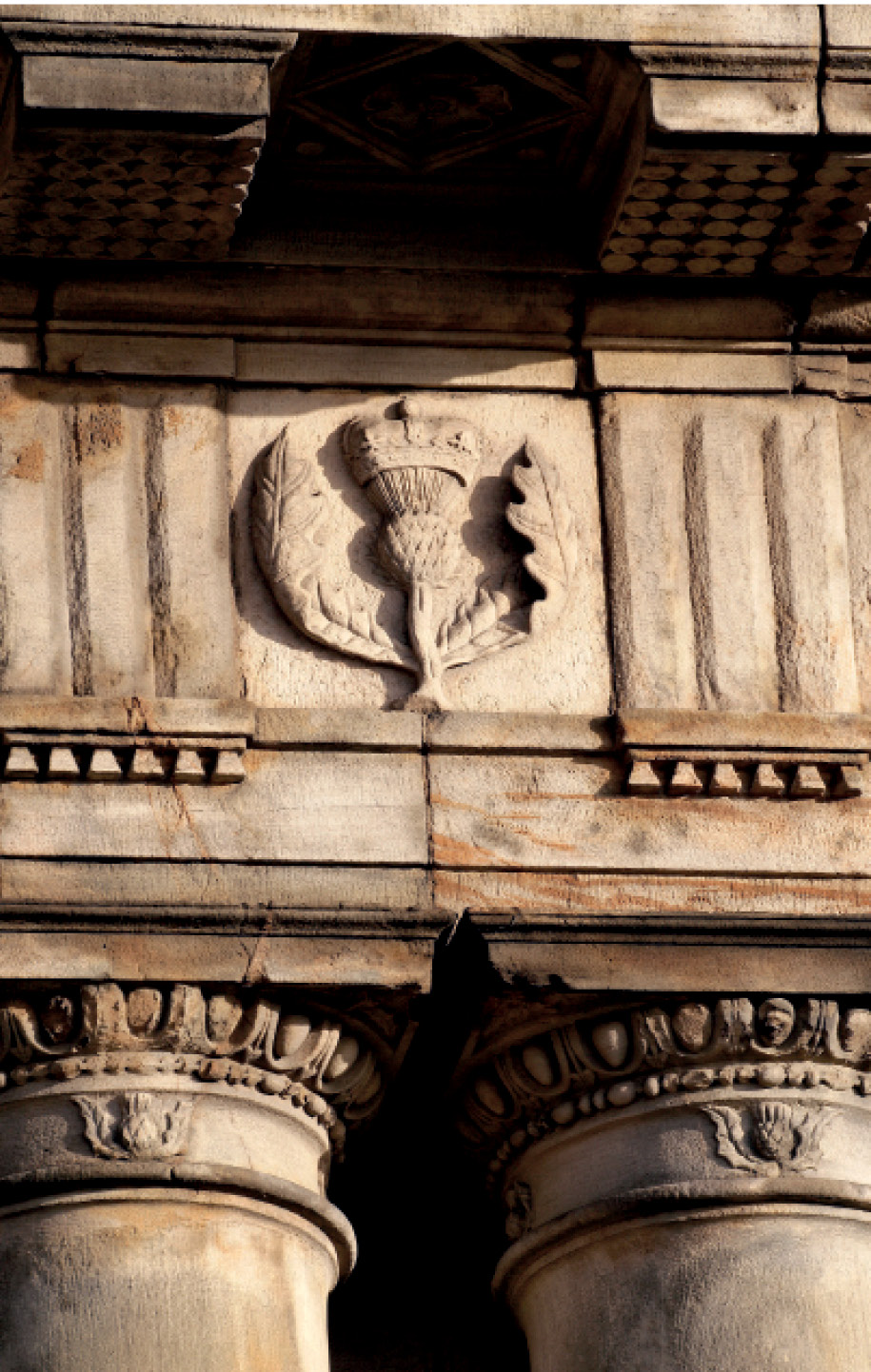
These fittings were not to survive long: the deposition of James II was accompanied by anti-Catholic riots and the short-lived furnishings were destroyed soon after their installation. The royal vault was also desecrated and was to remain ruinous: as late as 1776, the antiquary Francis Grose claimed that he ‘had seen the body of James V [together with] the head of Queen Margaret, which was then entire, and even beautiful, and the skull of Darnley’. The vault remained in that state until Queen Victoria ordered it to be restored in 1898.
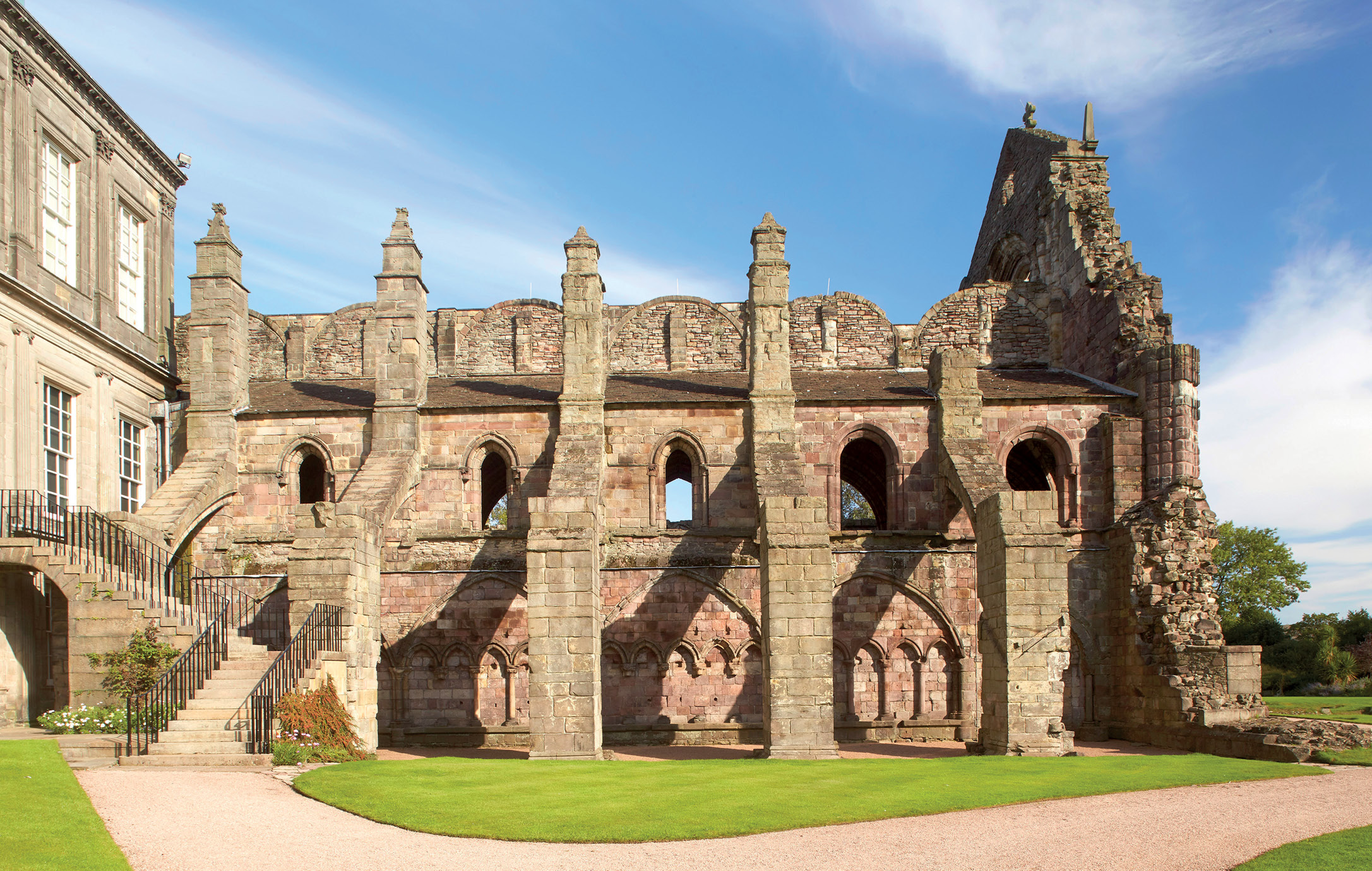
The present roofless state of the nave of the abbey church was the result of an unfortunate intervention in 1760, when the timbers of the medieval nave roof seemed close to collapse. They were removed and replaced by masonry cross walls, built above the medieval sexpartite vaulting. The combined weight of the walls and new roof of stone flags brought the vault crashing down in 1768, and the decision was then taken to stabilise what survived, rather than rebuilding the nave.
Royal visits, royal resting places
The palace continued to be maintained by the Dukes of Hamilton, as Hereditary Keepers, and in 1745 Bonnie Prince Charlie based his court at Holyroodhouse during the final Jacobite rising. The glittering balls that he is said to have held there before his ultimate defeat at the Battle of Culloden inspired writers and artists such as Sir Walter Scott and Sir John Pettie to depict the grandson of James VII and II and the Stuart claimant to the throne as a romantic figure.
In 1825, following the collapse of James Ballantyne & Co., the printing business in which he was a partner, Sir Walter Scott contemplated claiming refuge at Holyrood, which had served as a sanctuary for debtors since the abbey’s foundation by David I. Previously Scott had forged a hugely successful career as a popular poet and author, being instrumental in the invention of a heroic version of Scottish history that inspired George IV (r. 1820-1830) to visit in 1822, the first reigning monarch to visit the palace in almost 200 years. Scott himself was put in charge of the elaborate preparations for the king’s visit, for which he persuaded George to order a Highland dress outfit, appearing at his Holyroodhouse reception as a clan chief, surrounded by enthusiastic tartan-wearing supporters.
Public interest in the palace surged after George IV’s visit, and the RCT’s book traces its lasting influence on the imagination of writers, artists, and musicians, including Felix Mendelssohn, whose Scottish Symphony was inspired by a twilight visit to the abbey. King George V and Queen Mary, in the early 20th century, modernised Holyroodhouse, installing bathrooms and electricity and introducing the gardens that now surround the abbey and are used to host an annual garden party during the Holyrood Week visit of the King and Queen in July. In 2002, the King’s gallery was opened to show works of art from the Royal Collection.
On Sunday 11 September 2022, the late Queen Elizabeth II lay at rest in the Throne Room after her death at Balmoral Castle, the first monarch to die in Scotland since James V in 1542, thus adding another chapter to the history of what Robert Louis Stevenson, in 1878, rightly described as ‘a house of many memories’.

Further reading: Deborah Clarke (ed.) The Palace of Holyroodhouse: ‘a house of many memories’, with contributions from Richard Fawcett, Ailsa Hutton, Sally Goodsir, and Deborah Clarke (Royal Collection Trust, ISBN 978-1909741744, £55 from http://www.rct.uk/shop).