Fleeting finds: Investigating intertidal discoveries in the Severn Estuary

Intertidal archaeological sites are challenging to investigate, often being exposed for just a few hours at a time, but they can be rich repositories of organic finds and environmental evidence. Martin Bell, Thomas Walker, and Adam Turner describe the illuminating discoveries that have been made at Goldcliff in the Severn Estuary over the last three decades.
Start
This article is from Current Archaeology issue 418


Subscribe now for full access and no adverts

Archaeological sites exposed in intertidal zones can be exceptionally rich in terms of their preservation of organic finds and environmental evidence. Such discoveries often follow storms, which erode sediments to expose underlying remains – but these may only be exposed for a few hours at low spring tides before they are covered again by mobile mud and sand, perhaps never to be seen again, or to re-emerge in changed form a decade later. Building up the full story of a site can therefore require decades of observations, as well as funding from multiple sources, and an interdisciplinary team of researchers – as the history of research over the last 33 years at Goldcliff in the Severn Estuary shows.

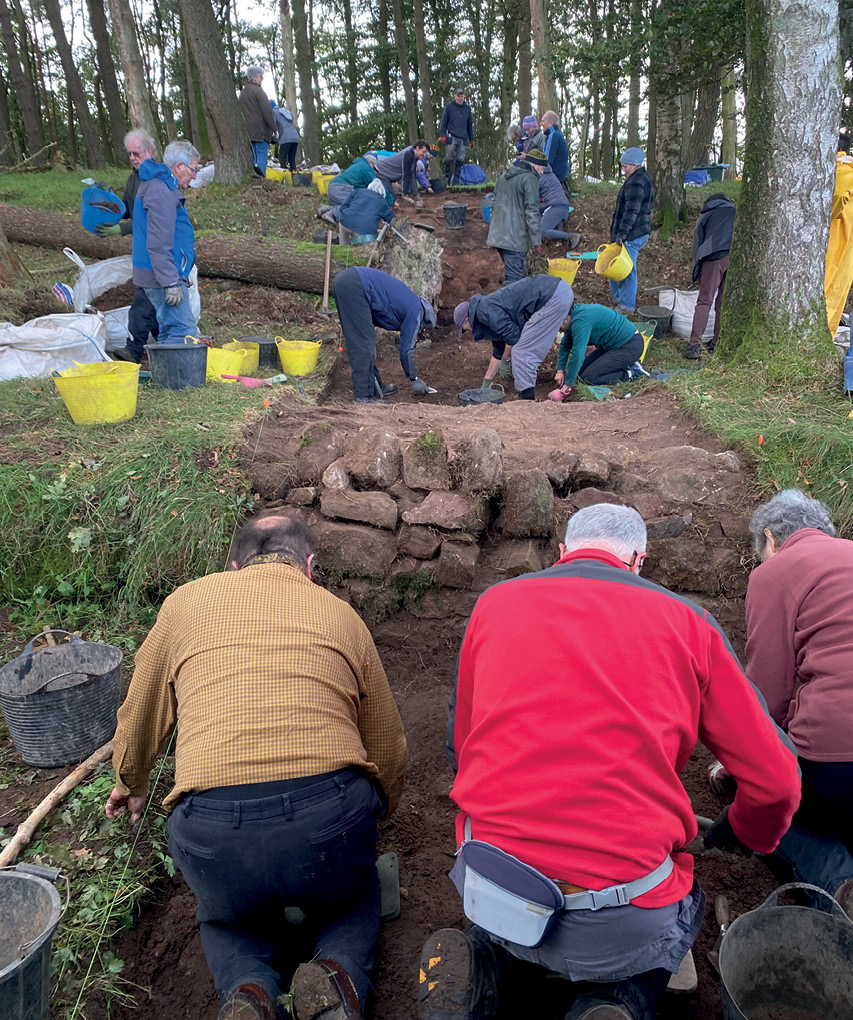
Investigations at Goldcliff have revealed the remains of now-submerged forests that stood there 7,000-8,000 years ago. Here the team are working on Mesolithic Site X and Site J. Image: M Bell

This work began in 1991, when a storm sparked the excavation of an Iron Age site located between the Prince of Wales Bridge (Second Severn Crossing) and Newport. Preserved within the estuary’s intertidal peats were the remains of eight rectangular Iron Age buildings and a series of trackways, and surviving environmental evidence revealed that these related to spring and summer grazing of cattle on the saltmarsh. They were not the only archaeological remains to emerge from this area, however: between 1991 and 1993 surveys (funded by Cadw) uncovered a Mesolithic site, two planks from a Bronze Age sewn-plank boat, and human skulls that had been deposited at the edge of a former bedrock island surrounded by wetland during the Bronze Age. Following these initial explorations, Dr Heike Neumann undertook a wider survey (funded by the Board of Celtic Studies) of the entire intertidal zone between Cardiff and the bridge, revealing a wealth of other sites – particularly those of Bronze Age date – some of which, including Redwick and Peterstone, would go on to be excavated. The headland at Goldcliff, the remains of a former island, would also prove to contain many more secrets than we first suspected.

The location of Goldcliff in the Severn Estuary. Map: J Foster

As part of our early fieldwork, in 1993 we had identified the extensive remains of a submerged forest to the east of the former island – but, as it produced little other archaeological evidence, it was rather dismissed at the time. Fast forward to 2001, though, and our Reading University team succeeded in getting funding from the Natural Environment Research Council (NERC) for a project studying Mesolithic to Neolithic Coastal Environmental Change. One of the submerged forests we decided to focus on was the apparently archaeologically unpromising area east of the island. We were lucky with our timing, as the Severn foreshore was relatively clear of mud and sand, and within a day of starting work we discovered human, animal, and bird footprints preserved in a 6m sequence of laminated silts which had accumulated as a result of sea-level rises, separating two Mesolithic submerged forest layers. The discovery of footprints was not unprecedented: the late Professor John Allen, who was a member of our project, had recorded footprints on several other sites in the estuary, and had collaborated with the late Professor Stephen Aldhouse-Green and others on the investigation of Mesolithic footprints identified 4km to the west at Uskmouth. The Goldcliff examples would add exciting new information to this growing picture.

Recreating landscapes

At Goldcliff, we selected an area of the submerged forest to make a detailed plan, where each tree would be identified and linked to analysis of pollen and insects to help investigate woodland composition and history. In one small corner of this area, the old land-surface below the forest peat was exposed, and as we cleaned this for recording, charcoal and flint artefacts emerged. This was dubbed Mesolithic occupation Site J, and as we redoubled our attention east of the island we discovered two further Mesolithic occupation sites: one within the Lower Submerged Forest (Site B), and one lying between the two forest layers (Site A).
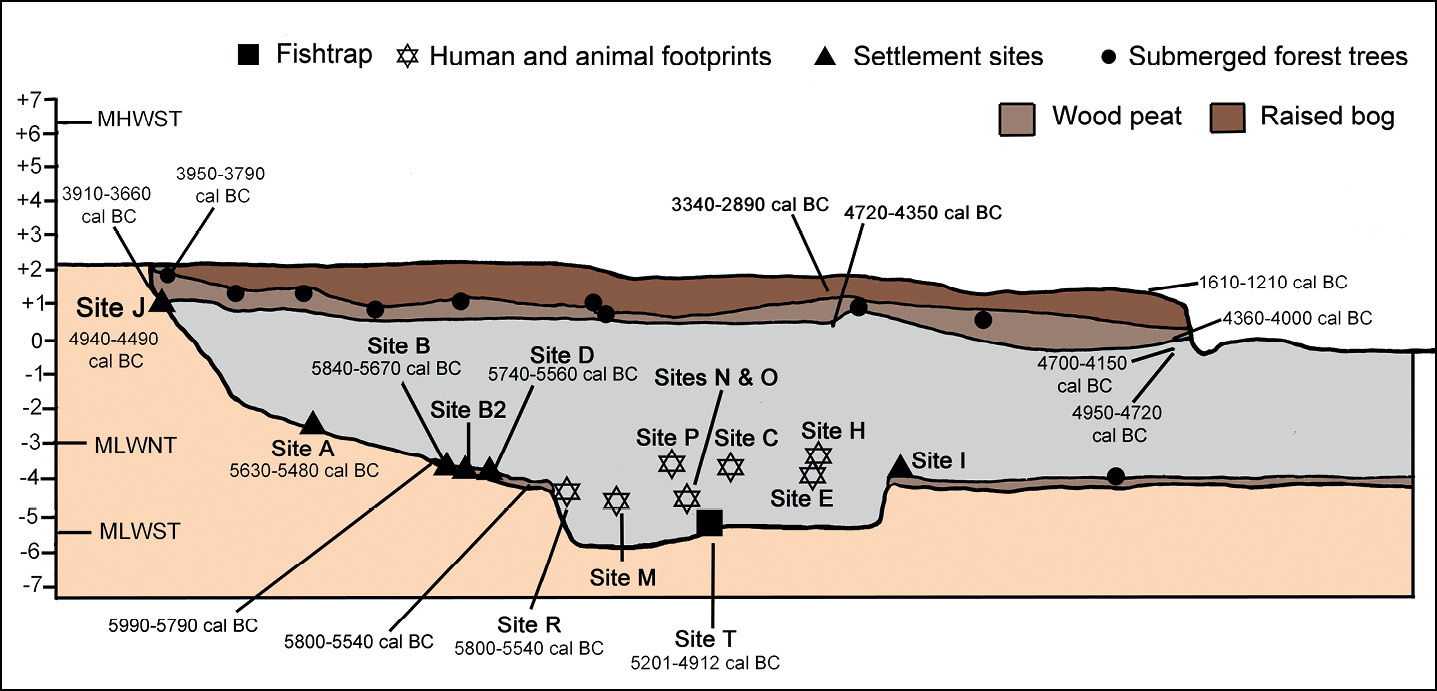
A cross section of the intertidal area east of Goldcliff island, showing the main deposits and sites. Image: J Foster

The earliest Mesolithic evidence was associated with the Lower Submerged Forest, which dates to c.5800 BC and pre-dates the later inundation of this woodland. The latest Mesolithic occupation, Site J, lies beneath the Upper Submerged Forest layer and dates to c.4800 BC. Our excavations, undertaken in parallel with the NERC project and part-funded by Cadw in 2002-2003, revealed concentrations of worked stone, but not in great density, perhaps suggesting areas of short-term activity. Mesolithic groups were also using this landscape for hunting; surviving animal bone suggests that their prey included red deer, roe deer, boar, and aurochs, as well as otter and wolf, and some birds. There was evidence of fish, too, particularly eels. Excitingly, the peat had also preserved wooden artefacts at Site J: a pointed stick and a carved Y-shaped object. Wooden artefacts are very rare on Mesolithic British sites – and equally rare and exciting is the association between these excavated settlement sites and the footprint evidence.
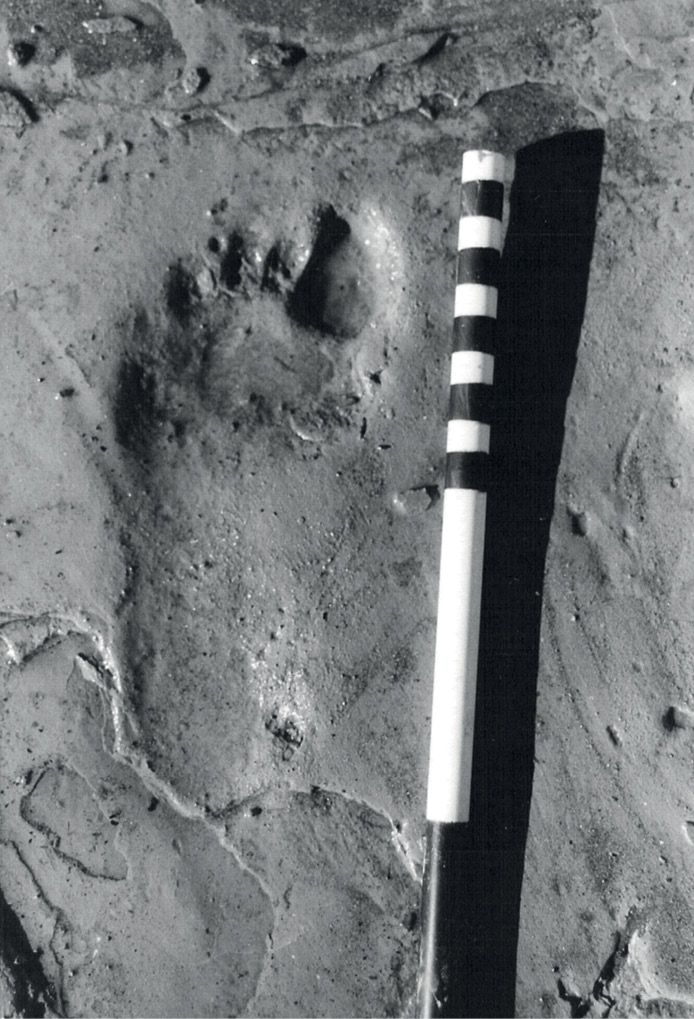
 A footprint left by a Mesolithic child, aged around eight or nine. Image: E Sacre; R Miller
An area of human footprints in laminated silts recorded as a 3D model. Image: E Sacre; R Miller

The footprints formed a key focus of our 2001-2003 fieldwork, initially undertaken as part of Dr Rachel Scales’ and Dr Kirsten Barr’s PhD projects, followed by regular monitoring and recording at low spring tides, when the areas are exposed for around 1.5 hours. Locating and recording them within that short window is challenging – not least because we originally relied on photography, conventional drawn plans, and tracing areas of footprints on plastic sheeting. This work has been transformed, however, by the advent of 3D photogrammetry, whereby we can photograph entire areas of footprints 30-50 times from all angles and use these to create digital models. We can also record their location within centimetres using differential GPS (dGPS), and the sediment exposures and submerged forests are mapped using drone survey. The first of these was undertaken by Dr Kevin White in March 2017, to map the laminated silts where many footprints had been found – and during his survey the project’s next major development unexpectedly occurred.

As part of the drone survey, we needed to lay out a grid of targets which could be precisely located using dGPS and used as reference points to create a 3D model of the intertidal zone. The most seaward line of targets was in an area where we had not made any discoveries, and which consequently had not been regularly monitored – but while laying out a target Dr Tom Walker spotted a line of roundwood stakes, each about 5cm in diameter. At the time, we thought that they were most likely medieval or later, as fish traps of that date are abundant in the Severn Estuary – but five radiocarbon dates placed them in 5310-4912 BC, dating the structure to the later Mesolithic, between the ages of Sites A and J.

Roundwood stakes and wattles representing the remains of a fish trap on Site T.

Set in the bed of a palaeochannel that cuts through the Lower Submerged Forest, the stakes were arranged at c.0.5m intervals, with thin wattle, like basketwork, woven around them. Over subsequent years, 52 stakes and intervening wattles have been discovered over an area of about 20m by 5m, and a further two have been found a little to the east. One area is V-shaped, c.4m by 2m, and another forms lines at 16° to the edge of the palaeochannel. They are interpreted as fish traps – the first Mesolithic examples to be found in Britain, though similar ones are known from Ireland, Denmark, and elsewhere in Europe. As the open end of the Goldcliff traps faces up-channel, it seems likely that they were intended to catch eels migrating downstream, and perhaps other fish carried on the retreating tide.

It is possible to determine, too, how the stakes were made, thanks to Dr Adam Turner’s efforts during PhD research on Mesolithic and Neolithic woodworking in the Severn Estuary region. His attempts to replicate the stakes using tranchet axes and polished axes produced nothing resembling the notably long and dished marks on the originals, but a comprehensive series of experiments revealed that they had been produced by splitting from the pointed end up the stem, probably with a chisel-shaped tool. In this way a sharply pointed stake could be produced with a minimum of effort, in as little as 4-5 minutes.

This plan shows the extent and alignment of the Site T fish trap. Image: T Walker

Populating the past

There were further discoveries to come: in 2023, facilitated by part funding from the National Geographic Society, we found another area of wood stakes (Site N2) about 40m east of the first. There, 31 posts stood in a line 4.65m long: they were mostly similar to the ones previously identified, but with some smaller withies, and radiocarbon dating established that this alignment was slightly later than the others, though still between the dates of Sites A and J, at 5203-4848 BC.

Between 10m and 40m from the two areas of wood stakes, and on the same alignment, were multiple, rather poorly preserved, human footprints, all moving on the same axis but in both directions. These have been interpreted as footpaths representing visits to the fish traps from a now-lost site on the eroded edge of the island some 50m to the west – and we can predict the location of other lost campsites and activity areas from the points at which alignments of footprints converge on the edge of the former island. Some footprints were also aligned on the Mesolithic settlement sites that we have excavated, while others follow the banks of the palaeochannel. Together they reveal patterns of movement and connectivity within the Mesolithic landscape – and shed important light, too, on the make-up of the community who left them behind. From their size, a large proportion of the footprints were those of children as young as four, who were clearly actively engaged in activities out on the saltmarsh, perhaps helping to empty the fish traps and gathering resources. As it is unusual to be able to glimpse the everyday activities of children on archaeological sites, these were particularly evocative finds.

This fish trap’s stakes had distinctively split ends. Image: M Bell

Other prints offer new insights into the estuary’s Mesolithic fauna, complementing excavated animal bones. We have found the tracks of deer, aurochsen, and a probable dog or wolf, while bird footprints are abundant, particularly cranes. These occur on the finest silt laminations laid down at the height of summer, suggesting that they bred in Britain at this time. We know from place names and bones that cranes were common in Britain through prehistory into the post-medieval period, but they became extinct here due to drainage and human exploitation. What is exciting is that, in recent years, a crane population re-established itself in Norfolk, and subsequently the Wildfowl and Wetlands Trust (in partnership with the RSPB) set up a breeding and reintroduction programme that saw cranes return to the Somerset Levels as well. A pair from this group has since nested on the edge of the Newport Wetlands Nature Reserve, within which the Goldcliff Mesolithic sites lie – highlighting how archaeological evidence can support reintroduction projects and biodiversity.

Alignments of footprints indicating Mesolithic footpaths – perhaps leading from a lost settlement to fish traps in the palaeochannel – were identified near the wooden stakes. Map: J Foster

The Newport Wetlands Reserve was established in the late 1990s, and fortunately it includes about 4km of coast between Goldcliff and Uskmouth, encompassing the Mesolithic footprints and forest sites. The reserve’s development also included the creation of new bird habitats in the form of one freshwater and two saline ponds just behind the seawall at Goldcliff; these are flooded at spring tides and then gradually dry to expose mud where birds feed. Before the ponds were dug, the Glamorgan Gwent Archaeological Trust carried out an evaluation which revealed a buried Romano-British landscape of ditches and banks 0.8m below the surface: these probably represent part of the farmstead that was identified during earlier pond-digging on the site, which produced Roman pottery and charred cereals. The bird feeding grounds were carefully designed so that they penetrated less than 0.8m and left much of the Roman landscape intact; the Mesolithic-to-Iron Age remains are more deeply buried and were preserved intact.

Crane footprints testify to the presence of this bird species during the Mesolithic. Scale: 0.5m. Image: M Bell

Living Levels

In order to help communities local to the new reserve engage with the nature and heritage of the Newport Wetlands, the RSPB, National Museums Wales, and numerous other organisations created the Living Levels Partnership to help connect local communities with the nature and heritage of the levels. The heritage aspects were the brainchild of Dr Rick Turner who, before his retirement as a Cadw Inspector, had done much to encourage archaeological research in the Severn Estuary, and the initiative obtained substantial financial support from the National Lottery Heritage Fund in 2018. Sadly, Rick died soon after the main project funding came through, but others have stepped in to continue his work, and the initiative’s successor projects are still running to this day.

Until that point, public outreach had been rather neglected by our investigations, but the Living Levels project provided a great opportunity to tell the local community about our discoveries over the previous 27 years. This included a programme of archaeological talks in village halls and walks to visit foreshore sites; intertidal archaeology training sessions; a redisplay of the prehistory gallery at Newport Museum; and the installation of archaeological information in the nature reserve’s visitor centre. Particularly important to presenting our results from Goldcliff, though, was a series of animated reconstructions showing the landscape around the former island at various dates. They include a Mesolithic scene complete with fish traps, and later depictions recreating evidence from the Iron Age, Romano-British finds, a medieval priory, and a great flood in AD 1607.

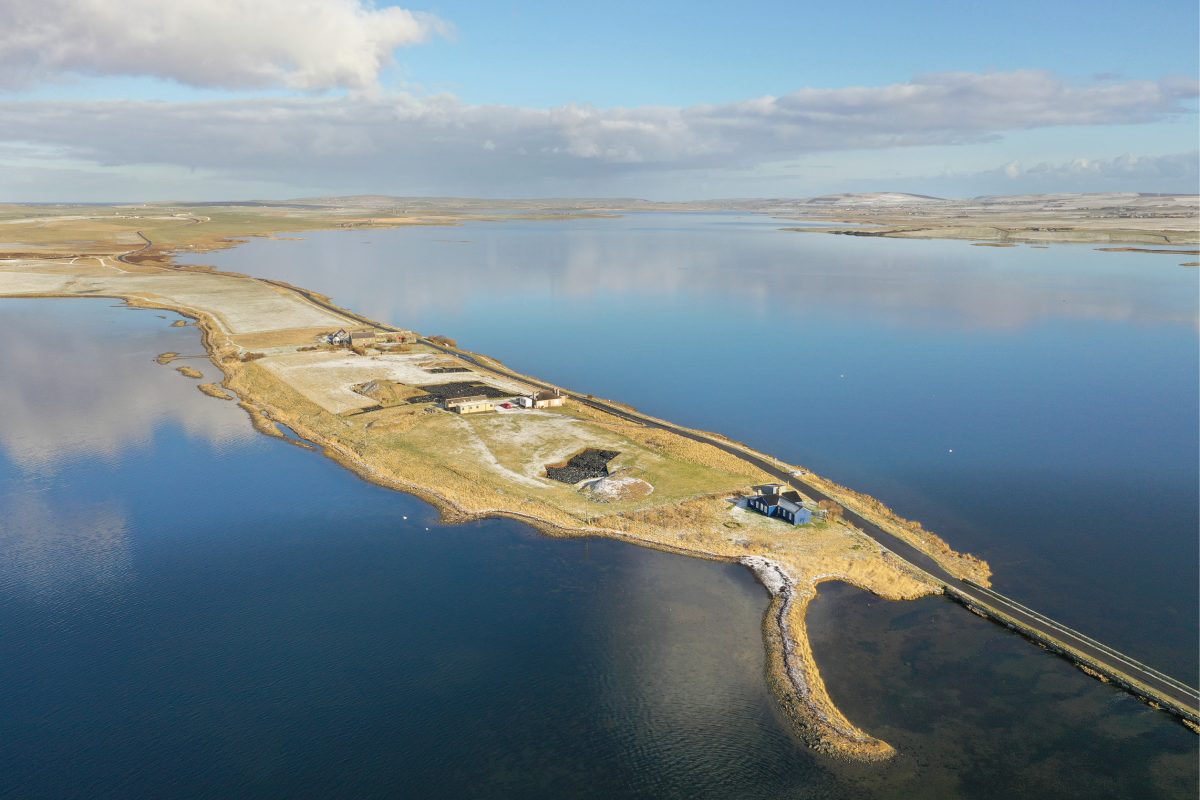
Overlooking the Newport wetlands, showing the rise at Goldcliff which is all that remains of the former island. Behind the seawall are the lagoons of the Newport Wetland Reserve. Image: Living Levels Partnership/Dextra Visual/Commission Air

As noted above, the highly episodic and dynamic nature of intertidal archaeological exposures means that gaining a full understanding of the archaeology at Goldcliff has involved knitting together vast numbers of observations made over what is now 33 years. It has also only been possible thanks to the interdisciplinary contributions of many people. We have been able to learn about the ecology of the submerged forests thanks to Professor Nigel Nayling and Dr Rod Bale (Trinity St David University) working on tree-ring aspects; Dr Scott Timpany (University of the Highlands and Islands) studying pollen and plants; and Dr David Smith (University of Birmingham) analysing evidence for beetles. Particularly significant, though, was the development of a Geographic Information System (GIS) with the support of Tim Sly, advised by Professor Rob Hosfield, Head of Archaeology at the University of Reading. This has allowed us to put all the Mesolithic discoveries into an integrated framework, and will facilitate reconstructions of the site’s settlement pattern, seasonality, patterns of movement, and how the landscape looked and was used over the period of Mesolithic and early Neolithic activity that our finds have revealed. In this way, decades of work are being synthesised into a single framework that can be handed on to the next generation.

This artistic reconstruction imagines the later Mesolithic landscape at Goldcliff, complete with settlement and fish trap. Image: Living Levels Partnership/Dextra Visual/Commission Air

Further information:
• For more information about the Living Levels project, and to see the landscape reconstructions described in this article, visit http://www.livinglevels.org.uk.
• Two monographs include our earlier work on Mesolithic Goldcliff: Prehistoric Intertidal Archaeology in the Welsh Severn Estuary (2000) and Prehistoric Coastal Communities: the Mesolithic in western Britain (2007). Both are published by the Council for British Archaeology and available to download for free from the Archaeological Data Service (http://www.archaeologydataservice.ac.uk). Fieldwork between 2010 and today is being synthesised as part of the current project.
• Goldcliff discoveries are also reported in CA 331 and CA 367.

By Country

Popular
UKItalyGreeceEgyptTurkeyFrance

Africa
BotswanaEgyptEthiopiaGhanaKenyaLibyaMadagascarMaliMoroccoNamibiaSomaliaSouth AfricaSudanTanzaniaTunisiaZimbabwe

Asia
IranIraqIsraelJapanJavaJordanKazakhstanKodiak IslandKoreaKyrgyzstan
LaosLebanonMalaysiaMongoliaOmanPakistanQatarRussiaPapua New GuineaSaudi ArabiaSingaporeSouth KoreaSumatraSyriaThailandTurkmenistanUAEUzbekistanVanuatuVietnamYemen

Australasia
AustraliaFijiMicronesiaPolynesiaTasmania

Europe
AlbaniaAndorraAustriaBulgariaCroatiaCyprusCzech RepublicDenmarkEnglandEstoniaFinlandFranceGermanyGibraltarGreeceHollandHungaryIcelandIrelandItalyMaltaNorwayPolandPortugalRomaniaScotlandSerbiaSlovakiaSloveniaSpainSwedenSwitzerlandTurkeySicilyUK

South America
ArgentinaBelizeBrazilChileColombiaEaster IslandMexicoPeru

North America
CanadaCaribbeanCarriacouDominican RepublicGreenlandGuatemalaHondurasUSA

Discover more from The Past

Subscribe now to keep reading and get access to the full archive.

Continue reading