Subscribe now for full access and no adverts
The products of ancient Egyptian jewellery workshops form some of the most attractive museum displays around the world. From the bracelets in the First Dynasty Tomb of Djer to the sets of jewellery of the Twelfth Dynasty royal ladies from Lahun, the skills of the goldsmiths and lapidaries are apparent. Grave goods from non-royal cemeteries from the Predynastic Period onwards reveal how beads and amulets made of natural stones or faience were worn by ordinary Egyptians, both men and women. Tomb images from the Old and Middle Kingdoms illustrate how wealth and status were displayed by the wearing of bangles and armlets, necklaces and collars, girdles and diadems. However, excavation of the Royal Tombs of Ur revealed that Mesopotamian women had been wearing ear ornaments for centuries before such adornments were adopted in Egypt during the Second Intermediate Period.


Nubian and Asiatic influence
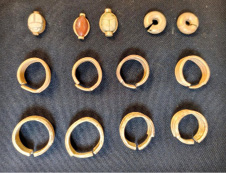
The earliest examples of Egyptian earrings date to the period when the Asiatic Hyksos occupied Lower Egypt. At this time, the Theban rulers in the south employed mercenary soldiers from semi-nomadic Nubian tribes, known from the shape of their graves as the Pan-Grave people. Female burials in Pan-Grave settlements in Upper and Middle Egypt, such as Mostagedda, just south of Asyut, included plain rings or spirals of silver or copper wire, made for pierced ears.


An identifying characteristic of the Nubian bearers, soldiers, and captives portrayed in tombs and temples from the early New Kingdom onwards is the wearing of white hoop earrings, which could have been made of bone, ivory, shell or stone. Earrings of this shape are described as ‘penannular’, from the gap in the circle which allowed for attachment. Some gaps are so narrow, hardly more than cracks, and the rings so thick and inflexible, especially when made of a hard stone like jasper or carnelian, that it is difficult to imagine how the ear lobe could have been introduced. Some images suggest that the rings were pinched on the junction of the ear with the cheek but, in others, the rings clearly pass through pierced lobes. Libyan and Asiatic captives included among the Nine Bows, the traditional enemies of Egypt, are also occasionally shown with earrings or studs.


Foreign fashions
The processes of acculturation and assimilation led to immigrant peoples adopting Egyptian dress and customs while retaining some of their most distinctive cultural traits. In turn, the Egyptians adopted features of ‘foreign’ cultures, especially regarding fashion such as jewellery and hairstyles. From the early New Kingdom, this trend is typified by the popularity of ear ornaments of all types and materials. At first worn by females, common forms of these earrings are simple wire split-rings and spirals, and hollow doughnut shapes of various sizes, in gold, silver or copper, all of which have been found in Seventeenth Dynasty tombs at Thebes. These shapes were soon imitated in faience and glass, often provided with loops for suspension. More elaborate examples were made from several tubes of triangular cross-section, soldered to form a ribbed hoop, the inner tubes extended to hang from pierced ears. Earrings of this type, embellished with coloured inlay, were among the jewellery found in the tomb of the Asiatic wives of Thutmose III.


The dowries of royal brides from northern states such as Mitanni, Babylon, and Hatti included vast quantities of jewellery of foreign manufacture and style. Then, as now, fashion was driven by the elite. By the mid-Eighteenth Dynasty, women of all classes were wearing hoop or disc earrings, sometimes two pairs at a time, as shown by the double ear-piercings on some mummies, notably that of Thuya, mother of Queen Tiye. Scenes of Amenhotep-Huy’s investiture as Viceroy of Nubia under Tutankhamun show that earrings were worn by male and female members of his court, Egyptians and Nubians alike.


With the growing popularity of ear adornment, piercings were made larger to admit the substantial shanks of mushroom-shaped ear studs, and the suspension bars of heavy pendant earrings. The round ends or bosses of these styles sat flush with the ear lobe at the front, and were often decorated with rosettes or daisy flowers, as can be seen on many female anthropoid coffins of the New Kingdom. Some ear studs were made in two parts, one with a short shank fitting into a hole in the other. Pierced ears are indicated in statues and tomb art, and are obvious on royal mummies from Amenhotep II onwards, revealing that the custom of wearing earrings had been adopted by men, although the rarity of images of earrings being worn by adult males suggests that boys only wore earrings until puberty. This idea is reinforced by the representations of the king as a child, or of child-gods such as Khonsu, Harpocrates, or Ihy.


Elaborate pendant earrings
Gold earrings and studs could be decorated with polychrome stone or glass inlay, gold granulation and amuletic symbols, a mid-Eighteenth Dynasty fashion epitomised by the elaborate earrings found in Tutankhamun’s tomb. Decoration often included solar imagery, such as rosettes, falcons, and uraei, while the dangling beaded strings might seem to represent the sun’s rays, as in the hieroglyph for ‘shine’ or the symbol of the Aten. On Tutankhamun’s gilded shrine, Queen Ankhesenamun wears this style of earring, which was particularly favoured by the royal ladies of Amarna.
Ramesses II’s wife, Nefertari, is shown in her tomb wearing several types of earrings, from a double-sided white stud to a uraeus serpent of the style worn by the goddess Hathor in the Tomb of Sety I. Gold earrings buried with Queen Tausret, wife of Sety II, have flower-shaped bosses and hanging cornflower buds, foreshadowing the elaborate pendant hoops popular with ladies in later ages. By the Late Period, jewellery styles displayed the influence of foreign invaders from Assyria, Persia, and Greece. Roman era mummy portraits show the preference for earrings in the Classical style, often of filigree gold, dripping with gemstones and pearls.

Earrings for animals
Humans were not the only wearers of earrings. Statues of cats representing the goddess Bastet commonly have pierced ears for the attachment of earrings of precious metal, and gold earrings have been found on cat mummies. The jewellery buried with the Apis bulls at Memphis indicates how sacred animals were adorned, in death at least, with jewellery fit for royalty, which sometimes included earrings.

All images: Hilary Wilson, unless otherwise stated