Subscribe now for full access and no adverts
The modern Egyptologist is drawn to the study of ancient Egypt by a variety of motives: a scientific interest, the intriguing nature of the subject, the glamour and spectacular nature of surviving remains, or the sheer pleasure of exploring a distant and very strange civilisation. When the subject was developing in the 19th century, further major motivations were a desire to confirm the traditions of the biblical narrative, or the accounts of Classical writers who formed the foundation of most higher-level education in the humanities. Not surprisingly, the ancient Egyptians, Greeks, and Romans also explored Egypt and its past with great industry and enthusiasm. However, the question inevitably arises as to whether their motives were the same as ours, or whether there were significant, even surprising, differences. It is the purpose of this article to establish, as far as possible, whether their motives could be described as anticipating those of the modern Egyptologist, by examining the activities of four ancient scholars to whom that term has sometimes been applied.
Khaemwaset
Without doubt, the best known ancient Egyptian ‘Egyptologist’ is Khaemwaset, the fourth son of Ramesses II. He enjoyed a brilliant career across the entire spectrum of activities expected of a royal prince, but is particularly renowned for his religious and architectural activities. We are fortunate in having a number of inscriptions that give an insight into his motivation for working on ancient monuments, and of these texts I want to examine two: the inscription on the Mastabat Fara‘un constructed for the Fourth Dynasty king Shepseskaf (c.2503-2498 BC) at Saqqara South, and the text recording Khaemwaset’s work on the statue of Kawab, eldest son of Khufu, now in the Cairo Museum.

The main text on the Mastabat Fara‘un is preceded and headed by two sets of royal names: those of Shepseskaf himself on the left, facing right; and the cartouches of Ramesses II on the right, looking left towards the name of Shepseskaf.
The main text translates as follows:
His Majesty instructed the Chief Controller of Craftsmen [i.e. High Priest of Ptah], Sem-Priest, King’s Son, Khaemwaset to establish the name of the King of Upper and Lower Egypt Shepseskaf [i.e. on the monument], since his name could not be found on his pyramid, inasmuch as the Sem-Priest Khaemwaset loved to restore the monuments of the Kings of Upper and Lower Egypt, because of what they had achieved, making firm again what had fallen into ruin. By [the Sem-Priest, King’s Son, Khaemwaset]
The first point to make is that Khaemwaset is acting here on his father’s command. This is very much in keeping with Nineteenth Dynasty concerns over legitimacy, which was of particular importance to this family because their right to the throne of Egypt was far from obvious. This preoccupation is particularly evident in the cenotaph of Sety I at Abydos. There we find a spectacular king-list depicting Sety making offerings to a long sequence of kings beginning with the First Dynasty, and running right down to the Nineteenth, a list that carefully avoids mentioning any ruler (such as Akhenaten) who might be regarded as illegitimate.

The text unequivocally asserts that Sety – and ipso facto the dynasty – is the legitimate successor to a long line of Egyptian kings running back to the beginning of Egyptian history. His son Ramesses shared this concern, as is made clear by his close self-identification with the great Eighteenth Dynasty Pharaoh Amenhotep III. This extended to usurping the latter’s monuments on a grand scale and becoming, in a very important sense, Amenhotep himself.

However, usurpation was not the only option. It was possible to assert legitimacy by showing concern for the monuments of predecessors, and this is where Khaemwaset became highly relevant as the agent of Ramesses’ strategy. It explains why the cartouches of Shepseskaf and Ramesses are linked at the beginning of the inscription, and why Ramesses appears at the very beginning of the main text. However, the text also insists that Khaemwaset himself had a particular interest in restoring ancient monuments, motivated, at least in part, by his admiration for the achievements of earlier kings – themes which we shall find recurring later.

A final point is that there is a considerable element of self-glorification in the formulation of the text, for Khaemwaset leaves us in no doubt of his critical role in executing the royal command, and signs himself off at the end to leave us in no doubt of his involvement.


The second Khaemwaset text I shall discuss was on a statue of Kawab, Khufu’s eldest son, born c.2500 BC. The inscription is badly damaged and eroded, presenting considerable difficulties of interpretation, not helped by linguistic errors in its formulation that require emendation. It translates, as best we can, as follows:
1. by the Chief Controller of Craftsmen, Sm-Priest, King’s Son, Khaemwaset
2. … on this statue of the King’s Son Kawab,
3. who took it from what was cast [away] in/for rubble
4. … beloved of his father, King of Upper and Lower Egypt, Khufu.
5. [The Sm-Priest, King’s Son Khaewaset] commanded …
6. place in Memphis, and the gods were libated in association with the excellent akhu
7. before the ka-chapel of Ro-Setau in virtue of the fact that
8. he loved antiquity and the noble ones who were before,
9. and the excellence of all they did in proper order
10. a million times, the inheritance for this being all life, stability [health], multiplying
11. offerings … … [Kha]emwaset,
12. after he re-established all the rituals of the temple
13. which had fallen into oblivion … of men.
14. He dug a lake before the noble wall in work
15. which conformed with his desire, there being pure channels to ensure purity for bringing libations
16. from the lake of Khafra, may he be given life.
Despite the serious damage to the inscription and its linguistic problems, it is essentially clear what is being described here. Khaemwaset is engaged, as often, in a programme of renovation of ancient monuments, in this case in the mortuary complex of Khufu at Giza. The text focuses particularly on a statue of Khufu’s son Kawab, which had fallen into neglect and was now being restored so that it could receive proper ritual attention.

In these two cases, Khaemwaset defines his motives precisely: he had a great love of the past, and of the great men of old and their achievements. For his own part, Khaemwaset expected to be rewarded with life, prosperity, and health for his services. However, here again we must allow for a large degree of self-advertisement and the broader context of dynastic legitimisation. Explicitly or not, he is functioning as his father’s agent in asserting a link with the great rulers of the Fourth Dynasty and the glories of that age.
All this made such an impression on Egyptian historical consciousness that a cycle of stories developed about his abilities, stories which survived into the last phase of pharaonic civilisation. Two major texts which reflect this development are the Demotic collections known as Setne I and Setne II. These present Khaemwaset in the form of Setne Khamwas, ‘Setne’ being a corruption of Khaemwaset’s priestly title Sem to form a proper name. The manuscript of the first text is of Ptolemaic date, the second is Roman, though it is extremely probable that the material in both is much older. Both collections are pre-eminently interested in ‘Khamwas’ as a sorcerer, but this is underpinned by a long-lasting tradition of Khaemwaset as a wise and learned man.

Qenherkhopeshef
Something which we might call a scholarly interest in the past seems to appear in the Ramesside archive associated with the Scribe of the Tomb Qenherkhopeshef, from Deir el-Medina. He flourished during the early Nineteenth Dynasty, but the archive contains family documents which extended for over a century. This collection contains personal and administrative documents, as we should expect, but some members of the family clearly had an interest in literary/historical texts and old religious rituals. This is indicated by the presence of a poem on the Battle of Kadesh, a Ritual of Amenhotep I, and a short king list, in correct order, of the legitimate rulers of the Eighteenth Dynasty, written by Qenherkhopeshef himself. It might be argued that the king list could have had a practical ritual purpose, and the Tomb of Inherkhau at Deir el-Medina (TT359) confirms this possibility.
The south-east wall of this tomb’s Chamber F contains a fascinating and most unusual offering scene (now largely destroyed) in which the owner and his wife are shown presenting incense to 20 royal divinities, protectors of the royal necropolis. The purpose of the scene is to guarantee the support of these royal figures for Inherkhau and his wife in the afterlife. It is just possible that Qenherkhopeshef drew up his list for some such purpose, but it is surely much more likely that it reflects no more than the writer’s interest in Egypt’s past.
The presence of the other two items in the archive must surely be seen in the same light. The Kadesh poem reflects an interest in a great event in the reign of Ramesses II, while the Eighteenth Dynasty ritual text was included simply because someone in the family of Qenherkhopeshef was interested in it, even though it was of no practical use to them.
Herodotus
The earliest extant author of Classical antiquity to produce an in-depth study of ancient Egypt is the great Greek historian Herodotus of Halicarnassus (c.484-425 BC). Others followed, but none were his equal. He visited Egypt c.450 BC, and in his history of the Persian Wars (Histories Book II and the beginning of Book III) he left us a detailed account of the country – the earliest comprehensive coverage of pharaonic Egypt and its history in any language.

His account covers an enormous range of material: geology, hydrography, botany, zoology, agriculture and food production, customs, religion, and history from the very beginning down to the end of the Saite Dynasty in 526 BC, though there are references to historical events up to his own time in other parts of his work. There was a clear methodology underpinning his acquisition of material, which is stated on several occasions, relying on verbal enquiry, autopsy, reported information, and considered opinion. Since he did not speak Egyptian and, like ancient writers in general, was not sensitive to culturally determined conceptual differences, there were significant limits to his ability to come to terms with the ethos of Egyptian civilisation.
Herodotus’ discussion of Egypt is far and away the longest excursus of many in his account, and there is no doubt that it is quite out of proportion, given the overall scheme of the history. Herodotus was evidently aware of this and provides us with something of an excuse at II.35.1, where he makes his motivation quite clear:
I shall speak at some length of Egypt because beyond all lands it possesses great wonders and marvels which pass all power to describe.
This mea culpa leaves us in no doubt that a key factor in his Egyptological self-indulgence was his fascination with a country that was very different from his own in many ways.
So, does Herodotus qualify for the title of ‘Egyptologist’? His evident fascination with Egypt’s geography, culture, and history, his research methodology (for all its faults), and his all-embracing curiosity amply justify awarding him that title, but, just as we found with Khaemwaset and other Egyptians interested in their past, such concerns are not the whole picture. In Herodotus’ case, there is an ancillary motive for talking at length of Egyptian history – the keen desire to record Greek activities and achievements in this wondrous land.

Horapollo
We turn finally to the Hieroglyphika of Horapollo. The identity of Horapollo is not entirely clear. We know of two distinguished Egypt-based scholars of that name, the second probably being the grandson of the first. They both came from the Panopolite Nome (Akhmim) of Upper Egypt, and both lived in the 5th century AD. It is generally held that our Horapollo is the younger of the two, but there is no absolute proof.

The Hieroglyphika (literally ‘The Hieroglyphic System’) is written in Greek and is divided into two books, but whether both were written by the same man is open to question. For our purposes it does not matter because, if there were two authors, they are still engaged in the same activity: that is, an attempt to explain how hieroglyphs work by discussing specific examples, and it is this attempt that matters to us. Therefore, and for convenience, I shall use the name Horapollo to cover both.
It is important to remember that, at the time Hieroglyphika was written, it is well-nigh certain that no one in Egypt could read a hieroglyphic text – the last dated example of such a text being the Graffito of Esmet-Akhom inscribed in the Philae temple on 24 August AD 394.

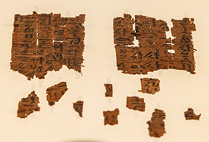
A fragment from Herodotus’ Histories, Book VIII, on Papyrus Oxyrhynchus 2099, dated to early 2nd century AD. Image: Sackler Library, Oxford via Wikicommons
The ability to use Demotic survived rather longer, the latest dated text in that script being composed in AD 452, but the ability to read and/or write Demotic did not mean that a scribe could read hieroglyphs. To get a sense of the character of Horapollo’s work, let us consider some typical examples to which I shall attach comments, as appropriate:
Book 1
1. But when they wish to represent Eternity in a different way, they draw a serpent with its tail concealed by the rest of its body. This, the Egyptians call Ouraion, but the Greeks a Basilisk. They make this of gold and put it around the [heads of the] gods. [Some knowledge here of the uraeus-serpent and its Egyptian name, but the interpretation of its significance is inaccurate.]
10. To signify a sole begotten, or birth, or a father, or the world, or a man, they draw a scarab. [The connection of the scarab-hieroglyph with birth is correct.]
11. When they denote a mother … they draw a vulture. [Correct.]
Book 2
4. A man’s heart hanging from his windpipe means the mouth of a good man. [This entry shows some knowledge of the significance of the nfr hieroglyph.]
94. When they wish to indicate a man guarding himself against the plots of his enemies, they draw a crane keeping watch, for they [i.e. cranes] guard themselves by standing watch in turn throughout the night. [Fanciful. The crane was regarded in antiquity as a watchful bird, but there is no basis for the claim in this extract.]
These examples are enough to demonstrate that, by the time Horapollo composed his exegesis of the hieroglyphic script, knowledge of the system had been reduced to scraps of approximately accurate knowledge, and a great deal of sheer nonsense inspired by Late Antiquity’s obsession with symbolic interpretation and allegory. There is no awareness anywhere in the book that the bedrock of the hieroglyphic script consisted of phonetic signs. However, this mix of half-knowledge, ignorance, and fantasy cannot obscure the fact that the Hieroglyphika represents a serious attempt to establish how the hieroglyphic system worked, and we are, therefore, justified in locating Horapollo in our canon of early Egyptologists.

The first Egyptologists?
The purpose of this article has been to establish whether it is justifiable to apply the term ‘Egyptologist’ to anyone in antiquity. Four cases have been discussed – two pharaonic Egyptians and two writers in Greek – to determine whether they show what we would regard as a scholarly commitment to the study of ancient Egypt.
In the case of Khaemwaset, there is explicit evidence of such a commitment, but ancillary motivations of a political and religious nature are certainly present. The Qenherkhopeshef archive also shows evidence of scholarly interest, though here we must concede that some items may have had other attractions. When we turn to the two authors who wrote in Greek, we can equally claim that a scholarly commitment is present, though, in the case of Herodotus, the desire to show-case Greek activities in Egypt played an important part. In the case of Horapollo, on the other hand, there is no obvious ancillary motive: he is simply concerned with explaining the workings of the hieroglyphic script, an aim which he pursues with diligence but conspicuous lack of competence. In this endeavour, unfortunately, he did a great deal of damage: when his work was published in Renaissance Europe, it pointed those interested in decipherment in quite the wrong direction. Herodotus did no such harm: he was a European with many of the interests of a modern student, and provided an account of pharaonic civilisation which, for all its faults, was the best available until the decipherment opened up that civilisation once more, allowing the ancient Egyptians to speak for themselves in their own words.

Alan B Lloyd is Professor Emeritus at the Department of History and Classics, Swansea University, and Vice President of the Egypt Exploration Society. He is an authority on the writings of Herodotus and author of many books, including Ancient Egypt: State and Society (reviewed in AE 87) and an article on Cleopatra VII in AE 131. You can read more about Khaemwaset in articles by Patrick van Gils (AE 90) and Aidan Dodson (AE 117).
Further reading:
• S Snape (2011) ‘Khaemwaset and the present past: history and the individual in Ramesside Egypt’, in M Collier and S Snape (eds), Ramesside Studies in Honour of K A Kitchen (Bolton: Rutherford Press), pp.465-473.
• D Asheri, A Lloyd, and A Corcella (2007), in O Murray and A Moreno (eds), A Commentary on Herodotus Books I-IV (Oxford University Press).
• G Boas (1950; revised edn, 1993) The Hieroglyphics of Horapollo (Bollingen Series XXIII; Princeton University Press).