
Subscribe now for full access and no adverts
As Willibald watched the customs officials rifle through his baggage, his native Wessex must have felt worlds away. The early medieval monk was no stranger to travel – he had just completed his fourth pilgrimage to Jerusalem – but while passing through Tyre, in modern Lebanon, in the 720s, he and his companions had been arrested and chained while authorities associated with the ruling Umayyad caliphate searched their belongings for contraband. The penalty for smuggling was death, and Willibald was carrying something that he desperately hoped would not be discovered. In his possession he had an innocuous-looking gourd – but this outwardly innocent fruit had been hollowed out and filled with balsam, a valuable and very strictly controlled plant resin that was much sought-after in the Christian West as a key component of chrism, the blend of oils used in various religious rites.
In an effort to disguise the substance’s distinctive smell, Willibald had inserted a reed into the top of the gourd, and topped it up with petroleum. He and his companions must have watched with their hearts in their mouths as the officials found the fruit and sniffed it to determine its contents – but the deception went undetected, and the group were able to continue safely on their way. Decades later, Willibald was living peacefully at the monastery in Heidenheim (in modern Germany) when he reportedly recounted his adventures to the nun Huneburc, who recorded them in her Hodoeporicon of St Willibald (Itinerary of St Willibald).
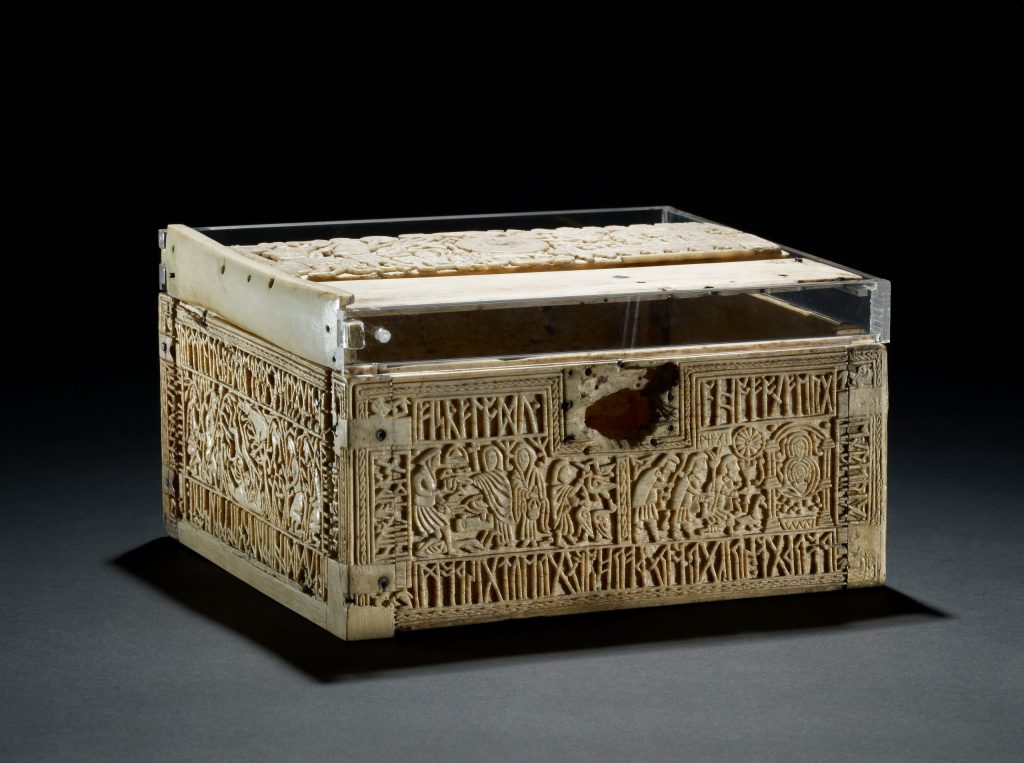
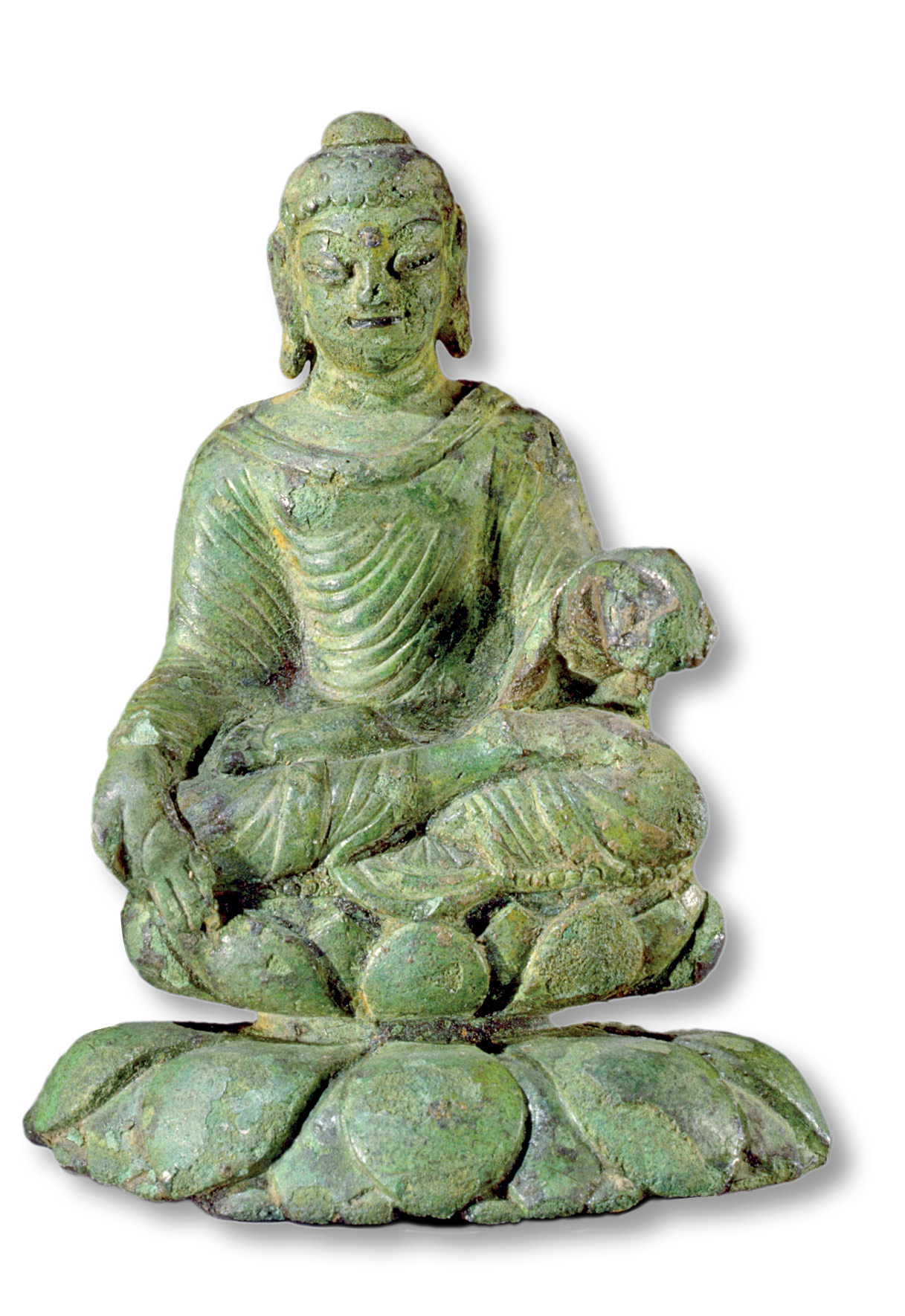
Willibald’s daring exploits defy the ‘Dark Age’ stereotypes that have long dogged post-Roman Britain. The centuries immediately after the end of imperial administration have traditionally been depicted as a period of decline, when Britain plunged into cultural obscurity and its inhabitants knew little of, and took less interest in, the wider world. Archaeological evidence completely contradicts this pessimistic picture, however, demonstrating that Britain and Ireland were in fact the westernmost point of a vast network of land, river, and sea routes along which an amazingly diverse range of people, ideas, and materials travelled for hundreds of years. Some of these cosmopolitan connections are explored in Silk Roads, a major exhibition currently running at the British Museum (see ‘Further information’ on p.32). Spanning the centuries between AD 500 and 1000, and covering a wide geographical sweep from Japan to Ireland, its displays draw on the collections of the British Museum itself, as well as loans from almost 30 other institutions at home and abroad. Its themes include intriguing insights into the impact of these routes on early medieval Britain and Ireland, and the interconnected, internationally interested, and often intrepid inhabitants of these isles.
Fashionable finds
Access to international markets was not severed by the withdrawal of Roman officialdom: long before Willibald set out for the Holy Land, elite settlements in the late 5th- and mid-6th-century British Isles were benefiting from far-reaching trade connections that have left lasting traces in the archaeological record. Over the last century, excavations at sites in south-west England, Ireland, Wales, and Scotland have uncovered fragments of pottery containers that once transported wine, oil, and other exotic treats from the eastern Mediterranean to the tables of high-status households.
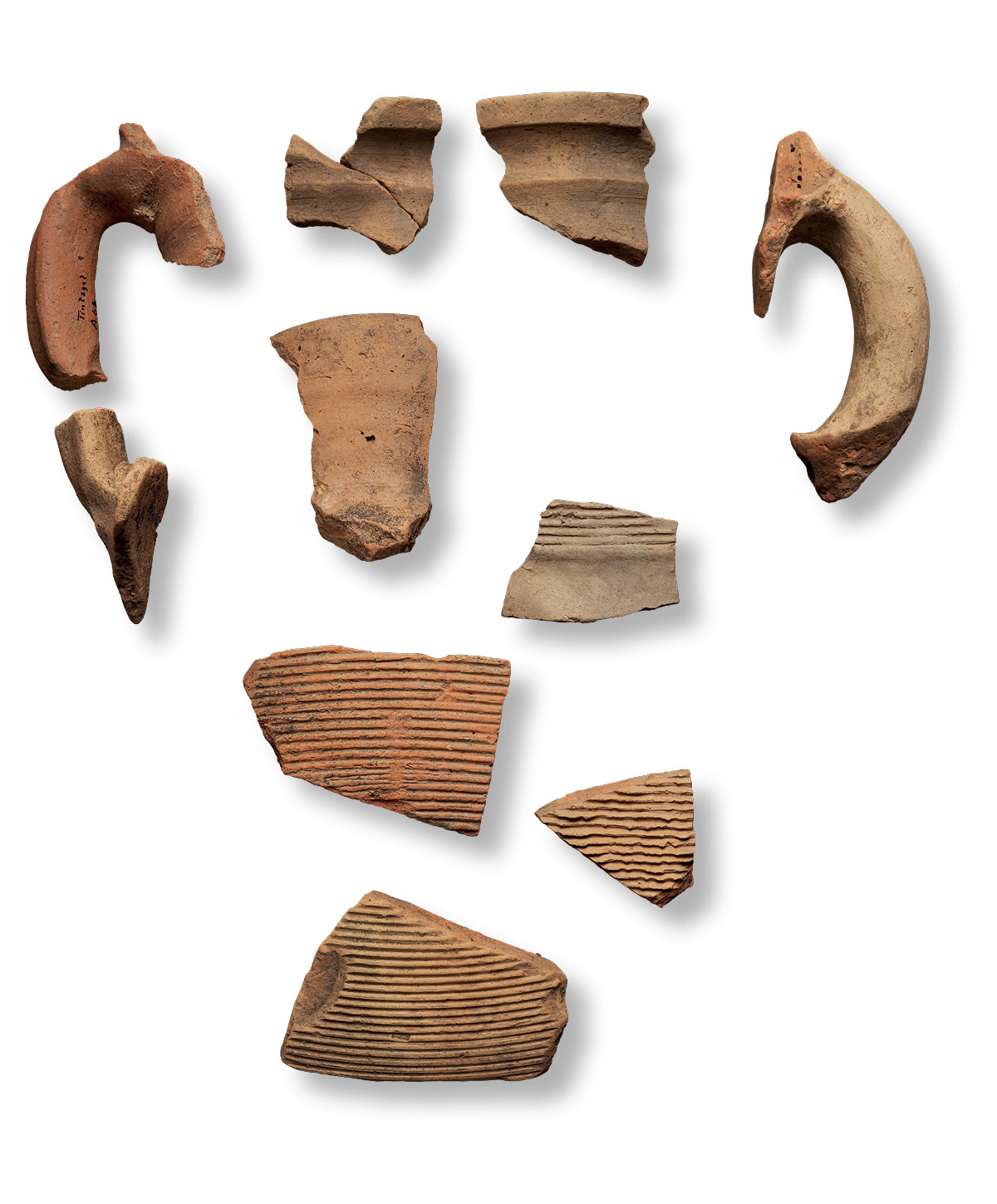
Perhaps the best-known such site is Tintagel on the northern coast of Cornwall, which has produced the largest collection of 5th- to 7th-century Mediterranean pottery in Britain: over 1,800 sherds from wine amphorae and fine tableware from Greece, Turkey, and (possibly) North Africa (see CA 227). These tastes travelled widely, however: as the exhibition catalogue notes, smaller numbers of these fragments are also known from locations along the Atlantic coast – at Bantham Sands in Devon (CA 178), Dinas Powys in Wales, and Dalkey Island in Ireland. A particularly striking addition to this list, though, is Rhynie in Aberdeenshire, a Pictish power centre known for its concentration of symbol stones (CA 289). It represents the most northerly findspot for this kind of pottery – and, more than that, it lies 40km inland, highlighting that these sought-after goods were not only accessible to coastal communities, but were actively acquired by more landlocked leaders.
Being able to show off these exotic wares at lavish feasts appears to have been a key sign of prestige in elite society, but such identities were not only expressed by the living. Grave goods of the same period also demonstrate a flair for the exotic, with particularly well-furnished burials across the 5th to 7th centuries containing glassware from the Mediterranean, cowrie shells from the Red Sea (CA 323 and CA 392), pouch-rings crafted from African ivory (CA 399), and beads of Egyptian glass. Among the most visually impressive of these no-doubt treasured imports are the garnets that were carefully shaped and set in gold ornaments like those that have been found in the ‘princely’ burials of Mound 1 at Sutton Hoo in Suffolk, Prittlewell in Essex (CA 190 and CA 352), and Taplow in Buckinghamshire.


Recent research into the Sutton Hoo garnets, Silk Roads attests, has revealed their diverse origins, with stones traced variously to Czechia, Sri Lanka, and India often mixed together on the same object. It is not only the ornaments’ materials that speak of far-reaching connections, however. The garnets are held in place using a technique called cloisonné, which is thought to have developed in the Black Sea area, the Caucasus region, or West Asia, and spread swiftly across Europe and further afield. As well as examples from Anglo-Saxon England, the exhibition includes a set of cloisonné ornaments found in a late 5th-century female grave at San Marino in Italy, and an extraordinarily ornate dagger sheath, dating to the 6th century, that was discovered in a high-status grave at Gyeongju in South Korea. This is not to suggest any direct contact between Korea’s Silla kingdom, the Ostrogoths, and Anglo-Saxon England; but the strikingly similar decoration adorning these objects attests to how far fashions and artistic inspiration could travel along the web of influences that we now call the Silk Roads.
Anglo-Saxons abroad?
Garnets are not the only ‘exotic’ items that have been identified within the elite Anglo-Saxon burials mentioned above. Sutton Hoo’s ship grave and the wood-lined burial chambers of Taplow and Prittlewell have also produced metalwork from the Eastern Mediterranean realm of the Byzantine Empire. These have traditionally been interpreted as prestigious imports or diplomatic gifts that may have travelled to early medieval England via multiple steps along a network of elite exchange. As an example, the exhibition catalogue discusses a large silver platter which is not included in the temporary displays but can be seen upstairs in the British Museum’s Sutton Hoo and Europe gallery. Its stamped insignia indicates that it was made in Constantinople during the reign of Anastasius I (491-518), an Eastern Roman emperor who was clearly close to his contemporary, Clovis I of Francia, as he made the king a consul in 508 and lavished him with ostentatious gifts. Might one of these have been the silver platter?

If so, the marriage of Bertha, Clovis’ great-granddaughter, to Æthelbert, king of Kent, c.580 could represent another key step on its journey to Sutton Hoo. Bertha was a Christian, and her influence is often credited for her husband’s conversion to the same faith, and the arrival of St Augustine’s mission from Rome in 597. The chronicler Bede tells us that Æthelbert held overlordship over the nearby kingdom of East Anglia, pressuring its ruler, Rædwald, to also adopt Christianity (though Bede notes that Rædwald did so rather half-heartedly, accepting baptism in Kent but maintaining altars to both Christ and the old gods back home). As Rædwald is one of the key candidates for the occupant of the Sutton Hoo ship burial, might this have been the route by which the silverware ended up in Mound 1?
While this kind of multi-generational journey can be reconstructed for the platter, many of the ‘Eastern’ artefacts from Sutton Hoo, Prittlewell, and Taplow are not heirloom objects but appear to have been new when they were committed to the ground. Could they have taken a rather more direct route to Anglo-Saxon England? Silk Roads touches on thought-provoking new research that offers a possible solution, highlighting the fact that the ‘princely’ burials represent a relatively short-lived phenomenon (spanning c.580-625) and placing them in the context of Byzantium’s late 6th-century wars with the Persian Sasanian Empire. This analysis is explored more fully in papers (cited in ‘Further reading’ below) by Dr Helen Gittos of the University of Oxford, and Dr St John Simpson of the British Museum. Both authors point to the writings of the 7th-century Byzantine historian Theophylact Simocatta, who describes a huge recruitment drive drawing thousands of mercenaries from both sides of the Alps. Might these have included men from the Anglo-Saxon kingdoms, seeking the kind of fame and fortune celebrated in Old English poetry?

Alongside discussions of distinctively Eastern copper-alloy basins (Gittos), analysis of Sasanian intaglios and coins found in England and Wales (Simpson), and descriptions of lumps of Syrian bitumen from the Sutton Hoo ship burial (both), these papers highlight an artefact that can be seen in Silk Roads: a copper-alloy flagon from Prittlewell. Its neck is encircled by a bracelet adorned with three medallions bearing the image of a figure on horseback. This has been interpreted as St Sergius, a soldier-saint who was martyred c.305 and who had a major shrine at Sergiopolis (modern Rusafa) in Syria, close to where much of the Byzantine–Sasanian fighting took place. Strikingly similar flagons are also held in the collections of the British Museum and V&A Museum in London, the Met Museum in New York, and the Walters Art Museum in Baltimore. They are not obvious imports, nor are they luxury items made from high-status materials; instead, Gittos interprets them as mass-produced pilgrim souvenirs, one of which may have caught the eye of a warrior from Essex.

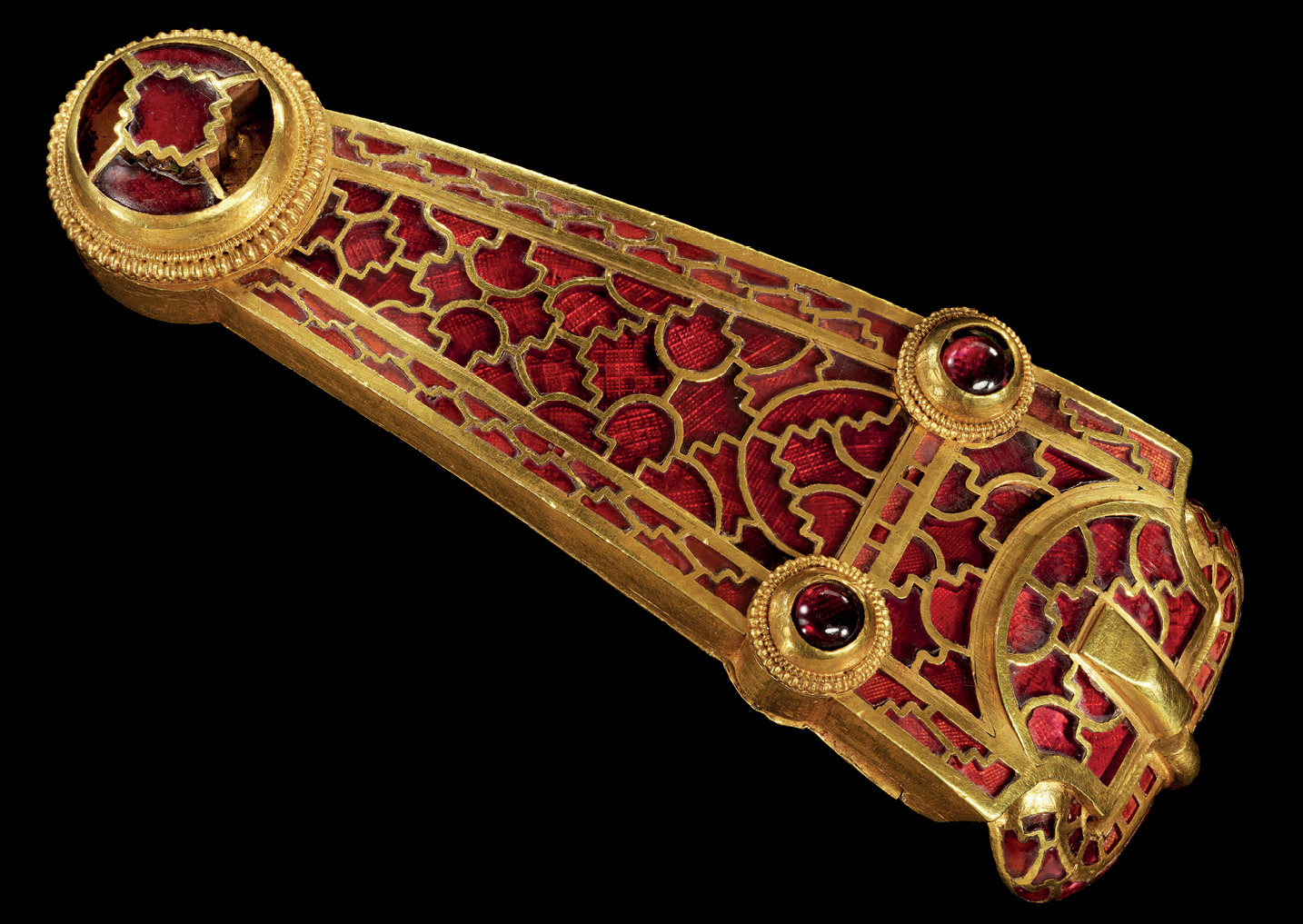
Above & below: The hinged shoulder-clasps from Sutton Hoo’s Mound 1 burial are reminiscent of examples on the eastern borders of Byzantium; the same grave also contained a coat of mail armour – unique in Anglo-Saxon England but familiar in the East.

These elite individuals may have returned home resplendent in Eastern fashions, too. As the exhibition points out, the clothing of the men buried at Taplow and Prittlewell can be reconstructed as a kind of wrap-over tunic reminiscent of riding jackets worn by the people of the Steppes and the Byzantine East, while the enigmatic ‘dancing warriors’ depicted on the Sutton Hoo helmet are dressed similarly. Eastern ideas are reflected as well in the design of the clasps that once fastened the Taplow individual’s tunic, combined with Anglo-Saxon animal imagery, and in Silk Roads they are displayed beside a set of hinged shoulder-clasps from Sutton Hoo. Although made in an East Anglian workshop, these latter objects are unique in England but comparable to artefacts from the Byzantine Empire. Contrasting with the gold-and-garnet gleam of these ornaments is a corroded lump of iron in the same glass case. It is all that remains of a coat of mail armour that was once placed in the Sutton Hoo ship burial; again, unique in England but a familiar sight in the Byzantine cavalry. While we cannot know for certain how these objects came to rest in Anglo-Saxon graves, the scenario proposed by Gittos and Simpson, and embodied by the objects in Silk Roads, offers an intriguing prism through which to view early medieval England.

Christianity and Islam
If warfare can be a conduit for new cultural ideas, so too is religion. Christianity arrived in Britain during Roman occupation, and had crossed the Irish Sea by around the 5th century. While the aftermath of Roman administration saw a marked decline in the religion in Anglo-Saxon England, however, the Irish church continued to thrive, with monasteries flourishing through the 6th and 7th centuries, and missionaries evangelising and establishing new religious communities in Britain and continental Europe – including, in 563, St Columba’s foundation of the influential monastery on Iona. When Christianity was reintroduced to the Anglo-Saxon kingdoms, following St Augustine’s arrival in 597, it again had something of a Roman flavour, and continental influences would continue to be key.

When Benedict Biscop founded the famous monastery at Wearmouth–Jarrow in late 7th-century Northumbria (a kingdom that had been restored to Christianity by an Irish monk, St Aidan, who first served on Iona and then established the monastery of Lindisfarne), Bede tells us that he drew on visits to Rome for architectural inspiration. Excavations at Jarrow tally with this account, and the exhibition includes a number of continental-style finds from the site, including a distinctively dressed stone window-head, fragments of glazing, flakes of colourfully painted plaster, and chunks of opus signinum (crushed concrete) flooring. Scholars from far afield travelled to Britain to share their learning, among them Bishop Hadrian (c.709), from North Africa, and Theodore (d. 690), from Tarsus in modern Turkey, who established a school in Canterbury. These journeys did not all go in one direction, however: Anglo-Saxon clerics were travelling abroad too, such as Alcuin of York, who played an important role at the 8th-century Carolingian court.


The Carolingian Empire enjoyed huge power and prestige, particularly during the reign of Charlemagne (r. 768-814), and one Anglo-Saxon ruler who was keen to emulate this success was Offa of Mercia (r. 757-796). Offa and Charlemagne were in frequent contact, exchanging correspondence and gifts – and, it appears, artistic inspiration. The influence of eastern Mediterranean styles can be clearly seen in the sculptures that adorned Mercian churches, and a particularly fine example is on display in Silk Roads. This is a 60cm-tall sculpted limestone panel depicting an angel, which was discovered during excavations at Lichfield Cathedral (CA 205). It was originally vibrantly painted, and late Antique influences can be discerned in its draped clothing, finely modelled hair, and eyes that have been drilled, possibly for glass settings. Carolingian connections may have brought Offa’s kingdom into contact with a very different religious sphere as well: the Islamic world.
Established in Arabia in the early 7th century, Islam first reached mainland Europe when Muslim forces crossed the Strait of Gibraltar in AD 711, quickly conquering the Christian Visigoths ruling Iberia (Spain and Portugal) and establishing al-Andalus, which grew into a prosperous and cosmopolitan caliphate with its capital at Córdoba. Francia maintained diplomatic links with this region, as well as with the Abbasid East – and it appears that Offa knew of, and desired to associate himself with, the caliphs’ power and wealth just as much as that of Charlemagne. These impulses may have inspired one of the most intriguing and surprising finds on display in Silk Roads: a small gold coin that was minted in Mercia, found in Rome, and is a clear imitation of a dinar of Caliph al-Mansur (r. 754-775)

The Mercian moneyer who produced it has copied the original so closely that they have replicated its date (157 in the Muslim Hijri calendar, equivalent to AD 773/774) and the Arabic text on both faces. This latter aspect may have been seen as a decorative element rather than recognised as writing – it seems odd that the piously Christian Offa would have wanted references to Allah and the Prophet Muhammad on his coins – and aesthetic choices rather than understanding may have also prompted the insertion of ‘OFFA REX’ between two lines of Arabic, with the king’s name upside down in relation to the other text. It has been suggested that the ‘error’ actually indicates an awareness that Arabic and Latin should be read in opposite directions, even if the precise details were not understood – however, a similar quirk has been observed on a late 8th- or early 9th-century silver-gilt brooch recovered from Ballycottin Bog in Co. Cork, which is also on display in Silk Roads. The cruciform ornament is clearly Carolingian and Christian in style, but its central setting is a glass Islamic seal with an Arabic inscription. It is possible that the gem was a recycled intaglio, originally set in a ring, as a similar example (housed in the Historiska Museet in Stockholm and not included in the exhibition) was found in a 9th-century woman’s grave at Birka, Sweden. When the Ballycottin Bog gem was reset in the brooch, however, it was positioned with the inscription running vertically.

Pilgrims and traders
Might early medieval individuals have experienced Islamic lands in person? As Willibald’s itinerary attests, pilgrims seem to have been able to visit the Holy Land when sites were under Islamic control, and Bede’s Ecclesiastical History and Adomnán’s Concerning Sacred Places preserve eye-witness accounts of Bethlehem, Nazareth, Jerusalem, Jericho, and other biblical sites courtesy of Arculf, a Frankish bishop. A more tangible trace can also be seen in Silk Roads: a terracotta pilgrim flask that was made in Abu Mina, Egypt, in c.AD 480-650, but was ultimately excavated in Canterbury.
Contact with the Islamic world continued in the Viking Age. More than 20 runestones in Sweden attest to expeditions to ‘Serkland’, often interpreted as the land of the ‘Saracens’. Scandinavian traders are also known to have travelled across the Baltic from the AD 700s, sailing far inland along rivers flowing through eastern Europe, Russia, and Ukraine – routes that they called the austrvegr, the ‘Eastern Way’, and which led to lucrative markets in the Byzantine Empire and Islamic lands further south. Along the way they founded multi-ethnic towns and a new hybrid cultural identity called Rus’. Rus’ traders had distinctive styles of dress and other markers of identity, including scabbard mounts decorated with falcons. These are known as ‘Birka-type’ mounts, but they appear to have been used as an expression of Rus’ identity across the Viking world. The example displayed in Silk Roads was found in Sweden, but similar ones have been recorded by the Portable Antiquities Scheme in Hampshire, Yorkshire, Lancashire, Lincolnshire, and Staffordshire.
Signs of slavery
Perhaps one of the most valuable – and most notorious – ‘commodities’ sold by the Rus’, however, was slaves. This trade is described in 10th-century accounts by Ahmad ibn Rusta and Ahmad ibn Fadlan, travellers from modern Iran and Iraq respectively, and the majority of captives are thought to have come from the Slav peoples of central and eastern Europe. Viking raiders are known to have taken slaves from Britain and Ireland too, although men and women seized from these shores were often pressed into service (or concubinage) in Scandinavia. The Vita Findani describes the life of an Irish nobleman from Leinster who was captured and sold multiple times before finally managing to flee to freedom when a ship transporting him to Norway made a stopover in Orkney. Stories of slavery also survive in Scandinavian sources: in Laxdæla Saga, we find the tale of Melkorka, an Irish princess who was captured as a teenager and sold by a Rus’ merchant to an Icelandic chieftain.
One of the most striking echoes of this trade in human lives, however, is found not in the written but the archaeological record. In 2001 and 2002, Headland Archaeology were excavating a medieval monastic site on Inchmarnock, an island off the west coast of Scotland, when they found pieces of a broken slate scratched with a dramatic scene. Although fairly crudely drawn, it depicts a long-haired, mailcoat-clad male figure leading a captive, possibly a monk, towards a Viking-style longship (CA 184). Known as the ‘Hostage Stone’, it is usually housed in Bute Museum, Rothesay, but has been loaned to the Silk Roads exhibition. The Inchmarnock excavations actually produced a large number of inscribed slates, which seem to have been treated as scrap paper by novice monks learning scholarly skills. Most had been used to practise writing, but might this sketch express the anxieties of a boy imagining events that must have traumatised many other monastic communities?

While high-born figures like Melkorka and Findan feature in medieval literature, countless other enslaved individuals remain anonymous, with the silver for which they were sold representing the only evidence of their existence. The Rus’ slave trade is thought to be one of the key reasons behind the vast numbers of Islamic coins which flooded along the ‘Eastern Way’ into the Baltic region and beyond, including into Viking Age Britain. Indeed, documented dirham finds may represent only a fraction of the coins that originally came west, as many were melted down and recast into other objects, including ingots and Scandinavian-style arm- and neck-rings (which were themselves sometimes cut up as ‘hack-silver’, or bullion).
The presence of dirhams ‘hiding in plain sight’ in artefacts can be revealed by analysing the chemical composition of their metal. Dr Jane Kershaw at the University of Oxford has carried out illuminating research into the origins of silver from Viking hoards, analysing lead isotopes to pin down the provenance of their materials (see http://www.vikingmetalwork.blogspot.com). The coins themselves could serve as bullion, too: Torksey in Lincolnshire preserves traces of a camp where, the Anglo-Saxon Chronicle attests, the Viking Great Army overwintered in AD 872-873 (CA 281). There, archaeologists have found over 100 dirhams cut into halves and quarters, together with dozens of Islamic-style weights. Finally, intact dirhams also appear in Viking hoards, including a cache found near Harrogate, North Yorkshire, in 2007 (CA 212). Known as the Vale of York Hoard, its contents included over 600 Anglo-Saxon, Anglo-Viking, Carolingian, and Islamic coins (including one from Samarkand, a key location on the Silk Roads in modern Uzbekistan). One of the most striking components, however, was a mid-9th-century silver-gilt cup, possibly looted or taken in tribute from a Frankish church. Its bulbous shape and decorative roundels filled with plant and animal motifs have clear parallels with Sasanian metalwork, and it is similar, too, to the Halton Moor Cup (not in the exhibition), which is also of 9th-century Frankish manufacture, and was found in an early 11th-century hoard in Lancashire.


Where did the inspiration for these objects come from? Had their creators travelled from Eastern lands, or were they made by Frankish artisans inspired by imported originals? A third cup, from the Galloway Hoard (CA 297 and CA 376), may hold the key. This lidded vessel probably dates to 650-800, and was buried c.900. It was wrapped in silk, but conservation and research has revealed underlying decorations, including motifs similar to the Zoroastrian fire altars of Sasanian art, and stylised leopards and tigers. This was not another Frankish copy, however: metallurgical analysis has traced its niello inlay to a Sasanian silver mine in modern Iran. The cup was not merely inspired by Eastern art, but is itself an Eastern artefact that had made its way to early medieval Scotland.
Further information: Silk Roads runs at the British Museum until 23 February 2025. For more details, see http://www.britishmuseum.org/exhibitions/silk-roads.
Further reading:
• Sue Brunning, Luk Yu-ping, Elisabeth R O’Connell, and Tim Williams (2024) Silk Roads (British Museum Press; pbk: ISBN 978-0714124988, £30; hbk: ISBN 978-0714124971, £45).
• Helen Gittos (forthcoming) ‘Sutton Hoo and Syria: the Anglo-Saxons who served in the Byzantine army?’, The English Historical Review.
• St John Simpson (2024) ‘Sutton Hoo, St Sergius and the Sasanians: Anglo-Saxon finds re-interpreted from an Eastern perspective’, Ash-sharq: Bulletin of the Ancient Near East 8: 1-35.
All images: © Trustees of the British Museum, unless otherwise stated

You must be logged in to post a comment.