Subscribe now for full access and no adverts
If you have heard of the Woolwich Rotunda at all, you will probably remember that it was, until it closed in 2010, the home of the Royal Artillery Museum, housing a large collection of military artefacts. It comes as a surprise to discover, from within the pages of a new richly documented Historic England monograph (see ‘Further reading’ below), that this distinctive building was originally erected as a giant tent, designed for use as a ballroom and party venue.
The unusual story of the Rotunda begins in 1814, with the defeat of Napoleon and his subsequent exile to Elba. His abdication and the Treaty of Paris, signed by France and the Allies on 30 May 1814, brought an end to 22 years of turmoil in Europe that had begun with the French Revolutionary Wars of 1792-1802 and continued with the Napoleonic Wars of 1803-1815. Napoleon’s invasion of the Iberian Peninsula in 1807 brought Britain into the war due to a long-standing alliance with Portugal. Field Marshal Arthur Wellesley (1769-1852) led British, Portuguese, and Spanish troops to a series of decisive victories over Napoleon’s troops during the Peninsular War, precipitating the collapse of the French army and its retreat from Spain. This was then followed by France’s final defeat when Russian and Prussian troops entered Paris on 31 March 1814.
Though this later became known as ‘the false peace’ (because hostilities began again when Napoleon escaped from Elba and returned to Paris in March 1815, only to be defeated at the Battle of Waterloo in June 1815) there was widespread jubilation throughout Europe from April 1814 onwards. London was lit up by illuminations and fireworks over three successive nights from 11 to 13 April. The French king Louis XVIII, who had spent seven years in exile in England, received a state reception before his return to France on 24 April.

On 7 June, a party of monarchs, generals, and ministers representing Britain’s allies arrived in London, including Tsar Alexander I of Russia, King Frederick William III of Prussia, and Prince Metternich of Austria. Three weeks of celebration followed, with banquets at London’s Guildhall, a grand military review in Hyde Park, a naval review at Portsmouth, and a ball at Almack’s exclusive assembly rooms in St James’s Street.
Before these dignitaries left Britain on 27 June, Arthur Wellesley arrived at Dover – his first home leave in six years. Newly ennobled as the 1st Duke of Wellington, he was roundly feted with a masked ball at Burlington House in Piccadilly on 1 July, a thanksgiving service in St Paul’s Cathedral on 7 July, and a grand dinner at the Guildhall on 9 July. Then, on 21 July, Wellesley was the guest of honour at the Wellington Fete, the first event to be held in the newly built Rotunda.
Welcoming Wellington
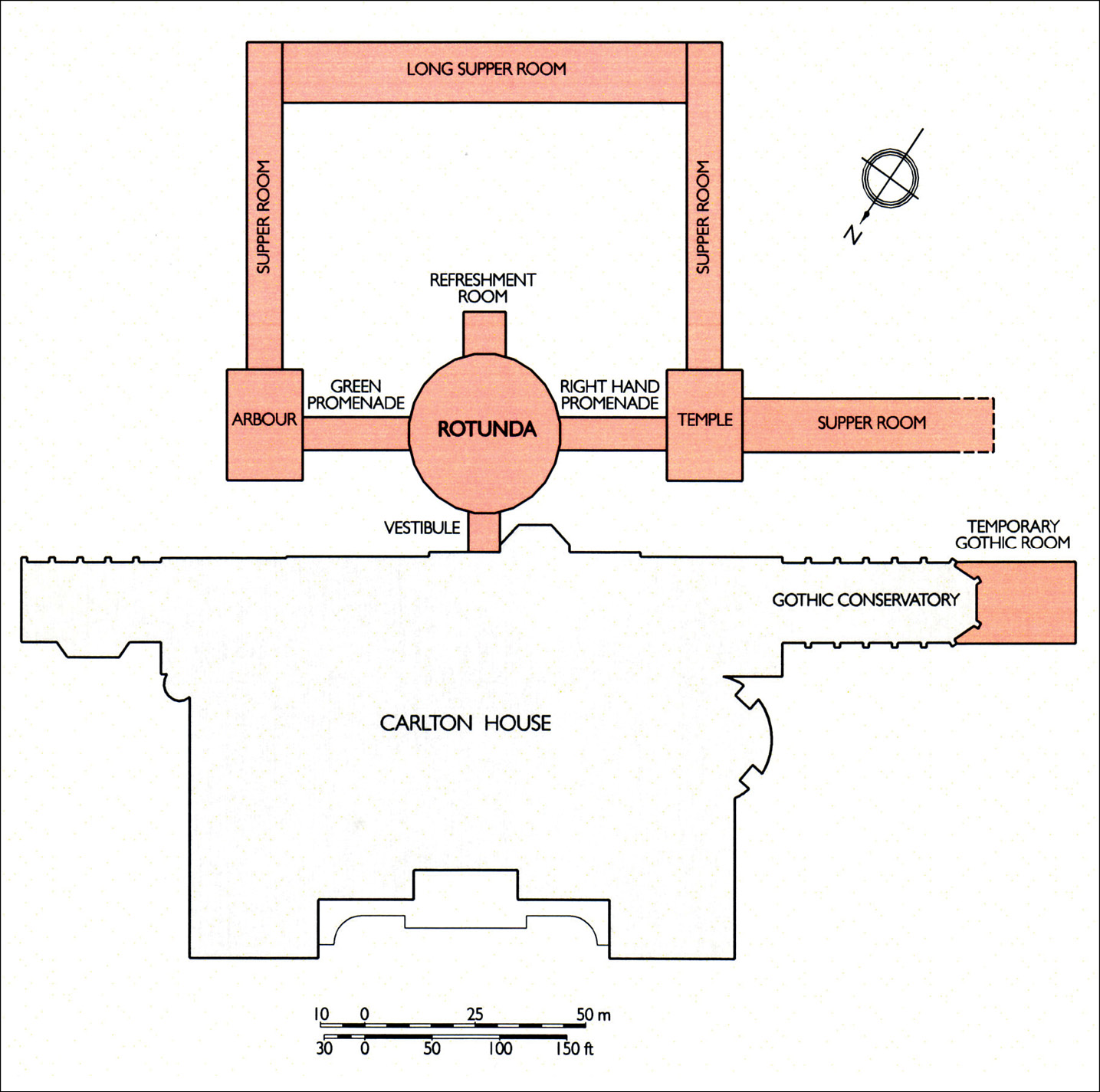
Originally known as the ‘polygon building’, the Rotunda was designed by John Nash (1752-1835) for the then Prince Regent (1762-1830; crowned George IV in 1820), and was erected in the gardens of Carlton House, the Prince’s home and the hub of royal life in London. Nash’s drawings (which survive in the National Archives and are reproduced in the book) show that the final design was in place by May 1814. It was intended that the Rotunda should have been built and ready for use in time for the visit of the Allied sovereigns in June, but despite the construction team working around the clock (including by torchlight at night), the scale of the work proved to be ‘too gigantic’ for that deadline to be met.

The newspapers of the day took a keen interest in the Rotunda’s construction. The Morning Post reported on 24 May 1814 that: ‘It was not to be an octagonal building but a polygonal one… this erection will have 24 angles instead of eight… this will be a magnificent pile, partaking completely of the oriental style and forming a rare combination after the Chinese, Hindostan, and Persian style of building and decoration. It will resemble, in the roof, a cone, rising to a towering height, above the summit of the lofty trees.’

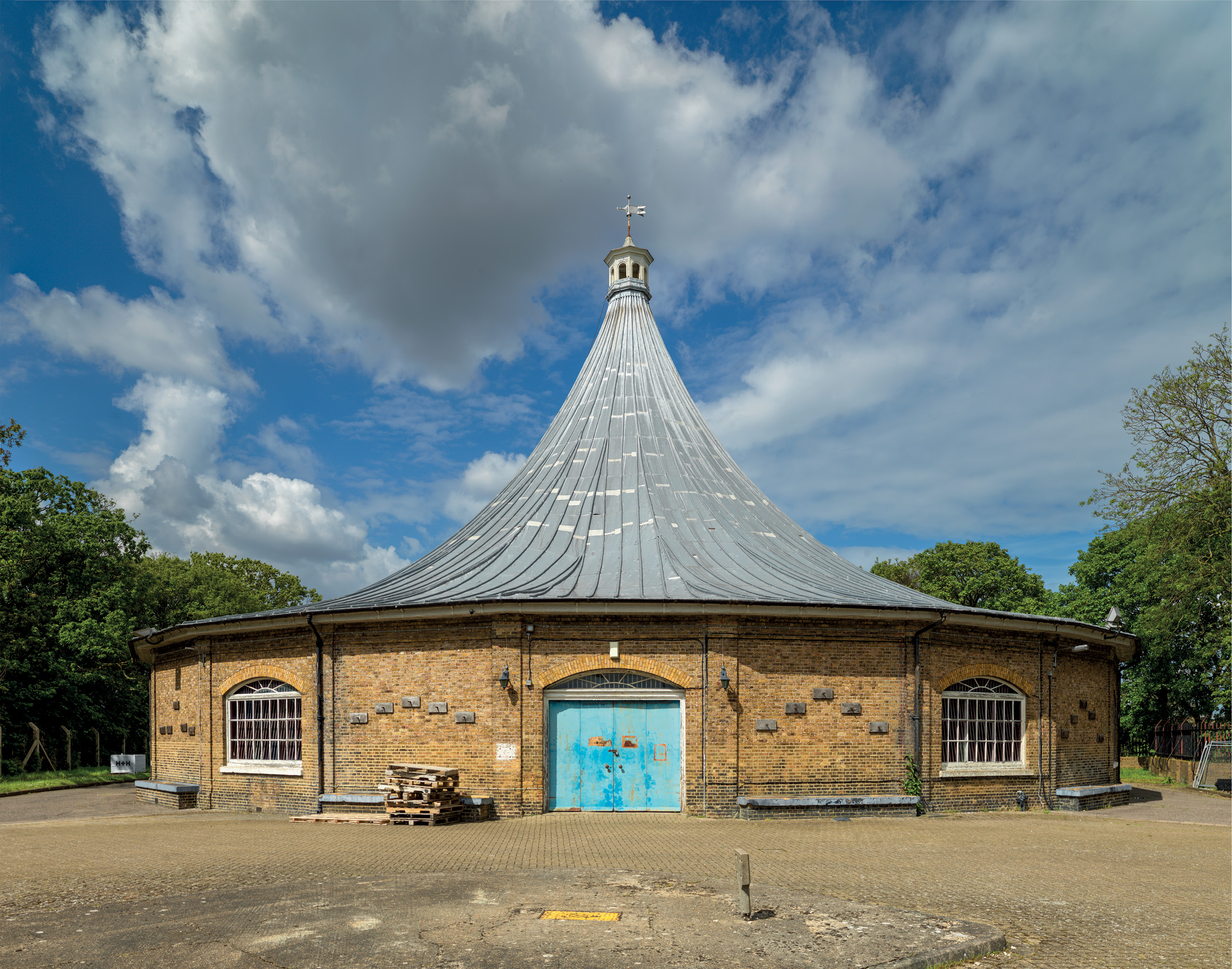
The roof was remarkable for spanning an area of 36.5m (120ft) in diameter without any columns (though a central column was inserted at a later date). This surpassed the diameters of some of the world’s largest domes, including St Paul’s (34m/112ft) in London and Hagia Sophia in Istanbul (33m/108ft). It was a major structural achievement to design a roof of this scale without placing unsustainable pressure on the outer walls. This was accomplished in part by the deployment of strong and stable concave curves for the main timber elements, rather than the convex members that had been used in the past for constructing domes. And although the Rotunda was intended to be a temporary structure, its cost was such that the Chancellor of the Exchequer insisted that it should be capable of being ‘taken asunder in such a way as to be easily put up on any future occasion’ – a prophetic requirement given its future uses and longevity.
Vivid descriptions have survived of the lavish entertainments laid on for the Wellington Fete. Invitations were sent to 2,500 guests, and the large number of uniformed officers present – many of whom had served under Wellington in the Peninsular War – gave the event a strongly military flavour. The main façade of Carlton House was hung with an enormous transparency (a picture painted on translucent cloth and lit from behind by some 40,000 lamps) that depicted Wellington as Mars, riding in a chariot, attended by Victory and Peace.


Arriving from 9pm, guests were admitted to the brightly illuminated Carlton House courtyard and directed through the palace to various tented supper rooms. The Rotunda, which functioned as the ballroom, was attached to Carlton House by a short curtain-lined vestibule. The interior was brightly lit by tent-shaped lamps, and the walls were lined by recesses with seats, decorated with mirrors, drapes, and flowers. Each of these recesses had its own roof, supported by columns carved to resemble fasces (the bundles of rods that symbolised authority in Classical art).

The roof was lined with canvas painted to look like white muslin, and a raised ‘temple’ in the centre of the floor, swathed in artificial flowers, housed the musicians. Corridors led off to the east and west, decorated with further ‘transparencies’ painted with allegorical subjects, such as the ‘Overthrow of Tyranny by the Allied Powers’. Looking through the corridor to the west, the viewer’s eye would be drawn to a temple housing a marble bust of the Duke of Wellington. The equivalent to the east was an arbour decorated with laurels (symbolic of victory) and rare plants brought from Kew Gardens. Beyond lay the supper rooms, fitted with more allegorical paintings, regimental flags, and military and naval trophies. Guests sat down to supper in the early hours of the morning – at 2am or 3am – and continued dancing until the fete ended at 6am.

Resurrecting the Rotunda
By spring 1815, almost all of the temporary structures created for the fete had been dismantled and their materials sold, but the Rotunda remained and it was again called into service for parties held in May 1815 and July 1816. In 1818, however, the Prince Regent decided that the ‘great circular room’ should be transferred to Woolwich, ‘there to be appropriated to the conservation of the trophies obtained in the last war’.
In making this decision, George was probably influenced by his friend Sir William Congreve, who was responsible for the military collections at Woolwich and saw the acquisition of the Rotunda as an answer to the lack of space. The Treasury was not happy, however, as dismantling the building and re-erecting it at Woolwich would have involved considerable expense. Better, they felt, to deconstruct the building and sell the materials.

In the stalemate that ensued, it was decided that the building should remain standing in the garden at Carlton House so that any potential purchaser could view the extant structure rather than having to imagine it from drawings and dismantled timbers. Nash himself proposed its reuse as a church, but in the end an offer to pay for the building’s dismantling and re-erection came from the Earl of Mulgrave, Master-General of the Ordnance.
The dismantling of the Rotunda, which began on 2 September 1818, was a feat in itself. Nash advised that the various components should be marked with numbers and illustrated on a drawing so that the timbers ‘may readily come into their places should the building ever be put up again’. William Wyatt, who supervised the dismantling, took Nash’s advice and the roof timbers retain their Roman numerals to this day. However, ‘a great part of the timber framework [was found to be] in a decayed state’, according to a Morning Chronicle report on the deconstruction, while the Morning Advertiser commented that ‘it was said to be constructed [so] that it could be taken down and put up again in three days, but a great number of workmen have been employed in its dilapidation for nearly a week and appear to have much to do’. In the end it was not until 14 November that the timbers were delivered to Woolwich by waggon train.
In its new location, the Rotunda became part of one of the earliest purpose-built military training landscapes in Europe. The Royal Military Repository, of which the Rotunda was now to form part, had been founded in 1778 as part of a school for teaching the use of ropes, pulleys, levers, and cranes for mounting, dismounting, and manoeuvring heavy guns in different types of ground – uphill and down, across ditches and ravines, through sand, gravel, water, and broken ground.

As the name ‘repository’ suggests, the school included a collection of guns and carriages, along with models and drawings, to be used as teaching aids. The victory against Napoleon resulted in a substantial increase in the size of the collection, including ‘trophies’ taken at the capture of Paris and at Waterloo. The Repository’s existing museum room was already full – hence Congreve’s desire to obtain the Rotunda, for which he chose ‘a most picturesque situation’, on the brow of a hill overlooking the wider Woolwich landscape with views towards the Thames and partnered by a small copse.
In this exposed position it would need to be strong and secure, so in place of the original timber walls the re-erected Rotunda was given walls of brick. To provide greater stability to the roof structure, a large Doric column made of sandstone was added to the centre of the interior, increasing the Rotunda’s resemblance to a military bell tent. The roof itself was protected by weatherboards covered in painted canvas.

The Rotunda as repository
The new Artillery Museum in the Rotunda was formally handed over to the Royal Military Repository on 4 May 1820, and an unusual feature was the admission of the public – for, as well as serving as a teaching collection, the Rotunda’s contents were intended as propaganda of a kind, intended to play a part in the ‘nation-building’ process of the time, and to instil a sense of Britain’s military strength and superiority.
The full range of the exhibits is demonstrated by the catalogue of 1,280 objects that Congreve drew up in 1822. These included models of the fortifications at Gibraltar and of various royal dockyards that had been made for the late George III (which are now in the National Maritime Museum). Later additions included guns from the Mary Rose (the Tudor ship that sank in 1545), which had been recovered by divers in 1836 as an early example of maritime archaeology.


A notable attraction was Napoleon’s funeral hearse, transported to England after his death in St Helena in 1821. This was eventually relocated out of harm’s way because visitors were in the habit of taking souvenirs by snipping pieces from the velvet hangings and hacking off pieces of the woodwork. In 1858, it was restored and returned to France, where is it is now displayed in the Napoleonic Museum in the Château de Malmaison in the suburbs of Paris.
Just before Christmas 1861, the Rotunda was closed to the public to enable repairs to be carried out and to prepare for a major expansion of the collection in the form of trophies from the Crimean War, which ended in 1856 with victory for Britain and its allies. The canvas roof-covering was removed and replaced with much more weatherproof lead sheeting, laid over the earlier deal boards. This preserved the shape and character of the tent-like roof, but must have imposed additional weight on the structure, making the central masonry column all the more essential. New windows were introduced in the roof in response to complaints that the darkness of the room ‘rendered the museum of little value’.

At the same time, the museum made numerous acquisitions of arms and armour from Japan, India, and Turkey, and of historic material such as 16th-century armour from Rhodes’ occupation by the Knights Hospitaller, an Elizabethan gun from Pevensey Castle, and even a ‘collection of Swiss stone-age weapons’. Some degree of rationalisation took place, too, between the Artillery Museum, the Tower of London, and the British Museum, resulting in the growth of the collection to some 4,500 objects.
Gradually the nature of the collection changed from military training to a wider public appeal, while an effort was made to encourage learned groups and antiquaries to study the collections. In the 1870s, there were further acquisitions relating to campaigns in India, Burma, and Afghanistan, as well as from the Anglo-Zulu War and the Boer Wars. By the end of the 19th century, the Rotunda was well cared for, with a dedicated curatorial staff and what The Daily Telegraph described as an ‘embarras de richesse’, adding that ‘it is positively too well off, actually overwhelmed with the burden of its own success’.
A notable attraction was Napoleon’s funeral hearse… This was eventually relocated out of harm’s way because visitors were in the habit of taking souvenirs…
Adding to this positive picture was the use of the Woolwich site for large public events, including an annual August Bank Holiday fete designed to raise money for military charities. An advertisement for such an event in 1906 promised ‘Musical Roundabouts, Cocoanut Shies, Aunt Sallies, Swings, Feats of Strength, Dancing on the Green, Music on the Raft, and side shows of all descriptions’, as well as swimming and greasy pole competitions, boating, fireworks, and ‘performing birds, cats, and mice’.
An uncertain future
The Rotunda survived its inevitable mothballing during the First World War, but faced a different kind of challenge from the 1920s when it had to compete with the much larger and more easily accessible Imperial War Museum (founded in 1917 and first opened in 1920) and later the National Maritime Museum in Greenwich (first proposed in 1927). This prompted official scrutiny into the issue of the duplication of collections and what the authors of the Historic England history of the Rotunda describe as ‘the sudden and highly controversial decimation of the Rotunda’s collections’, as hundreds of exhibits were moved to the Tower of London where, it was argued, they would be more publicly visible. Many other objects were transferred elsewhere, including the model showing the Rotunda in its original Carlton House setting, which was moved to the Museum of London and subsequently lost.
Those who objected to this process described it as destroying the museum’s integrity and its viability, and the decline was part of a more general evolution in the military’s relationship with Woolwich. For a time between the Wars, it continued to serve variously as a valuable place of training for the Military College of Science, as an army medical store, for equestrian sports, and for practising the use of cross-country motorcycles and military vehicles. Archaeological work undertaken in 2008 found remains of practice trenches and much surviving evidence of the military training landscape. But by the time of the Second World War, closure of the museum was already being considered, and Sandhurst became the main centre of military training after the conflict concluded.

The resulting contraction of activity led to the grounds being valued increasingly as a wildlife habitat, and to an unrealised proposal for Woolwich Borough Council to acquire the site as a public park. The Rotunda itself remained open as a museum. It was described by one visitor in 1949 as being ‘of bewildering diversity’ but desperately in need of repair, while another visitor in 1954 said it was ‘approaching the end of its useful life’, and ‘seemingly on the verge of collapse’, thanks to cracks in the lead roof, rainwater ingress, and woodwork damage.
In fact, collapse and closure were staved off more than once, and the Historic England monograph explains in detail the restoration schemes of the 1950s, 1960s, 1970s, and again in the 1990s, before a new Royal Artillery Museum, called ‘Firepower’, was opened elsewhere in Woolwich in 2001, and the Rotunda was used as a storehouse for the reserve collection until 2010. Firepower closed in 2016, having failed to attract the number of visitors needed to be sustainable, and the museum collection was moved to the Larkhill Garrison in Wiltshire, where it continues to be displayed for the public.
The Rotunda, and the grounds in which it sits, now await a new use. The building is an architectural wonder, genuinely unique among the world’s public edifices and a rare example of temporary architecture that has become permanent. Its surroundings can still be read and understood as a pioneering example of a military training landscape, designated at Grade II as a Registered Park and Garden – the earliest of its kind in England, if not in western Europe, and one of the few to remain intact. The monograph’s authors stress that the site has huge potential for ‘access to nature, exercise, learning, a focus for community and public events, an inspiring and creative place’. Let’s hope their optimism is justified and that the Rotunda’s third life proves to be as great a cause for celebration as its first two.

Further reading: Emily Cole and Sarah Newsome, with Verena McCaig (2025) The Woolwich Rotunda: from waltzes to wargames (Liverpool University Press on behalf of Historic England, ISBN 978-1836244592, £11.99).