
Subscribe now for full access and no adverts
It was a drizzly day on the Roman frontier as I made my way through Birdoswald fort towards a large trench just outside its eastern wall. There I was to meet Historic England’s Tony Wilmott and Professor Ian Haynes of Newcastle University who, since 2021, have been heading a project focused on the extramural settlement associated with the military site. Birdoswald is one of the most intensively excavated forts on Hadrian’s Wall, but its civilian settlement has historically seen much less digging – and so for the last four years Tony and Ian have been working to redress this balance and to characterise what was going on in the landscape immediately around the fortifications.
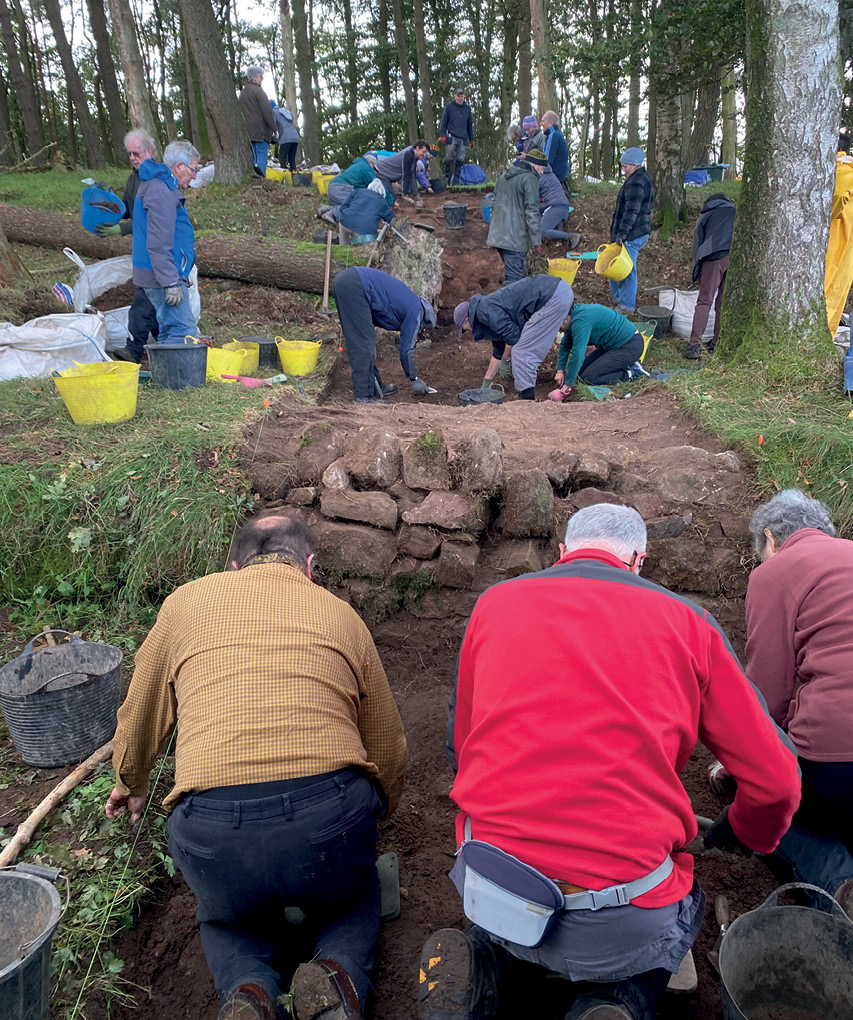
The project is a partnership between Tony and Ian’s respective institutions, facilitated by English Heritage (in whose care the site lies), and involves both Newcastle University students and members of Historic England’s heritage apprenticeship scheme (see ‘Further information’ below). This summer marked my third and final visit to the investigations, and as I met Tony and Ian beside Trench A, I was eager to hear how interpretations had developed during the initiative’s concluding season of digging.
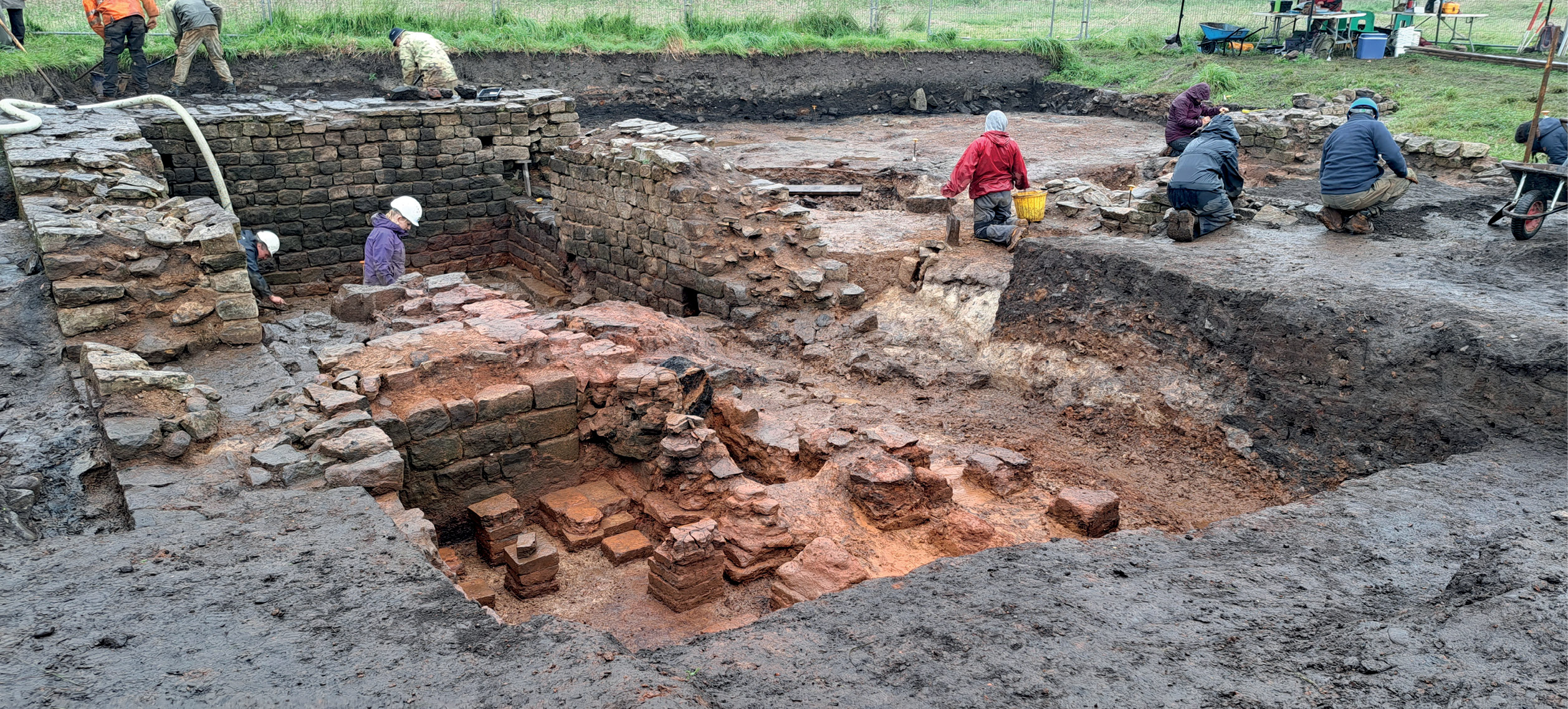
When Trench A was first opened in 2021, the team hoped to make sense of a curious structure described by Ian Richmond in the 1930s. Richmond reported finding a square ‘tower’ or ‘turret’ whose remains survived to a height of 13 courses – but, from the earliest days of the present project, it was clear that his interpretations had not been correct. We now know that the structure was not square but rectangular, it was not a turret but a bathhouse, and after reaching the building’s flagstone foundations this summer, Ian and Tony can also attest that it has not 13, but 14 courses of stonework still standing.
As reported in CA 402, when I last visited the site Tony and Ian’s excavations had already revealed intriguing insights into the bathhouse’s infrastructure, including the heating channel from its praefurnium (furnace), stone blocks with carefully bored holes to accommodate pipes, pilae from its hypocaust system, and a series of iron bars that would have been used to support a testudo (a half-cylindrical tank that helped to keep the bath water warm). This summer’s work has added vivid new details to this picture, including a stone-capped drain running beneath the stoking chamber floor, and evidence of how the baths had been supplied with water. A channel for a water pipe could be seen running through the ground outside the building, entering a square hole that led to a vertical drop through the bathhouse wall, with a corresponding square opening on the inside of the building. This drop would have helped to increase the water pressure, Tony noted. He also highlighted that the water had been coming from the north, but the nearest river lies to the south – might the wider landscape conceal the remains of an aqueduct?

Diverse discoveries
Some of the excavated areas that I had visited in previous seasons were no longer operating in 2024, among them Trench B (which had revealed strip houses associated with the road running north out of the fort; see CA 379), Trench C (looking for defensive structures north of Hadrian’s Wall), and Trench D (also north of the Wall, it had found foundation platforms and drainage gullies associated with timber buildings). The great 60m-by-10m sweep of Trench E, which was opened in 2023 to the west of the fort, was still running, however, and its complex contents were raising even more questions than before.
Contrasting with the mighty masonry of Trench A, Trench E’s features are rather less substantial but much more diverse in character. This is a brilliantly busy area of the site, and some of the remains that I described in CA 402 had become more clearly visible since my last visit.
These include a section of the Turf Wall (the western portion of Hadrian’s Wall was originally constructed from earth and turf, before it was rebuilt in stone a short distance to the north of its original line), represented by a distinctive pale stripe across the southern end of the trench. After this earlier boundary went out of use, it appears to have been built over by a timber structure, whose joists have left sharply angled black marks in the soil.
The cambered road surface that runs through the centre of the trench had also been revealed in more detail, and on its northern side were the robbed remains of a number of strip houses very similar in character to those already found in Trench B. Like those identified in the project’s previous seasons, they appear to have hosted both domestic activity and light industry, including basic smithing, melting glass, and sharpening items.
On the southern side of the road were a series of features outlined in stone that had just started to emerge during last year’s dig. When I visited this summer, they were fully exposed, revealing clear rectangular cuts surrounded by large stones – but what were they?
It was initially thought that these features could have been funerary in nature, perhaps representing overspill from the large cremation cemetery that is known to occupy high ground to the west of Birdoswald (CA 353), but subsequent examination suggested that they are more likely to be constructions associated with the activities of the living: possibly industrial ovens or kilns. Certainly, they reflect a change of use for the area, as they post-date the large timber building. Whatever their function, though, they present a contrast to the nature of the activity that has been identified on the north side of the road.
The four-year project has produced a diverse range of finds, which will be invaluable for comparison with the assemblage amassed through decades of work within the fort itself. Significantly, though, nothing from the extramural settlement post-dates the 3rd century, in contrast to activity within the fort walls, where occupation appears to have persisted into the 5th century (CA 116 and CA 240). This follows a pattern noted during many excavations at sites on Hadrian’s Wall, with extramural settlements apparently abandoned in the 3rd century, while life went on within the fort walls.
Further information:
• For more information about Birdoswald Roman fort, see www.english-heritage.org.uk/visit/places/birdoswald-roman-fort-hadrians-wall.
• For further details of Historic England’s apprenticeships, see https://historicengland.org.uk/about/jobs/apprenticeships.