Subscribe now for full access and no adverts
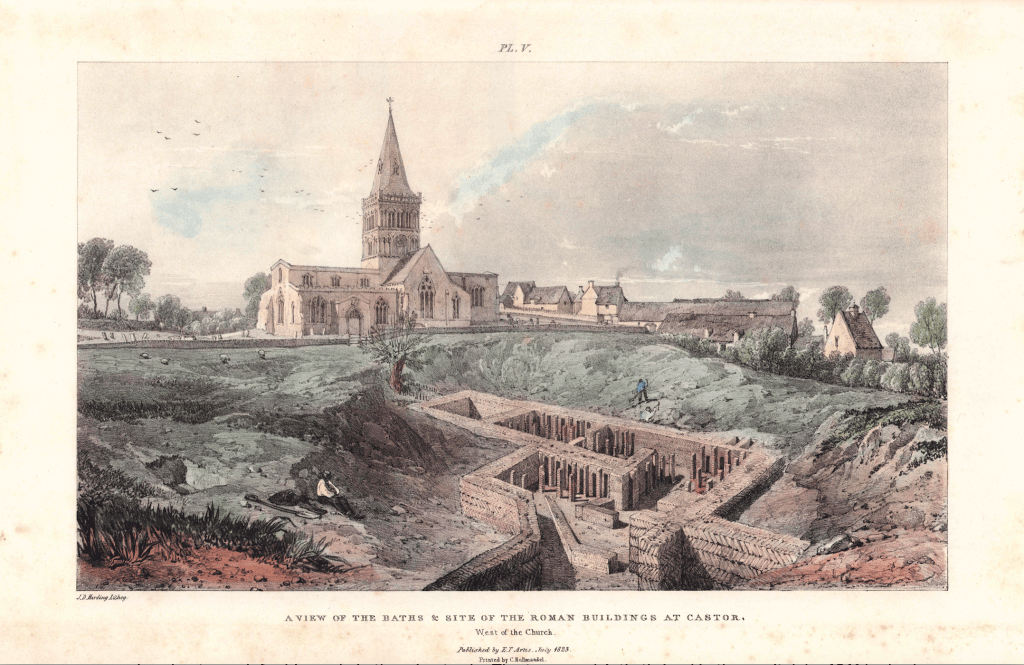
In 1789, James Artis and his wife Mary (née Watling) welcomed a son into their home at Sweffling, near Saxmundham in Suffolk. Christened Edmund, the boy would grow into an avid and influential researcher whose work spanned the scholarly interests of the late Georgian period, from studying geology and collecting plant fossils to excavating Roman remains. A talented artist, his publications were beautifully self-illustrated, and one of his key contributions to archaeology was The Durobrivae of Antoninus, a series of plates drawing on his investigations at Castor, near Peterborough. These were produced in several parts, with the first sets released in 1823-1824. To mark the 200th anniversary of the volume’s creation, the Nene Valley Archaeological Trust has published an A4 facsimile volume of the Durobrivae’s plates (see ‘Further reading’ below), for which I wrote the foreword – and here I will share the story of the relatively unsung, pioneering polymath behind the original. It is a tale of life-changing cakes and encounters with poets, of fossils and philandering, and of racehorses and Roman remains.
Portrait of Edmund Artis as a young man
Although Artis would later be described as having been born into ‘easy circumstances’, it is hard to argue that his origins were not humble. His father was a carpenter or cabinet-maker, his mother was illiterate, and both parents died poor. Edmund himself appears to have received little in the way of education – but in 1805 he was offered what would prove to be a transformative opportunity, when he was sent to London to work for his uncle in the wine trade. The teenaged Artis thrived in the capital: by 1811 he had opened his own confectioner’s shop in Marylebone, and his star continued to rise. In the same year he married Elizabeth Poole, originally from the Bristol area; their daughter, also called Elizabeth but known as Betsy, was born in 1812, and in 1813 the family’s fortunes were changed forever when Artis attracted the attention of an influential new patron.

William Wentworth-Fitzwilliam, the 4th Earl Fitzwilliam, was a leading Whig politician of the day, and he was reportedly so taken by one of Artis’ iced cakes – shaped like a fantastic castle – that he invited its creator to join his household. By 1816 Artis had risen to the rank of House Steward at Milton Hall, the Earl’s seat near Peterborough. There, he proved that his artistry extended beyond baking, painting the Earl’s portrait in oils, and it was also around this time that he met the poet John Clare, best known for his rural writings. Clare freely acknowledged the debt that he owed to Artis on the subject of Natural History (this shared interest in the natural world may have sparked Artis’ long pursuit of fossil-collecting), and it appears that he also shared Artis’ archaeological interests. When Clare’s copy of the Durobrivae was rediscovered, its margins preserved notes indicating that the poet had participated in Artis’ excavations; one of the engravings is also thought to commemorate this assistance, showing Clare working on a Roman pottery kiln.
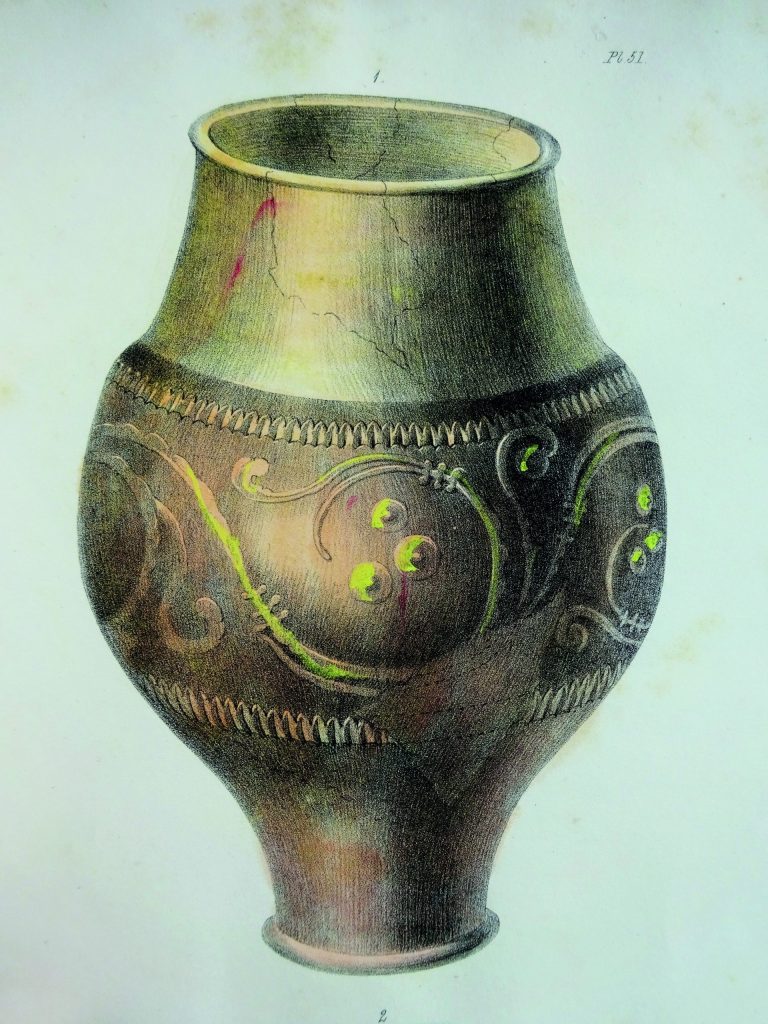
Roman pottery kilns were a key focus of Artis’ investigations, and he was particularly keen to piece together how potters of this period had operated. In his writings, Artis describes ‘fumed ware’ – what we today would call ‘grey ware’ – and how it attained its characteristic colour by using carbon to fill a kiln’s firing chamber with smoke. Artis might even be called an early practitioner of experimental archaeology, as he built and fired a pottery kiln in his own garden to test his theories. Such innovations put Artis at the forefront of contemporary archaeological thinking, marking a step-change from the descriptive work of antiquarian predecessors like Camden and Stukeley.

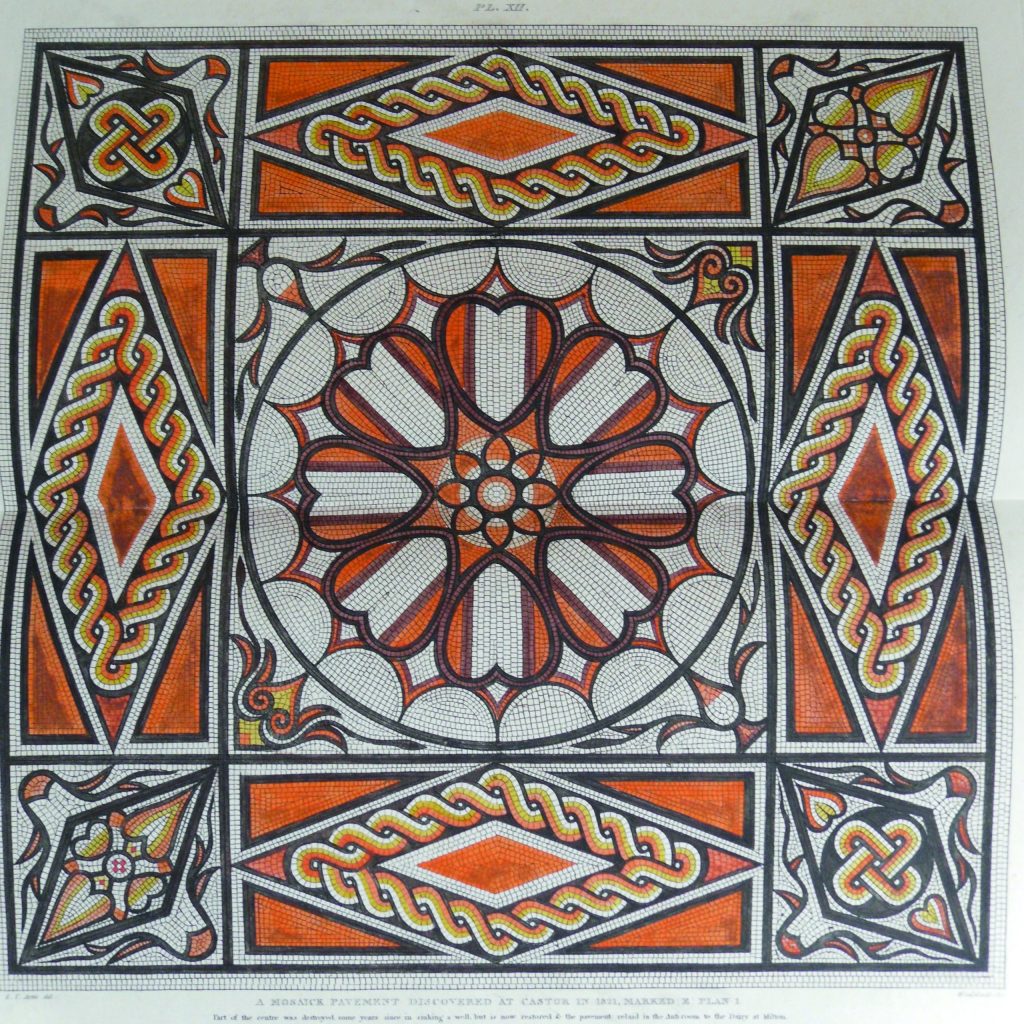
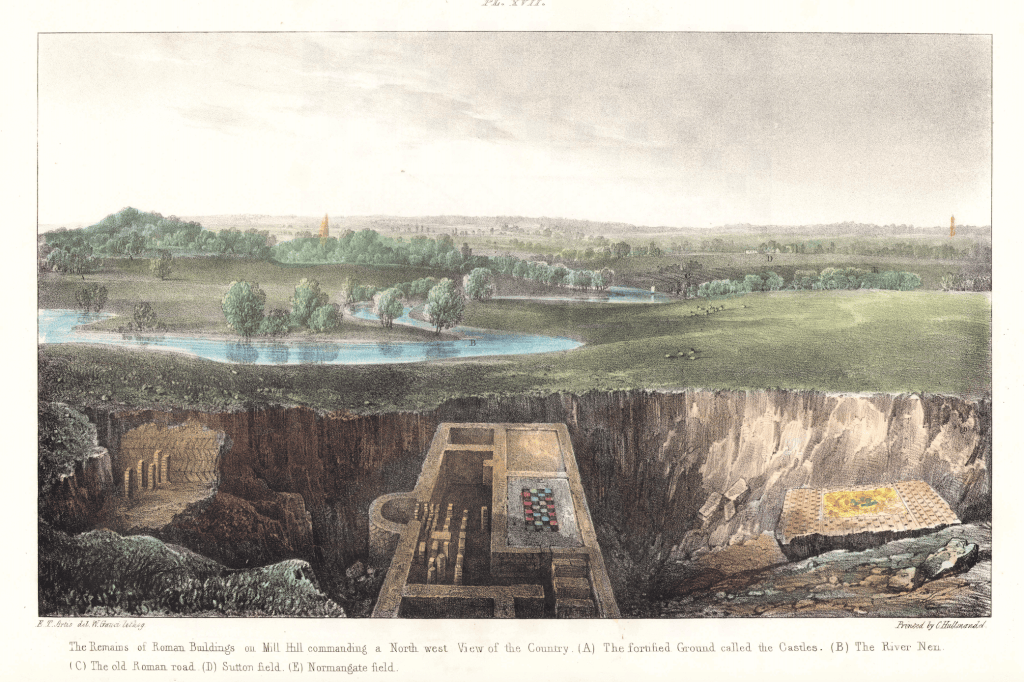
Of course, running alongside this research between 1823 and 1828 were his investigations within the churchyard at Castor, close to Milton Hall. One of his early discoveries there was a colourful mosaic pavement, which prompted a wider exploration of the area’s Roman remains, including the site of what he termed ‘The Praetorium’, which today is considered to be one the largest buildings of Roman Britain.
Pioneering publications
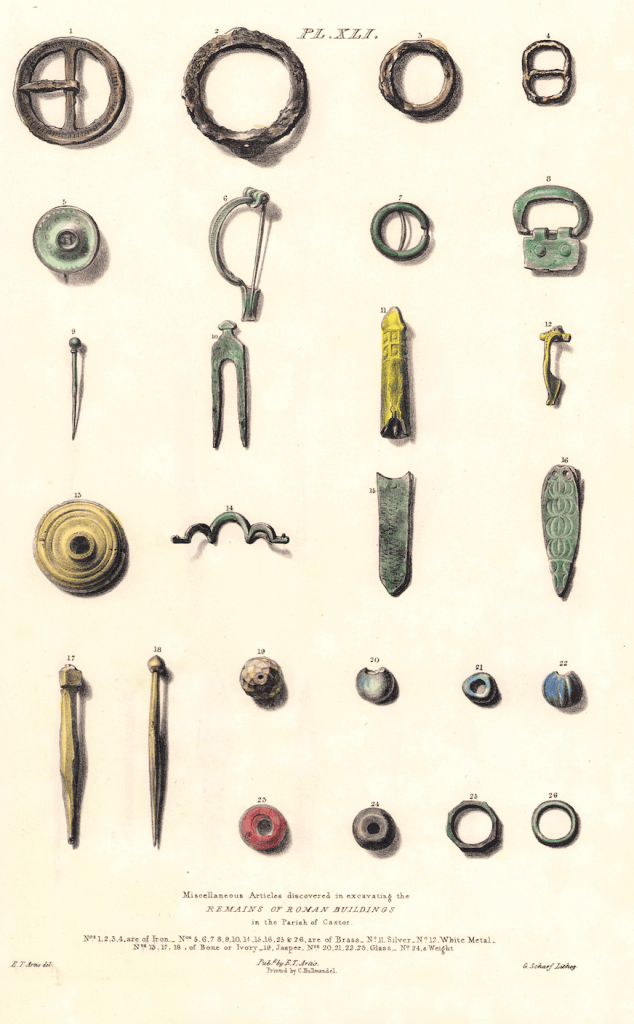
It was from these imaginative investigations that the Durobrivae was born. Its 60 lithographic plates were not published all at once, but were sent out in groups to a list of subscribers who could bind them into a single volume. Culminating in 1828, its print-run was very limited, producing around 200 sets in all, but the work was so well received by the academic world that it earned Artis election to the Society of Antiquaries of London. He was already a fellow of the Geological Society, and in 1826 had published another influential book, this time on palaeobotany. Antediluvian Phytolology contained illustrations of his extensive collection of plant fossils, recovered from Carboniferous deposits in Lord Fitzwilliam’s coal mines in South Yorkshire. Yet all was not well between Artis and the Earl: that same year he left Milton Hall under a cloud, his disgrace reportedly linked to a dalliance with a member of the household. (This would not be his only such indiscretion: in 1831 Artis also fathered an illegitimate son with a local barmaid.)

His reputation does not seem to have been irreparably damaged, however. After leaving Milton, Artis was able to buy the Doncaster Race-Club House (possibly funded through the sale of his fossil collection, some of which is now in the Natural History Museum), a lodging-place for elite racegoers which was under Fitzwilliam patronage. This career move initially proved a great success. No doubt drawing on his past catering experience, Artis hosted his grand guests lavishly, throwing a celebratory dinner for the Duke of Wellington in 1829, and (according to adverts in the Doncaster Gazette) offering ‘live turtles of over 100lbs, and ices’ during Race Week.
From such prosperity, Artis was able to keep a carriage and buy two houses in Castor, but the good times were not to last. Just as Artis invested a considerable sum in extending the clubhouse, a scandal enveloped Yorkshire racing, leading the 5th Earl Fitzwilliam (son of Artis’ previous patron) to withdraw from the sport. Worse, when Queen Victoria ascended the throne in 1837, she was not a racing fan, which must have dampened the sport’s appeal to the upper classes.
A lasting legacy
Less is known of Artis in his later years, although records attest that his daughter Betsy was married in 1836, and in 1838 he made another fortunate acquaintance, that of the noted London antiquary Charles Roach Smith. Their friendship appears to have sparked a new burst of archaeological activity, as we find references to Artis in the discovery of Roman statuary near Kingscliffe, and the opening of a Roman gypsum burial at York. He was also documenting wall paintings in churches around Castor, and writing papers about pottery kilns for the recently formed British Archaeological Association. Most significantly, though, he was working on a more ambitious publication.
In 1846, a leaflet seeking subscribers announced a forthcoming archaeological volume called The History of Castor and its Environs under the Romans. It was intended to address criticisms levelled at the Durobrivae plates, which had not included explanations of the sites they showed. The History of Castor, by contrast, promised descriptions of Roman frescos and mosaics, inscriptions and small finds, as well as discussion of the sources of clay used in pottery production. Artis had already devoted hundreds of pounds to producing the book’s materials, the flyer attests, printers and engravers had been engaged, and 127 subscribers had already been secured. However – and, in trying to piece together the life of Edmund Artis, there is always a ‘however’ – the book was never finished. The mention of printers and engravers indicates that proofs had been created, but no sign survives of even a partly finished version; perhaps the venture had proved financially unviable.
Despite this setback, Artis continued digging, braving appalling conditions to excavate near Kingscliffe in 1847. The weather was so cold that his labourers deserted him, and the work appears to have had dire consequences for Artis’ health: he succumbed to his illness on Christmas Eve of that year. Artis was buried just outside the porch of Castor church – he reportedly asked to be interred upright, so that he could look out over the Nene Valley, the setting for his archaeological endeavours – but what of his legacy? Some of Artis’ finds and notes are housed at Peterborough Museum, whose resident Museum Society (founded as the Peterborough Natural History and Field Club in 1871) has done so much to preserve details of his life and work. The lasting impact of his research can also be seen in the fact that his Phytology was quoted by geologists for nearly a century after its publication, and his descriptions of the workings of Roman pottery kilns were unsurpassed until very recent times.
As a man of insatiable curiosity, keen observation, and remarkable deductive and artistic skill, Artis should be counted as one of the key contributors to moving the study of the past from an antiquarian pastime to the more rigorous approach taken by the modern profession – his illustrations in the Durobrivae show that he understood stratigraphy completely. Perhaps John Clare put it best when he wrote, in 1822: ‘he seems to me quite a clever man and everything but a poet’.
Source:
Professor Stephen Upex is an Archaeologist and Landscape Historian at the University of Cambridge’s Institute of Continuing Education. He has excavated on, and written widely about, Roman and Saxon sites in the East Midlands, and collaborated for many years with the late Geoffrey Dannell on Artis-related research.
Further reading:
Stephen Upex (2023) E T Artis and the Durobrivae of Antoninus (Nene Valley Archaeological Trust, ISBN 978-1739875619; £30 pbk/£40 hbk). Copies can be ordered via http://www.nenevalleyarchaeology.co.uk.
All images: Nene Valley Archaeological Trust