Subscribe now for full access and no adverts
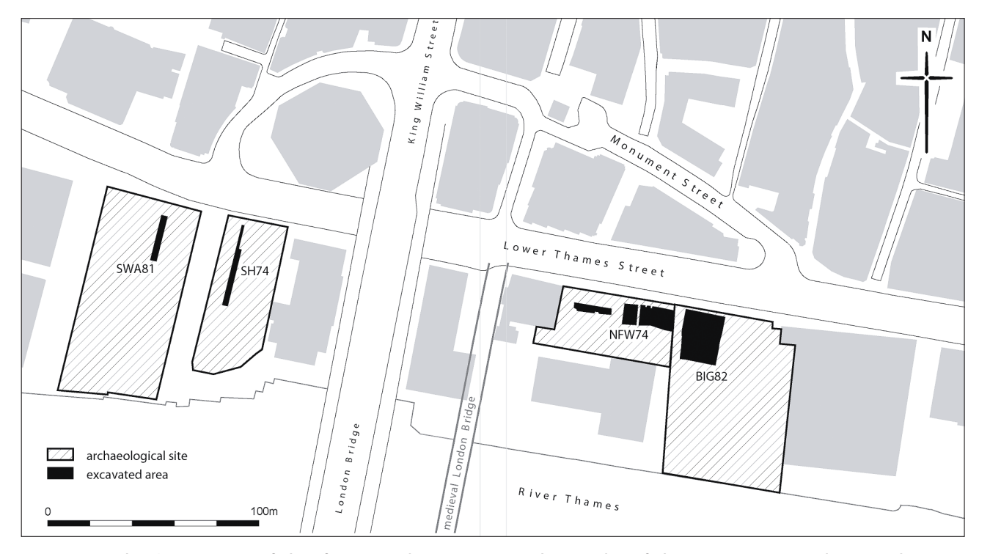
The four sites covered in London’s Waterfront and its World (see ‘Further reading’) lie in two pairs on either side of London Bridge. To the west of the bridge (upstream), the Swan Lane Car Park (Site A) was excavated in 1981-1982, while the adjacent Seal House (Site B) was explored in 1974. To the east of the bridge, New Fresh Wharf (Site C) was excavated in 1974-1978, and the Billingsgate Fishmarket Lorry Park (Site D) in 1982-1984.
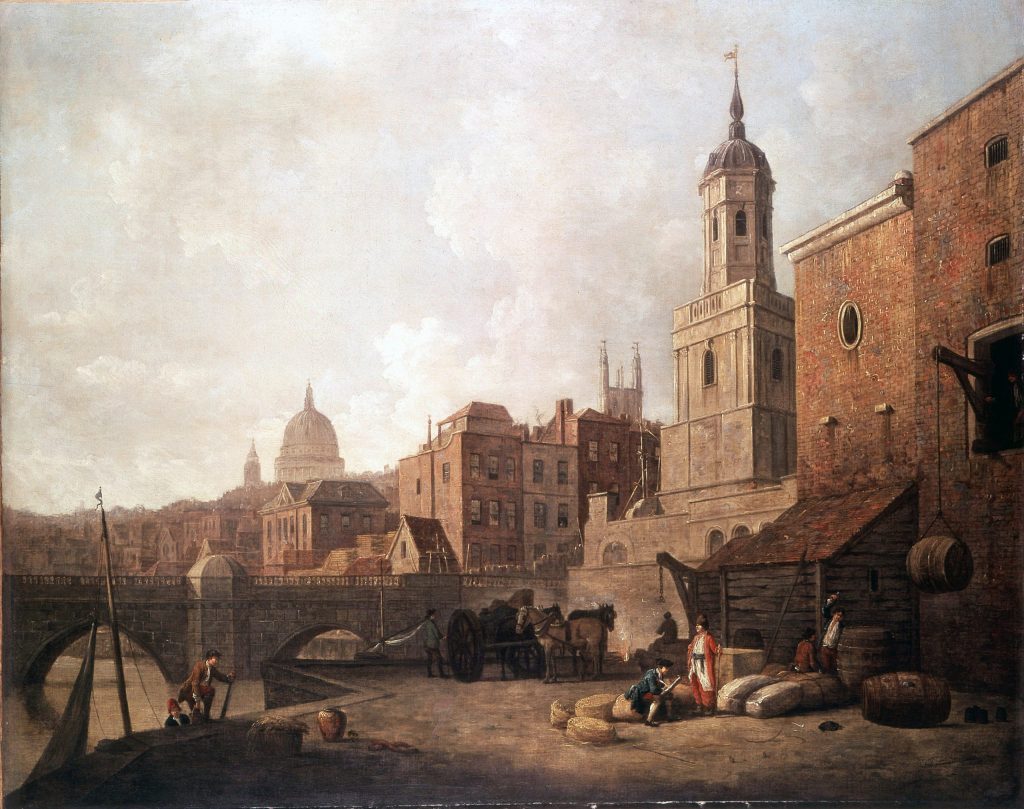
All four sites tell a similar story of domestic properties being constructed in the immediate post-Great Fire period, despite grand schemes for wholesale redevelopment as quays lined by public buildings. Whole swathes of domestic dwellings then gave way to the warehouses that came to dominate the character of both sides of the Thames in the 18th century, not just at these four sites but along the whole of the waterfront to meet the growing demand for places to store and distribute the increasing volume of imports that London sucked in from around the world. In time, as London developed as the hub of a global empire, these relatively small-scale facilities gave way to the new and grander purpose-built docks some distance east of the City early in the 19th century.
Out of the ashes
Discussions about rebuilding the City began only a few days after the Great Fire: one of the earliest of the various schemes for laying out new streets was published on 17 September 1666, just 11 days after the flames had been extinguished. This proposed the construction of a broad, flat quay along the riverside, clear of all obstructions, built by extending the riverbank into the Thames where necessary – not unlike the directly contemporary stone-fronted and paved quaysides of such Continental cities as Antwerp, Rotterdam, Paris, Bordeaux, Genoa, and Naples.
A similar proposal is depicted in the plan hastily drawn up by Christopher Wren (also in September 1666, and now held by the library of All Souls, Oxford), which famously shows the medieval alleys of the City completely transformed by a rational street grid, with wide colonnaded avenues leading to open piazzas. John Evelyn’s less-well-known plan of the same year also borrowed ideas from Renaissance Europe and proposed grouping the City’s main public buildings along the riverside, with their principal façades facing the water rather than the street.
Already one can see in these plans the seeds of a conflict between those who envisaged the riverside as being mainly for trade and those who saw it as an embellishment of the City. In the event, Wren’s and Evelyn’s plans were rejected as impractical by citizens who recognised that such schemes could be costly and would involve a large-scale revision of land ownership. London’s commercially minded property owners wanted nothing more than the swiftest possible return to business as usual, meaning that they wanted simply to clear the rubble and rebuild their shops and houses on existing plots, while conforming to the new London Building Acts of 1667 and 1670, which set the maximum heights of new buildings and stipulated the use of less flammable brick, slate, and tile.
Some modification was carried out to the waterfront, however. The Commissioners for Rebuilding issued an instruction requiring the steep and undulating lanes that ran from Thames Street down to the river to be modified ‘for the preventing of inundations and for easiness of Ascent’. The lower parts of the streets and lanes along the waterfront were raised by as much as 5ft using demolition rubble cleared from the City, while the upper levels were graded and reduced by between 1ft 6in and 5ft. Relatively flat streets were the result, raised above the height of the river’s spring high tide.

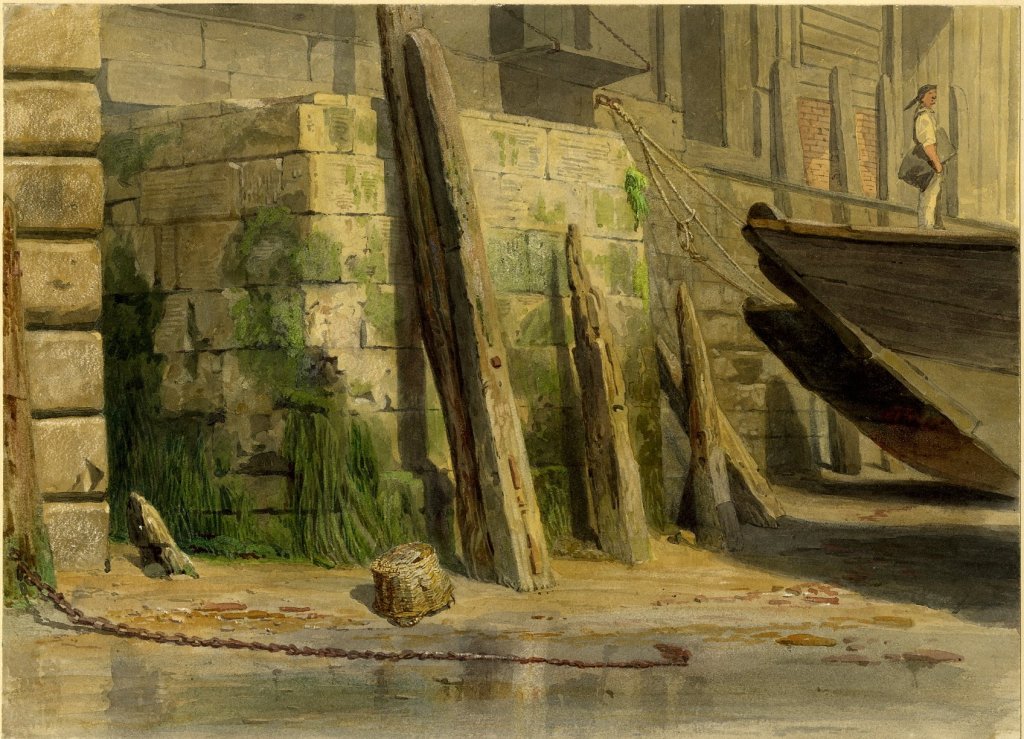
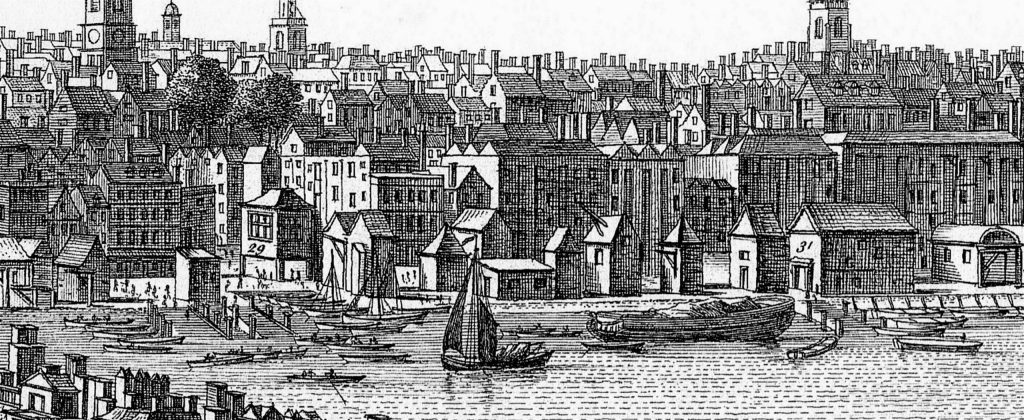
Some contemporary engravings show a continuous river wall of stone, but this might be an idealised picture, since archaeological excavations and watching briefs have failed to find evidence for a new post-Fire wall, though excavation at Blackfriars in 2009-2013 found probably post-Fire reclamation deposits in front of a 16th-century river wall. Instead, it seems likely that a continuous quay never existed to the west of London Bridge. Any intended wharf was encroached on by piecemeal building almost immediately after the Fire, and the riverside ends of these new properties probably used the pre-1666 riverside wall for their foundations. Later, when warehouses replaced these properties, they met the river’s edge with no intervening space. Goods were lifted from small boats directly into the warehouse by means of a wall-mounted gibbet crane, thus avoiding the double-handling involved in landing goods on to a quay, and then moving them from the quay into nearby buildings.

Setting the scene at Swan Lane and Seal House
Billingsgate was established as a market for fish by an Act of Parliament in 1699, but the inevitable smell, mess, and early morning noise from the fishmongers’ shops seemed not to have deterred people from living close by, and the first post-Fire buildings on these sites were domestic. One of the grandest was the house on Billingsgate Dock built for ‘Major Beckford’ – alderman, sheriff, supplier of clothing to the Navy, and subsequently Master of the Clothworkers’ Company. Constructed after 1668, the house, shown in a 1736 engraving by Arnold Vanhaecken, is a large and imposing four-storey building with flat roof and balustrade.
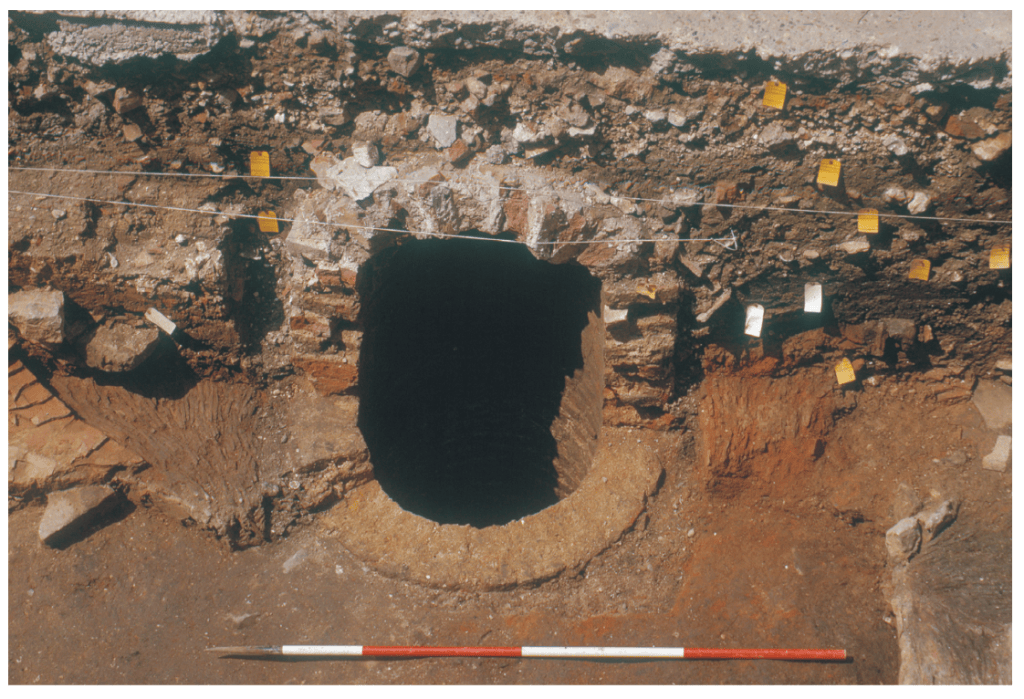
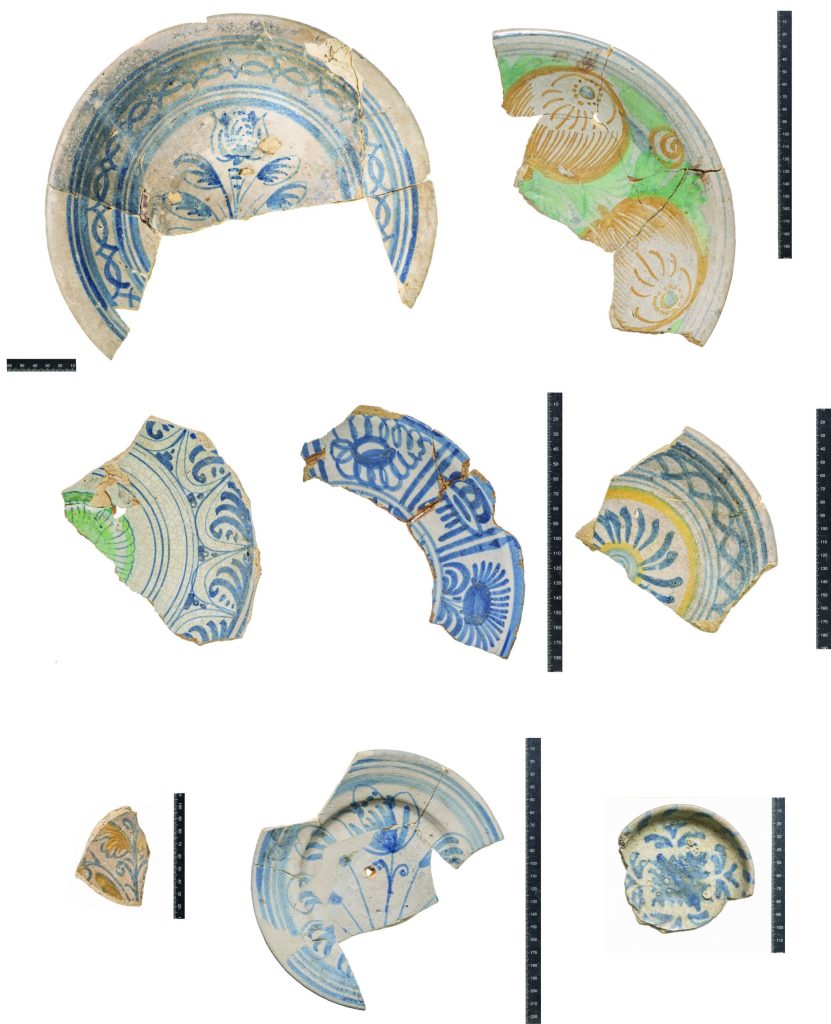
Upstream of the bridge, the most important find from Site A (Swan Lane) was a stone-lined cesspit that had been backfilled with a large group of pottery, amounting to 565 sherds from 119 vessels, some of them largely intact. The assemblage consisted mainly of vessels manufactured in London, Essex, and the Surrey/Hampshire borders, probably representing a house clearance from the immediate post-Fire period. They thus provide an insight into the range of everyday domestic forms in use in London at around the time of the Great Fire. Most of the vessels were associated with serving and consuming food (dishes, plates, mugs, jugs, and cups) with some cooking vessels (cauldrons, skillets, and pipkins); in addition, there were six chamber pots and three money boxes. The same deposit contained the remains of glass wine bottles, flasks and phials, beakers, window glass, and the bowls of 92 clay pipes.
The excavation of Site B (Seal House), just to the east of Site A, revealed a row of small brick houses built in 1671 by William Darvoll, who leased the land from the Fishmongers’ Company. When that lease ran out in 1732, the Fishmongers leased the property to John Garrett, who was allowed to convert all or some of the houses into warehouses. This involved removing fireplaces and staircases, and altering doors, while retaining the basic plan and party walls. Two of these had external cranes and storage lofts, and one had a counting house. By 1754, when John Armitage and William Brook, wine merchants, took on the lease the property, it was described as ‘tenements and warehouses, formerly six tenements’. They were all demolished in 1776, in favour of one large warehouse.
From a well in the cellar of one of the houses came another large pottery assemblage, consisting of a mix of medieval and post-medieval vessels, including imports of German stoneware, north Italian marbled slipware, a jug with the arms of Amsterdam, and even Chinese Ming dynasty porcelain. Once again, the vessel forms were largely associated with the domestic consumption of food and drink, along with wine bottles, clay pipes, and chamber pots.
Both assemblages add to a growing corpus of pit groups from this period, from the City and from Old Church Street in Chelsea. Jacqui Pearce and Lyn Blackmore, authors of the volume’s pottery report, ask whether such clearances of mainly household ceramics were prompted by a desire to replace older ceramic styles with new factory-made products, such as the Staffordshire-made salt-glazed stoneware, creamware, and pearlware products that were beginning to enter the market in the late 17th and early 18th centuries, with a marked impact on consumer tastes. Indeed, the upper levels of the Site B well deposit included a sherd of pearlware dating from after 1770.

Finds from New Fresh Wharf and Billingsate lorry park
At Site C (New Fresh Wharf), discoveries consisted mainly of a few post-Fire walls, whose history has been filled in from leases which describe a property in 1669 consisting of cellar, shop, kitchen, chambers over, and a garret – buildings of mixed commercial and domestic use, one part of which had a crane on it. A newspaper report of 1760 paints a vivid portrait of the damage caused by a fire that broke out there, ‘occasioned by a servant who was drawing off some oil, leaving the candle to [sic] near whilst he went to see Lord Ferrers pass from the Tower’.
This dates the fire to 5 May 1760, when Laurence Shirley, 4th Earl Ferrers (1720-1760), was taken from the Tower of London to Tyburn and hanged, having been found guilty of murdering his steward when tried by his peers in Westminster Hall. There was huge public interest in the case, because it demonstrated that aristocrats were not above the law, the only concession to his nobility being the use of silk for the hangman’s rope.
The resulting fire destroyed ‘a thousand hogsheads of sugar, a large quantity of wine, rice, and oil… two men were blown up and killed by some gunpowder taking fire’, while a lighter ‘took fire but was extinguished with little damage’. A large Dutch ship lay close to the wharf, ‘but was happily got off before the flames reached her’.
Much more extensive remains were uncovered when Site D, the Billingsgate Lorry Park site (originally Botolph Wharf), was excavated, including parts of the pre-Fire church of St Botolph Billingsgate. This small, square church was not rebuilt after the Great Fire. Initially the ruins were used to store supplies for refugees from the conflagration, then as a store yard for coal and other forms of fuel. Adjacent landowners subsequently successfully applied to the parish and City authorities to buy, lease, or rent parts of the former church site to extend their own properties.
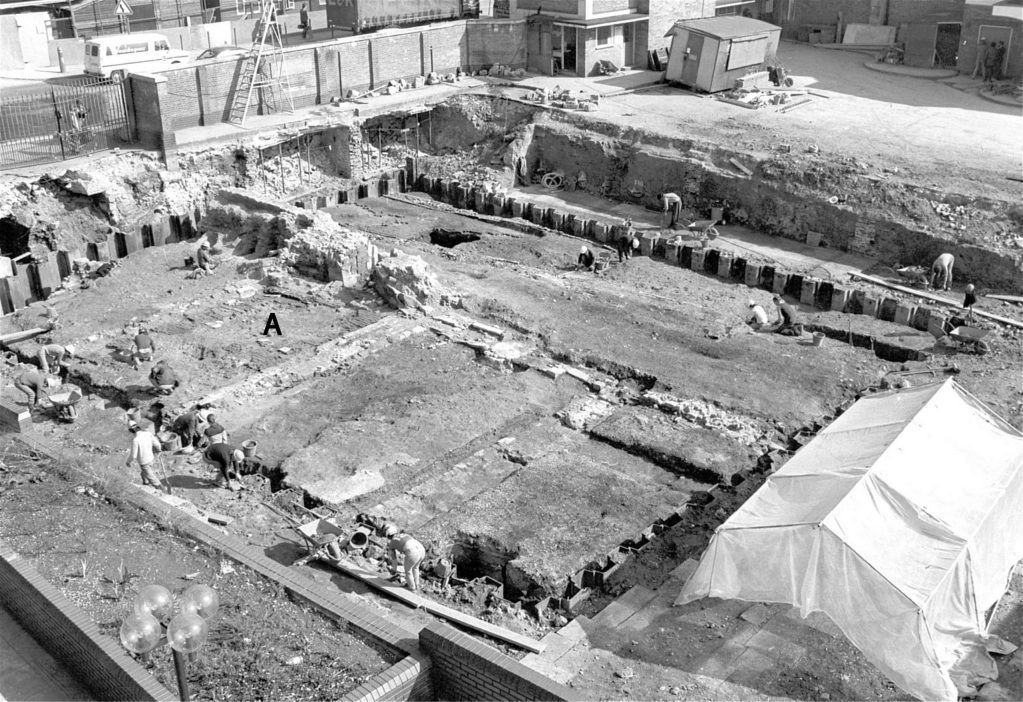
One of these was Josiah Child (c.1630/31-1699), who bullied the City into letting him create a wider alley over the location of the church to improve access to his buildings on the rest of the wharf. A strange house incorporating the rest of the site was built and let in 1674 to Francis Minshull. This building incorporated the large 15th-century undercroft that archaeologists found beneath the south aisle of the church. The lease describes Minshull as a vintner, but his commercial interests probably also included importing oranges, lemons, and limes from the Canaries (he was in Tenerife in November 1702 when war broke out with Spain, but he managed to leave before being interned). He was part-owner with other merchants of several privateers during the wars with France and Spain, and, although he probably never visited America, Minshull was a shareholder in the West (New) Jersey Society, a land development company.
The inventory made on Minshull’s death in 1704 tells us that the cellar was used for storing barrels of Canary wine, but also olive oil from Florence, as well as lemon juice, tobacco, hair, beeswax, and no fewer than 1,000 fans. The rooms above were furnished with tables, chairs, mirrors, pictures, tapestries, Turkey-work carpets, and much plate, as well as ‘old’ gold and silver, and two watches.

The rest of the site was developed initially by Sir Josiah Child who, by the time he died, had amassed a huge fortune, as well as a baronetcy and a country estate at Wanstead in Essex. Whatever it cost him to rent the wharf he more than made up for with the rents he was able to charge to those who leased the properties he constructed: a mixture of dwellings built above shops with warehouses to the rear. Archaeologists found evidence of these to match the plans attached to the deeds, as well as the footings for a substantial gateway that could be used to close off the wharf.
Gentleman or thug?
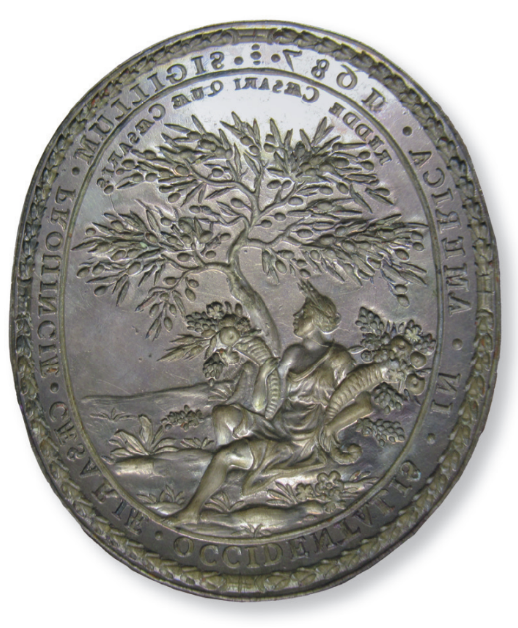
In turn, those who rented from Child made fortunes from their activities: Joseph Ashton, for example, made enough money to lease Covent Garden market from 1712 to 1718. He is described as a ‘gentleman’ in parish records, but various court records suggest that he was not a man to be crossed. One historian described him as ‘an unscrupulous, foul-mouthed drunken bully, all too ready to throw his antagonists into the Thames if they crossed his path’. The secret of his wealth was his membership, for 21 years, of a secret cartel of wharf owners located along the riverfront between the Tower of London and London Bridge that fixed the fees for landing goods.
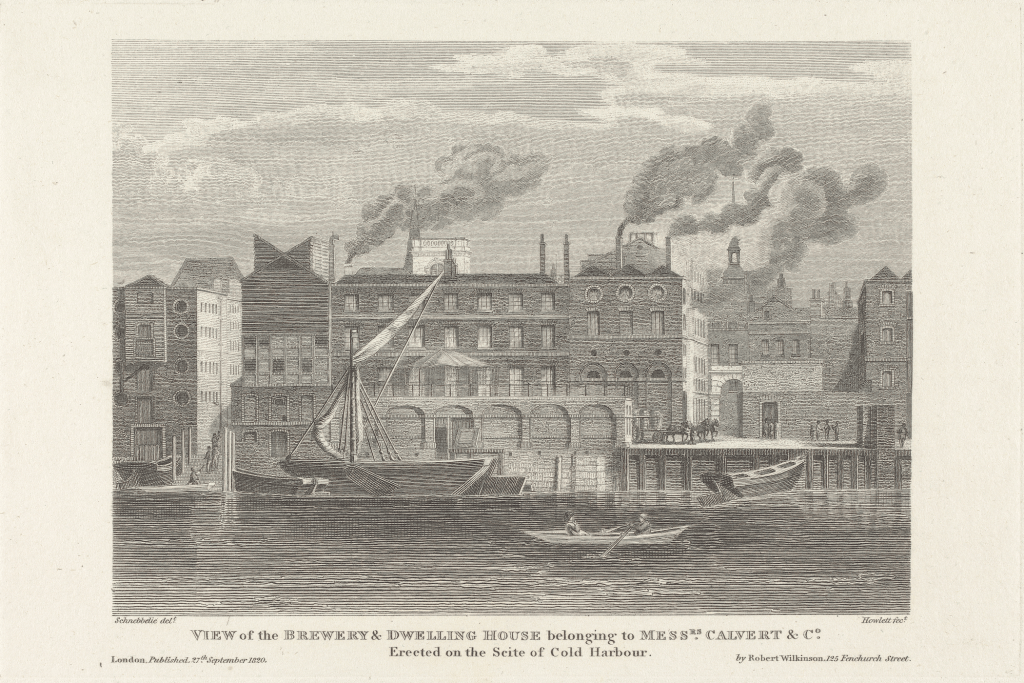

Pocket notebooks have survived among Joseph Ashton’s papers that provide evidence of the nature and quantity of goods landed or shipped out: they include wine, sugar, turpentine, ginger, pitch, tobacco, wood, fruit, cheese, oil, carpets, blankets, guns, ink, stationery, chests of cloth, soldiers’ uniforms, pepper, tea, coffee, china, ivory, brandy, and cocoa nuts. He also seems to have been more willing than some wharfingers to take risks, for the accounts show that he used Botolph Wharf for the lucrative storage of ‘gross and combustible goods’.
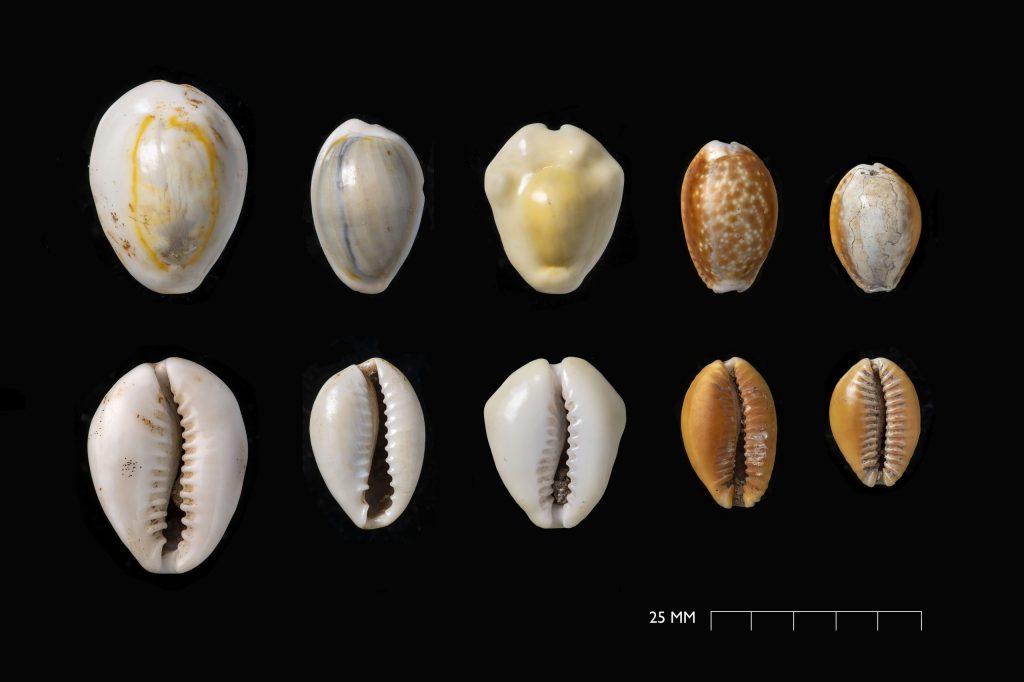
Ashton did not enjoy unalloyed good fortune: historians know so much about him because he was constantly in and out of court, fighting one battle or another with his business and cartel partners. Theft of goods seems to have been a common occurrence, though whether genuine or fraudulent it is not possible to say. In 1722, for example, a reward of £50 was offered for information leading to the conviction of those responsible for stealing saltpetre and 53 bags of cowrie shells from a warehouse on Botolph Wharf.
Cowrie shells were used by European and American slave traders as currency, and London and Amsterdam were the two main sources of supply, importing many tons of shells and selling them by auction in bags weighing 1cwt or 3cwt (1cwt is equal to 112lbs or 50kg). Archaeologists found artefactual evidence for this trade in the form of a small number of cowrie shells in three buildings on the site, and records show that Ashton, as well as his nephew and heir Henry Ashton, were both involved with the South Sea Company, which traded in enslaved people in Jamaica and Barbados.
The beginning of the end
By the time Ashton died in 1728, Thames tides had begun to wash away the foundations of the wharf and ooze into the cellars, spoiling the goods stored there. The state of the wharf deteriorated still further after Ashton’s death. In 1731, surveyors reported that the cellars regularly flooded to the depth of a foot, rendering them useless. The ‘walls in every part of the foundation [are] very ruinous and all the boarding and joints and girders in all the floors of the warehouses [are] very much decayed’. The era of Child family ownership and Ashton tenancy ended when the City authorities demanded in 1733 that any future leaseholder should rebuild the entire wharf in brick, involving a considerable investment.

This was a pattern that was becoming established elsewhere, as the use of land along London’s riverbanks changed from mixtures of small-scale housing, shops, and warehouses to the large warehouses that came to dominate the waterfront from the 1730s. These large-scale specialist developments represented a new form of architecture, described by a contemporary observer as consisting of buildings of great height and numerous storeys, ‘multitudes of windows and curious cranes for hoisting the goods’. In writing about these, the authors of London’s Waterfront comment that ‘suitable buildings for the empire had arrived’.

Even so, they were already outdated. Royal Commissions of Enquiry into the ‘best mode of providing sufficient accommodation for the increased trade and shipping of the port of London’ were set up in 1762 and 1765. Their work was obstructed by wharfingers anxious to protect their monopoly, but it was obvious to the Commissioners that the existing facilities were ‘infinitely too small for the commerce of the port’, which had tripled over the course of the 18th century, as had the number and size of the ships, from 1,335 in 1702 to 3,663 in 1794, while the total tonnage rose fourfold from 157,035 in 1702 to 620,845 in 1794. Pilots complained about the overcrowding, which was made worse by the 3,500 or so smaller craft working on this part of the river – lighters, coastal traders, and punts.
Eight sets of plans were drawn up for resolving the problem, but only one of them entailed redevelopment of the existing Thames Street wharfs and this was the most expensive; it also required the removal and consolidation of hundreds of individual properties. All the other schemes involved the construction of new docks in various places east of the City: the West India Docks followed in 1801-1806, then the London Dock in Wapping in 1805, the East India Docks at Blackwall in 1803-1806, and the Commercial Docks at Rotherhithe in 1810.
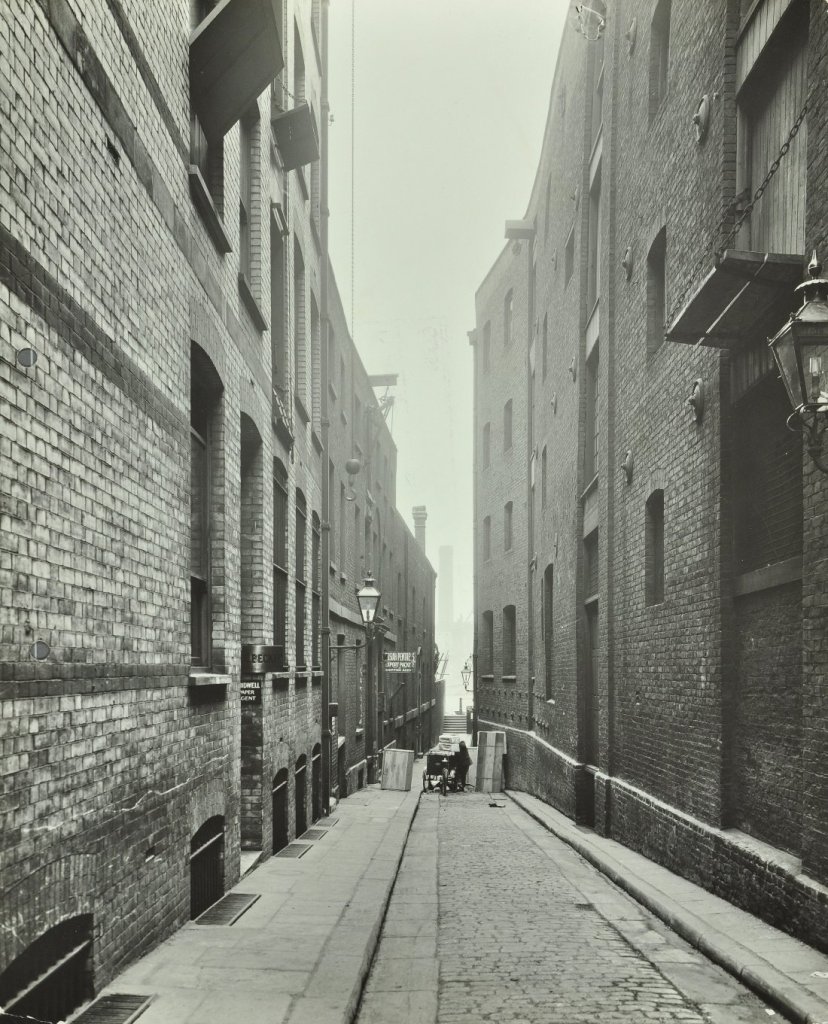
The development of these new facilities left the streets and wharfs around London Bridge intact in their 18th-century forms until the 1970s, and a few were still standing – though damaged by Second World War bombing – when the Museum of London carried out extensive waterfront excavations in the first half of the 1970s. At this time the conservation movement was weak, and some developments (such as the Cutler Street warehouses) were insensitive. ‘Upper and Lower Thames Street now form a thundering bypass, lined with characterless modernist buildings and the occasional overwhelmed Wren church’, the authors conclude, before calling for the ‘forgotten cultural heritage of waterfronts and port towns around the world’ to be the subject of ‘widespread, comparative international research, before the evidence is destroyed’.
Further reading:
• John Schofield and Stephen Freeth (2023), London’s Waterfront and its World, 1666-1800, with contributions by I M Betts,
• Lyn Blackmore, Julian Bowsher, Jacqui Pearce, and Alan Pipe (Archaeopress, £50, ISBN 978 1803276540); available for free from the publisher’s website  as an open-access .pdf eBook.