
Subscribe now for full access and no adverts
The Museum Gardens in York are home to an impressive array of historic buildings, from the dramatic medieval ruins of St Mary’s Abbey to the imposing Roman masonry of the Multangular Tower, as well as the neo-classical grandeur of the Yorkshire Museum itself. During the second half of August, though, visitors to the site could also see a temporary new neighbour to these structures – rather more humble in scale, but based on much older remains: a reconstructed Mesolithic house that was based on evidence from Star Carr.
Around 11,000 years ago, the shores of Lake Flixton (near Scarborough in North Yorkshire) were fringed with occupation sites used by hunter-gatherer communities. Although the lake has long since vanished from the landscape, the environment’s still-waterlogged and peat-rich conditions have preserved an astonishing array of organic remains, offering invaluable insights into what life was like in the years after the end of the last Ice Age (see CA 282 and 349).

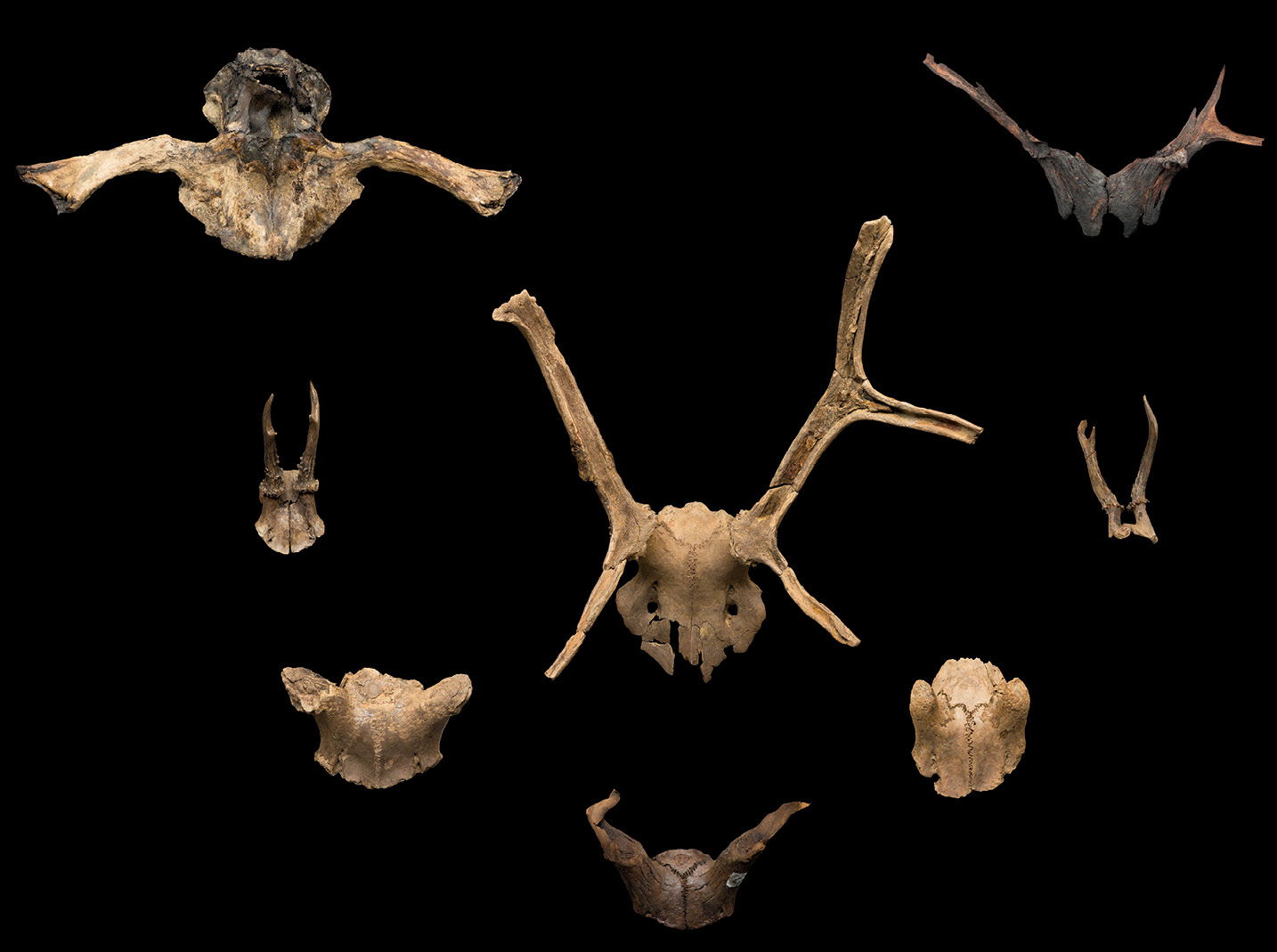
The most famous of these sites is Star Carr, which was discovered by John Moore in 1947, and excavated first by Grahame Clark in 1949-1951, and more recently by Nicky Milner (University of York), Chantal Conneller (then University of Manchester, now Newcastle University), and Barry Taylor (University of Chester) in 2004-2015. These investigations recovered diverse artefacts, ranging from practical tools used for everyday tasks like butchery, crafting, fishing, and lighting fires to items of jewellery and enigmatic antler headdresses – some of which can currently be seen in Star Carr: Life after the ice, an exhibition running at the Yorkshire Museum until spring 2026 (see here).
Rather more subtle, but no less significant, though, were a series of ghostly outlines formed from post- and stake-holes: traces of structures that had once stood on the lakeside site. The first of these to be identified was dubbed ‘Britain’s oldest house’ (CA 248), as dating evidence put its construction in c.9000-8500 BC, displacing the previous title-holder, the ‘Howick house’ discovered in Northumberland and dated to 8000-7100 BC.

Other Mesolithic structures have been identified at wide-ranging locations including East Barnes near Dunbar in East Lothian, Mount Sandel near Coleraine in Northern Ireland (CA 59), Stainton West near Carlisle (as reported by Fraser Brown in New Light on the Neolithic of Northern England, edited by Gill Hey and Paul Frodsham), and Ronaldsway on the Isle of Man. These also post-date the Star Carr finds (see CA 331 for a more detailed discussion of some of them, and the same issue and CA 262 for wider explorations of life in Mesolithic Britain and Ireland), but they nevertheless add to a growing body of evidence that Mesolithic people, often viewed as nomadic communities who are archaeologically elusive compared to the ‘first farmers’ of the Neolithic period, did make some more-lasting marks on their surroundings.
The ‘houses’ identified to-date may represent temporary settlements marking ‘special’ places returned to periodically, or used during seasonal exploitation of specific resources, while the Star Carr artefacts reveal that the hunter-gatherer lifestyle was not a hand-to-mouth struggle for subsistence, but one with sophisticated beliefs and enough leisure time to create objects beyond those needed for survival.
Structural clues
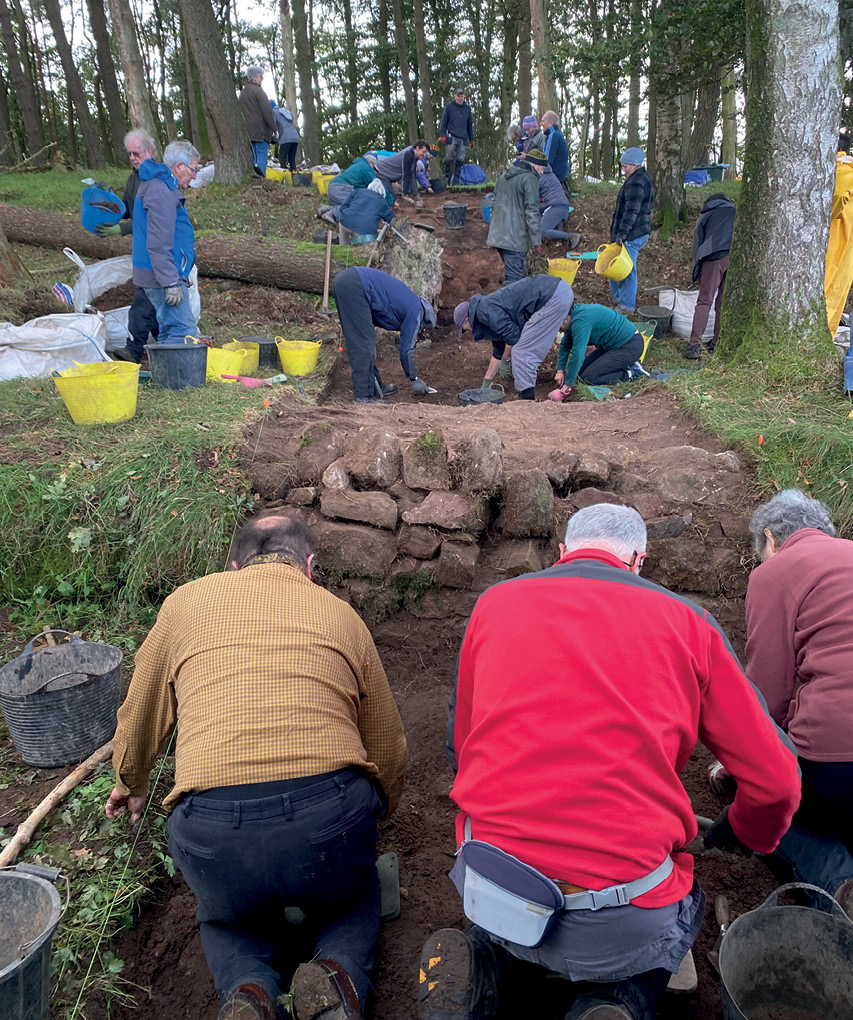
Almost two decades ago, co-director of the Howick excavations Clive Waddington built a reconstruction of the Northumberland building (see CA 189 for photographs of this work), and now an experimental interpretation of Star Carr’s first structure has also been created, in a collaboration between York Museums Trust and the University of York, supported by the National Lottery Heritage Fund. Its excavated remains were only slight, represented by a circular outline at least 3.5m in diameter, picked out by post-holes, and with a distinctive hollow in the centre. Using these clues, combined with environmental evidence from the site, however, the project team have been able to tease out how this long-vanished structure may have looked 11,000 years ago.
Like the Howick reconstruction, the Star Carr build took a conical form, but the project team emphasise that this is only one possible interpretation of the evidence: while we can be confident of the structure’s footprint, its top has been lost to history and could equally have had a more domed shape. Further deductions – this time drawing on environmental evidence from the site rather than structural remains – were required as well, in order to decide which materials to use.
The house’s superstructure was built using poles and circular bands of willow, which is known to have grown beside Lake Flixton. How this skeleton should be filled in, however, presented multiple options: it is possible that the walls had been covered with turf or animal skins, though no trace of either has survived to the present day. Instead, the team took their lead from pollen and palaeobotanical analysis, which confirms the presence of reeds growing beside the ancient lake. As these would have been an abundant and ever-growing resource for the Mesolithic builders at Star Carr, they were deemed a suitable material with which to thickly thatch the exterior of the reconstruction.

Interpreting evidence
In addition to these archaeologically attested materials, the build (which took place over four days between 7 and 11 August) used replica stone tools based on Mesolithic finds. The project was headed by Professor Nicky Milner (co-director of the more-recent Star Carr excavations) and Dr Jess Bates, both of the University of York; working with Diederik Pomstra and Leo Wolterbeek, specialists in experimental archaeology and prehistoric reconstructions; and supported by Dr Adam Parker, Curator of Archaeology at York Museums Trust.
Speaking to CA beside the then half-built reconstruction, Nicky commented: ‘People are often surprised by how sophisticated life was 11,000 years ago – with reconstructions like this, it brings what is otherwise often viewed as a distant, abstract period to life. You can see that Mesolithic people really understood their environment and the materials around them; they had lots of skills.’
Jess added: ‘At sites like Star Carr we can see Mesolithic hunter-gatherers working collaboratively to build these structures, and we are starting to gain insights into how they organised their space within structures, carrying out tasks in certain areas.’
Jess’ PhD research centred on analysing microscopic patterns of wear, polishing, and damage on the flint tools from Star Carr: from these, it is possible to work out what the artefacts were used for, and their distribution within the Mesolithic structures also suggests that different areas were used for different tasks. A paper describing these findings was recently published in PLOS ONE (see ‘Further information’ below), and we hope to run a feature exploring this research in the near future – watch this space.
The house stood outside the Yorkshire Museum until 1 September, after which it was dismantled – but the team hope to rebuild it next year, a process that also forms part of their experiment. Mindful of how mobile Mesolithic people are thought to have been, the researchers wanted to see how easy it would be to take the structure apart, store its components, and reconstruct it once more. To this end, the walls were deliberately formed from mats of reeds that could be easily removed and rolled up for later use.
Commenting on how the house build and the ongoing exhibition complemented each other, Adam Parker added: ‘These projects are aimed at a family audience, but are underpinned by academic research using cutting-edge technology and experimental archaeology. The Mesolithic is often depicted as very brown and grey, all sticks and stones – but we want to show how people really lived “after the ice”, and how their objects had biographies and lives too.’
Further information:
• You can read more about the Star Carr Archaeology Project and its research at http://www.starcarr.com.
• For more details about visiting the Yorkshire Museum and its exhibition, see http://www.yorkshiremuseum.org.uk.
•J Bates, N Milner, C Conneller, and A Little (2024) ‘Spatial organisation within the earliest evidence of post-built structures in Britain’, PLOS ONE 19(7); https://doi.org/10.1371/journal.pone.0306908 (open access).
All images: Yorkshire Museums Trust, unless otherwise stated