Subscribe now for full access and no adverts
In September, Sherds attended a lecture given by Richard Dance, Professor of Early English in the Cambridge University Department of Anglo-Saxon, Norse and Celtic, on the theme of ‘Vikings in your Vocabulary: Adventures in the History of English’, based on his Gersum Project (http://www.gersum.org) looking at the Scandinavian influence on our language.
Richard persuaded his audience to imagine they were out shopping for fish and eggs in a market in 10th-century England. Half the audience were given phrases in Old English and the other half in Old Norse, and the strong similarities between the two languages enabled each group to understand the other – more to the point, we speakers of modern English were able to recognise words in both languages, but it was Old Norse that was the most familiar in sentence structure and vocabulary.
It came as a surprise to many in the audience to discover that we speak as much ‘Viking’ today as we do Old English, and Richard went on to show his audience a long list of Norse-derived words in common contemporary usage – even more remain in use in the north of England. Many of the Norse words are single-syllable everyday words, such as ‘egg’, ‘fish’, ‘knife’, ‘bank’, ‘cake’, and ‘cut’ (as well as the millennials’ favourite: ‘awesome’, from agi, ‘terror’). This led Richard to explain that English is a ‘contact’ language that includes many words borrowed from other tongues (including Latin and Gaelic). Since the grammatical structure of Old Norse and Old English were already similar, it was easy for the populations of England in the 10th and 11th centuries to absorb new words into their own languages.
That was made all the easier, Richard explained, because English is an ‘eroded’ language compared to other forms of Low German: instead of having inflected noun endings like Latin, French, and German, endings in English are replaced by prepositions that subtly explain the meaning. Of the 150 or so prepositions in English, ‘in’, ‘at’, ‘on’, ‘of’, and ‘to’ are the most common.
All of this hints at an explanation for a conundrum: why did the people of early medieval England readily pick up new Germanic languages brought by migrants from the near continent, but did not adopt French after the Norman Conquest? One long-standing suggestion is that early medieval migrants formed the elite, and in order to survive and prosper it was wise to learn to communicate with them. Perhaps a better theory is that English is demotic – the language of ordinary people going about their daily lives. Perhaps we had all the basic words we needed by 1066; perhaps there was less social contact between the English and the Normans, so that French was only used by the aristocracy.
The term ‘Anglo-Saxon’
Answering questions after the lecture, Richard was asked why the term ‘Anglo-Saxon’ had become so controversial. In his reply, he referred to white supremacists who had hijacked the term for their own purposes, and that it was a widely misunderstood concept. ‘Anglo-Saxon’ is not an ethnicity (see CA 392), just as ‘Viking’ does not refer to people from a specific part of northern Europe (instead it is a ‘job description’, meaning ‘raider’). Although Bede repeats the story that Saxon means ‘people from Saxony’, it is more likely that it means ‘the knife people’, from Old English seax.
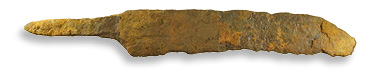
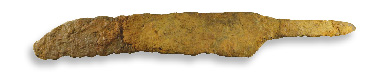
Does the word ‘Saxon’ derive from the Old English seax, a distinctive kind of knife with a single-edged blade? This example (SF-445676 on the Portable Antiquities Scheme database, https://finds.org.uk) was found in Suffolk. Images: Suffolk County Council CC BY 2.0
The BBC Radio 4 programme called AntiSocial, in which controversial topics are discussed and analysed, tackled the use of ‘Anglo-Saxon’ in May 2024, and it is worth listening to the podcast on iPlayer (about 20 minutes in) for a very clear explanation of the origin of the term by Joanna Story, Professor of Early Medieval History at the University of Leicester. Jo explains that early medieval Britain was not a homogenous nation, but was inhabited by a patchwork of different people with their own languages and identities, including Britons in western England and Wales, and Picts in Scotland. According to Bede, writing in the 730s, Angles from Angeln, now in northern Germany, settled in East Anglia, Mercia, and Northumberland; Jutes from southern Jutland, now southern Denmark, inhabited Kent; and Saxons from Lower Saxony, now north-western Germany, occupied Essex, Sussex, and Wessex.
Bede himself does not use the term ‘Anglo-Saxon’, which is first encountered in continental literature in the 9th century. It occurs for the first time in a contemporary English context in the early 10th century, when Alfred the Great and his successors began to fight back against the Vikings who dominated parts of northern and eastern England, and were taking over formerly Anglian territory north and east of Wessex (CA 366).
The term then begins to be used to describe a geopolitical entity, not a people – the combined Anglian and Saxon territories – but not for very long, since Alfred’s great-grandson Edgar (r. 959-975) calls himself ‘King of the English’, ruling over a territorial unit called England. Edgar takes his cue from the title of Bede’s great work, The Ecclesiastical History of the English People, which cites papal authority for the term, recounting the story that Pope Gregory the Great sent St Augustine to reconvert the English in AD 597 after seeing some fair-haired boys in the slave-market at Rome and being told that they were Angles.
So ‘Anglo-Saxon’ is really a very short-lived 10th-century term – one of many that have been used to describe the early medieval period – and one that has acquired all sorts of erroneous connotations, which is why some scholars of the period are now reluctant to use it.
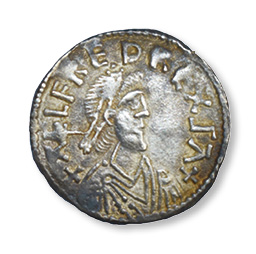
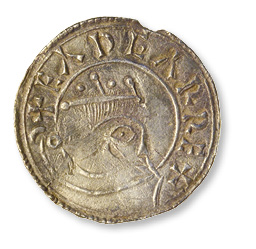
Coins of Alfred the Great (above; GLO-47F292 on the PAS database), during whose reign the term ‘Anglo-Saxon’ emerged in a geopolitical context, and his great-grandson, Edgar (below; NMS-C12261), who instead called himself ‘King of the English’. Images: Bristol City Council CC BY 2.0/Suffolk County Council CC BY 4.0
Cattle and culture
Jo Story was on fine form again when she gave a lecture to the British Archaeological Association in September called ‘The Calf and the Codex: Insular Manuscripts and the Use of Vellum’. From this we learned that, whereas calf-skin was used for manuscript-production in Britain and Ireland in the 6th to 9th centuries, it was more common to use sheepskin in France and goatskin in Italy.
The implications of such a simple statement are considerable: it can help to identify insular manuscripts in continental collections (the vast majority of which are in German libraries); it raises questions about agricultural practice (and cattle-raiding) in the early medieval period in Britain and Ireland, when cattle are synonymous with wealth; and, using DNA analysis, it should be possible to link manuscripts to specific scriptoria (if the calves used for each book share a lineage that can be linked to one place).
Jo spared her audience none of the grim anatomical details: how vellum is made from new-born calves before their skin becomes too tough to be processed; how dispatching the animals required real skill because they have to be drained of blood very quickly to prevent skin discolouration; and how cheese (made with rennet from calf stomachs) and black pudding were the food by-products of the industry. Apparently both sexes were used for vellum-production, not just male calves, and the sheer size of some insular manuscripts implies slaughter on an industrial scale. But for Sherds the biggest question of all is how people got the idea for vellum-production in the first place. Who looked at a new-born calf and thought ‘book!’?
Warwick Rodwell’s Library
Talking of books, CA 415 described Warwick Rodwell’s library at Northwold Manor as having been fitted out with elegant oak bookshelves dating from 1841 that he had rescued after they were ‘ejected’ from the Queen’s College Library in Oxford. Sherds has since learned that this was not quite the act of cultural vandalism that the article implied.
For the record, the bookshelves that Warwick acquired date from 1890, not 1841. They were originally inserted between the bays of the late 17th-century Upper Library at Queen’s to increase its capacity. When the Upper Library was returned to its original form in the 1950s, they were relocated to the Lower Library, where they were again interspersed with the original fittings designed by C R Cockerell in 1841. This resulted in an extremely cluttered space and, when a new underground library was created at the college in 2013, the Lower Library was restored to its original appearance. The college is very pleased to have found a good new home for these bookcases in Warwick’s splendid new library.