Subscribe now for full access and no adverts
A little urbanism can be a dangerous thing. Sometimes all it takes is a patch. In the modern world, for all its cities, there are still many places where one does not need to travel far to meet landscapes of villages, fields, and farm animals. Yet, even there, maybe near a roadside, one can suddenly find an estate dotted with small businesses and workshops – perhaps best compared to the American phenomenon of strip malls, which can be seen in abundance there, particularly when you visit mid-sized and smaller urban centres. The effect can sometime be incongruous: as if a patch of the urban world has crept into an otherwise rural landscape. Catch a ride to the nearest city, and one sees villages that blend increasingly into urban buildings, to the point where you find but a few puzzled fields still cultivated next to busy intersections and high rises.
Such scenes are familiar on the perimeters of fast-growing modern cities from Cairo to Jakarta. But go to Paris and see the lonely patch of vineyard marooned in the midst of the Montmartre quarter, or to Copenhagen’s former suburbs to tease out the remains of stables still visible in backyards, now often-as-not turned into garages, and you will see that the intersection of rural and urban is nothing new.

Patchwork cities
Contemporary modernisers and planners have looked with disbelief at such mixed settlements, which defy the idea of any neat separation between what is city and what is countryside. Such mixing is often dismissed as ‘agro-towns’ or desakota, to use an Indonesian word for exactly this type of environment. Yes, the critics admit, such places might be home to thousands of inhabitants, but they hardly support any business or industries, or much in terms of administration or political power. And, certainly, they must be a hybrid, transitory feature of the modern world, a short and soon-extinguished moment that occurs as ‘proper’ urban centres are growing, but before they have eclipsed formerly rural villages.
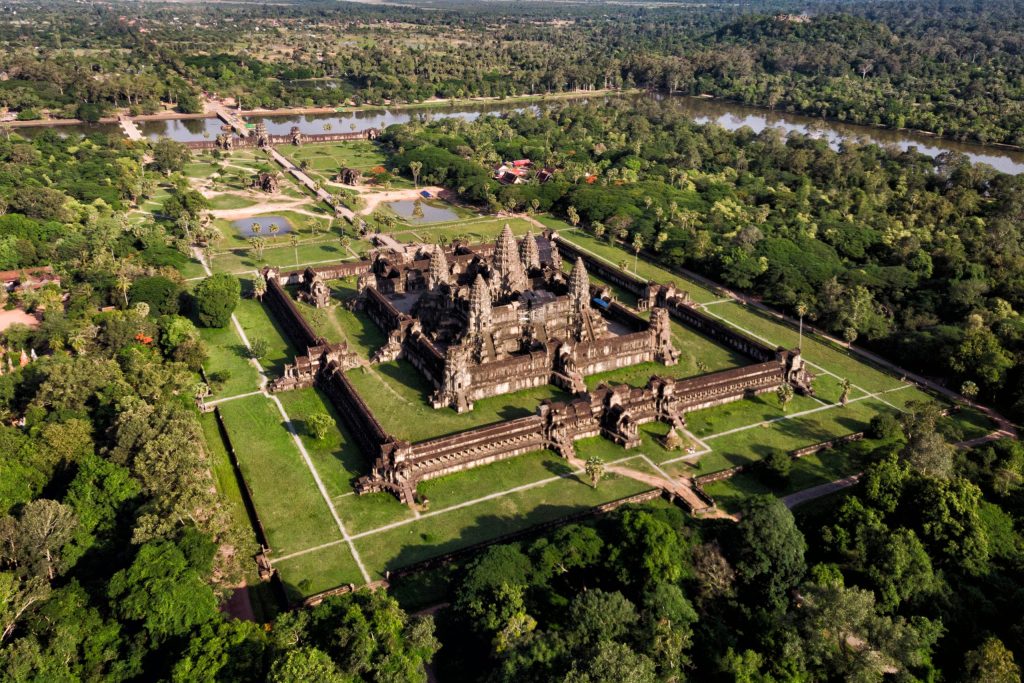
Except that’s not what archaeologists are finding to be the case in the past. In a recent paper in the journal Urban Studies, archaeologist and architect Scott Hawken from the University of Adelaide, Australia, and Maya specialist Christian Isendahl from the University of Gothenburg, Sweden, beg to differ from mainstream opinion on the matter. Urbanism and the urban can be a patchwork, is their verdict. Hawken and Isendahl point out how ancient centres in the tropical zone, such as Angkor in Cambodia, share characteristics with the modern desakota. In their view, stirring together a heady mix of huge farming communities and temple centres with tropical jungle makes Angkor the ancient equivalent of these agro-towns.
Far from being a brief transition, the co-existence of urban culture and village life has persisted in a symbiosis for centuries, without a distinct separation between what is urban and what is hinterland. This finding flies in the face of the accepted narrative in archaeology and history for centuries. What has disposed contemporary researchers towards recognising ‘patch urbanism’, as they propose to call this phenomenon, is not observed reality, but our imagination of urbanism as centralised, bounded, and well-defined. Perhaps dispersed urban forms were – and are – even more ecologically viable and historically resilient than compact cities, Hawken and Isendahl suggest.
Their conceptual rebellion is part of a broader turn towards exploring alternatives to the idea of the city as a container of power, a concentration of economic wealth, and a political strongbox, which could be divided from the countryside by walls and gates, yet simultaneously exploit it. This last point was the concept cultivated by thinkers such as the famous American scholar of classical antiquity Moses Finley. Finley, who lived and worked for most of his career in England – exiled from the USA in 1955 by the then prevailing political currents in his home country – famously mocked the ‘consumer cities’ of classical antiquity as a reserve for the rich and powerful, who shamelessly exploited the rural hinterlands and pumped the profits into their walled and richly decorated home towns. Yet Finley always imagined ancient cities as naturally confined and gated communities, essentially an image of a fossilised social struggle.
This is the received wisdom now being challenged. Perhaps, some believe, compact cities should even be seen as an exception. Manuel Fernández-Götz at Oxford University certainly thinks this was the case among Celtic communities in Iron Age Europe, where mixed ‘rurban’ landscapes prevailed, as he suggested in 2022 in the Journal of Urban Archaeology. There was also a patchwork quality to many ancient cities in Mesoamerica and the Andes, such as the 3rd-millenium BC city of Caral in Peru, and the newly reported discovery of its successor Peñico. In a recent interview with the BBC, excavator Ruth Shady highlighted how Caral was home to about 3,000 people, yet had no defensive walls or obvious spatial boundary markers. On the contrary, the site blended into a landscape, where nearby villages were evidently part of its ecosystem. The finds from Caral show that its inhabitants maintained relationships with people across much greater distances, into the jungle and mountains as far as Ecuador and Bolivia. Perhaps the Caral civilisation was another case of ‘patch urbanism’.
‘Rurban’ revolution
The same could be said to be the case with the famous oasis city of Palmyra, also known as Tadmor, in the Syrian Desert. Throughout its flourishing life in the first three centuries AD, it did not possess any city walls, despite being one of the largest trading centres in the Roman East, while its wealthy elite numbered among the most prosperous and powerful in the region for centuries. It was only after the city fell to the Roman army following Queen Zenobia’s short-lived attempts to reject Rome’s authority that walls were built around parts of Palmyra, to help the Roman legion stationed there to protect themselves. Recent research has shown that Palmyra’s societal make-up might have been much more complex than hitherto acknowledged, so perhaps the strategies of the society to survive, adapt, and develop were rather more flexible than we tend to think.
However, Palmyra is not the only ancient city to display different ‘rurban’ modes when we look at the evidence in detail. In recent years, exciting new work has been undertaken in Italy on villas and their surroundings. Many of these elite rural residences were no great distance from cities and their owners most likely owned property there. These are not new thoughts, but fresh evidence brought to the forefront from such places is telling us new stories about the city and its relationship to the areas in-between. In particular, we can see how developments sometimes led to landscapes changing rapidly, which forced villa owners to adapt their agricultural strategies or sometimes even abandon these properties. Such scenarios find support in new archaeological work led by Dirk Steuernagel and colleagues at Bibione, on the northern shore of the Adriatic (belonging to the territory of the Roman city of Concordia) in Italy.
It seems, then, that we still have a lot to look for and learn when it comes to understanding the city and its impact. This is equally true of the strategies of the people who made them, lived in them, changed them, and were changed in turn by them.
Rubina Raja is Professor of Classical Archaeology and Art and director of the Centre for Urban Network Evolutions, Aarhus University, Denmark. Together with Søren, she is founding editor of the Journal of Urban Archaeology.
Søren M Sindbæk is Professor of Medieval Archaeology at Aarhus University, Denmark, and co-director of the Centre for Urban Network Evolutions.