Subscribe now for full access and no adverts
Scented candles… claim to smell of old library or the works of William Shakespeare…
Heritage smells
Even those who have never ploughed through Proust’s Remembrance of Things Past will know that the French author’s multi-volume reminiscences were sparked by the taste and smell of madeleine cake crumbs combined with lime-flower tea. Proust wrote that, when consuming these, ‘an exquisite pleasure invaded my senses… this new sensation having had on me the effect which love has of filling me with a precious essence… I had ceased now to feel mediocre, accidental, mortal. Whence could it have come to me, this all-powerful joy?’. He then describes the memories evoked by the madeleine crumbs as being like the Japanese paper pellets that unfurl to form beautiful flowers when dropped in water.
Proust should surely be the patron of the several projects that are under way to give smells a greater prominence in our understanding of the past. Inger Leemans, Professor of Cultural History at the Vrije Universiteit Amsterdam, argues that we have neglected the role of smell as a cultural phenomenon. She leads the Odeuropa ‘olfactory heritage’ project, funded by the European Union’s Horizon Europe science programme, which has created an online encyclopaedia (https://odeuropa.eu) that uses ‘smell experiences’ as an entry point.
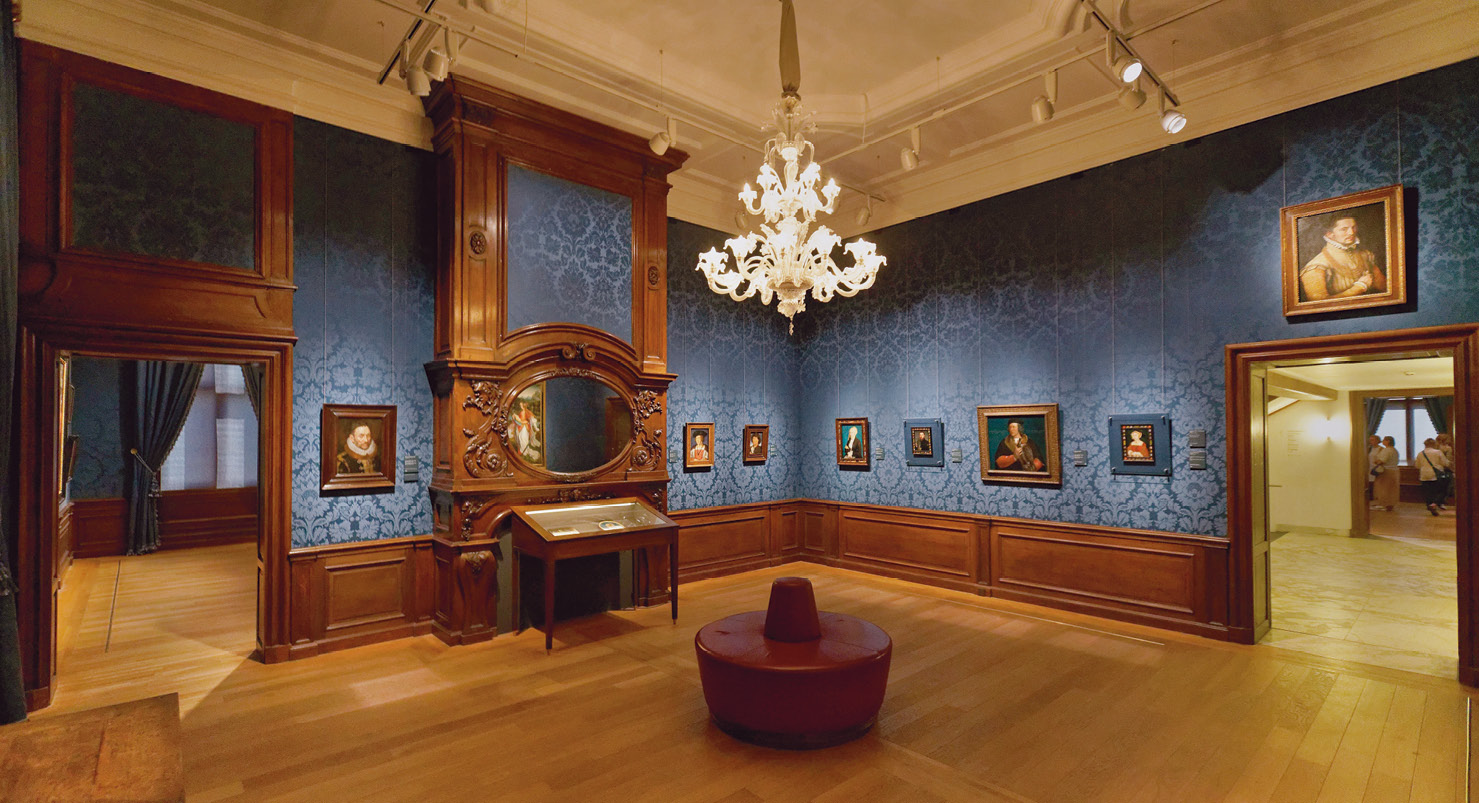
The database pulls together some 167,000 documented references to smells from the last 300 years of history, and 43,000 images that will ‘help people discover the olfactory cultures and vocabularies of the past’. One aim of the project is to encourage museums and heritage institutions to use smell as a storytelling technique, like the various odours that were recreated for a special exhibition at the Mauritshuis art gallery, in The Hague, in 2021. These included the scent of the Brazilian wood panels that line the rooms of the museum, the perfumes that were burned in pomanders to disguise the stench of the city, and the odour of a 17th-century Dutch canal, a mixture of ‘festering fish and damp and rotting clothes’ according to one commentator.
In Madrid, several of the magnificent 17th-century portraits in the Museo del Prado show the sitter wearing or holding soft leather gloves. These were infused with scent as a symbol of luxury and status, and as a means of disguising more pungent body odours. An installation alongside these paintings gives out the sort of scents that these perfumed gloves would have possessed, based on various wood resins, herbs, and flower essences.
Researchers in Poland have gone a step further by analysing and recreating the smells given off by Leonardo da Vinci’s painting of the Lady with an Ermine (1489-1491), a portrait of Cecilia Gallerani, the mistress of Ludovico Sforza, now housed at the Czartoryski Museum in Kraków. When the painting was removed from its glass case in 2022, conservators realised that the work had its own distinctive fragrance. This was made up of the walnut wood that Leonardo painted on, his oil paints, and what Andrzej Szczerski, the museum director, described as a distinct note of ‘fruitiness’ – reminiscent, he liked to think, of the 15th-century palace in Milan where the painting was created.
The research team, led by Tomasz Sawoszczuk of Kraków University, used gas chromatography and an olfactometer to make a detailed map of the chemicals that made up the painting’s distinctive aroma, which was then integrated into a felt-tipped device that visitors can sniff as they look at the portrait, thus adding an additional sensual dimension to their visual enjoyment of the painting. The same method has been applied to nine other objects from the museum. They include a snuffbox that had belonged to France Pešeren, Slovenia’s national poet; the ceremonial clothes of a 17th-century Polish warrior; and a sculpture by Alina Szapocznikow, one of Poland’s best-known 20th-century artists, who often incorporates decaying objects into her work.
These curators are not alone in arguing for adding the sense of smell to our encounters with the past. In 2017, Dr Cecilia Bembibre Jacobo and Professor Matija Strlič, both of University College London, published a paper in Heritage Science (https://doi.org/10.1186/s40494-016-0114-1) on the ‘Smell of heritage’. It set out a framework for the identification, analysis, and archiving of the historic odours that ‘play an important role in our daily lives… affect[ing] us emotionally, psychologically and physically, and influenc[ing] the way we engage with history’.
By matching chemical analysis with the terms that library visitors used to describe the smell of old books, they created a Historic Book Odour Wheel, which they claim as ‘the first step towards documenting and archiving historic smells’. Volunteers at the Birmingham Museum & Art Gallery were asked to describe the smell of a 1928 novel by Bernard Gasset called Les Chardons du Baragan: chocolate and cocoa were the words used most frequently, followed by coffee, wood, and burning. The researchers wrote that this was not surprising, because coffee and chocolate share many volatile organic compounds with decaying paper.
In another experiment, they asked visitors to the Cathedral Library in St Paul’s in London to say what the library smelled like to them. Everyone described it as woody, while 86% also experienced it as smoky, 71% as earthy, and 41% reported the scent of vanilla, all smells associated with particular chemicals in old books.
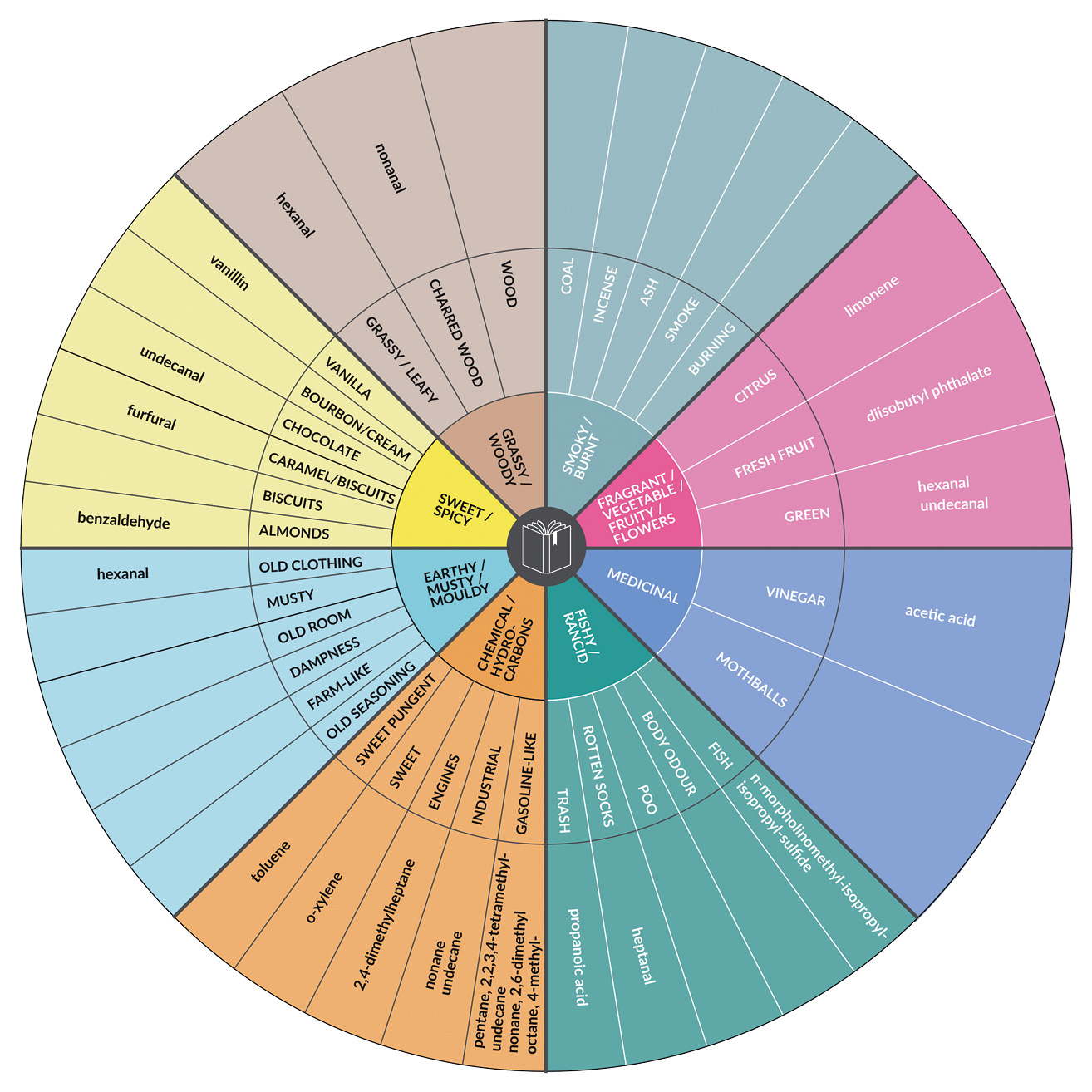
The Historic Book Odour Wheel is a tool developed to help record the scents of old books. The system includes general aroma categories, sensory descriptors, and the likely chemical compounds causing the smells. Image: C Bembibre & M Strlicˇ (2017) ‘Smell of heritage: a framework for the identification, analysis and archival of historic odours’, Heritage Science 5: 1-11
Professor Strlič said that the Historic Book Odour Wheel could become a useful diagnostic tool for conservators, helping them to assess a book’s condition. A chocolatey smell indicates the degradation of the cellulose and lignin in paper. Books printed before 1850 have a different smell to those produced after the introduction of acid sizing in the mid-19th century to reduce the water-absorbency of paper. Books that have travelled or that have been kept in damp or dry environments have distinctive odours, as does parchment made from animal skins. Foxing, the brown blotches that appear on aging paper, gives off a musty earthy smell.
Archivists and curators at the British Motor Museum in Gaydon, Warwickshire, have discovered that visitors have fond memories of the smell of classic cars, too – aromas that have been lost as vehicle manufacturing has changed to become more sterile. With the shift to electric vehicles, petrol and the fumes of car exhausts are now becoming ‘heritage smells’. Luxury carmakers are having to recreate artificially the odours that people associate with vintage models, and the UCL research team has helped by using gas chromatography, mass spectrometry, and olfactometry to analyse their distinctive leather and wood fragrance. The car they used for their sampling was a 1973 Rover that belonged to the late Queen Elizabeth II.
Pongs of the past
Some smells from the past are enjoyed because, like the Proustian madeleine, they evoke fond memories, such as holidays by the sea, though they don’t have to be pleasant smells to stir nostalgia. Industrial smells top the list when people are asked to describe local identity: examples include the Marmite-like scents of brewing, the sulphuric smell of coal-burning factories and power stations, the reek of rubber from tyre- making plants, or the caramel scent of industrial biscuit- and cake-making.
In the heritage science laboratory at UCL where Dr Cecilia Bembibre Jacobo works, the emphasis is on capturing or recreating rare and significant smells – the culturally important odours – which are then added to the lab’s olfactory heritage archive, such as the tobacco-saturated air of pubs and the smoking sections of railway and metro carriages. Currently, the team is using written accounts of the Battle of Waterloo to recreate the smell of horses, sweat, gun smoke, mud, and the rosemary, bergamot, and bitter orange cologne worn by Napoleon Bonaparte.
All those involved in this research agree that we need to include odour in the way we engage with history, and a campaign is under way to persuade UNESCO to recognise smells as part of its definition of intangible cultural heritage. Japan is setting an example: in 2001, the Ministry of the Environment designated 100 aromas from a list of 5,600 candidate smells submitted by the public, including the scent of ancient pine woods, sea breezes, and sake distilleries. The bottles used to contain the 100 protected aromas carry a seal that reads ‘scents to be handed down to our children’. And there is money in it as well: an internet search reveals that there are dozens of scented candles on the market that claim to smell of old library, old bookshop, or the works of William Shakespeare, Charles Dickens, and Jane Austen.
Chris Catling is an archaeologist and writer, fascinated by the off-beat and the eccentric in the heritage world.