Subscribe now for full access and no adverts
We all enjoy stories about new discoveries, and it is these that tend to grab the news headlines, but there is another kind of story that gets far less coverage: those that contradict an earlier claim. In that category is the finding that our species – Homo sapiens – may not have been responsible for the extinction of our close relations, H neanderthalensis. According to previous thinking, we outcompeted Neanderthals because of our superior linguistic skills and tactical teamwork when hunting red deer and other large mammals. The migration of H sapiens into Europe c.60,000 years ago has been characterised as the beginning of the end for the ‘less intelligent’ Neanderthals, who lost out when faced with competition for increasingly scarce food resources at a time of challenging climate change.
The idea that Neanderthals were greatly inferior to us is increasingly difficult to sustain in the light of recent discoveries showing that archaic humans manufactured tar from birch bark to use as an adhesive for joining flint tips to wooden spear shafts – clear evidence of the ability to invent materials that do not occur naturally. Recent research has also shown that the abstract patterns engraved on the walls of La Roche-Cotard cave, on the north bank of the Loire River, in France, date from around 75,000 years ago and thus predate the arrival of H sapiens – further evidence of creative thinking on the part of Neanderthals (see CWA 121).
Now, a team of researchers based in Santander, Spain, and Cambridge, UK, has demonstrated that Neanderthals actually survived longest in the regions that both species shared. This apparently counter-intuitive conclusion was based on an analysis of environmental and climate data (see Science Advances: https://doi.org/ 10.1126/sciadv.adi4099) and comparing food abundance with the survival of each species.
This shows that both species happily coexisted where plants and animals were abundant and easy to find, but Neanderthals – who had arrived in Europe and become well established across the landscape long before H sapiens – died out fastest in the areas where food became increasingly scarce. Those areas were avoided by the newcomers, H sapiens, who tended to seek out and inhabit areas with ample food resources. It may well have been in these areas that the two species interbred, with the result that modern human populations in Europe now have gene clusters inherited from Neanderthals amounting to c.2% of their genome.
A metaphorical leap
Another recent research report that turns past conclusions on their head concerns the famous fresco known as ‘the Paestum swimmer’. Painted on the stone slab that formed the roof of the Tomb of the Diver and now in the Paestum Museum, in the province of Salerno, southern Italy, this shows a naked youth diving into a pool from a stone or timber tower. The fresco dates from c.470 BC and has been interpreted in metaphorical terms as the representation of a soul suspended between birth and death, or between mortality and immortality.

Tonio Hölscher, Professor Emeritus of Classical Archaeology at Heidelberg University, Germany, and a scholar of Greek mythological imagery, is now arguing that we have gone too far to read meaning into a painting that is just what it seems to be: a courageous young man of athletic ability diving into water. The only symbolism is that of the healthy and strong body that the ancient Greeks associated with human perfection. ‘It is not a metaphor; it’s a real image of a social activity,’ Hölscher argues in The Swimmer of Paestum (2021), noting that young people continue to compete in cliff-jumping competitions in the Paestum region to this day.
The idea that the sea represents death, says Hölscher, is based on the view that the ancient Greeks did not like the sea and regarded it with fear. Not so, he argues: ‘Although some scholars still deny it, the Greeks swam and liked to do so. In fact, there is a Greek proverb that equates not knowing how to swim with not knowing how to read.’
The origin of tin
Archaeometallurgists are at odds, too, over the origin of the tin that was essential to the tool- and weapon-makers of the Bronze Age in Europe. Different researchers have come up with very different claims about the provenance of the tin ingots excavated from a Late Bronze Age ship that sank off what is now the west coast of Turkey near Uluburun around 1320 BC. The merchant vessel was carrying the largest assemblage of metallic tin yet known from Bronze Age contexts, along with copper ingots, glass, and other commodities.
One research team, led by Professor Wayne Powell of Brooklyn College, New York, reported in the journal Science Advances in November 2022 (https://doi.org/10.1126/sciadv.abq3766) that ores from mines in modern-day Uzbekistan and Tajikistan were used to produce one- third of the Uluburun tin ingots. The remaining two-thirds were derived from two mines in the Taurus Mountains of Turkey, near the present-day Syrian border. This conclusion was based on matching the ratios of tin and lead isotopes in samples taken from 105 tin ingots from the wreck to samples taken from these mines. The presence of the trace element tellurium also points to Central Asia as the source.
In the journal Frontiers in Earth Science (https://doi.org/10.3389/feart.2023.1211478), a team led by Dr Daniel Berger of the Curt-Engelhorn-Centre of Archaeometry, Germany, says that tin isotopes are not a magic bullet to solve ‘the origin problem’ because there is such a high degree of overlap between ores from different sources. This means that there is never an unambiguous answer to the question of tin provenance using tin isotopes alone. The paper offers an alternative interpretation: that the overall mix of elements in the ingot assemblage rules out a source in Central Asia and points to a Cornish origin, like that of ingots found in the Salcombe (Devon) wreck and with others found off the coast of Israel, for which a Cornish origin has also been suggested.
The basic overall message is that new methods are needed to solve the problem of where tin came from, and that the effort is worthwhile because of the far-reaching insights into early trade and cultural connections (including, for example, the development of language, coinage, and standard weights and measures). Tin is a key proxy for long-distance trade because, while copper ores are found in many regions of Eurasia and Africa, tin ores that were accessible in the Bronze Age can only be found in a few places in Central Asia, Iran, and Europe.
Numerous archaeological finds show connections during the Bronze Age between the British Isles, Central Europe, and the Mediterranean via the transport routes of the Atlantic and the Danube, Rhine, and Rhône rivers. Amber beads from the Baltic were found in the Uluburun wreck, for example.
Stonehenge Altar Stone not Welsh
And another ‘revisionist’ paper was published in the Journal of Archaeological Science in October (https://doi.org/10.1016/j.jasrep.2023.104215) suggesting that the Stonehenge Altar Stone should no longer be considered Welsh in origin. Instead, this large recumbent piece of Old Red Sandstone (2m in length and 6 tonnes in weight), should be regarded as an anomaly – that is to say, of different origin from the other mainly igneous monoliths of the inner circle, which have previously all been grouped together as ‘bluestones’.
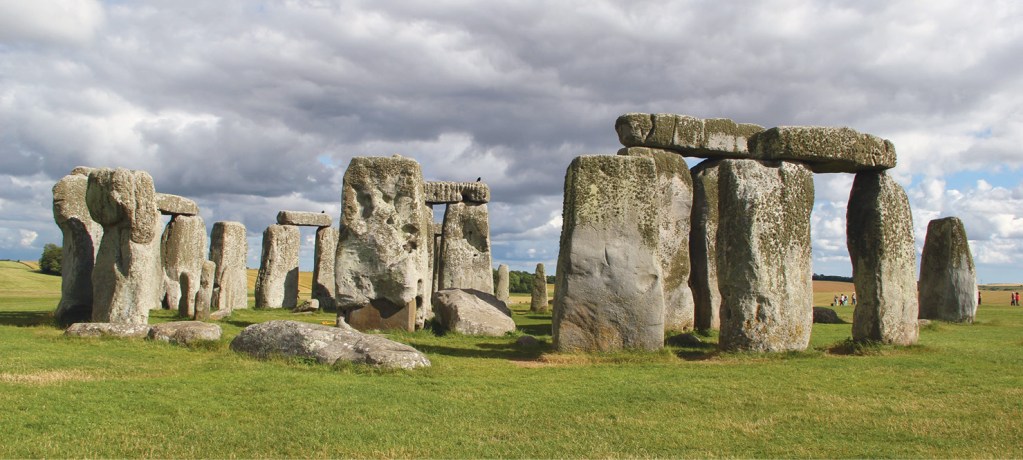
The team that published the report includes geologists who have been working for many years to develop geochemical fingerprinting for stones from Wales; they have successfully matched the bluestones in the inner circle to Neolithic quarry sites in the Mynydd Preseli area of Pembrokeshire. But no match has been found between the Altar Stone and samples of Old Red Sandstone (ORS) taken from sources within the Anglo-Welsh Basin (covering south Wales, the Welsh Borderland, the West Midlands, and Somerset).
The authors say that the search for an origin for the Altar Stone should be broadened to include all the various parts of Britain where ORS occurs. A clue lies in the stone’s unusually high barium content, and attention will now turn to possible sources in the Midland Valley, the Permian-Triassic of northern England, and even the Orcadian Basin of Scotland. Such distant sources pose the possibility that the Altar Stone (so named by the 17th-century architect Inigo Jones because of its shape) was brought to Stonehenge over hundreds of miles – many more even than the Preseli bluestones of west Wales.
Chris Catling is an archaeologist and writer, fascinated by the off-beat and the eccentric in the heritage world.